

Key takeaways
- Place the center as close to the screen as possible, with its acoustic center aligned near the middle of the picture.
- Keep the front edge of the cabinet flush with, or slightly ahead of, the furniture. A recessed speaker can create reflections that blur consonants.
- Angle the cabinet upward or downward toward seated ear height. Do not leave a center firing into the floor or above listeners’ heads.
- Keep the speaker away from the back wall when practical. A small gap reduces excessive upper-bass reinforcement.
- Set the receiver’s center to “Small” and begin with an 80 Hz crossover. Try 60 or 100 Hz only if measurement or listening shows a clear benefit.
- Run the receiver’s room correction after final placement, then check that the center has not been assigned an unusually low level.
- Use the center speaker from the same product family as the left and right channels when possible. Matching timbre makes voices move more naturally across the front stage.
The best center channel speakers for clear dialogue are the ones whose size, sensitivity, and frequency response suit both your room and your AV receiver—not necessarily the most expensive model.
Our top picks
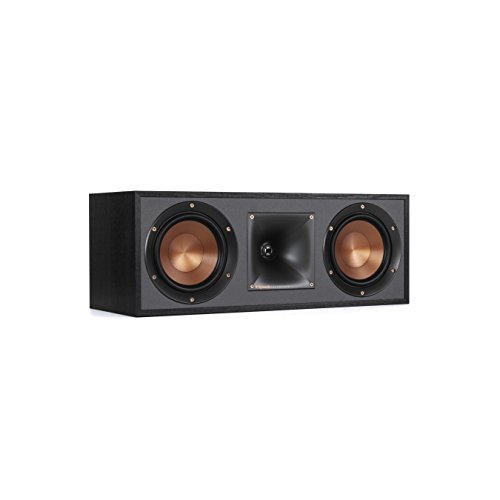
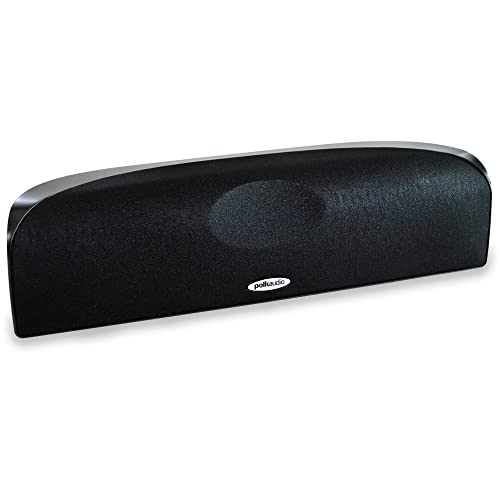
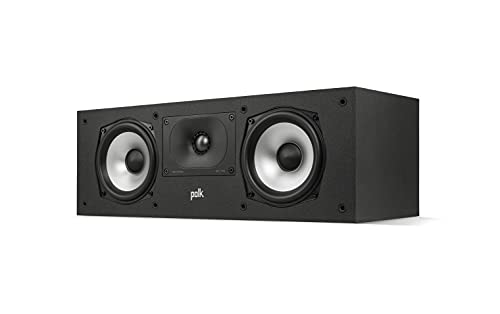
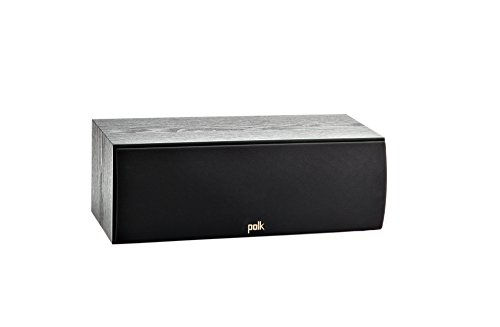
As an Amazon Associate we earn from qualifying purchases at no extra cost to you. Ratings are shown as listed on Amazon.
Quick picks by room and system
| Situation | Recommended type or model | Useful specifications | Why it fits |
|---|---|---|---|
| Small room, compact receiver | KEF Q250c or a compact three-way center | Approximately 20–22 inches wide; around 87 dB sensitivity; roughly 42 Hz–120 kHz rated response | Fits beneath smaller televisions without demanding substantial amplifier power |
| Medium room, mainstream 5.1 receiver | ELAC Debut 2.0 C6.2 | Approximately 24.6 inches wide; 87 dB sensitivity; 55 Hz–35 kHz rated response | Good dialogue scale and a relatively easy load for ordinary AV receivers |
| Medium room, wide cabinet or low-profile installation | Polk Audio Signature Elite ES35 | Approximately 26 inches wide; six 3-inch woofers; 88 dB sensitivity; about 45 Hz–40 kHz rated response | Broad, shallow design works where a tall center speaker will block the screen |
| Large room or high-volume movie viewing | Klipsch Reference Premiere RP-504C II | Approximately 30 inches wide; 97 dB sensitivity; about 49 Hz–25 kHz rated response | High efficiency produces strong output from moderate receiver power |
| Premium matched home theater | KEF R6 Meta | Approximately 23.6 inches wide; 88 dB sensitivity; around 58 Hz–34 kHz rated response | Controlled dispersion and a refined tonal match for KEF R Series speakers |
Manufacturer measurements use different methods, so frequency-response figures should not be treated as a perfect head-to-head ranking. Sensitivity, impedance, cabinet width, driver layout, and dispersion are more useful for choosing a center speaker for a particular room.
What matters most for clear dialogue
Match the speaker to room size
In a small room of roughly 100 to 150 square feet, a compact center with one or two midbass drivers is often sufficient. A large cabinet can make placement difficult and may not provide an audible advantage at normal listening distances. For rooms around 150 to 250 square feet, a center between 22 and 28 inches wide is a practical starting point. Large rooms, open-plan spaces, or seating more than 12 feet from the screen benefit from a physically larger design with greater output capability.
Room size is only part of the calculation. A reflective room with bare floors and walls can make consonants sound sharp, while heavy curtains, carpet, and upholstered furniture absorb upper midrange energy. If dialogue sounds dull, replacing the speaker may not solve the problem; aiming the speaker toward ear level and reducing excessive absorption near the screen can help more.
Use sensitivity to estimate receiver demands
Sensitivity indicates how loudly a speaker can play from a standard amount of amplifier power, usually measured at one watt and one meter. A speaker rated at 97 dB sensitivity, such as the RP-504C II, needs substantially less power for a given volume than an 87 dB model.
The difference is meaningful: every 3 dB increase in sensitivity approximately halves the amplifier power required for the same output. A 97 dB center therefore needs roughly one-tenth the power of an 87 dB center for comparable sound pressure under idealized conditions. This does not mean the high-sensitivity speaker is automatically better; horn designs can have a more pronounced tonal character, and directivity must suit the seating arrangement.
Do not overvalue deep bass
Movie dialogue is concentrated mainly in the midrange and upper midrange, while explosions and musical bass are normally redirected to the subwoofer. A center rated to 40 Hz is not automatically clearer than one rated to 55 Hz. With an 80 Hz crossover, both may send most low-frequency content to the subwoofer.
For most systems, prioritize smooth response from approximately 500 Hz to 4 kHz, controlled dispersion, and low distortion at the intended listening level. A center with a dedicated midrange driver or a three-way layout can maintain clearer voices when the speaker is played loudly or when listeners sit far off-axis.
Head-to-head: which type is right for your system?
Compact two-way center
Compact models such as the KEF Q250c suit smaller rooms, apartment systems, and receivers in the approximately 50–100 watts-per-channel class. Their main advantage is placement flexibility. The limitation is maximum output: a small enclosure may sound clean at normal levels but run out of headroom during loud action scenes in a large room.
Wide multi-driver center
A wide center such as the ELAC Debut 2.0 C6.2 offers more cone area and cabinet volume than a compact model. That can produce fuller voices and greater dynamic range, although a conventional horizontal two-way arrangement may create uneven response for listeners far to the side. It is a strong general-purpose choice when the main seating is centered.
Low-profile array
The Polk Audio Signature Elite ES35 is designed for installations where a conventional center would obstruct the bottom of a television. Its shallow height is useful with low furniture and wall-mounted screens. Measure carefully: a low-profile design may be wide, and multiple small drivers do not automatically provide the same vocal body as a larger midrange driver.
High-sensitivity horn center
The Klipsch Reference Premiere RP-504C II is suited to large rooms, long listening distances, and users who enjoy cinema levels. Its high sensitivity reduces the load on the receiver. However, placement and toe-in matter because horn-loaded speakers can sound different as listeners move off-axis. Choose this type when output capability is a priority and the rest of the front stage is tonally compatible.
Three-way premium center
The KEF R6 Meta uses a dedicated midrange and concentric driver arrangement intended to provide consistent radiation across a broad listening area. This is valuable when several seats need equally intelligible dialogue. Its price is usually in the premium range, and it makes the most sense when the left, center, and right speakers belong to the same series.
A simple receiver-and-room matching calculation
Suppose your listening seat is 10 feet from the center speaker and you want peaks around 95 dB. Distance from one meter to 10 feet costs approximately 10 dB of level. A speaker rated at 87 dB sensitivity might therefore produce about 77 dB from one watt at the seat. Reaching 95 dB requires approximately 18 dB more output, or about 63 watts under simplified conditions.
Real movie peaks, room gain, impedance changes, and multiple speakers complicate the result, so leave headroom rather than operating a receiver continuously at its limit. A 90–92 dB center offers a more comfortable match for this example. If the receiver becomes hot, clips during loud scenes, or sounds harsh, reduce the listening level, use an external amplifier, or choose a more sensitive speaker.
Placement steps that often improve dialogue more than an upgrade
- Place the center as close to the screen as possible, with its acoustic center aligned near the middle of the picture.
- Keep the front edge of the cabinet flush with, or slightly ahead of, the furniture. A recessed speaker can create reflections that blur consonants.
- Angle the cabinet upward or downward toward seated ear height. Do not leave a center firing into the floor or above listeners’ heads.
- Keep the speaker away from the back wall when practical. A small gap reduces excessive upper-bass reinforcement.
- Set the receiver’s center to “Small” and begin with an 80 Hz crossover. Try 60 or 100 Hz only if measurement or listening shows a clear benefit.
- Run the receiver’s room correction after final placement, then check that the center has not been assigned an unusually low level.
- Use the center speaker from the same product family as the left and right channels when possible. Matching timbre makes voices move more naturally across the front stage.
Ownership realities and common mistakes
The component most likely to suffer over time is not usually the cabinet but the tweeter or crossover, especially after repeated clipping from an underpowered amplifier. “More watts” does not protect a speaker if the receiver is driven beyond its limits. Keep ventilation around the receiver, avoid covering the center’s grille, and inspect the terminals periodically for loose connections.
Dust the cabinet with a dry or barely damp microfiber cloth. Do not spray cleaner onto the grille, drivers, or binding posts. If children or pets can reach the speaker, leave the protective grille installed. A soft dome or exposed cone can be damaged by surprisingly light pressure.
Another common mistake is selecting a center solely by its claimed bass extension. For movie dialogue, a properly aimed speaker with adequate sensitivity and smooth midrange response is usually more valuable than extra low-frequency specifications that the subwoofer will handle.
Bottom line
Choose a compact KEF Q250c-type center for a small room, an ELAC Debut 2.0 C6.2-type model for a balanced medium-room system, a Polk ES35-type design when height is restricted, a Klipsch RP-504C II-type speaker for high-output cinema use, and a KEF R6 Meta-type three-way center when wide-seat consistency and premium matching matter most. The best center channel speakers are those that reach your required volume without strain, remain intelligible across your seating area, and can be positioned and crossed over correctly.





Write Your Review
No reviews yet. Be the first to share your experience!