

Key takeaways
- Best Bookshelf Speakers for Small Rooms & Desks The best bookshelf speakers for a small room or desk are usually compact models with a 4- to 6.5-inch woofer, sensitivity around 85 dB or higher, and a front port—or enough space…
Best Bookshelf Speakers for Small Rooms & Desks
The best bookshelf speakers for a small room or desk are usually compact models with a 4- to 6.5-inch woofer, sensitivity around 85 dB or higher, and a front port—or enough space behind a rear port to breathe without overwhelming the room.
For a desk up to roughly 4 feet wide, choose smaller speakers such as the Edifier R1280DB or Audioengine A2+. For a 100- to 250-square-foot room, the KEF Q150, Q Acoustics 3030i, and ELAC Debut 2.0 B6.2 offer more convincing bass and scale, provided you can keep them away from the wall. If you want the simplest setup, powered speakers are the practical choice; if you already own an amplifier or plan to upgrade later, passive speakers give you more flexibility.
Our top picks
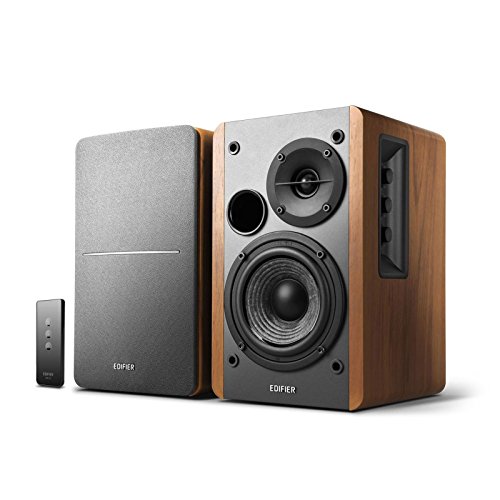


As an Amazon Associate we earn from qualifying purchases at no extra cost to you. Ratings are shown as listed on Amazon.
Quick picks by placement and system type
| Situation | Recommended type or model | Why it fits | Important limitation |
|---|---|---|---|
| Very small desk, nearfield listening | Compact powered speakers such as Audioengine A2+ | Small enclosure, built-in amplification, convenient desktop connections | Limited deep bass and output compared with larger bookshelf speakers |
| Desk with a little more room | Edifier R1280DB | Affordable powered design with Bluetooth and optical input | 4-inch woofer cannot produce the weight of a larger 5- or 6.5-inch model |
| Balanced passive system for 100-200 sq ft | KEF Q150 | 5.25-inch woofer, coaxial driver layout, detailed near- and midfield presentation | Requires a separate amplifier and rear-port clearance |
| Warm, fuller sound in a medium-small room | Q Acoustics 3030i | 6.5-inch woofer supplies more bass and body at moderate listening levels | Large for many desks; rear port needs careful placement |
| Maximum bass value from a passive speaker | ELAC Debut 2.0 B6.2 | 6.5-inch woofer and front-firing port make wall placement easier than many rear-ported rivals | Cabinet depth and weight make it better on stands than directly beside a monitor |
What woofer size means in a small room
Woofer size is not a complete measure of sound quality, but it is a useful guide to placement and bass expectations. A 3- to 4-inch woofer is generally easier to position on a desk and can sound clean at close range, but it will not move as much air in the lowest octaves. A 5- to 5.25-inch woofer is a strong compromise for a desk, bedroom, office, or 100- to 180-square-foot room. A 6.5-inch woofer can fill a 150- to 250-square-foot room more comfortably, although the cabinet may dominate a desktop.
Room gain also matters. Boundaries reinforce bass, especially in corners. A speaker that sounds balanced on a stand may become boomy when pushed against a wall. In a small room, a smaller woofer placed correctly often sounds better than a larger woofer crammed into a corner.
Head-to-head specifications that matter for desks
| Speaker | System | Woofer | Nominal sensitivity or output information | Port location | Approx. cabinet size |
|---|---|---|---|---|---|
| KEF Q150 | Passive | 5.25-inch Uni-Q driver | About 86 dB sensitivity | Rear | 12 x 11.1 x 10.7 inches |
| Q Acoustics 3030i | Passive | 6.5-inch woofer | About 88 dB sensitivity | Rear | 12.8 x 7.9 x 8.8 inches |
| ELAC Debut 2.0 B6.2 | Passive | 6.5-inch woofer | About 87 dB sensitivity | Front | 14.8 x 10.6 x 8.7 inches |
| Edifier R1280DB | Powered stereo pair | 4-inch woofer | 21 watts RMS per channel | Rear | About 9.5 x 5.75 x 7.75 inches per speaker |
| Audioengine A2+ | Powered stereo pair | 2.75-inch woofer | About 60 watts peak per pair | Rear | About 6 x 4 x 5.25 inches per speaker |
Dimensions are approximate and can vary slightly by revision or finish. Sensitivity figures are most useful when comparing passive speakers measured under similar conditions; powered-speaker wattage is not directly equivalent to passive-speaker sensitivity.
Best choices by room size
For a desk or room under 100 square feet
Compact powered speakers are easiest to live with. The Audioengine A2+ is a good fit when the speakers must sit beside a monitor, laptop, or small television. Its compact enclosure saves desk space, but its small woofer makes a subwoofer useful if you expect strong low bass for electronic music, films, or games.
The Edifier R1280DB is physically larger but remains desk-friendly. Its 4-inch woofer produces more warmth than ultra-compact computer speakers, while Bluetooth and optical input reduce the need for extra equipment. Keep the powered speaker with the controls and connections where its rear panel remains accessible.
For a 100- to 180-square-foot room
The KEF Q150 is an appealing middle ground. Its 5.25-inch coaxial driver places the tweeter at the center of the woofer, which can help create a coherent image for one person sitting at a desk or centered listening position. It needs an amplifier, and its rear port means that a few inches of clearance is not an optional detail.
Choose the Q150 when imaging and compactness matter more than maximum bass. For a desk, place each speaker on a small stand or isolation platform so the tweeter points toward ear height rather than firing into the desktop.
For a 150- to 250-square-foot room
The Q Acoustics 3030i and ELAC Debut 2.0 B6.2 are better suited to filling a small living room or bedroom from several feet away. Their 6.5-inch woofers give music more body and reduce the need to run the amplifier hard. The ELAC’s front port is particularly convenient when the speakers must sit closer to a wall.
These models are usually too deep for a narrow desk. If the front edge of a speaker hangs over the desk, or if the cabinet blocks your monitor, use dedicated stands instead. A stand also reduces vibration transmitted into the desktop.
How much clearance does a rear port need?
Start with 6 to 12 inches between a rear-ported speaker and the wall. Measure from the back of the cabinet, not from the front baffle. If the bass sounds thick, move the speaker farther out in 2-inch increments before changing amplifier settings. If the speaker must sit within about 4 inches of the wall, a front-ported model or a sealed design is usually the safer choice.
Corner placement is more aggressive than flat-wall placement because two boundaries reinforce the bass. Avoid putting a large 6.5-inch speaker directly in a corner unless you can reduce bass with room correction or careful positioning.
Amplifier matching: a useful small-room calculation
Suppose a passive speaker has 86 dB sensitivity at 1 watt and you listen about 8 feet away. Doubling amplifier power adds roughly 3 dB: 1 watt produces about 86 dB, 2 watts about 89 dB, 4 watts about 92 dB, and 8 watts about 95 dB under idealized conditions. Distance and room reflections change the result, but this illustrates why a clean 40- to 80-watt-per-channel amplifier is normally ample for a compact room.
Do not choose an amplifier solely by its largest advertised wattage. Stable operation at the speaker’s impedance, clean output, useful inputs, and a convenient volume control matter more for daily use. Powered speakers remove this matching decision, but they also make future amplifier upgrades impossible without replacing the speakers.
Desktop setup in five steps
-
Form an equal triangle. Keep the distance between the left and right speakers close to the distance from each speaker to your ears. This improves center imaging.
-
Raise the tweeters. Aim the high-frequency drivers toward ear height. Foam wedges or short desktop stands are better than placing the cabinets directly on a resonant desk.
-
Leave rear clearance. Start with at least 6 inches for a rear-ported design and listen for excess bass before moving the speakers closer.
-
Angle the speakers inward. Mild toe-in can sharpen vocals and dialogue. If the sound is too bright, reduce the angle rather than immediately increasing bass.
-
Control reflections. Keep the speaker fronts near the front edge of the desk, not far behind the monitor. This reduces early reflections from the desktop.
Ownership realities and common mistakes
Speaker cabinets require little maintenance, but dust can collect around the grille and woofer surround. Use a dry, soft brush or microfiber cloth; do not spray cleaner onto the drivers. Fabric grilles can loosen or attract pet hair, while foam isolation pads may compress and need replacement after extended use.
The most common mistake is buying a speaker that is physically too large for the intended desk. Another is covering a rear port with a wall, curtain, or monitor shelf. Avoid pushing the volume into audible distortion, especially with small powered models. Clipping can damage tweeters more quickly than normal moderate listening.
For a simple desk system, choose a compact powered pair. For the best balance of imaging and upgrade potential in a small room, choose a 5-inch passive speaker such as the KEF Q150. For fuller room-filling bass, select a 6.5-inch model such as the Q Acoustics 3030i or ELAC Debut 2.0 B6.2, but give it proper stand height and wall clearance. General market pricing ranges from roughly $100–$300 for compact powered pairs and about $300–$700 per passive pair, depending on sales, finish, and product revision.





Write Your Review
No reviews yet. Be the first to share your experience!