

Key takeaways
- Check joists, pipes, ductwork, and wiring first. A speaker that fits the diameter may still be impossible to install in the chosen bay.
- Use the supplied template. Cutting even a quarter-inch too large can prevent the dog-leg clamps from gripping securely.
- Add backer boxes where appropriate. A backer enclosure can reduce sound transfer and make bass more predictable, but it must match the speaker’s installation requirements.
- Keep insulation from blocking the driver. Use an approved enclosure or clearance method rather than compressing insulation against the cone.
- Paint grilles before installation. Remove the grille, apply thin coats, and do not clog the perforations with heavy paint.
- Use speaker wire suited to the run. For longer runs or higher-power systems, 14-gauge cable can reduce resistance compared with 16-gauge cable.
The best in-ceiling speakers are chosen by room volume and listening distance first: use a 6.5-inch, wide-dispersion speaker for most bedrooms and living rooms, an 8-inch woofer for larger rooms or stronger bass, and moisture-resistant models for bathrooms, covered patios, and kitchens.
Our top picks
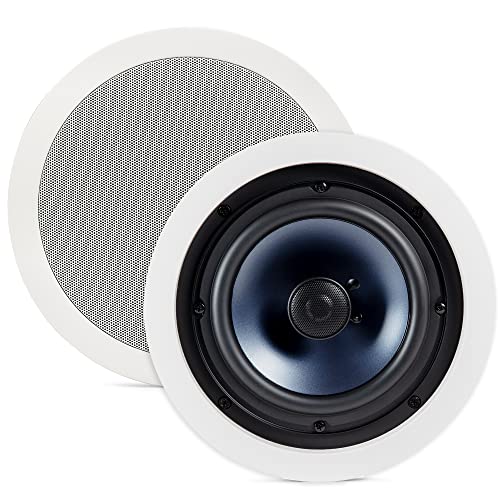
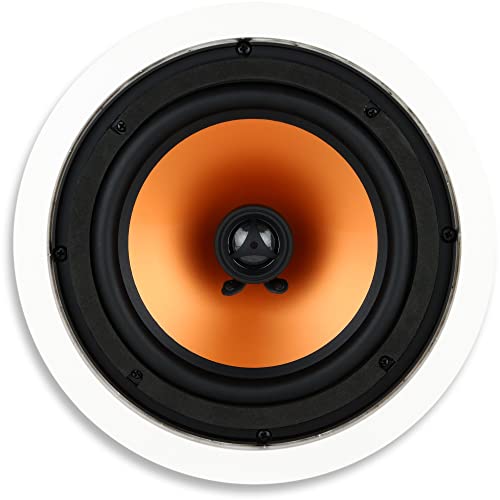

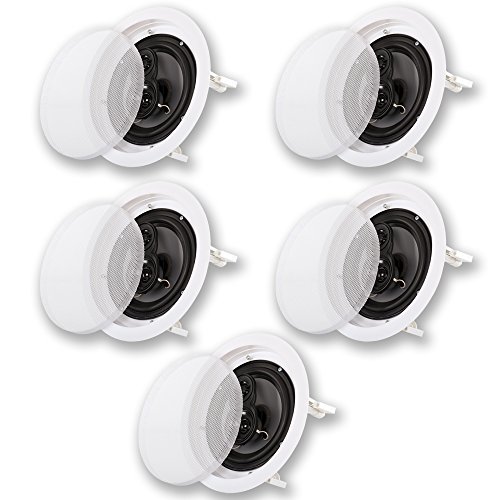
As an Amazon Associate we earn from qualifying purchases at no extra cost to you. Ratings are shown as listed on Amazon.
Quick picks by room and priority
| Situation | Recommended type | Useful target specifications | Why it fits |
|---|---|---|---|
| Small bedroom or office up to 120 sq. ft. | 6.5-inch coaxial pair | 88–91 dB sensitivity, 40–100 W recommended amplifier power | Good coverage without excessive bass buildup or a large ceiling cutout |
| Living room from 120–250 sq. ft. | 6.5-inch wide-dispersion pair | 40–120 W per channel, 90° or wider dispersion | Balances vocal clarity, coverage, and installation flexibility |
| Large family room over 250 sq. ft. | 8-inch coaxial pair or four 6.5-inch speakers | 50–150 W per channel, 88 dB or higher sensitivity | Moves more air and reduces the need to run speakers near their limits |
| Bathroom, kitchen, or covered outdoor area | Moisture-resistant in-ceiling speaker | Polypropylene or mica woofer, sealed or protected tweeter, corrosion-resistant grille | Better tolerance of humidity, steam, and occasional splashes |
| Music-focused room with a separate subwoofer | 6.5-inch directional or angled coaxial speaker | Adjustable tweeter, aimable mid/high-frequency assembly | Lets you direct detail toward the listening position instead of straight at the floor |
How woofer size changes the decision
A 6.5-inch woofer is the safest starting point for most residential installations. It typically provides enough mid-bass for voices, television, acoustic music, and background listening while keeping the ceiling opening manageable. A pair works particularly well in rooms where the main seats are less than about 12 feet apart.
An 8-inch woofer has a larger cone area and can produce fuller bass at the same listening level. That does not automatically make it more accurate or more powerful, but it gives the speaker more acoustic headroom in a large room. Choose 8-inch models when the listening area is wide, the ceiling is high, or the system will play music loudly without a subwoofer.
There is a practical alternative to installing two large speakers: use four 6.5-inch speakers at a lower level. Distributed sound produces more even coverage, so people near one speaker do not hear a disproportionately loud channel. Four speakers are often the better solution in a long family room, open-plan kitchen, or rectangular basement.
Best in-ceiling speakers by real-world use
Best budget choice: a basic 6.5-inch coaxial speaker
For a bedroom, hallway, or casual living room, look for a 6.5-inch polypropylene woofer, a pivoting or adjustable tweeter, and a paintable magnetic or snap-on grille. Models such as the Micca M-6C represent this general category: affordable, compact, and suitable when the system does not require extreme output.
Expect a general market range of about $50–$120 per pair for entry-level speakers, depending on construction and sales timing. The compromise is usually lower bass extension, less robust mounting hardware, and limited moisture protection. They are a sensible choice for moderate-volume listening, not for filling a large open floor plan.
Best all-purpose choice: a 6.5-inch wide-dispersion model
A wide-dispersion speaker is usually the strongest choice for a typical living room. The tweeter spreads high frequencies across a larger area, reducing the “hot spot” effect that occurs when one chair sounds bright and another sounds dull. The Polk Audio RC80i is a well-known example of a 6.5-inch in-ceiling speaker designed for broad residential coverage, while the Yamaha NS-IC800 is another established option in the larger 8-inch category.
Prioritize adjustable tweeter level controls if the ceiling is reflective or the room has hard flooring. A small high-frequency adjustment can be more useful than a higher maximum-wattage claim. General pricing for established midrange models is roughly $100–$250 per pair.
Best for a large room: 8-inch speakers or distributed 6.5-inch coverage
For a room larger than about 250 square feet, do not select an 8-inch model solely because its product page lists a higher wattage. First calculate speaker spacing and listening distance. If the room is wide but the seats are spread throughout it, four 6.5-inch speakers can sound more even than two 8-inch speakers.
If the seats are concentrated in one area and you want stronger bass from the ceiling, an 8-inch coaxial speaker is appropriate. Models such as the Klipsch CDT-5650-C II use a directional design intended to aim sound toward the listening position. Directional models can improve clarity, but they require more careful installation than broad-dispersion speakers.
Best for humid spaces: a moisture-resistant architectural speaker
Bathrooms, kitchens, laundry rooms, and covered patios need more than a paintable grille. Look for a polypropylene, mineral-filled, or mica woofer; a sealed or protected tweeter assembly; stainless or coated mounting hardware; and a grille designed to resist corrosion. “Indoor/outdoor” labeling is useful, but verify whether the speaker is rated for direct rain. Many moisture-resistant architectural speakers are suitable for covered spaces only.
Do not install a normal paper-cone ceiling speaker directly above a shower or in a location exposed to condensation. Even if it works initially, moisture can weaken the cone, corrode terminals, stain the grille, and create intermittent distortion. In a very wet location, follow local electrical and building requirements and use a qualified installer where necessary.
Dispersion and placement matter more than maximum wattage
In-ceiling speakers radiate downward, so placement determines whether the sound reaches the listener evenly. For a stereo pair, place the speakers symmetrically on either side of the main seating area rather than directly behind it. A common starting point is to keep each speaker about 2–4 feet in front of the listening position and separated by roughly the same distance as the distance from each speaker to the seats.
For a 5.1 or 7.1 home theater, ceiling speakers are normally best used for surround or overhead channels, not as a replacement for a front left, center, and right speaker at ear level. Keep overhead channels aligned with the seating row and avoid placing them immediately beside the listener’s head.
As a rough planning rule, one 6.5-inch speaker may cover approximately 80–120 square feet for relaxed background listening, depending on ceiling height, dispersion, and volume. For focused music listening, use closer spacing. A 20-by-15-foot room is 300 square feet: two speakers would each need to cover about 150 square feet, while four speakers reduce the load to about 75 square feet each.
Amplifier matching: a simple calculation
Suppose a speaker recommends 20–100 watts per channel and has 90 dB sensitivity. An amplifier delivering 60 watts per channel sits comfortably within that range. If the room requires 10 dB more peak output, power demand increases by roughly ten times, which is why a speaker that sounds clean at moderate volume can distort when pushed hard in a large room.
Do not treat “maximum power” as a target. It may describe a short-term limit rather than continuous clean output. Match the amplifier to the speaker’s recommended range, avoid clipping, and use a subwoofer crossover around 80–100 Hz when available. Removing deep bass from small ceiling speakers leaves more amplifier power for voices and midrange detail.
Installation details that affect long-term ownership
- Check joists, pipes, ductwork, and wiring first. A speaker that fits the diameter may still be impossible to install in the chosen bay.
- Use the supplied template. Cutting even a quarter-inch too large can prevent the dog-leg clamps from gripping securely.
- Add backer boxes where appropriate. A backer enclosure can reduce sound transfer and make bass more predictable, but it must match the speaker’s installation requirements.
- Keep insulation from blocking the driver. Use an approved enclosure or clearance method rather than compressing insulation against the cone.
- Paint grilles before installation. Remove the grille, apply thin coats, and do not clog the perforations with heavy paint.
- Use speaker wire suited to the run. For longer runs or higher-power systems, 14-gauge cable can reduce resistance compared with 16-gauge cable.
The parts most likely to show wear are the grille finish, mounting clamps, foam or rubber surround, and exposed terminals. Dust can be removed with a soft brush or low-suction vacuum held away from the cone. Never press the woofer, spray cleaner through the grille, or use a wet cloth on a paper cone. In humid rooms, inspect the grille and mounting hardware periodically for corrosion.
Final buying checklist
Choose 6.5 inches for most rooms, 8 inches for larger spaces or stronger bass, and four smaller speakers when even coverage matters more than maximum output. Prefer wide dispersion for mixed seating positions and aimable tweeters when the listening area is fixed. Confirm moisture resistance instead of assuming any ceiling speaker is safe near water. Finally, measure the cutout diameter, mounting depth, and joist spacing before ordering.
The best in-ceiling speakers are not necessarily the largest or most powerful. They are the models whose woofer size, dispersion pattern, durability, grille design, and placement suit the room—and whose amplifier can drive them cleanly without being pushed beyond its limits.





Write Your Review
No reviews yet. Be the first to share your experience!