

Key takeaways
- Polyester fabric: Light, inexpensive and usually washable. It is a good all-purpose option, but thin fabric can sag or tear where the handles attach.
- Oxford fabric: A denser woven polyester, often marketed as 600-denier or similar. It resists abrasion better and holds its shape more effectively, though it can retain odors if stored damp.
- Canvas: Sturdy and attractive, but heavier when full and slower to dry. Check the care label before machine washing.
- Mesh: Offers the best airflow for towels and workout clothing. It is less private and can snag on zippers or hook-and-loop fasteners.
- Plastic or resin bins: Easy to wipe clean and suitable for damp items. They are less flexible, may be noisy, and often waste more vertical space.
The best laundry sorters for most homes are a three-section rolling sorter with washable fabric bags, a frame no wider than 24 inches, and at least 3 bushels of total capacity; choose a slim two-section model for a closet, a rigid-bin sorter for damp laundry, or a heavy-duty four-section cart for a large family.
Our top picks


As an Amazon Associate we earn from qualifying purchases at no extra cost to you. Ratings are shown as listed on Amazon.
Best laundry sorters by household situation
| Situation | Best design | Useful target specifications | Why it fits |
|---|---|---|---|
| Small closet or apartment | Two-bag vertical sorter | 18–22 in. wide; 2–3 bushels total; under 15 lb | Uses wall height while leaving walking space clear |
| One or two adults | Three-bag rolling sorter | 3–4 bushels; 3–4 in. casters; removable bags | Separates lights, darks and towels without overflowing quickly |
| Family laundry room | Four-section heavy-duty cart | 4–6 bushels; steel frame; 2–3 in. bag openings | Reduces pre-sorting and handles several wash loads |
| Damp sportswear or towels | Ventilated rigid-bin sorter | Perforated plastic or mesh; removable bins; 20–30 gal. total | Provides airflow and resists moisture better than untreated fabric |
What makes a laundry sorter worth buying?
Capacity is the first decision, but the advertised number can be misleading. A bushel is 1.25 cubic feet, so a three-bushel sorter has roughly 3.75 cubic feet of nominal space. Clothing does not pack perfectly: towels create empty pockets, and a full bag becomes difficult to lift. In practical use, plan on filling a fabric compartment to about 75–85% of its stated capacity.
For example, a three-bag sorter rated at 3 bushels holds 3.75 cubic feet on paper. At an 80% working fill, that is about 3 cubic feet of usable laundry. If one average wash load occupies roughly 1.5–2 cubic feet before compression, the sorter can hold about two loads comfortably, not three. This calculation helps explain why a family may need four sections or a second hamper even when the product description sounds generous.
Bag materials
- Polyester fabric: Light, inexpensive and usually washable. It is a good all-purpose option, but thin fabric can sag or tear where the handles attach.
- Oxford fabric: A denser woven polyester, often marketed as 600-denier or similar. It resists abrasion better and holds its shape more effectively, though it can retain odors if stored damp.
- Canvas: Sturdy and attractive, but heavier when full and slower to dry. Check the care label before machine washing.
- Mesh: Offers the best airflow for towels and workout clothing. It is less private and can snag on zippers or hook-and-loop fasteners.
- Plastic or resin bins: Easy to wipe clean and suitable for damp items. They are less flexible, may be noisy, and often waste more vertical space.
Removable bags are more important than decorative labels. A bag that lifts out lets you carry one category directly to the washer, while a permanently attached liner forces you to move the entire cart or transfer clothes by hand. Look for reinforced handles, a washable interior and a bottom panel that does not collapse under a heavy towel load.
Rolling frames: convenience versus stability
A rolling frame is useful when the sorter lives outside the laundry room. Four casters make a full cart easier to move, but small wheels can catch on thresholds and grout lines. For carpet, tile transitions or a slightly uneven floor, wheels around 3–4 inches are more practical than tiny furniture casters.
Locking wheels matter when you pull out a bag. Without brakes, the cart may roll backward while you lift a heavy load, putting stress on the handles and frame joints. At least two locking casters are preferable; four locking casters provide better stability but may make repositioning slower.
Steel frames generally support more weight than lightweight aluminum or plastic frames. The trade-off is rust risk in a humid laundry room. Powder-coated steel is the sensible middle ground. Inspect the lower joints and caster sockets, because those are usually the first places to loosen. A crossbar or X-shaped support helps prevent a tall, narrow sorter from twisting.
Head-to-head: the main sorter designs
Three-bag rolling carts
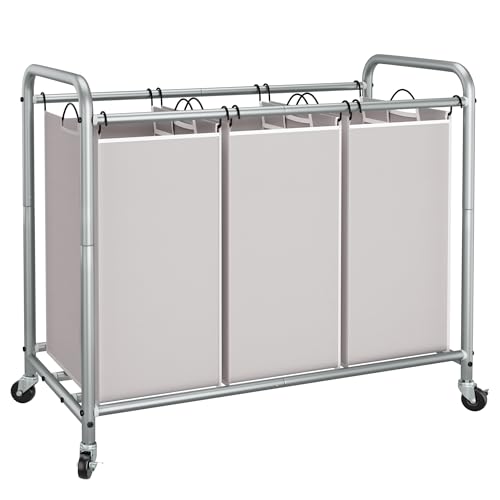
These are the best laundry sorters for general-purpose use. Three equal bags can handle lights, darks and towels, or you can assign sections to adults, children and linens. Brands such as Whitmor, Simple Houseware, Honey-Can-Do and Seville Classics sell versions of this familiar design in different sizes.
The strongest models combine a steel frame, removable washable bags and a lower support shelf or crossbar. The main weakness is that three full bags can make a narrow cart top-heavy. Keep heavier towels in the lowest or most central position, and avoid dragging the cart sideways over a threshold.
Two-section slim sorters
A two-section sorter is the better choice when width matters more than maximum organization. It can divide lights and darks, washable clothing and delicate clothing, or everyday laundry and towels. Vertical designs often fit inside a wardrobe or beside a stacked washer and dryer.
The compromise is frequent emptying. If each section holds about 1–1.5 bushels, a couple may need to wash every few days. A tall frame also deserves an anti-tip check, particularly in a home with children or pets. Choose a broad base, a wall-clearance-friendly design and a lid or deep bag opening if the sorter will sit in a bedroom.
Four-section family carts
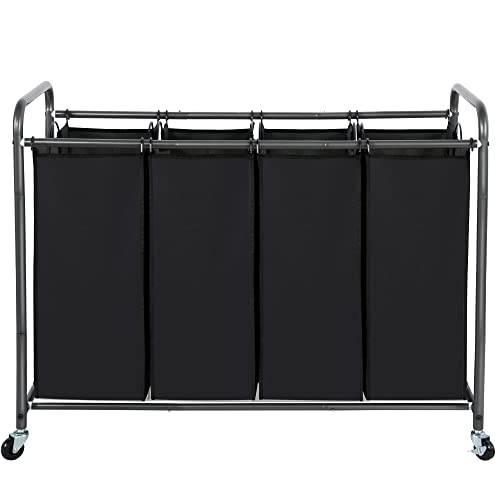
Four-bag carts are the most useful for households that wash multiple times each week. They allow more precise sorting—darks, lights, whites and towels—before the washer is full. Some designs use two rows of bags, while others place four bags side by side and require more width.
Measure the route to the washer, not merely the empty floor space. A 28-inch-wide cart may fit beside a machine but fail at the doorway or turn into a narrow hall. For a busy family, choose a frame with a stated load rating, reinforced bag seams and casters that can carry the total weight without bending.
Decision matrix: match the sorter to your routine
| Your priority | Recommended choice | Avoid |
|---|---|---|
| Lowest initial cost | Two- or three-bag fabric sorter with a basic tubular frame | Oversized carts with shelves and premium hardware you will not use |
| Sorting once a week | At least 4 bushels, reinforced bags and a stable steel frame | Small hanging compartments that overflow before wash day |
| Sorting several times a week | Three or four removable bags with wide openings | Deep, narrow bags that require reaching to the bottom |
| Very limited floor space | Under-22-inch vertical sorter or stackable separate hampers | Four-bag side-by-side carts |
| Frequent damp loads | Mesh or ventilated plastic compartments that can be wiped dry | Closed, unlined fabric bags used for overnight wet clothing |
Ownership realities: what wears out first
The bags usually fail before the frame. Handles fray from being lifted while overfilled, seams split at the corners, and the bottom panel bows under wet towels. Do not exceed the bag’s practical fill line even if there is still room at the top. If replacement bags are unavailable, a sound frame becomes difficult to keep using.
Casters are the next common failure point. Hair and lint can wrap around axles, increasing resistance and causing the wheel mount to loosen. Vacuum or pull debris from the wheels monthly, then tighten accessible screws. Do not apply oil to plastic wheel components unless the manufacturer allows it; oil can attract more lint.
Wash fabric bags according to their labels, and allow them to dry completely before reinstalling them. For routine cleaning, a damp cloth and mild detergent are safer than bleach or abrasive powder. Never leave wet clothing in a closed sorter overnight when the bag is not designed for ventilation. That habit can create persistent odors and shorten the life of the lining.
How to size and set up your sorter
- Measure the space and route. Record width, depth and height, then measure the narrowest doorway or turn on the way to the washer.
- Estimate weekly volume. Count your usual loads and multiply by roughly 1.5–2 cubic feet per load. Add 20% reserve capacity so the bags are not packed solid.
- Choose the number of categories. Two sections are enough for basic lights and darks; three or four are worthwhile if you separate towels, whites or work clothing.
- Check bag removal. Confirm that handles remain accessible when the compartments are full and that the bag can reach the washer without scraping the floor.
- Level and lock the frame. Install casters fully, tighten fasteners after the first week and engage wheel brakes whenever you load or unload.
For many buyers, the best laundry sorter is a three-bag steel-frame cart with washable Oxford-polyester bags and locking casters. Choose a slim two-bag vertical model when floor space is the constraint, and move to a four-bag heavy-duty cart only when your weekly volume justifies its greater width and cost. In general market terms, basic fabric sorters often cost about $25–$60, sturdier rolling carts about $60–$130, and larger commercial-style designs about $130–$250.





Write Your Review
No reviews yet. Be the first to share your experience!