
Key takeaways
- True 2-ohm 6.5-inch car speakers verified against manufacturer specs: DS18 PRO-SM6.2, ORION Cobalt CM652 and DS18 PRO-CF6.2NR, with amplifier stability and install notes.
As an Amazon Associate we earn from qualifying purchases.
Most speaker roundups that claim to cover 2-ohm models quietly cheat. A speaker rated at 3 ohms, 2.7 ohms or plain 4 ohms gets folded into the list because it is “close enough,” and the reader who specifically needs a 2-ohm load for a factory amplifier or a low-impedance aftermarket setup ends up with the wrong part. This guide takes the stricter route. Every model below is a 6.5-inch car speaker whose nominal impedance is published as exactly 2 ohms by its manufacturer or in its listing specifications. If the spec sheet said anything else, the speaker was left out, no matter how popular it is.
That strict filter changes the shape of the list, and it is worth understanding why before choosing. Genuine 2-ohm 6.5-inch speakers that are still in production and still sold through major US channels are almost entirely pro-style midrange and mid-bass drivers from brands such as DS18 and ORION, not the mainstream coaxial door speakers sold by the big retail brands. The mainstream brands mostly left this segment years ago, and their older 2-ohm models have been discontinued. What remains is a small, specialized group of drivers built for high-output builds and for replacing low-impedance factory speakers, and the three picks below are the strongest verified examples of that group.
What “2 ohm” actually means, and why the exact figure matters
Nominal impedance is the load a speaker presents to an amplifier, averaged across its operating range. A 2-ohm speaker draws roughly twice the current of a 4-ohm speaker at the same output voltage, which is why amplifiers that are stable into 2 ohms can deliver substantially more power into them. It is also why the exact rating matters. Connect a speaker with a lower impedance than an amplifier or factory head unit is designed for, and the amp runs hot, distorts early, or shuts down into protection. Connect a higher-impedance speaker where a system was tuned around 2 ohms, and output drops noticeably.
Two traps catch buyers in this segment. The first is rounding: some manufacturers rate a speaker at 2.5, 2.7 or 3 ohms, and retailers or roundup writers shorten that to “2 ohm.” Those speakers are not 2-ohm speakers. The second trap is measuring a voice coil with a multimeter and reading the DC resistance, which is always lower than the nominal impedance and proves nothing about the published rating. The only figure that counts for matching is the nominal impedance in the manufacturer’s specification, and that is the figure used for every pick here.
The practical consequence is simple: before buying any speaker on this page, confirm that the amplifier or factory system driving it is rated for a 2-ohm load per channel. Many factory premium systems from brands such as Bose were built around low-impedance speakers, and many aftermarket amplifiers are 2-ohm stable, but a basic head unit’s internal amplifier often is not. The speakers below assume a 2-ohm-stable source.
The picks
1. DS18 PRO-SM6.2
- Product: DS18 PRO-SM6.2 6.5-Inch Slim Midrange Loudspeaker (Single)
- Best for: Shallow doors and tight factory locations where mounting depth is the limiting factor
The PRO-SM6.2 is the pick for installs where depth is the problem. DS18’s manual for the model lists a nominal impedance of 2 ohms, power handling of 200 watts RMS and 400 watts maximum, a sensitivity of 95 dB, and a frequency response of 80Hz to 14kHz. It is a slim-profile midrange driver, sold as a single speaker, which suits door locations where a standard-depth driver will not clear the window mechanism or door panel.
Because it is a dedicated midrange, the PRO-SM6.2 is not a full-range replacement for a factory coaxial. It covers the midrange band with high efficiency, which means it plays loudly on modest amplifier power, but it needs a separate tweeter and a crossover (or an active crossover in the amplifier or processor) to complete the front stage. Its shallow design also makes it a sensible candidate for replacing a failed low-impedance factory midrange where the original speaker was built to a slim pattern. Buyers should order two for a stereo pair, since the box contains one driver.
2. ORION Cobalt CM652
- Product: ORION Cobalt CM652 6.5-Inch Midrange Bullet Loudspeakers (Pair)
- Best for: High-output builds that need a matched pair with maximum efficiency
The Cobalt CM652 is the efficiency pick. ORION rates the pair at 2 ohms nominal, with 250 watts RMS and 1,000 watts maximum power handling per pair as stated in the listing, a 1.5-inch voice coil, and an efficiency figure around 96.7 dB in retailer specifications. That sensitivity is the highest of the three picks here, and it translates directly into output: in a build where the amplifier channels are shared or modest, the CM652 reaches a given volume with less power than the alternatives.
Unlike the two DS18 drivers, the CM652 is sold as a pair, which simplifies ordering for a standard two-door or front-stage install. The bullet-style design is a midrange loudspeaker, so the same system-planning note applies: pair it with separate tweeters and proper crossover filtering rather than expecting full-range sound from one driver per side. The CM652 suits listeners building a loud, forward front stage, including the pro-audio-style door builds where multiple midrange drivers per door are common. Its efficiency also makes it the least demanding of these picks on amplifier current for a given listening level, though the amplifier still must be rated stable at 2 ohms.
3. DS18 PRO-CF6.2NR
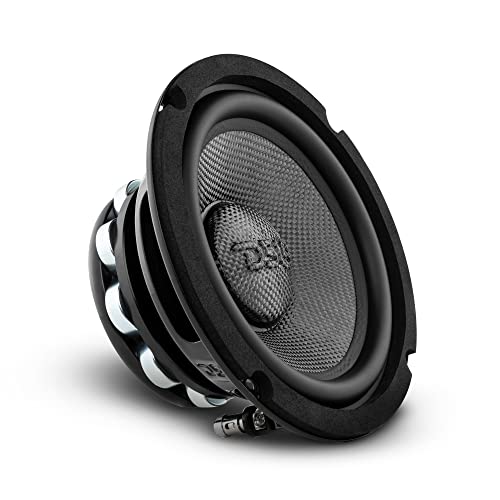
- Product: DS18 PRO-CF6.2NR 6.5-Inch Carbon Fiber Mid-Bass Loudspeaker (Single)
- Best for: Doors that see moisture, and builds that need strong mid-bass output
The PRO-CF6.2NR is the heavy-duty option. Its listing specifications give a nominal impedance of 2 ohms, power handling of 250 watts RMS and 500 watts maximum, sensitivity of 95 dB, and a frequency response of 80Hz to 12kHz. The cone is water-resistant carbon fiber driven by a neodymium ring magnet, a combination aimed at durability in door cavities that regularly see rain runoff, and at strong mid-bass punch from a compact motor structure.
Practical details matter with this model. It is sold as a single speaker with no grille included, its mounting depth is 2.73 inches, and DS18 recommends a high-pass filter at 100Hz, which underlines its role as a mid-bass and midrange driver inside a larger system rather than a standalone full-range unit. Of the three picks, this is the one to choose when the doors are deep enough and the system includes subwoofer support below and tweeters above, leaving the CF6.2NR to do the high-output middle work it was designed for.
How the three picks compare
The choice between the three comes down to the job each driver has to do. The PRO-SM6.2 is the problem-solver: it is the one to reach for when the mounting location is shallow or when a factory low-impedance midrange has failed and the replacement has to fit the same tight space while presenting the same 2-ohm load. The CM652 is the output play: sold as a pair, with the highest efficiency of the group, it suits builds where volume per watt matters more than anything else and where the system design already includes tweeters and proper filtering. The PRO-CF6.2NR is the durability and mid-bass play: its water-resistant carbon-fiber cone and neodymium motor make it the strongest choice for doors that see weather and for systems with subwoofer support that free it to concentrate on the mid-bass and midrange bands.
All three share the same electrical contract: a published nominal impedance of 2 ohms, high sensitivity figures between 95 dB and roughly 96.7 dB, and power handling rated in the hundreds of watts at maximum. None of them should be bought as a casual like-for-like swap for a full-range factory coaxial, and all of them will reward a properly configured amplifier far more than a basic head unit ever could.
The honest catch: these are system drivers, not drop-in coaxials
Anyone expecting this list to look like a typical set of two-way door speakers should pause here. The verified 2-ohm market in this size is a pro-audio market. All three picks are midrange or mid-bass drivers. None of them includes a built-in tweeter, none of them covers the full audible range alone, and all of them assume an amplifier that is stable into 2 ohms and a crossover strategy, whether that is passive crossovers, an active digital signal processor, or the filtering built into a suitable amplifier.
That is not a flaw in the picks; it is the reality of the category, and it is exactly why so many competing lists quietly substitute 3-ohm and 4-ohm coaxials and hope nobody checks. If your goal is a simple like-for-like swap of a factory 2-ohm coaxial and you do not want to add tweeters or amplification, the correct move is to match the factory speaker’s published specification from the vehicle manufacturer rather than forcing a pro driver into the job. If, on the other hand, you are building a system, replacing low-impedance factory midrange drivers, or feeding a 2-ohm-stable amplifier, the three drivers above are the verified options.
Buying and installation notes
Check the amplifier first. Every channel that will drive one of these speakers must be rated for 2-ohm loads in the configuration you plan to use. Bridged channels on many amplifiers are only stable at 4 ohms, so a bridged setup and these speakers usually do not mix.
Mind the format. The DS18 drivers are sold singly and the ORION is sold as a pair; ordering the wrong quantity is the most common mistake with pro-style drivers. Confirm mounting depth against your door before ordering: the PRO-SM6.2 exists precisely for shallow locations, while the PRO-CF6.2NR needs 2.73 inches of depth. Finally, budget for the supporting parts the category assumes, namely tweeters, crossovers or a processor, and suitable speaker wire runs, because none of the three picks is a complete front stage on its own.
Frequently asked questions
Can I run 2-ohm speakers on a factory head unit?
Only if that factory system was designed for 2-ohm speakers, as many premium factory systems were. A standard head unit amplifier rated for 4 ohms can overheat or shut down with a 2-ohm load. Check the factory specification for your vehicle before connecting them.
Are 3-ohm speakers close enough?
No. A 3-ohm speaker presents a different load and draws less current than a 2-ohm speaker. Systems and amplifiers chosen around a 2-ohm specification should be matched with speakers published at 2 ohms nominal, which is the standard applied to every pick in this guide.
Why are there no big-brand coaxial speakers on this list?
Because the major retail brands’ true 2-ohm 6.5-inch models have largely been discontinued, and their current models are rated at 3 or 4 ohms. Rather than relabel those speakers, this guide lists the 2-ohm models that manufacturers currently publish and sell.
Do these speakers need an amplifier?
In practice, yes. They are designed for systems with 2-ohm-stable amplification and crossover filtering. Running them directly from a basic head unit is not the use case they were built for.
Disclosure
Disclosure: This article contains affiliate links. If you buy through those links, a commission may be earned at no additional cost to you. Product information was taken from the listings and manufacturer details available at the time of writing, and specifications should be confirmed on the live listing before purchase.
More from Amazon
Programs that pair well with the guide above. Offers and eligibility are set by Amazon and may change.
Free shipping on eligible items, Prime Video and more. Eligible new members can start with a free trial.
Start a Prime free trialAudiobooks and podcasts to listen to on the go. Eligible new members can start with a free trial.
Try Audible freeAd-free music streaming. Eligible new subscribers can start with a free trial.
Try Music Unlimited freeA free business account with business pricing and bulk-buying tools for work, shop or home office.
Create a business accountAs an Amazon Associate we earn from qualifying purchases.








Write Your Review
No reviews yet. Be the first to share your experience!