
Our Top Picks
 Yamaha Audio A-S301BL Natural Sound Integrated Stereo Amplifier17.1 x 15.25 x 6 inches19.8 PoundsCheck on Amazon

An old Pioneer record player deserves better than being left silent on a shelf. Decks from Pioneer’s golden era — the PL-12D, the PL-518, the PL-530 and their many belt-drive and direct-drive cousins — were built to a standard that still holds up, and most of them need only two things to sing again: an amplifier that understands a phono signal, and a pair of passive speakers matched to that amplifier. This guide explains what a vintage Pioneer turntable actually needs from modern electronics, then picks two phono-ready amplifiers and two passive bookshelf speakers that pair cleanly with one.


As an Amazon Associate we earn from qualifying purchases.
What an Old Pioneer Turntable Needs From an Amp
The single most important detail is the phono stage. A cartridge produces a very small signal, far weaker than the output of a CD player or a phone, and the grooves of a record are cut with reduced bass and boosted treble that must be corrected during playback. An amplifier with a dedicated phono input does both jobs: it raises the cartridge signal to line level and applies the standard RIAA equalization curve so records sound full rather than thin and quiet.
Most vintage Pioneer decks use moving magnet cartridges, so look for a phono input labeled MM. Both amplifier picks below include one, which means the turntable connects directly with its RCA cables and ground wire — no separate phono preamp box, no extra power supply, and no guessing about gain. If your deck’s cartridge has been replaced with a moving coil type at some point, that is a different situation, but the overwhelming majority of surviving Pioneer turntables still run moving magnet cartridges and work with a standard MM input.
The second detail is the ground wire. Old Pioneer turntables have a thin ground lead alongside the RCA cables, and it must be attached to the ground terminal next to the phono input on the amplifier. Skip it and you will likely hear a low hum through the speakers that rises with the volume. Every amp in this guide provides that terminal because both were designed with turntables in mind.
Power matching is the third consideration, and it is simpler than it sounds. Vintage listening is rarely about maximum volume. What matters is that the amplifier can drive the speakers’ impedance comfortably and deliver clean power at ordinary levels. The receivers and integrated amplifiers below are rated for the speaker impedances of the bookshelf models in this guide, so each suggested pairing sits well inside safe operating territory.
Amp Picks
Sony STRDH190 2-Channel Stereo Receiver
The Sony STRDH190 is the straightforward route back to playing records. It is a two-channel stereo receiver rated at 100 watts per channel into 8 ohms, with a dedicated phono input for a turntable, four stereo RCA inputs for other sources, a front-panel 3.5mm input, and built-in Bluetooth for streaming from a phone when the record shelf has been exhausted. An FM tuner with 30 station presets is built in, and the speaker selector allows A, B, or A+B operation if a second pair of speakers ever joins the system.
For a vintage Pioneer owner, the appeal is the lack of friction. The phono input sits on the back panel with its ground terminal, the controls are conventional knobs rather than menus, and the low-profile chassis, a little over five inches tall, slides into the same kind of cabinet or rack that held seventies and eighties components. Sony also positions the phono stage and transformer to minimize interference, which matters when the signal coming off a cartridge is as small as it is.
- Power output: 100 watts per channel into 8 ohms
- Phono input: Yes, moving magnet, with ground terminal
- Other inputs: 4 stereo RCA, 3.5mm front input, Bluetooth
- Speaker switching: A, B, or A+B
- Extras: FM tuner with 30 presets, full-size headphone jack
See the Sony STRDH190 on Amazon
Yamaha A-S301 Integrated Amplifier
The Yamaha A-S301 takes the more traditional integrated-amplifier route. It is rated at 60 watts per channel across the full 20 Hz to 20 kHz range, a conservative way of quoting power that suits music listening well. Its analog inputs include a moving magnet phono input for a turntable, and it adds optical and coaxial digital inputs so a television or disc player can share the same speakers. A Pure Direct mode bypasses the tone and balance circuitry for a shorter signal path, and there is a subwoofer output if low bass ever needs reinforcement.
Yamaha builds the A-S301 around its ToP-ART circuit layout with a symmetrical design and an anti-resonance base, and the front panel keeps the classic arrangement of large knobs, including a continuously variable loudness control that helps low-volume evening listening keep its warmth. Speaker A, B, and A+B switching is included, along with a headphone output. For a Pioneer deck of similar vintage character, this is the pairing that feels most like a period system — updated where it counts, familiar everywhere else.
- Power output: 60 watts per channel, 20 Hz to 20 kHz
- Phono input: Yes, moving magnet, with ground terminal
- Other inputs: Analog RCA inputs, optical and coaxial digital
- Speaker switching: A, B, or A+B
- Extras: Pure Direct mode, subwoofer output, loudness control
See the Yamaha A-S301 on Amazon
Speaker Picks
ELAC Debut 2.0 B6.2 Bookshelf Speakers
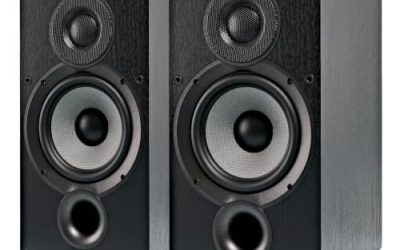
The ELAC Debut 2.0 B6.2 is a passive two-way bookshelf speaker sold as a pair, built around a 6.5-inch woven aramid-fiber woofer and a 1-inch cloth dome tweeter. ELAC rates its frequency response at 44 Hz to 35,000 Hz, with a nominal impedance of 6 ohms and power handling up to 120 watts, figures that make it a comfortable match for both amplifiers above. The larger woofer gives it more low-frequency weight than most speakers of its size, which suits the warm, full presentation many people want from vinyl.
Two practical points are worth knowing. The cabinet is substantial — roughly 14.8 inches tall and 10.6 inches deep — so measure the shelf before ordering. The bass reflex port also needs a little breathing room behind the cabinet rather than being pushed flat against a wall. Give it that space and the B6.2 rewards you with a relaxed, even sound that flatters older recordings instead of exposing every flaw in them.
- Design: 2-way bass reflex, passive, sold as a pair
- Woofer: 6.5-inch woven aramid fiber
- Tweeter: 1-inch cloth dome
- Frequency response: 44 Hz to 35,000 Hz
- Impedance: 6 ohms
See the ELAC Debut 2.0 B6.2 on Amazon
Klipsch R-51M Bookshelf Speakers
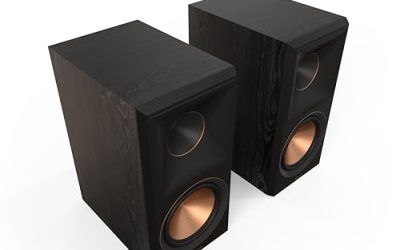
The Klipsch R-51M takes almost the opposite approach to the ELAC. It is a passive two-way bookshelf speaker, sold as a pair, with a 5.25-inch spun-copper IMG woofer and a 1-inch aluminum tweeter loaded into Klipsch’s 90-by-90 Tractrix horn. The horn is the story here: it makes the R-51M notably efficient, with a sensitivity of 93 dB and an 8-ohm impedance, so it plays lively and clear at modest amplifier settings — a real virtue when the source is a turntable and the listening happens at civilized volumes.
Frequency response begins at 62 Hz, so deep bass is limited, as expected from a cabinet about 13.3 inches tall, but the midrange and treble presence that carries vocals, horns and string detail is exactly what this design emphasizes. The rear-firing port again asks for a little space from the wall. Paired with the Sony receiver, the R-51M makes an especially forgiving combination for smaller rooms, because very little power is needed to reach comfortable listening levels.
- Design: 2-way bass reflex, passive, sold as a pair
- Woofer: 5.25-inch spun-copper IMG
- Tweeter: 1-inch aluminum LTS in a Tractrix horn
- Sensitivity: 93 dB
- Impedance: 8 ohms
See the Klipsch R-51M on Amazon
Suggested Pairings
Any amplifier here can drive any speaker here, but two combinations stand out. The Sony STRDH190 with the Klipsch R-51M is the easy-listening pairing: the receiver’s generous power headroom and the speakers’ high efficiency mean clean, confident sound in small to medium rooms, with Bluetooth and FM radio filling the gaps between record sessions.
The Yamaha A-S301 with the ELAC Debut 2.0 B6.2 is the pairing for listeners who want the fullest, most relaxed presentation. The ELAC’s 6-ohm load sits comfortably within the Yamaha’s capabilities, the bigger woofer fills in the lower registers that older pressings can lack, and the Yamaha’s loudness control keeps late-night listening balanced at low volume. Listeners with larger rooms or a taste for orchestral weight will lean this way; listeners in compact spaces who value clarity and liveliness will lean toward the Sony and Klipsch.
Setting the System Up
Connection order is simple. Place the turntable on a level, stable surface away from the speakers, since vibration fed back into a cartridge becomes audible rumble. Connect the deck’s RCA leads to the amplifier’s phono input — not to a regular line input — and fasten the ground wire to the ground terminal. Connect the speakers with ordinary speaker wire, keeping polarity consistent: positive terminal to positive terminal on both channels, or the stereo image will lose focus and bass will thin out.
Set the amplifier’s input selector to phono, start the volume low, and raise it gradually on a first play. If a hum appears, the ground connection is the first suspect, followed by RCA leads running alongside power cables. If the sound is extremely quiet and tinny, the turntable has almost certainly landed on a line-level input by mistake. If it is loud and distorted, a deck with a built-in preamp switched on has been connected to the phono input — most vintage Pioneer models have no built-in preamp at all, which is precisely why the phono input matters.
Speaker placement deserves ten minutes of attention. Bookshelf speakers sound best at ear height when seated, angled slightly toward the listening position, and given the rear clearance their ports require. Keep the two speakers and the listening seat forming a rough triangle, and avoid placing one speaker in a corner while the other sits in open space, which unbalances the bass between channels.
A Note on the Turntable Itself
An amplifier and speakers can only reproduce what the deck sends them, so a few minutes of attention to an old Pioneer pays off. A drive belt on a belt-drive model stretches with age and is inexpensive to replace. A stylus that has played for decades should be inspected or replaced before it is trusted with good records. Dust on the RCA plugs can be wiped clean, and the deck’s speed can be checked against the strobe markings many Pioneer platters carry. None of this requires a specialist, and all of it protects the investment made in the new electronics.
Frequently Asked Questions
Can an old Pioneer turntable plug into any modern amplifier?
Only into one with a phono input, or into a line input if a separate phono preamp is used between the deck and the amplifier. A bare cartridge signal connected to a normal line input will be extremely quiet and thin because it has not been amplified or equalized. Both amplifiers in this guide include a phono input, so no extra box is needed.
Do these speakers need a separate amplifier, or are they powered?
Both speaker picks are passive, which means they contain no amplifier of their own and must be driven by the receiver or integrated amplifier. That is the traditional arrangement a vintage Pioneer deck was designed for, and it keeps the upgrade path open: speakers and amplifier can be changed independently later.
What if the Pioneer turntable has a built-in preamp?
A small number of later models offer switchable output. If yours has a phono/line switch, set it to phono when using the amplifier’s phono input, or to line when using a regular input — never both stages at once. Most classic Pioneer decks have no such switch and simply output a phono-level signal.
Will these amplifiers work with a moving coil cartridge?
The phono inputs on both picks are designed for moving magnet cartridges, which cover the vast majority of cartridges fitted to vintage Pioneer turntables. A low-output moving coil cartridge would need a dedicated step-up device or a phono stage with a moving coil setting feeding a line input instead.
How much speaker wire is needed?
Enough to run from the amplifier to each speaker with a little slack for placement adjustments. Standard copper speaker wire of ordinary gauge handles runs of typical living-room length without difficulty, and bare wire or banana plugs both work with the binding posts and terminals used by the products in this guide.
The Bottom Line
Reviving an old Pioneer record player does not require exotic equipment. It requires an amplifier with a proper moving magnet phono input and a pair of passive speakers matched to it. The Sony STRDH190 and Klipsch R-51M make the simplest, liveliest combination, while the Yamaha A-S301 and ELAC Debut 2.0 B6.2 offer a fuller, more traditional hi-fi presentation. Either way, the deck that has been waiting in the cabinet finally gets to do what it was built to do.
More from Amazon
Programs that pair well with the guide above. Offers and eligibility are set by Amazon and may change.
Free shipping on eligible items, Prime Video and more. Eligible new members can start with a free trial.
Start a Prime free trialAudiobooks and podcasts to listen to on the go. Eligible new members can start with a free trial.
Try Audible freeAd-free music streaming. Eligible new subscribers can start with a free trial.
Try Music Unlimited freeA free business account with business pricing and bulk-buying tools for work, shop or home office.
Create a business accountAs an Amazon Associate we earn from qualifying purchases.


Write Your Review
No reviews yet. Be the first to share your experience!