

Key takeaways
- Drain trays: Mineral scale and scratches appear before the frame fails. Empty and rinse the tray daily if water pools in it.
- Rubber or silicone feet: They can loosen, flatten, or collect grime. Replace them if the rack begins touching the counter.
- Coatings: Scratches around welded joints expose steel to moisture. Dry those areas promptly and do not use abrasive scouring pads.
- Sliding extensions: Food particles can make expandable sections stick. Remove the sections where possible and clean the tracks with a narrow brush.
- Utensil cups: These often stay wet longest. A ventilated, removable cup is easier to rinse and dry.
The best dish drying racks for small and busy kitchens are usually a compact over-sink rack when counter space is scarce, a countertop rack with a controlled drainboard when convenience matters most, and an expandable model when your dish load changes from day to day.
Our top picks



As an Amazon Associate we earn from qualifying purchases at no extra cost to you. Ratings are shown as listed on Amazon.
Quick picks by kitchen situation
| Kitchen situation | Best design | Useful target specification | Why it fits |
|---|---|---|---|
| Very little counter space | Over-sink roll-up or bridge rack | 17–20 inches wide; 5–10 lb capacity | Uses the sink instead of valuable worktop area and drains directly below. |
| One or two people | Compact countertop rack | 12–16 inches wide; 8–12 plates | Easy to load, move, and clean without occupying the entire counter. |
| Family or frequent cooking | Two-tier countertop rack | 18–22 inches wide; 12–20 plates | Creates vertical capacity for plates, bowls, glasses, and utensils. |
| Changing dish loads | Expandable rack | 14–22 inches adjustable width | Stays compact after a quick meal but opens for cookware and larger loads. |
| Hard water or humid climate | Stainless-steel or coated steel rack | 304 stainless steel or intact powder coating | Better resistance to staining and corrosion than uncoated mild steel. |
Countertop versus over-sink: the important trade-off
Countertop racks are easier to live with
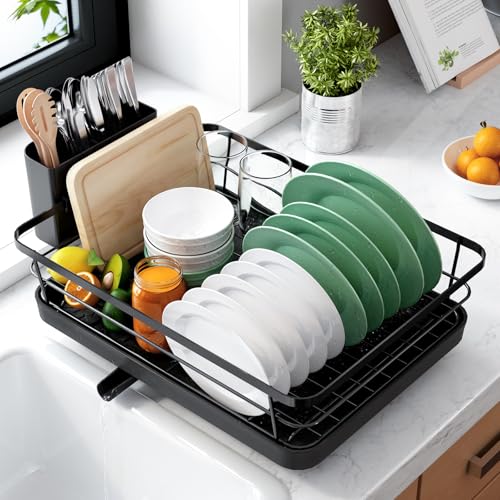
A countertop rack is the safer choice if you want dishes to remain accessible after washing. A good model has a raised wire frame, a separate cutlery holder, and a sloped drainboard that directs water into the sink. It can hold plates at an angle while leaving space for mugs and bowls.
The drawback is footprint. A compact rack may occupy about 12 by 14 inches, while a two-tier family rack can require roughly 20 by 13 inches. That is a substantial area beside the sink. Measure the usable counter, not the full counter length: taps, wall outlets, cabinet doors, and the sink rim can make a listed width unusable.
Countertop designs also vary in drainage quality. A drainboard with a removable spout or channel is more useful than a flat plastic tray, where water can pool underneath the rack. Look for feet that lift the frame at least 1 inch above the tray so air can circulate and the underside can dry.
Over-sink racks save space but require accurate measuring
Over-sink racks sit across the sink or attach to the counter beside it. Water falls directly into the basin, eliminating a separate tray and reducing the chance of a damp patch on the worktop. Roll-up silicone-coated racks are especially convenient because they can be folded into a drawer when not needed.
They are less forgiving of poor sizing. Measure the sink’s inside width at the exact points where the rack will rest, including any rounded corners. A rack that is only slightly too narrow can slide, while one that is too wide may rest on the countertop rather than the sink. For a bridge-style model, confirm that the sink can support the weight of wet cookware without flexing.
Over-sink racks are also less versatile for large loads. They can be excellent for plates, produce, and a few glasses, but a deep stockpot may block the sink or make the rack unstable. A countertop rack is usually better when you wash a full meal’s dishes at once.
Specifications that matter more than capacity claims
Capacity and footprint
“Holds 20 plates” does not describe the whole load. That figure may leave no room for bowls, glasses, or utensils. For everyday use, estimate the dishes you wash in one cycle and add about 25 percent spare capacity. If you normally wash eight plates, four bowls, four glasses, and a pan, a rack marketed for roughly 12–16 plates may be more appropriate than the smallest eight-plate model.
A two-tier rack increases capacity without increasing floor area, but it adds height. Check the distance below wall cabinets; around 17–20 inches of vertical clearance is often needed for a tall rack with cups or bowls loaded. Measure before buying, particularly beneath low cabinets.
Drainage
The best dish drying racks keep water moving away from dishes and the counter. Prefer a sloped tray, a defined drainage channel, or a spout that reaches the sink. A removable tray is easier to wash than one permanently attached to the frame.
For a rack beside the sink, test the route water must travel. A spout that stops several inches short of the basin may drain onto the counter rather than into it. Some compact racks allow the drain outlet to be positioned on either side, which is useful when the faucet or backsplash limits the layout.
Rust resistance
Stainless steel is not automatically rust-proof, but a well-finished 304 stainless-steel frame is generally a stronger choice for repeated wet use than bare steel. Powder-coated steel can also last well if the coating remains intact. Inspect welds, sharp bends, feet, and the underside of the cutlery cup: these are common places for coating damage and trapped moisture.
Silicone-coated roll-up racks avoid exposed steel in many areas, but their flexible coating can split at folds over time. Plastic racks will not rust, though they can discolor, scratch, or become brittle near heat. Avoid leaving any material permanently submerged in standing water.
Adjustability and cleaning effort
Expandable racks are practical when the number of dishes changes, but sliding sections create seams that collect food residue. A fixed rack has fewer crevices and is usually quicker to rinse. Removable utensil holders, detachable feet, and a tray that comes fully apart are more valuable than decorative accessories.
A useful test is whether you can reach every surface with a dish brush. Narrow tubes, closed channels, and permanently attached cups are difficult to clean. If your tap water is hard, choose a tray with broad, smooth surfaces rather than textured grooves that hold mineral deposits.
Recommended design types and who should choose them
Compact countertop rack
Choose this for a small household, limited washing, or a rental kitchen where you do not want to alter the setup. A 12–16-inch rack with a plate section, cup rails, and a separate utensil holder offers a good balance. The main compromise is that pans may need to dry elsewhere.
Brands such as OXO, Joseph Joseph, and simplehuman offer recognizable examples of compact or expandable countertop designs, but compare the current dimensions and materials of the specific model rather than relying on the brand name.
Two-tier countertop rack
This is the better choice for frequent cooking and family-size loads. The upper shelf can hold plates or bowls while the lower level handles cups and cookware. Check the center of gravity: a tall rack loaded with heavy pans on one side can become unstable.
Leave enough clearance to remove the cutlery basket without lifting the whole rack. If the upper shelf cannot be removed, cleaning around its supports may take longer than expected.
Over-sink roll-up rack
Pick this when every inch of counter space matters or when you want water to drain directly into the sink. It is also useful as a temporary surface for rinsed produce. Its limitations are lower rigidity and reduced capacity. Do not use it for a heavy cast-iron pan unless the manufacturer specifically gives a suitable load rating and the sink supports it securely.
Expandable rack
An expandable model is a strong compromise for busy kitchens. It can occupy a narrow footprint during breakfast, then open for a larger evening load. Measure both its minimum and maximum width, and make sure the extended section will not cover a hob, block a drawer, or overhang an unprotected counter edge.
A practical sizing calculation
Suppose your usual load is six dinner plates, four bowls, four glasses, one saucepan, and a utensil basket. Allow roughly 1 inch of width per plate slot, but remember that bowls and glasses need separate space. A rack with six to eight plate slots alone is not enough; you need approximately 25–35 percent additional open area for the bowls, glasses, and pan.
If the rack’s listed footprint is 16 by 12 inches, its counter area is:
16 × 12 = 192 square inches.
On a counter that is 24 inches deep, that leaves only 8 inches of working depth in front of or behind the rack, depending on its orientation. If that remaining strip is too narrow for food preparation, an over-sink model may be the better solution even if its dish capacity is lower.
Ownership realities: what wears out first
- Drain trays: Mineral scale and scratches appear before the frame fails. Empty and rinse the tray daily if water pools in it.
- Rubber or silicone feet: They can loosen, flatten, or collect grime. Replace them if the rack begins touching the counter.
- Coatings: Scratches around welded joints expose steel to moisture. Dry those areas promptly and do not use abrasive scouring pads.
- Sliding extensions: Food particles can make expandable sections stick. Remove the sections where possible and clean the tracks with a narrow brush.
- Utensil cups: These often stay wet longest. A ventilated, removable cup is easier to rinse and dry.
For routine care, empty standing water each day, rinse the tray, and let the rack dry fully at least once a week. For scale, soak removable plastic or stainless parts in diluted white vinegar only when the manufacturer permits it, then rinse thoroughly. Never mix vinegar with chlorine bleach or other cleaning chemicals.
Final buying decision
Choose a countertop rack if you want the easiest loading and the most dependable support for a mixed dish load. Choose an over-sink rack if preserving counter space and direct drainage are your top priorities. Choose an expandable rack if your kitchen alternates between light and heavy washing. Whichever style you buy, prioritize accurate measurements, a genuinely sloped drainage path, removable parts, and a corrosion-resistant finish over an impressive plate-count claim.

Write Your Review
No reviews yet. Be the first to share your experience!