

Key takeaways
- Class D DSC, which maintains a dedicated receiver for channel 70 while monitoring the working channel.
- Built-in GPS or a reliable connection to an external GPS source.
- A clearly protected distress button that is easy to operate under stress.
- Position polling and individual, group or all-ships calling where supported.
- Registration capability for your local maritime authority and a readable MMSI entry process.
The best marine radios for most recreational boaters are a floating handheld VHF with an IPX7 or IPX8 rating, a long enough battery for the trip, and Class D DSC capability if you regularly travel offshore or beyond easy reach of other boats.
Our top picks



As an Amazon Associate we earn from qualifying purchases at no extra cost to you. Ratings are shown as listed on Amazon.
Quick picks by boating situation
| Boating situation | Best fit | Why it makes sense | Typical market range |
|---|---|---|---|
| Occasional coastal trips on a budget | Standard Horizon HX210 | Floating design, IPX7 waterproofing, built-in GPS and a practical five-watt output | $110–$150 |
| Frequent coastal cruising | Icom IC-M37 | Strong battery endurance, IPX8 submersibility and a high-output speaker | $180–$240 |
| Offshore or emergency-focused use | Standard Horizon HX380 | Class D DSC, integrated GPS, waypoint navigation and IPX8 protection | $230–$300 |
| Compact backup radio | Icom IC-M25 | Lightweight, floating, USB-chargeable and easy to keep in an emergency bag | $120–$170 |
| Inshore use where flotation matters most | Cobra MR HH350 FLT | Floating waterproof construction, weather alerts and a simple interface | $90–$140 |
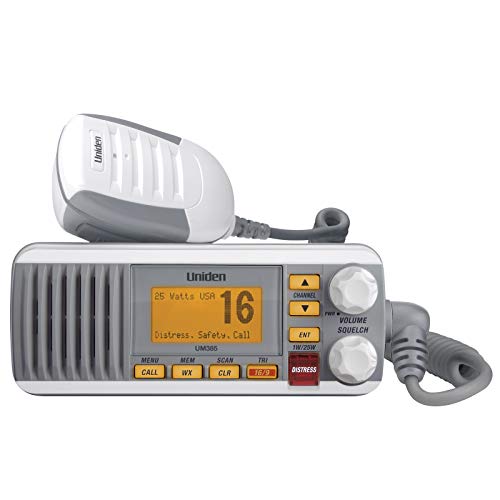
Prices are broad 2026 market ranges and vary with included chargers, regional versions and promotions. A fixed-mount VHF with an external antenna is usually the better primary radio for a larger boat, while a handheld is the essential backup when the boat’s electrical system fails.
What separates the best marine radios?
Waterproof rating: IPX7 versus IPX8
IPX7 means a radio can generally survive temporary immersion in about one metre of water for up to 30 minutes under laboratory conditions. IPX8 indicates protection during longer or deeper immersion, but the exact limit is set by the manufacturer. Neither rating means the radio is indestructible, and seals can deteriorate from salt, grit, impact or an incorrectly closed charging cover.
For calm inland and protected-water use, IPX7 is normally adequate. Choose IPX8 if the radio will be clipped to a life jacket, used on an open deck, or carried offshore where dropping it overboard is a realistic possibility. A floating radio is also valuable, but flotation does not replace a lanyard: waves, wind and current can still carry a radio away.
Range depends more on the antenna than the advertised wattage
Most handheld VHFs transmit at one or five watts. Five watts is useful for communicating with nearby vessels, marinas and rescue services, but VHF is primarily line-of-sight. A practical handheld-to-handheld range may be roughly 2–8 nautical miles depending on antenna height, sea state, obstructions and receiver quality. A handheld used from a low cockpit can have less range than a fixed radio whose antenna is mounted several metres above the water.
For example, if one handheld antenna is approximately 2 metres above the sea and another is 2 metres high, the radio-horizon estimate is:
Distance in nautical miles ≈ 2.23 × (√antenna height in metres + √antenna height in metres)
That gives about 6.3 nautical miles in ideal conditions. Real-world range can be shorter because of waves, rigging, buildings, interference and imperfect antenna performance. Treat high-wattage claims as a secondary consideration; antenna height and line of sight matter more.
DSC is the feature that changes an emergency call
Digital Selective Calling, or DSC, lets a compatible VHF send a standardized digital distress alert on channel 70. A radio with a registered Maritime Mobile Service Identity, or MMSI, can transmit your identity and, when connected to GPS, your position. This can be much faster and less ambiguous than trying to describe your location verbally on channel 16.
For serious offshore use, look for:
- Class D DSC, which maintains a dedicated receiver for channel 70 while monitoring the working channel.
- Built-in GPS or a reliable connection to an external GPS source.
- A clearly protected distress button that is easy to operate under stress.
- Position polling and individual, group or all-ships calling where supported.
- Registration capability for your local maritime authority and a readable MMSI entry process.
DSC does not automatically summon help unless the radio can transmit, the antenna works, the distress button is used correctly and the receiving authority or vessel is monitoring the relevant system. Continue with a voice Mayday on channel 16 whenever possible.
Head-to-head: the strongest choices
Standard Horizon HX210: sensible coastal value
The HX210 is a straightforward five-watt handheld with a floating design, IPX7 waterproofing, a lithium-ion battery and built-in GPS. It is a good fit for a family boat, fishing skiff or occasional coastal cruiser that needs reliable voice communication without paying for a larger navigation feature set.
Its limitation is the absence of the more advanced Class D DSC package found on higher-end models. If your trips regularly take you offshore, select a DSC-equipped radio rather than treating the HX210 as your only emergency communication device.
Icom IC-M37: endurance for frequent use
The IC-M37 is known for a high-capacity battery, IPX8 submersibility and a loud audio output designed to remain intelligible around engines and wind. Depending on power settings and usage, its rated battery life is commonly around 18 hours under manufacturer test conditions. Real runtime falls when transmitting frequently, using maximum volume or monitoring multiple features.
This is an excellent frequent-use coastal radio, particularly when long periods away from a charger are common. Check the exact regional version before buying because DSC, GPS and channel functions can vary by model and market.
Standard Horizon HX380: the offshore-oriented handheld
The HX380 adds the features that matter when a radio may need to support a real emergency: Class D DSC, an integrated GPS receiver, IPX8 protection and navigation functions such as waypoint support. Its five-watt output is typical for a handheld, but the combination of location data and DSC is more important than a small difference in transmitted power.
It is a stronger choice than a basic floating radio for offshore fishing, passagemaking and boats that may operate beyond immediate assistance. Set up the MMSI and verify the GPS position before departure; an unregistered DSC radio cannot deliver its full benefit.
Icom IC-M25: compact backup protection
The IC-M25 is a slim, lightweight handheld designed for carrying convenience. Its floating waterproof construction and USB charging make it practical as a secondary radio in a ditch bag, tender or day pack. It is best viewed as a backup or short-trip radio rather than a replacement for a DSC-equipped primary unit on offshore passages.
Battery runtime and charging: a realistic calculation
Manufacturers usually rate battery life with a duty cycle such as 5% transmit, 5% receive and 90% standby. A radio advertised at 18 hours may therefore provide substantially less than 18 hours during a busy day of calling, weather monitoring and high-volume listening.
As a planning example, assume a 1,800 mAh battery and an average current draw of 150 mA during a mixed-use trip:
1,800 mAh ÷ 150 mA = approximately 12 hours
If frequent transmitting increases the average draw to 300 mA, the same battery provides about six hours. Keep the battery at least half charged before departure, carry a second battery or approved power bank where supported, and use a 12-volt charging cradle on longer trips. Do not charge through a wet or salt-contaminated connector.
Decision matrix: which type fits your boat?
| Your priority | Recommended specification | Trade-off |
|---|---|---|
| Lowest sensible cost | Five watts, floating, IPX7, lithium-ion battery | May lack Class D DSC and built-in GPS |
| Small console or life-jacket carry | Under 300 g, compact body, USB or cradle charging | Smaller battery may reduce runtime |
| Offshore emergency readiness | IPX8, Class D DSC, built-in GPS, protected distress button | Higher price and more setup complexity |
| Heavy daily use | Large-capacity battery, loud speaker, replaceable charging accessories | Usually larger and heavier |
| Primary communication on a larger boat | Fixed-mount 25-watt VHF with elevated external antenna | Depends on boat power and cannot be carried away easily |
Ownership details that are easy to overlook
- Rinse after saltwater use: Use fresh water around the exterior, then let the radio dry before opening covers or connecting a charger.
- Inspect seals: Charging-port covers, battery gaskets and antenna connections wear first. Replace damaged seals rather than relying on the original waterproof rating.
- Protect the antenna: Do not use a cracked or loose antenna. A damaged antenna can reduce range and may stress the transmitter.
- Test without causing a nuisance: Use the radio’s built-in diagnostics and a marina radio-check service where available. Never make an unauthorized distress transmission.
- Program the MMSI carefully: Many radios allow the MMSI to be entered only once by the owner. An error may require authorized service to correct.
- Keep a voice plan: Learn channel 16, the local working channels and the correct Mayday format before leaving the dock.
Final recommendation
Choose the Standard Horizon HX210 for affordable coastal backup, the Icom IC-M37 for long battery endurance and frequent inshore use, and the Standard Horizon HX380 when offshore safety and DSC location signaling are priorities. Whatever model you select, a charged battery, registered MMSI, working antenna and practiced Mayday procedure contribute more to safety than a longer feature list.








Write Your Review
No reviews yet. Be the first to share your experience!