

Key takeaways
- Obtain the appropriate amateur-radio license. Operating privileges and permitted frequencies vary by country and license class.
- Program only verified frequencies. Confirm repeater input, output, offset, tone or digital-access settings, and any required bandwidth.
- Start with receive-only testing. Listen for activity before transmitting, and identify according to the applicable rules.
- Use the correct antenna. A quarter-wave or gain antenna installed at a useful height is usually a major improvement over a stock handheld antenna.
- Check power and cooling. Mobile and base radios need correctly rated fuses, suitable cable, ventilation, and a power supply with enough continuous current.
- Measure before optimizing. An antenna analyzer or SWR meter can reveal feed-line and antenna problems before they damage equipment.
The best ham radios depend on where you will operate: a handheld is the most affordable starting point, a mobile radio is the practical choice for vehicles and repeaters, and a base-station radio offers the strongest upgrade path for serious home or portable operators.
Our top picks



As an Amazon Associate we earn from qualifying purchases at no extra cost to you. Ratings are shown as listed on Amazon.
Quick Picks by Operator and Situation
| Situation | Best radio type | Recommended direction | Typical market range |
|---|---|---|---|
| Lowest-cost entry into local VHF/UHF | Handheld | Dual-band FM handheld with a removable battery | $30–$250 |
| Reliable repeater use while driving | Mobile | 50–75 watt dual-band mobile radio | $300–$650 |
| Emergency communications from home or a vehicle | Base/mobile | 50–100 watt VHF/UHF radio with detachable control head | $350–$800 |
| Long-distance HF experimentation | Base-station or portable HF | 100 watt HF/50 MHz transceiver | $700–$1,500 |
| One radio for local and worldwide operation | All-band base | HF/VHF/UHF transceiver with a suitable antenna system | $1,000–$2,000 |
Handheld Radios: Best for Beginners and Portable Use
Handheld radios, often called HTs, are compact, battery-powered transceivers designed mainly for the 2-meter VHF and 70-centimeter UHF bands. They are easy to carry, inexpensive to replace, and useful for local repeaters, public-service events, hiking, and neighborhood communication. Their main limitation is not usually the advertised wattage; it is the short antenna and small battery.
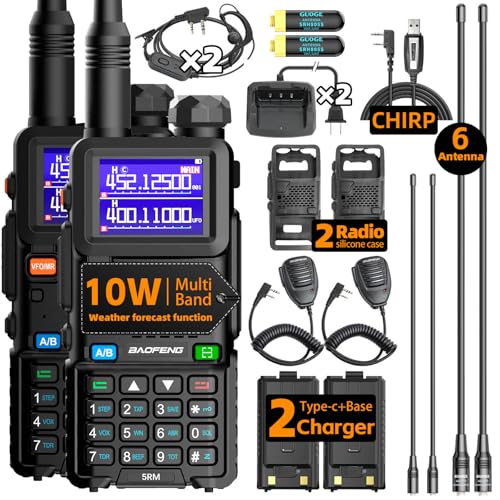
Best budget choice: Baofeng UV-5R-style handhelds
The Baofeng UV-5R and similar dual-band handhelds remain popular because they provide basic 2-meter/70-centimeter FM operation, removable batteries, a flashlight, and computer programming for a low price. Typical output is around 1–5 watts, depending on the version and operating mode.
These radios can work well for learning, but programming is less forgiving than with more refined models. Menu names can be unclear, receive audio may be modest, and front-panel entry is slow. A programming cable and software such as CHIRP are usually a better approach than entering dozens of channels manually. Buy from a reputable source and verify that the radio is configured for the frequencies and emission types allowed by your license.
Best beginner upgrade: Yaesu FT-65R
The Yaesu FT-65R is a more polished dual-band handheld with a tougher feel, clearer controls, a higher-capacity battery than many budget HTs, and approximately 5 watts of output. It is a sensible choice when reliability and ease of use matter more than achieving the lowest purchase price.
The FT-65R is still primarily an FM radio. It does not provide the digital-network flexibility of some newer handhelds, so confirm that it matches the repeaters and groups you plan to use.
Best advanced handheld: Icom ID-52A
The Icom ID-52A adds advanced digital capabilities through D-STAR, a color display, GPS-related functions, Bluetooth support, and a stronger user interface than entry-level HTs. It is better suited to operators who already understand repeater offsets, digital voice systems, and programming software.
Its advantages are most apparent when you actually use D-STAR or need advanced portable features. If your local activity is almost entirely analog FM, a less expensive handheld may provide nearly the same practical coverage.
Mobile Radios: The Best Balance of Power and Practical Coverage
A mobile radio is usually the strongest value for regular operation. It can use a properly installed roof, trunk, or magnetic antenna and draw power from the vehicle electrical system. That combination generally provides a larger improvement than moving from 5 watts to 10 watts on a handheld.
Best for straightforward dual-band operation
The Icom IC-2730A is a 50-watt-class dual-band FM mobile radio with a detachable control head and a relatively accessible interface. It is a good fit for drivers who want dependable VHF/UHF repeater access without paying for extensive digital-network functions.
The Yaesu FTM-500DR is a more advanced alternative. It offers higher-end display and control features, dual-receive capability, and Yaesu System Fusion digital operation. It is attractive for operators who want analog FM plus a path into C4FM digital repeaters and related networks.
Best for serious repeater and APRS work
The Kenwood TM-D710GA is an established dual-band mobile platform known for its APRS and packet-radio features, detailed status information, and flexible control-head installation. It is more complicated than a basic FM mobile, but that complexity is useful for operators who actively use APRS, messaging, telemetry, or packet applications.
For any mobile installation, budget for more than the radio. A quality antenna, coaxial cable, fuse protection, mounting hardware, and a safe power connection can equal a significant portion of the radio cost. Poor grounding and routing coax beside noisy vehicle wiring can cause more problems than the transceiver itself.
Base-Station Radios: More Capability, More Infrastructure
A base station is not defined only by the radio cabinet. The antenna, feed line, grounding, power supply, and location often determine performance. A 50-watt transceiver connected to an efficient outdoor antenna can outperform a higher-powered radio connected to a poor indoor antenna.
Best single-radio upgrade path: Yaesu FT-991A
The Yaesu FT-991A covers HF, 6 meters, 2 meters, and 70 centimeters, with a maximum output of approximately 100 watts on HF and 50 watts on VHF/UHF. It is appealing when you want one radio for local repeaters, regional simplex, and worldwide HF contacts.
The trade-off is operational complexity. You need to understand antenna tuning, band plans, digital modes, power supply requirements, and HF propagation. It is a flexible long-term purchase, but it is not necessarily the easiest first radio.
Best HF-focused choice: Icom IC-7300
The Icom IC-7300 is an HF and 6-meter transceiver with 100-watt output, a real-time spectrum display, and a touch-screen interface. Its direct-sampling receiver architecture makes it easier to see nearby signals and manage crowded bands than many older entry-level HF radios.
It does not replace a VHF/UHF mobile radio. If local repeaters are important, pair it with a separate dual-band radio or choose an all-band model such as the FT-991A.
Head-to-Head Comparison
| Radio category | Typical power | Common bands | Receiver and audio | Programming difficulty | Upgrade potential |
|---|---|---|---|---|---|
| Budget handheld | 1–5 W | VHF/UHF FM | Basic; short antenna limits usable range | Moderate to high without software | External antenna, battery, speaker-mic |
| Premium handheld | 5 W typical | VHF/UHF FM and possibly digital | Better filtering, display, and audio | Moderate | Digital networks, GPS, Bluetooth, larger batteries |
| Dual-band mobile | 25–75 W | VHF/UHF FM and possibly digital | Improved with vehicle-mounted antenna | Low to moderate | Better antenna, APRS, remote head, digital modes |
| HF base transceiver | Up to 100 W | HF and often 6 meters | More selective receiver and spectrum tools | Moderate to high | Antennas, tuners, amplifiers, digital modes |
| All-band base transceiver | 50 W VHF/UHF; 100 W HF | HF through UHF, model dependent | Broad capability, more menu complexity | High | Strongest single-radio expansion path |
What Matters More Than the Wattage Number
Power affects signal strength, but antenna height and efficiency often matter more for everyday communication. In free-space conditions, quadrupling transmitter power produces only about twice the electric-field strength, not four times the range. Terrain, buildings, interference, repeater location, and antenna polarization can dominate the result.
Receiver performance matters when signals are weak or several transmitters are close together. Look for published sensitivity, selectivity, adjacent-channel rejection, and audio quality rather than relying only on “dual-band” or “high power” wording. A quiet receiver with effective filtering may be more useful than a nominally stronger transmitter.
Ownership Costs and a Simple Runtime Calculation
A handheld advertised with a 2,000 mAh battery does not transmit continuously for the number of hours implied by its capacity. Suppose a 7.4-volt, 2,000 mAh battery stores about 14.8 watt-hours. If the radio averages 1.5 watts during a realistic cycle of listening, standby, and occasional transmitting, the theoretical runtime is about 9.9 hours. After conversion losses, aging, cold weather, and higher-power transmission, planning for roughly 6–8 hours is more realistic.
The items that wear first are usually batteries, belt clips, rubber antenna seals, knobs, and charging contacts. Keep spare batteries charged according to the manufacturer’s instructions, clean contacts with appropriate electronics-safe methods, and avoid storing a handheld fully discharged. Do not transmit without an antenna connected; even a brief transmission into a poor load can damage the final amplifier.
Setup Steps That Prevent Common Problems
- Obtain the appropriate amateur-radio license. Operating privileges and permitted frequencies vary by country and license class.
- Program only verified frequencies. Confirm repeater input, output, offset, tone or digital-access settings, and any required bandwidth.
- Start with receive-only testing. Listen for activity before transmitting, and identify according to the applicable rules.
- Use the correct antenna. A quarter-wave or gain antenna installed at a useful height is usually a major improvement over a stock handheld antenna.
- Check power and cooling. Mobile and base radios need correctly rated fuses, suitable cable, ventilation, and a power supply with enough continuous current.
- Measure before optimizing. An antenna analyzer or SWR meter can reveal feed-line and antenna problems before they damage equipment.
Final Recommendation
For most beginners, start with a quality dual-band handheld such as the Yaesu FT-65R, then add an outdoor or vehicle antenna before buying a more powerful radio. Choose a mobile radio if you operate from a car regularly or need dependable local coverage. Choose the Icom IC-7300 for an HF-focused station, or the Yaesu FT-991A when one radio must cover both worldwide HF and local VHF/UHF work. Advanced operators should select based on receiver performance, digital-mode compatibility, antenna plans, and long-term operating goals—not simply the highest advertised wattage.



Write Your Review
No reviews yet. Be the first to share your experience!