

Key takeaways
- Compare the best tremolo pedals for home and worship rigs, from the classic Boss TR-2 to mini optical pedals, with specs on waves, controls, and power.
Tremolo is one of the oldest effects in recorded music, and it still earns its place on a home pedalboard. The effect simply raises and lowers the volume of your signal in a steady rhythm, turning plain chords into something that breathes. A slow, shallow pulse can make a clean worship progression feel alive without adding clutter, while a fast, deep chop can anchor an indie or surf part all on its own.
The five pedals below cover the main ways tremolo is built today. There is a long-running analog standard with a wave control, two compact optical designs modeled on vintage amp circuits, a mini pedal that squeezes the effect into almost no board space, and a simple three-knob option with a wave knob for shaping the pulse. Each one runs on standard 9 volt power and suits a different kind of player, from a first-pedal buyer to someone replacing an amp tremolo their current amplifier does not have.
As an Amazon Associate, we earn from qualifying purchases.
Quick Answer
For most players, the Boss TR-2 is the tremolo to start with: its Wave knob sweeps from a smooth triangle pulse to a choppy square edge, and the compact case suits a crowded board. Players who want the warm swell of an old amp should look at the optical JOYO JF-09 or the mini Donner Golden Tremolo, while the Rowin Trelicopter and Kmise Belcat suit tight budgets and tight boards.
Boss TR-2 Tremolo Pedal
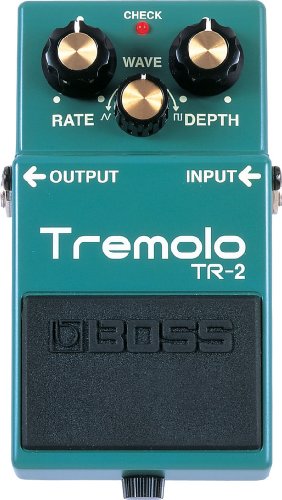
The TR-2 has been the default answer to the tremolo question for decades, and the reason is the Wave knob. Where most simple tremolos give you one fixed pulse shape, the Wave control moves continuously from a rounded triangle wave on one side to a harder square wave on the other, so the same pedal covers a gentle throb under ballad chords and a stuttering chop for rhythmic parts. Rate and Depth knobs handle speed and intensity, and the familiar Boss compact enclosure includes the hinged pedal switch and a check indicator.
Because the circuit is analog and mono, the TR-2 sits comfortably anywhere in a mono chain, ideally after overdrive and before delay or reverb. The bypass is buffered rather than true bypass, which can help at the end of a long cable run in a home studio. There is no tap tempo and no stereo output, so players who need the pulse locked to a click track should weigh that first. For everyone else, it remains the reference point.
Specs
- Effect type: Analog tremolo, mono
- Controls: Wave, Rate, Depth
- Wave shapes: Variable, triangle through square
- Bypass: Buffered bypass
- Power: 9V DC or 9V battery
- Extras: Confirm on the listing
JOYO JF-09 Tremolo
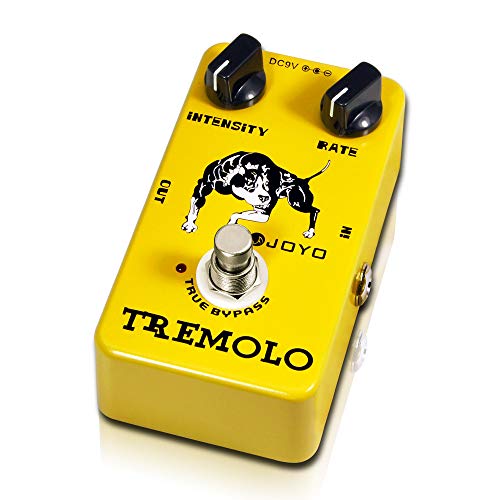
The JF-09 takes a different route to a vintage sound. Its optical photoelectric circuit is modeled on the tremolo built into classic tube amplifiers, producing a smooth, rounded pulse with a slightly organic feel. The control set is as simple as the format allows: an Intensity knob sets how deep the volume dips go, and a Rate knob sets the speed, with a listed range from a slow 1 Hz sway up to a fast 20 Hz shimmer. An LED pulses in time with the rate, making it easy to set the speed before you play a note.
The JF-09 uses true bypass switching, so the signal path stays clean when the effect is off, and the aluminum alloy housing is built for regular stomping. An internal trim pot lets you fine-tune the output level if you notice a volume drop at deep settings. It is a mono pedal with no wave-shape options, so the pulse shape you get is the one the optical circuit produces. Players who want that single, well-judged amp-style pulse will find little wasted here.
Specs
- Effect type: Optical analog tremolo, mono
- Controls: Intensity, Rate
- Rate range: 1 Hz to 20 Hz per listing
- Bypass: True bypass
- Power: 9V DC, regulated adapter recommended
- Housing: Aluminum alloy
Donner Golden Tremolo

The Golden Tremolo shrinks the optical tremolo idea into a mini pedal that fits boards where a full-size stompbox will not. It is inspired by the optical tremolo sound of US style combo amps, and it adds one control the simplest minis leave out: a Bias knob. Alongside the Speed and Depth knobs, Bias adjusts the waveform bias of the optical unit, tightening or loosening the character of the pulse so the same pedal can lean harder or softer without changing the rate. The circuit is fully analog, and true bypass keeps the dry tone transparent when off.
The aluminum alloy chassis measures just 42 by 93.5 by 52 millimeters and weighs 225 grams, so it tucks beside a tuner on a small home board. Current consumption is a modest 10 mA, leaving headroom on a shared power supply. There is no battery option, which is normal for mini pedals, and no stereo or tap features. As a first tremolo, or a compact way to add amp-style pulse to a small karaoke-and-guitar rig, it covers the essentials with extra shaping control.
Specs
- Effect type: Analog optical tremolo, mono
- Controls: Speed, Bias, Depth
- Bypass: True bypass
- Power: 9V DC center negative, 10 mA
- Dimensions: 42 x 93.5 x 52 mm
- Weight: 225 g
Rowin Trelicopter

The Trelicopter name describes the sound this mini optical tremolo is chasing: a classic photocell pulse with a wide range of speeds and depths. It carries three knobs, Speed, Bias, and Depth, so like the Donner above it lets you adjust the bias of the optical unit, which changes the on and off ratio of each pulse and therefore the feel of the effect. Turn the bias up and the pulse tightens; turn it down and the swell loosens. That makes it more flexible than its size suggests.
At 95 by 45 by 48 millimeters, the Trelicopter is one of the smallest ways to add tremolo to a board, and its working current of 26 mA is easy on a daisy chain or a small brick. The input impedance is listed at 1M ohms with a 1K ohm output, standard figures for guitar-level signals. It does not offer wave-shape switching, stereo output, or tap tempo, and the small knobs reward a set-and-leave approach. For a compact board that needs one dependable optical pulse, it fits the brief.
Specs
- Effect type: Optical tremolo, mono
- Controls: Speed, Bias, Depth
- Bypass: True bypass
- Power: 9V DC, 26 mA
- Dimensions: 95 x 45 x 48 mm
- Input impedance: 1M ohms
Kmise A0967 Belcat Tremolo Pedal

The Kmise A0967, built around the Belcat tremolo design, is the straightforward three-knob option in this group. Depth, Wave, and Rate controls cover the core tremolo decisions: how deep the volume dips, how the pulse is shaped, and how fast it moves. The Wave knob is the interesting part at this level, since it gives you some control over the character of the swell instead of a single fixed shape. True bypass switching keeps the signal path clean when the effect is off.
The pedal is compact and light, listed at 11.2 ounces, and it works for bass guitar as well as electric guitar, making it a flexible spare for a home studio where instruments rotate. Connections are the standard trio of DC input, instrument input, and output. It is a mono pedal with no tap tempo, no stereo, and no presets. Buyers who want to learn how tremolo controls interact, without paying for modes they will not use, get an honest, simple tool here. Confirm the current finish and accessories on the listing before ordering, since budget listings change packaging from time to time.
Specs
- Effect type: Tremolo, mono
- Controls: Depth, Wave, Rate
- Bypass: True bypass
- Power: 9V DC
- Weight: 11.2 ounces per listing
- Instruments: Electric guitar and bass
How to Choose
Start with the pulse shape you need. If you want one pedal that can move from a smooth swell to a hard chop, pick a model with a wave control, like the Boss TR-2 or the Kmise. If you prefer the single rounded pulse of a vintage amp, an optical design such as the JF-09, the Golden Tremolo, or the Trelicopter gets you there with fewer decisions. Next, check size. Mini pedals save real space, but their small knobs are harder to adjust mid-set, so regular tweakers may prefer a standard enclosure.
Power and bypass matter more than they first appear. All five pedals here run on 9V DC, but the minis cannot take a battery, and current draw on the listed minis runs from 10 mA to 26 mA, so check your supply’s per-output rating. True bypass suits short cable runs; the TR-2’s buffered bypass can be the better choice at the end of a long chain. Finally, be honest about extras: a simpler pedal you understand beats features you never touch.
Who Should Skip
Skip this whole category if your amplifier already has a tremolo you love and you never record through a second amp or interface; a pedal would only duplicate it. Skip these five specific pedals if you need tap tempo to lock the pulse to a band’s tempo, if you run a stereo rig and want the tremolo to pan between two amps, or if you need preset recall for programmed set changes. Those players should look at larger digital tremolos instead. Also skip the mini pedals if you adjust settings with your foot or play on dark stages; a full-size enclosure will serve you better.
FAQ
Is tremolo the same as vibrato?
No. Tremolo changes the volume of the signal in a repeating pulse, while vibrato changes the pitch. Many vintage amps labeled the effect vibrato even though the circuit produced tremolo, which is why the two words are often mixed up.
Where should a tremolo pedal go in the signal chain?
A common placement is after overdrive and before delay and reverb, so the pulse stays even and the echoes carry the movement. Placing it before gain makes the effect subtler, because the drive pedal compresses the volume dips.
Do I need tap tempo on a tremolo pedal?
Only if the pulse must match a song’s tempo exactly, such as a choppy rhythmic part played with a band or a click. For slow swells under chords, setting the rate by ear works well, and none of the five pedals here includes tap tempo.
Can these pedals run on a battery?
The Boss TR-2 accepts a 9V battery as well as an adapter. The mini pedals in this guide, including the Donner Golden Tremolo and the Rowin Trelicopter, are adapter-only designs, so plan on a 9V DC center negative supply.
Final Verdict
The Boss TR-2 remains the safest single recommendation: the variable Wave control covers more musical ground than any other pedal here, and the build suits years of home and stage use. The JOYO JF-09 is the pick for a pure amp-style optical pulse with true bypass, while the Donner Golden Tremolo and Rowin Trelicopter deliver the same optical idea in mini form. The Kmise Belcat is the simple learning tool, with a wave knob at a basic level. Match the pulse style and the footprint to your board, and any of the five will add the movement your clean tones have been missing.
Product and ASIN Reference
| Product | ASIN |
|---|---|
| Boss TR-2 Tremolo Pedal | B000EMLM06 |
| JOYO JF-09 Tremolo Pedal | B004U1QDL0 |
| Donner Golden Tremolo Pedal | B01DEVT3IQ |
| Rowin Trelicopter Tremolo Pedal | B01IV510DG |
| Kmise A0967 Belcat Tremolo Pedal | B010ODIRR0 |
More from Amazon
Programs that pair well with the guide above. Offers and eligibility are set by Amazon and may change.
Free shipping on eligible items, Prime Video and more. Eligible new members can start with a free trial.
Start a Prime free trialAudiobooks and podcasts to listen to on the go. Eligible new members can start with a free trial.
Try Audible freeAd-free music streaming. Eligible new subscribers can start with a free trial.
Try Music Unlimited freeA free business account with business pricing and bulk-buying tools for work, shop or home office.
Create a business accountAs an Amazon Associate we earn from qualifying purchases.




Write Your Review
No reviews yet. Be the first to share your experience!