

Key takeaways
- Compare the best guitar fretboard conditioners for rosewood and ebony boards, from classic lemon oil to natural oil blends, with application tips.
An unfinished fretboard is exposed wood, and exposed wood slowly loses moisture to dry indoor air, heating, and the dirt that builds up from playing. Over time a dry rosewood or ebony board can look pale, feel rough under the fingers, and in neglected cases develop small cracks along the grain. A fretboard conditioner addresses both halves of the problem: it lifts away grime that dulls the surface, and it feeds the wood with oil so the board keeps its deep color and smooth feel between string changes.
This guide compares five conditioners covering the main approaches a home player is likely to meet: two classic lemon oils in different bottle sizes, a lemon-oil-free natural blend from MusicNomad, a small-bottle treatment from D’Addario made only for dark unfinished boards, and a set of pre-moistened conditioner wipes from Ernie Ball for players who would rather skip bottles and cloths altogether.
As an Amazon Associate, we earn from qualifying purchases.
Quick Answer
For most players, the MusicNomad F-ONE Oil is the safest all-round pick: a natural tree and seed oil blend with no lemon oil, wax, or petroleum distillates. The Jim Dunlop 6554 Ultimate Lemon Oil is the traditional alternative in a larger applicator bottle. D’Addario Hydrate suits dark boards only, Ernie Ball Wonder Wipes trade depth for convenience, and the Dowite lemon oil offers a mid-size bottle for regular upkeep.
MusicNomad F-ONE Fretboard Oil Cleaner and Conditioner (MN105)

F-ONE is built around a blend of ultra-refined tree and seed oils rather than the mineral-oil base most lemon oils use. MusicNomad states the formula is completely free of lemon oil extracts, waxes, petroleum distillates, silicone, and water, which makes it the pick here for players who want to avoid petroleum-based products on a valued instrument. The maker positions it for unfinished fretboards, naming rosewood, ebony, and unfinished maple among its intended woods.
The 2-ounce bottle is small, but the formula is concentrated and a little is meant to go a long way, spread thinly with a cloth and buffed after it soaks in. The maker says the treated board dries fast and is left smooth rather than sticky or tacky. Because it cleans as it conditions, it also suits boards with a visible layer of finger grime, not just boards that look dry.
Specs
- Model: MN105
- Size: 2 fl oz
- Formula: ultra-refined tree and seed oil blend
- Free of: lemon oil extracts, waxes, petroleum distillates, silicone, and water, per the maker
- Intended boards: unfinished rosewood, ebony, and maple, per the maker
- Item weight: 2.4 ounces
- Dimensions: 1.38 x 1.38 x 4 inches
Jim Dunlop 6554 Ultimate Lemon Oil
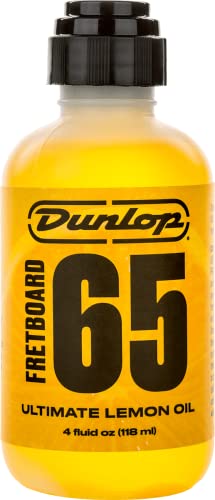
The Dunlop 6554 is the long-running standard in this category, a lemon oil cleaner and conditioner in a 4-ounce bottle with an applicator top that spreads a thin, even coat without pouring oil straight onto the wood. Dunlop describes it as removing grime, returning the fretboard to its original luster, and leaving an invisible sealant that helps keep stains and moisture from soaking back in.
Lemon oil formulas like this one are intended for dark, unfinished boards such as rosewood and ebony. The listing’s safety information states plainly that it is not for use on maple fretboards, so owners of finished or light maple boards should choose a different product here. The directions are the classic three steps: apply, wipe off the excess, and let the sealant dry before restringing. For players maintaining several guitars, the larger bottle is the practical draw.
Specs
- Model: 6554
- Size: 4 fl oz
- Type: lemon oil cleaner and conditioner
- Applicator: built-in applicator top
- Intended boards: rosewood and ebony
- Not for: maple fretboards, per the listing safety information
- Item weight: 3.52 ounces
- Dimensions: 2.1 x 2.1 x 4.7 inches
D’Addario Hydrate Fingerboard Conditioner (PW-FBC)
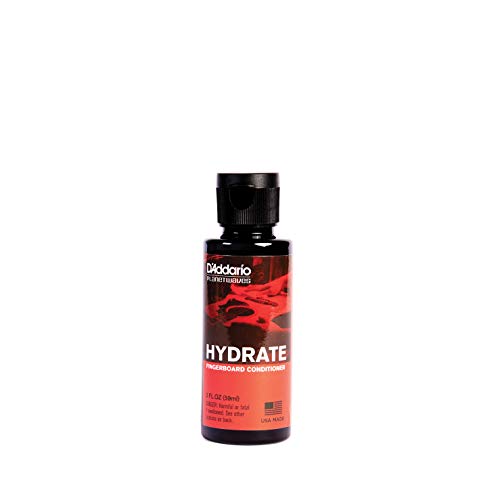
Hydrate is D’Addario’s dedicated treatment for dark, natural wood fingerboards, sold under both the D’Addario and Planet Waves names over the years. The formula combines oils and cleaners, and the maker describes it as restoring the character of the wood so the board feels clean and fast with a glowing surface rather than a greasy one. It is a single-purpose product, with no body polish or string cleaner bundled in.
D’Addario is explicit about the limits. Its guidance states that Hydrate is intended for fingerboards made of dark, unfinished woods only, and should not be used on light wood fingerboards such as maple or on any finished fingerboard. Within that lane, it is a straightforward choice for rosewood, ebony, and similar dark boards on guitars, basses, and other stringed instruments, applied sparingly a few drops at a time.
Specs
- Model: PW-FBC
- Type: oil and cleaner conditioner blend
- Intended boards: dark, unfinished woods such as rosewood and ebony, per the maker
- Not for: maple or finished fingerboards, per the maker
- Bottle size: confirm on the listing
Ernie Ball Wonder Wipes Fretboard Conditioner, 6-Pack (P04276)
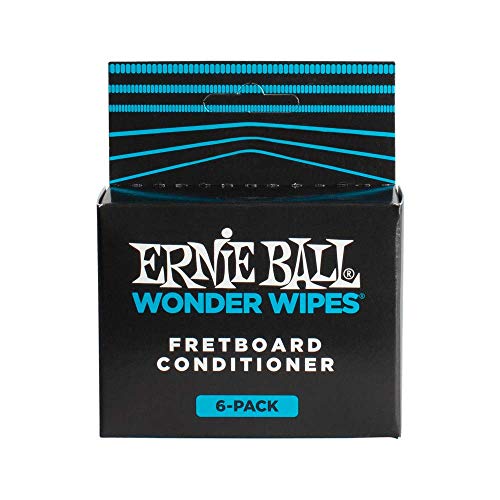
Wonder Wipes take a different format from every bottle in this guide: six individually wrapped, pre-moistened wipes, each carrying a blend of orange, jojoba, and linseed oils. There is no bottle to spill and nothing to measure out. You tear open a wipe, work it along the board to lift dirt and grime, and let the oils condition the wood in the same pass.
That convenience suits a gig bag or guitar case better than a workbench. A wipe delivers a light, even application, a reasonable match for routine upkeep on a board already in decent shape, and the sealed packets travel without leaking. The trade-off is depth and economy: a heavily dried-out board that needs a generous soak is better served by a bottle, and players who maintain many instruments will go through packets quickly.
Specs
- Model: P04276
- Format: 6 individually wrapped pre-moistened wipes
- Formula: orange, jojoba, and linseed oils, per the maker
- Intended boards: unfinished fretboards such as rosewood and ebony
- UPC: 749699142768
Dowite Guitar Fretboard Lemon Oil, 3.5 oz
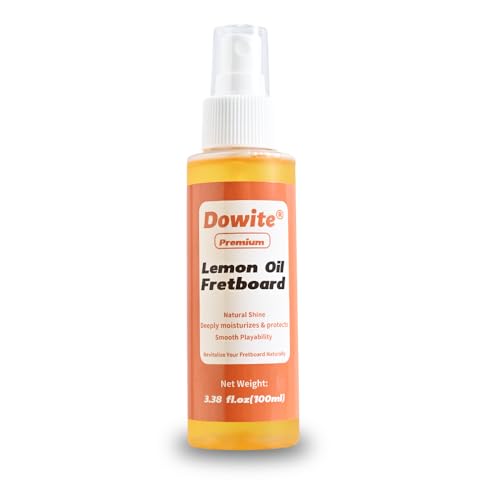
The Dowite entry is a straightforward lemon oil in a 3.5-ounce bottle, sized between the small treatment bottles and the large workshop bottles in this group. It is presented as a combined fingerboard cleaner and conditioner, meant to restore shine to a dulled board and help guard the wood against drying and cracking as part of regular maintenance at string-change time.
Because lemon oil products vary in their directions, the sensible approach here is to follow the instructions printed on the bottle for your specific board, apply a thin coat with a soft cloth rather than flooding the wood, and wipe away any excess. Players with a finished or light-colored board should confirm suitability on the listing before ordering, since lemon oil as a class is aimed at unfinished boards. For a rosewood or ebony board that simply looks thirsty, it covers the basics without a kit or extra accessories.
Specs
- Size: 3.5 fl oz (100 ml)
- Type: lemon oil cleaner and conditioner
- Intended use: fretboard cleaning and conditioning at string changes
- Applicator: confirm on the listing
- Board guidance: follow the directions on the bottle for your board type
How to Choose a Fretboard Conditioner
Start with the board itself, because it rules out more products than any other factor. Lemon oils and most conditioners are made for unfinished dark woods, chiefly rosewood and ebony. A finished maple board should not be oiled at all, and light woods need a product whose maker explicitly allows them, as MusicNomad does for F-ONE. If you are unsure whether a board is finished, check the guitar maker’s care guidance before buying.
Next, decide how you feel about formula type. Traditional lemon oils, like the Dunlop and Dowite picks, are mostly refined mineral oil with lemon scent and a long track record. Natural blends like F-ONE use plant-derived oils and avoid petroleum distillates, wax, and silicone, which some owners of high-value instruments prefer. Neither family needs much product: a thin coat, a short soak, and a thorough wipe-off is the correct routine for all of them, and over-oiling is the most common mistake.
Finally, match the format to your habits. Bottles with applicator tops make controlled, repeatable applications easy and last through many string changes. Small treatment bottles suit one or two guitars. Wipes are the format most likely to get used on the road or before a rehearsal, because they remove every step except opening the packet. If your board is already cracked or severely dried, though, no conditioner here is a repair product, and a luthier is the right next step.
Who Should Skip These Products
Skip every product here if your guitar has a finished maple fretboard, a gloss-coated board, or any board the maker says to clean with a damp cloth only. Oils are for unfinished wood, and on a sealed surface they leave residue without benefit. Players whose boards are clean, dark, and supple also gain little from conditioning more than a couple of times a year, since excess oil can attract dust.
You should also skip these if what your instrument needs is fret work, a deep clean of corroded frets, or crack repair. Conditioners maintain wood; they do not polish metal, level frets, or fix damage.
Frequently Asked Questions
How often should you condition a fretboard?
For most players, once or twice a year is enough, usually at a string change when the board is fully exposed. Boards kept in very dry rooms or played daily may benefit from a light treatment slightly more often, but the wood should look dry or faded before you reach for the bottle, not just due by the calendar.
Can you use fretboard conditioner on a maple fretboard?
Generally no. Most conditioners and lemon oils are made for unfinished dark woods, and the Dunlop listing states outright that its lemon oil is not for maple fretboards. Finished maple should simply be wiped clean. The exception here is F-ONE, whose maker lists unfinished maple among its intended boards, so follow the specific product’s guidance.
What is the difference between lemon oil and natural oil conditioners?
Guitar lemon oil is usually a refined mineral oil base with lemon scent, made to clean grime and leave a light seal on the wood. Natural blends such as F-ONE use tree and seed oils instead and leave out petroleum distillates, wax, and silicone. Both condition unfinished boards; the choice comes down to ingredient preference and stated wood compatibility.
How do you apply fretboard conditioner correctly?
Remove the strings, wipe the board with a soft cloth, then apply a thin coat of conditioner along the grain and let it soak for a few minutes. Wipe off all excess with a clean cloth so no oil pools around the frets, let the board dry, and restring. A light coat repeated later beats one heavy application.
Final Verdict
The MusicNomad F-ONE Oil is the most versatile pick here, with a natural oil blend, broad stated compatibility across unfinished boards, and a cleaning action that handles grimy as well as dry fretboards. The Jim Dunlop 6554 remains the benchmark lemon oil in a larger applicator bottle. D’Addario Hydrate is the focused choice for dark boards only, the Ernie Ball Wonder Wipes are the convenience pick for cases and gig bags, and the Dowite lemon oil fills the middle ground for routine upkeep.
Product and ASIN Reference
| Product | ASIN |
|---|---|
| MusicNomad F-ONE Fretboard Oil Cleaner and Conditioner (MN105) | B006WPGZAG |
| Jim Dunlop 6554 Ultimate Lemon Oil | B0002OOMW6 |
| D’Addario Hydrate Fingerboard Conditioner (PW-FBC) | B001F4X1WY |
| Ernie Ball Wonder Wipes Fretboard Conditioner, 6-Pack (P04276) | B005BE170W |
| Dowite Guitar Fretboard Lemon Oil, 3.5 oz | B0F32Z8NYD |
More from Amazon
Programs that pair well with the guide above. Offers and eligibility are set by Amazon and may change.
Free shipping on eligible items, Prime Video and more. Eligible new members can start with a free trial.
Start a Prime free trialAudiobooks and podcasts to listen to on the go. Eligible new members can start with a free trial.
Try Audible freeAd-free music streaming. Eligible new subscribers can start with a free trial.
Try Music Unlimited freeA free business account with business pricing and bulk-buying tools for work, shop or home office.
Create a business accountAs an Amazon Associate we earn from qualifying purchases.



Write Your Review
No reviews yet. Be the first to share your experience!