

Key takeaways
- Compare the best expression pedals for keyboards and synths, from dual-output pro models to compact budget treadles, with polarity and sizing tips.
An expression pedal is the one keyboard accessory that changes how a performance feels rather than how the rig looks. A sustain pedal is a switch: the sound is held or it is not. An expression pedal is a continuous control, a treadle that works like a remote knob for whatever parameter your keyboard assigns to it. Rock it forward and a volume swell rises under a chord, a filter opens up, a rotary speaker effect speeds toward its fast setting, or a string patch grows louder while your hands stay on the keys. For worship keys, home studio work, and synth practice, that foot control often separates a flat performance from a musical one.
The catch is compatibility. Expression inputs are not fully standardized: keyboards expect different potentiometer values and different wiring polarity, so a pedal that sweeps perfectly on one brand can feel reversed or compressed on another. The five pedals in this guide cover the main approaches to that problem, from polarity switches and minimum controls to a dual-output model that drives two devices at once. The notes under each pick explain who it suits and where its limits sit.
As an Amazon Associate, we earn from qualifying purchases.
Quick Answer
Start with the Roland EV-5 if you play a Roland or Boss keyboard and want the set-and-forget option, or the Boss EV-30 if you need to control two devices from one pedal. The M-Audio EX-P suits mixed-brand rigs thanks to its polarity switch, the SONICAKE Vexpress is the compact pick for tight pedalboards, and the Hotone Ampero II Press adds a footswitch for processor rigs.
Roland EV-5 Expression Pedal

The EV-5 is the long-running Roland standard, the pedal most Roland and Boss keyboard owners are pointed to first. It is a compact, lightweight treadle with a captive cable, so there is no separate lead to lose: the two metre cable ends in a 1/4-inch TRS plug that goes straight into the expression input on a compatible keyboard, synth, or multi-effects unit. Once connected, the pedal can ride volume or control an assigned effect parameter, depending on how the connected instrument is set up.
Its one onboard control is a minimum volume knob, which sets the floor the pedal returns to at heel down. That matters more than it sounds: for volume swells you may want heel down to mean silence, but for filter control you often want the effect to stay partly present rather than vanish. The EV-5 has no polarity switch, the main thing to check before buying for a non-Roland instrument, because some other brands read the pedal travel in reverse. Within the Roland and Boss ecosystem, though, it remains the straightforward default.
Specs
- Type: Single expression pedal, continuous controller
- Controls: Minimum volume knob
- Cable: Captive 2 metre cable, 1/4-inch TRS plug
- Size: 86 x 200 x 54 mm
- Weight: 400 g
- Polarity switch: No
- Model: Roland EV-5
Boss EV-30 Dual Expression Pedal

The EV-30 answers a different question: what if one foot needs to control two things? It carries two expression outputs in a single compact pedal, and the outputs are electronically isolated, which prevents the ground loop noise that can appear when one pedal feeds two devices. A keyboard player can send one output to a synth and the other to an effects processor, or drive two parameters on a multi-effects unit, and move both with a single sweep.
The chassis is die-cast aluminum, noticeably more rugged than the plastic shells in this class, and an internal mechanism gives the treadle a smooth, precise feel despite the small footprint. A polarity switch extends compatibility beyond Boss gear. One stereo TRS cable is included; a second cable is needed to use both outputs. Players with a single keyboard will not use the second output, but for anyone running two expression-capable devices, this is the tidiest solution in the guide.
Specs
- Type: Dual expression pedal, two isolated outputs
- Outputs: 2 x 1/4-inch TRS (EXP 1 OUT, EXP 2 OUT)
- Chassis: Die-cast aluminum
- Controls: Polarity switch
- Size: 80 x 192 x 58 mm, maximum height 92 mm
- Weight: 780 g
- Included: 1 metre stereo TRS cable
- Model: Boss EV-30
M-Audio EX-P Universal Expression Pedal

The EX-P is the universal budget workhorse of this group, built for players whose rig mixes brands. Its defining feature is a polarity switch, which lets the same pedal work with the two common wiring conventions used by keyboard makers. That one switch is why the EX-P shows up in so many home studio setups: it can move between an M-Audio controller, a stage keyboard, and a supported guitar effects pedal without the sweep running backward.
The cable is hardwired, a 1/4-inch TRS lead that is part of the pedal, so setup is a single plug. The molded body keeps the weight low and the textured foot surface helps the treadle stay put under a shoe. There is no minimum or range knob, so the full travel always covers the full parameter range, which some players prefer for predictable filter sweeps. The molded construction will not shrug off abuse the way the metal Boss pedal does, but for studio desks and practice rooms, the EX-P covers the essentials.
Specs
- Type: Single expression pedal
- Controls: Polarity switch
- Cable: Hardwired 1/4-inch TRS cable
- Body: Molded construction, textured foot surface
- Power: Passive, no power supply required
- Model: M-Audio EX-P
SONICAKE Vexpress Passive Volume and Expression Pedal
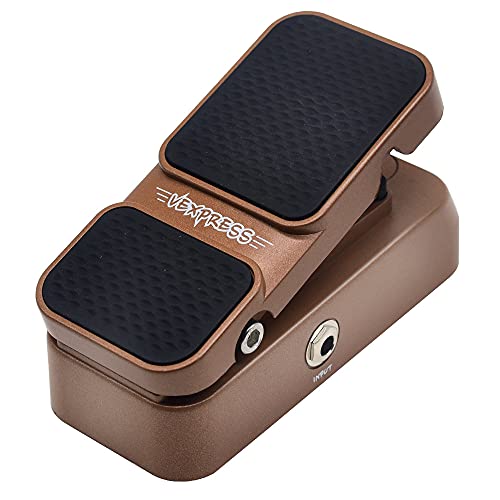
The Vexpress is the mini pedal of the group, a passive two-in-one design that works as either a volume pedal or an expression pedal depending on how it is connected. It automatically detects which function the connected jack expects, so the same small treadle can sit in a guitar signal chain one day and in a keyboard expression input the next. For players who double on guitar and keys, that flexibility in a pocket-sized pedal is genuinely useful.
The trade-off for the size is travel: a mini treadle moves through a shorter arc than a full-size pedal, so very fine volume swells take a steadier foot. The passive design needs no power supply. Its listed dimensions make it the easiest pedal here to fit on a crowded pedalboard or drop into a gig bag pocket. Keyboard players with a small arranger setup who only occasionally need expression control will find this the least intrusive way to add it.
Specs
- Type: Passive volume and expression pedal, two in one
- Detection: Automatically detects volume or expression function
- Size: 5.85 x 2.58 x 2.4 inches
- Power: Passive, no power supply required
- Connections: 1/4-inch jacks, TRS for expression use
- Model: SONICAKE Vexpress (QEP-02)
Hotone Ampero II Press Expression and Footswitch Pedal
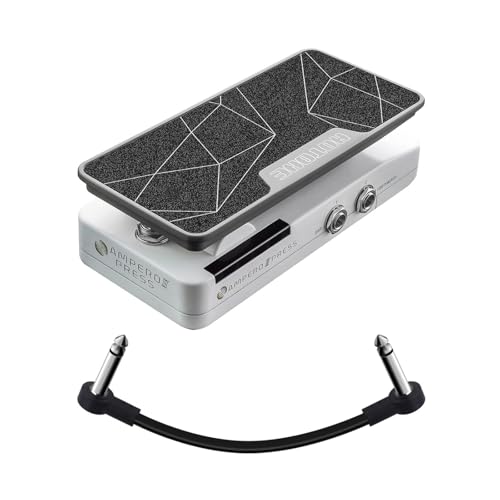
The Ampero II Press is built for processor-based rigs, pairing a passive expression treadle with a built-in footswitch in one unit. The expression side sweeps volume or an assigned parameter on a compatible multi-effects processor or keyboard. The switch side adds a momentary control that can toggle an effect block or trigger whatever the host processor assigns to an external switch, so one pedal on the floor does two jobs.
It is passive, so it needs no power of its own, and the box includes a short 15 cm TS cable for the switch connection. The design is aimed squarely at Hotone Ampero processors, although the expression output follows the common TRS convention; confirm the potentiometer value your gear expects on the listing before pairing it with a non-Hotone keyboard. Players running a compact processor rig who keep wishing for one more foot control will get the most from this one, while players with a plain keyboard may never use the switch half.
Specs
- Type: Passive expression pedal with built-in footswitch
- Functions: Expression control plus momentary switch control
- Included: Additional 15 cm TS cable for the switch connection
- Power: Passive, no power supply required
- Potentiometer value: Confirm on the listing
- Model: Hotone Ampero II Press (SP-35)
How to Choose
Begin with compatibility, because it decides whether a pedal works at all. Find the expression input in your keyboard manual and note two things: the potentiometer value it expects, commonly 10K or 50K ohm designs, and the wiring polarity. Roland and Boss keyboards follow the EV-5 and EV-30 convention directly. If you mix brands, choose a pedal with a polarity switch, such as the EX-P or the EV-30, so the sweep direction can be corrected.
Next, decide how many devices the pedal must drive. One keyboard and one parameter calls for a single-output pedal; two devices make the dual isolated outputs of the EV-30 worth their space. Then consider the extras: a minimum knob, as on the EV-5, sets the heel-down floor, and a built-in switch, as on the Ampero II Press, only pays off with a host processor that can assign it a job. Finally, match size to setting: full-size treadles give smoother swells, while mini pedals like the Vexpress suit crowded boards.
Who Should Skip
Skip every pedal here if your keyboard has no expression input, because a sustain-only jack cannot read a continuous pedal and the two are not interchangeable. Skip the dual-output EV-30 if you own a single keyboard and no effects processor, since the second output solves a problem you do not have. Skip the mini Vexpress if you play long organ or synth swells and need the fine control of a long treadle arc. And skip the Ampero II Press if you have no processor to assign its footswitch to; a plain treadle will serve you better.
FAQ
Is an expression pedal the same as a sustain pedal?
No. A sustain pedal is an on-and-off switch that holds notes, while an expression pedal sends a continuous range of values as the treadle moves, controlling volume, filter, modulation, or other assigned parameters. Most keyboards have separate jacks for the two, and one cannot do the job of the other.
Why does my expression pedal work backward?
The sweep direction depends on wiring polarity, and brands do not all wire their inputs the same way. If toe down makes the sound quieter instead of louder, the pedal and keyboard use opposite conventions. A polarity switch on the pedal, or a polarity setting in the keyboard menu, corrects it.
Can one expression pedal control two keyboards or effects?
Yes, with a dual-output pedal such as the Boss EV-30, which has two electronically isolated TRS outputs that move together with one treadle. A single-output pedal can only feed one expression input at a time.
Do expression pedals need power?
The pedals in this guide are passive and need no power supply or battery. The connected keyboard or processor supplies the reference voltage through the TRS cable, and the pedal varies it as the treadle moves.
Final Verdict
For most keyboard players, the choice comes down to rig size. The Roland EV-5 is the dependable default for Roland and Boss instruments, the Boss EV-30 is the pick for layered rigs that need two isolated outputs, and the M-Audio EX-P is the flexible budget option for mixed-brand setups. The SONICAKE Vexpress suits players who want the smallest possible two-in-one pedal, and the Hotone Ampero II Press is the specialist choice for processor rigs that can use its extra footswitch. Check your keyboard input specification first, and any of the five will add real-time control that hands alone cannot give you.
Product and ASIN Reference
| Product | ASIN |
|---|---|
| Roland EV-5 Expression Pedal | B0002D03VG |
| Boss EV-30 Dual Expression Pedal | B01NAV3253 |
| M-Audio EX-P Universal Expression Pedal | B000NLRWEI |
| SONICAKE Vexpress Passive Volume and Expression Pedal | B077PVVC38 |
| Hotone Ampero II Press Expression and Footswitch Pedal | B0CQZS5MMG |
More from Amazon
Programs that pair well with the guide above. Offers and eligibility are set by Amazon and may change.
Free shipping on eligible items, Prime Video and more. Eligible new members can start with a free trial.
Start a Prime free trialAudiobooks and podcasts to listen to on the go. Eligible new members can start with a free trial.
Try Audible freeAd-free music streaming. Eligible new subscribers can start with a free trial.
Try Music Unlimited freeA free business account with business pricing and bulk-buying tools for work, shop or home office.
Create a business accountAs an Amazon Associate we earn from qualifying purchases.



Write Your Review
No reviews yet. Be the first to share your experience!