

Key takeaways
- Warm or bass-forward: Good for electronic music, hip-hop and films. The Momentum 4 Wireless offers a full low end that can be adjusted in its app.
- Balanced and adaptable: The Sony WH-1000XM5 and Bose QuietComfort Ultra offer app-based equalisation, allowing you to reduce or increase bass without changing headphones.
- Energetic and monitor-like: The ATH-M50x emphasizes clarity and impact, making it useful for tracking and editing, though some listeners may find its upper frequencies prominent.
- Detailed and spacious: Focal Bathys gives more emphasis to resolution and separation, while the DT 990 Pro’s open-back design creates room around instruments but can sound bright to treble-sensitive listeners.
The best over ear headphones depend on what you value most: choose the Bose QuietComfort Ultra for light clamp and strong noise cancelling, the Sennheiser Momentum 4 Wireless for battery life and a warm musical sound, the Sony WH-1000XM5 for smart everyday features, or the Audio-Technica ATH-M50x for affordable wired monitoring.
Our top picks


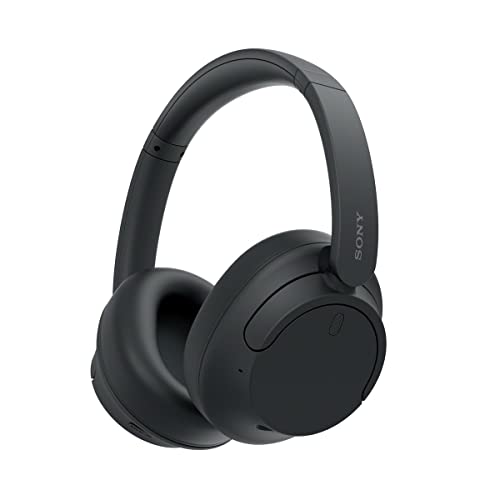
As an Amazon Associate we earn from qualifying purchases at no extra cost to you. Ratings are shown as listed on Amazon.
Quick picks by listening priority
| Listening priority | Best match | Why it fits |
|---|---|---|
| Maximum travel comfort | Bose QuietComfort Ultra | Low clamp pressure, deep pads and effective active noise cancellation |
| Longest wireless battery | Sennheiser Momentum 4 Wireless | Up to 60 hours with noise cancellation enabled |
| Balanced everyday smart features | Sony WH-1000XM5 | Comfortable fit, adaptive noise control, multipoint Bluetooth and LDAC |
| Wired music and home recording | Audio-Technica ATH-M50x | Closed-back isolation, replaceable cable and dependable studio-style tuning |
| Detailed wireless listening | Focal Bathys | Premium materials, USB-DAC mode and a more resolving tonal presentation |
| Open, spacious home listening | Beyerdynamic DT 990 Pro | Open-back design creates a broad presentation, but leaks sound and has no Bluetooth |
What matters more than the product name
Clamp force and ear-cup size
Clamp force determines how firmly the headband presses the cups against your head. A strong clamp can improve stability and passive isolation, but it may become tiring during long sessions. A relaxed clamp feels easier for commuting, reading and office work, although the headphones may move more when you walk.
Ear-cup dimensions matter just as much. Your ears should sit inside the pads rather than touch the driver grille or fold against the cushion. As a useful starting point, internal openings around 60 by 40 mm suit many listeners, while larger ears may need openings closer to 65 by 45 mm or more. Shapes vary, so measurements are only a guide.
The Bose QuietComfort Ultra is a strong choice for listeners who dislike pressure. The Sony WH-1000XM5 also has a relatively gentle fit, while the Audio-Technica ATH-M50x uses a firmer seal that is useful for monitoring but less forgiving over very long sessions. If glasses interrupt the seal, softer pads and lower clamp can be more comfortable, though they may reduce isolation.
Isolation: active versus passive
Closed-back headphones block some sound through their cups and pads. Active noise cancellation, or ANC, adds microphones and electronic processing to reduce mainly steady low-frequency noise such as aircraft engines, trains and air conditioners.
ANC is not equally effective against voices, keyboard clicks or sudden sounds. The best travel headphones therefore combine good electronic cancellation with a reliable physical seal. Bose and Sony are particularly compelling for frequent travel; Sennheiser provides strong everyday ANC while placing more emphasis on battery life and musical playback.
Open-back headphones such as the Beyerdynamic DT 990 Pro are a different category. They allow air and sound through the ear cups, which can produce a more natural sense of space, but people nearby will hear your music and outside noise will remain audible. Use them in a quiet room, not on public transport.
Codec support and connection options
Bluetooth codecs affect how audio is transmitted, but codec support is only useful when both the phone and headphones support the same option. The Sony WH-1000XM5 supports Sony’s LDAC codec, while the Focal Bathys supports aptX Adaptive as well as standard Bluetooth formats. The Sennheiser Momentum 4 Wireless supports aptX Adaptive, and the Bose QuietComfort Ultra supports aptX Adaptive on compatible devices.
For iPhone users, AAC support and stable Bluetooth performance may matter more than a high-resolution codec label. For Android users with compatible phones, LDAC or aptX Adaptive can offer higher-quality transmission, but battery use and connection conditions can vary. A wired USB-DAC mode, available on the Focal Bathys, can be more useful than Bluetooth codec specifications when listening from a computer.
Tonal balance: match the sound to your library
- Warm or bass-forward: Good for electronic music, hip-hop and films. The Momentum 4 Wireless offers a full low end that can be adjusted in its app.
- Balanced and adaptable: The Sony WH-1000XM5 and Bose QuietComfort Ultra offer app-based equalisation, allowing you to reduce or increase bass without changing headphones.
- Energetic and monitor-like: The ATH-M50x emphasizes clarity and impact, making it useful for tracking and editing, though some listeners may find its upper frequencies prominent.
- Detailed and spacious: Focal Bathys gives more emphasis to resolution and separation, while the DT 990 Pro’s open-back design creates room around instruments but can sound bright to treble-sensitive listeners.
Head-to-head choices for common situations
For flights and daily commuting: Bose versus Sony
The Bose QuietComfort Ultra is the easier recommendation if comfort and noise reduction come first. Its ear cups are generous, its headband distributes weight well, and its noise cancelling is designed for long periods of transport. The Sony WH-1000XM5 is the better alternative if you want more control over adaptive sound, speak-to-chat features and high-resolution Bluetooth through LDAC.
Neither pair is ideal if you regularly need to hear announcements without removing the headphones. Both offer ambient or transparency modes, but always check your surroundings before crossing roads or cycling.
For long workdays and frequent charging avoidance: Sennheiser Momentum 4
The Momentum 4 Wireless stands out with a claimed battery life of up to 60 hours with ANC enabled. That is substantially more than the roughly 24-to-30-hour range common among premium ANC competitors. Its large ear cups suit many people, although its relaxed, full-bodied tuning may benefit from a small bass reduction for spoken audio.
A simple runtime calculation shows the advantage: at two hours of listening per weekday, 60 hours provides about six weeks of weekday use before reaching 20 hours remaining. Actual runtime changes with volume, calls, codec choice and temperature, so treat this as an estimate rather than a guarantee.
For home recording: Audio-Technica ATH-M50x
The ATH-M50x remains a practical wired option because it needs no battery, has a closed-back design and includes detachable cables. Its approximate 285-gram weight is reasonable for studio work, but its firm pads and clamp may not suit everyone for eight-hour sessions. It is a monitoring headphone, not a noise-cancelling travel headset, and it has no Bluetooth microphone or wireless convenience.
For a lower-cost setup, its replaceable cable is an ownership advantage. A damaged cable can be replaced without discarding the headphones, and replacement ear pads are widely available from the manufacturer and third-party suppliers.
For premium home listening: Focal Bathys or Beyerdynamic DT 990 Pro
Choose the Focal Bathys when you want wireless convenience, premium construction and the option to connect digitally by USB. Choose the DT 990 Pro when you have a quiet room, a suitable headphone output and want an open presentation at a much lower general market price.
The DT 990 Pro is not automatically better because it is open-back. Its sound leakage makes it unsuitable beside a sleeping partner or in an office, and its permanently attached cable is less convenient to replace. The Focal Bathys costs considerably more, but combines Bluetooth, ANC and USB-DAC playback in one product.
Specification comparison
| Model | Design | Approx. weight | Claimed battery | Notable connection support |
|---|---|---|---|---|
| Bose QuietComfort Ultra | Closed-back wireless ANC | About 253 g | Up to 24 hours | Bluetooth, USB-C charging, wired audio |
| Sony WH-1000XM5 | Closed-back wireless ANC | About 250 g | Up to 30 hours with ANC | AAC, LDAC, Bluetooth multipoint |
| Sennheiser Momentum 4 Wireless | Closed-back wireless ANC | About 293 g | Up to 60 hours with ANC | AAC, aptX Adaptive, Bluetooth multipoint |
| Focal Bathys | Closed-back wireless ANC | About 350 g | Up to 30 hours | AAC, aptX Adaptive, USB-DAC mode |
| Audio-Technica ATH-M50x | Closed-back wired | About 285 g | Not applicable | Detachable 3.5 mm cables, screw-on adapter |
| Beyerdynamic DT 990 Pro | Open-back wired | About 250 to 370 g, depending on version | Not applicable | Wired connection; impedance varies by version |
Ownership costs and maintenance
Premium wireless over-ear headphones commonly occupy a general market range of roughly $250 to $550, while wired models range from about $120 to $400 depending on construction and version. Do not compare only the purchase price. A $350 wireless pair used for five years at four hours per week represents about 1,040 listening hours, or approximately $0.34 per hour before replacement pads or cables. More frequent use lowers the cost per hour, while a non-replaceable battery can shorten the useful life.
The parts most likely to wear first are ear pads, headband surfaces, hinges and charging batteries. Wipe pads with a dry or lightly damp microfiber cloth, allow perspiration to dry before storing, and keep the headphones in their case rather than compressed in a bag. Avoid soaking synthetic leather or using household solvents. Replace flattened pads when the seal, comfort or tonal balance changes.
Common mistakes include buying open-back headphones for commuting, choosing a codec your phone does not support, judging comfort from weight alone, and wearing a pair whose ear cups are too small. Before buying, measure the space around your ear, check the return policy, and consider whether your main listening happens at home, at work or in transit.
Final recommendation
For most people seeking the best over ear headphones, start with the Bose QuietComfort Ultra if comfort and travel isolation lead your priorities, the Sennheiser Momentum 4 Wireless if battery life and a warm musical sound matter most, and the Sony WH-1000XM5 if you want the broadest mix of smart features and codec support. Choose a wired Audio-Technica or Beyerdynamic model when reliability, low ownership complexity and home listening matter more than wireless convenience.

Write Your Review
No reviews yet. Be the first to share your experience!