

Key takeaways
- Speeches, presentations, and ceremonies: Choose a powered 10- or 12-inch speaker with a microphone input, simple level controls, and a pole-mount socket. The QSC CP12, Yamaha DBR12, and Electro-Voice ZLX-12P G2 are practical choices.
- Small bands and acoustic performers: A pair of powered 12-inch speakers gives better vocal headroom and wider coverage than a single cabinet. The RCF ART 912-A, QSC K12.2, and Yamaha DXR12mkII are strong options.
- DJs and electronic music: Prioritize output, low-frequency extension, and a separate subwoofer option. The Yamaha DZR12, RCF ART 912-A, and QSC K12.2 work well as tops, but serious dance music usually needs one or two subwoofers.
- Mobile events with limited power: A battery-powered speaker such as the JBL EON ONE MK2 can simplify outdoor speeches and background music, although it will not match a large powered pair for sustained bass or long-throw coverage.
- Frequent professional use: Spend more on rugged plywood or reinforced composite cabinets, replaceable grilles, dependable limiters, and service support. The Yamaha DZR and RCF ART 9 series are aimed higher than entry-level portable PA models.
The best PA speakers for most events are powered 12-inch two-way speakers: choose the RCF ART 912-A or QSC K12.2 for a strong all-round live system, the Yamaha DZR12 when maximum output and bass authority matter, and a battery-powered column or portable speaker when fast setup matters more than coverage.
Our top picks
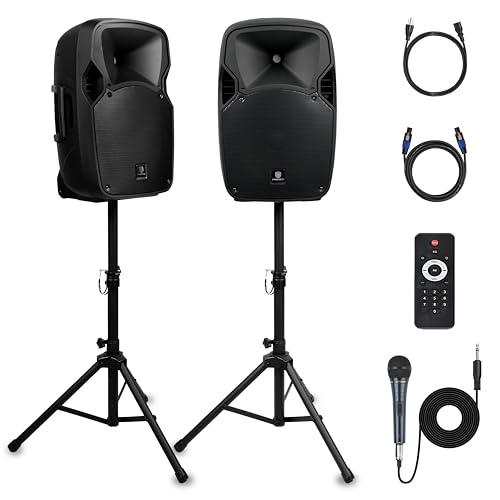


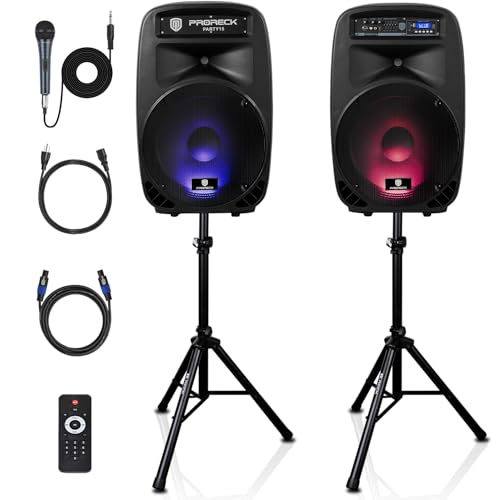
As an Amazon Associate we earn from qualifying purchases at no extra cost to you. Ratings are shown as listed on Amazon.
Best PA speakers by situation
- Speeches, presentations, and ceremonies: Choose a powered 10- or 12-inch speaker with a microphone input, simple level controls, and a pole-mount socket. The QSC CP12, Yamaha DBR12, and Electro-Voice ZLX-12P G2 are practical choices.
- Small bands and acoustic performers: A pair of powered 12-inch speakers gives better vocal headroom and wider coverage than a single cabinet. The RCF ART 912-A, QSC K12.2, and Yamaha DXR12mkII are strong options.
- DJs and electronic music: Prioritize output, low-frequency extension, and a separate subwoofer option. The Yamaha DZR12, RCF ART 912-A, and QSC K12.2 work well as tops, but serious dance music usually needs one or two subwoofers.
- Mobile events with limited power: A battery-powered speaker such as the JBL EON ONE MK2 can simplify outdoor speeches and background music, although it will not match a large powered pair for sustained bass or long-throw coverage.
- Frequent professional use: Spend more on rugged plywood or reinforced composite cabinets, replaceable grilles, dependable limiters, and service support. The Yamaha DZR and RCF ART 9 series are aimed higher than entry-level portable PA models.
Head-to-head comparison
The figures below are useful for planning, but maximum SPL ratings are manufacturer measurements made under specific conditions. They should not be treated as a guarantee of equal loudness from one brand to another.
| Model | Driver and amplifier | Published maximum SPL | Frequency range | Weight | Inputs and useful features |
|---|---|---|---|---|---|
| QSC CP12 | 12-inch woofer, 1.4-inch compression driver; 1000 W peak | 126 dB | 47 Hz–20 kHz (-10 dB) | 約 19 kg | Two combo mic/line inputs, stereo RCA input, mix output, 75° conical coverage |
| QSC K12.2 | 12-inch woofer, 1.4-inch compression driver; 2000 W peak | 132 dB | 45 Hz–20 kHz (-10 dB) | 約 17.7 kg | Two combo inputs, 3.5 mm auxiliary input, DSP presets, delay, EQ, mix output |
| RCF ART 912-A | 12-inch woofer, 1.75-inch compression driver; 2100 W peak | 130 dB | 50 Hz–20 kHz (-10 dB) | 約 19.6 kg | Two-channel mixer, XLR inputs, XLR link, FiRPHASE and Bass Motion Control processing |
| Yamaha DZR12 | 12-inch woofer, 2-inch compression driver; 2000 W peak | 139 dB | 39 Hz–20 kHz (-10 dB) | 約 21.4 kg | Two combo inputs, DSP, FIR filters, Dante version available, 90° × 50° rotatable horn |
| Electro-Voice ZLX-12P G2 | 12-inch woofer, 1.4-inch compression driver; 1000 W peak | 127 dB | 48 Hz–20 kHz (-10 dB) | 約 15.6 kg | Two combo inputs, Bluetooth audio and control, LCD interface, QuickSmart DSP |
| JBL EON ONE MK2 | Eight 2-inch column drivers and 10-inch woofer; battery-powered | 123 dB | 37.5 Hz–20 kHz (-10 dB) | 約 19.3 kg | Four-channel digital mixer, Bluetooth, rechargeable battery, poleable column design |
Weights and specifications can vary slightly by regional version and published measurement method. The important pattern is that the DZR12 is designed for substantially higher output, while the ZLX-12P G2 is easier to carry and the EON ONE MK2 offers the simplest battery-powered setup.
What matters more than wattage?
Output and headroom
Watt figures are a poor way to compare PA speakers because amplifier power, driver efficiency, limiting, and cabinet design all affect the result. Maximum SPL and the amount of clean headroom are more useful. A speech system may sound fine at moderate volume but become harsh when an excited presenter moves close to the microphone. A band also needs headroom for snare hits and vocal peaks.
For a small indoor event of roughly 50 to 100 people, one 10- or 12-inch speaker can cover announcements if the room is quiet. For live music, use two speakers in stereo or mono across the audience. If the room is deeper, noisier, or regularly holds more than 150 people, move to higher-output 12-inch speakers or add subwoofers rather than forcing small tops to reproduce heavy bass.
Dispersion and placement
A speaker’s coverage angle determines how evenly it serves the audience. A 90° horizontal horn spreads sound broadly; a 75° horn can provide greater forward energy but may leave side seats quieter. Wider coverage is useful for a shallow, wide room, while narrower coverage can be better in a long venue when the cabinets are aimed carefully.
Place full-range speakers on poles so the horn is above the heads of the audience, usually with the horn around 2 to 2.5 metres high. Aim them toward the back of the audience, not at nearby walls. This reduces reflections and helps the rear seats hear more clearly without making the front row uncomfortably loud.
Mixer inputs
Built-in mixers are convenient for a microphone and music player, but they do not replace a proper mixer for a band. Two combo inputs are enough for a presenter with a backup microphone, or a DJ using a compact controller. A band will normally need a separate mixer for several microphones, monitor sends, equalization, and feedback control.
Bluetooth is helpful for background music and breaks, but it is not the best primary connection for a live set. Use balanced XLR or TRS connections for longer cable runs. A speaker with a link output can pass the mixed signal to the second cabinet, reducing cabling when the system is simple.
Decision matrix: match the speaker to the job
| Situation | Recommended format | Suitable direction | Why |
|---|---|---|---|
| Occasional speeches, modest budget, one operator | One powered 10- or 12-inch speaker | QSC CP12, Yamaha DBR12, or EV ZLX-12P G2 | Simple connections, enough vocal projection, manageable weight |
| Weekly acoustic gigs, small rooms | Pair of powered 12-inch speakers | QSC K12.2 or RCF ART 912-A | More headroom, wider coverage, useful DSP and link outputs |
| DJ events where bass is central | Pair of high-output tops plus subwoofer | Yamaha DZR12 or RCF ART 912-A with a compatible sub | Cleaner tops and deeper, less strained low end |
| Outdoor event with uncertain power | Battery-powered column system | JBL EON ONE MK2 or a comparable battery PA | Fast setup and fewer cables; realistic for speeches and background music |
| Frequent rental or production work | High-output powered 12-inch system | Yamaha DZR12 or comparable professional cabinet | More output margin, stronger processing, and better long-term service prospects |
Do you need a subwoofer?
For spoken word, folk music, choirs, and background playlists, a full-range 12-inch speaker may be sufficient. For kick drums, dance music, hip-hop, and electronic music, the answer is usually yes. A subwoofer handles the energy below roughly 80 to 120 Hz, allowing the main speakers to produce vocals and instruments with less excursion and distortion.
As a planning example, suppose a DJ plays four-hour events twice a month. A pair of midrange tops costing roughly $1,000 to $1,800 total may provide a sensible starting system. Adding one powered subwoofer can raise the system cost to approximately $1,700 to $3,200, but it may be more useful than replacing the tops with heavier high-output models that still lack deep bass. At 24 events per year, a $2,400 system costs about $100 per event before transport, maintenance, and eventual replacement.
Setup requirements that prevent common problems
- Place the speakers in front of the microphones. Keeping microphones behind the speaker line is the most effective first step against feedback.
- Raise the speakers above the audience. Do not put the main cabinets on the floor unless the event is very close-range; floor placement wastes treble and increases obstruction.
- Set gains conservatively. Begin with the source and mixer channels low, bring the main output up gradually, and watch for limiter activity or audible harshness.
- Use a high-pass filter for speech. Removing unnecessary low bass from microphones can improve intelligibility and preserve headroom. Many powered speakers provide a speech preset.
- Link the second speaker correctly. Send the mixer’s balanced output to the first cabinet, then use its link output to feed the second. Avoid connecting outputs to outputs.
- Secure outdoor systems. Use stable stands, sandbags, weather protection, and proper cable routing. Never leave powered speakers exposed to rain or standing water.
Ownership realities
The parts that commonly suffer first are input sockets, power cables, handles, grille fasteners, cooling fans, and cabinet corners. Transport the speakers in padded covers, avoid lifting them by cables, and do not stack heavy cases on the grille. Dust buildup can reduce cooling performance, so clean vents with a soft brush or low-pressure air while the speaker is disconnected.
Powered speakers also need appropriate electrical power. Use properly rated extension cables, avoid overloaded outlets, and allow ventilation around the amplifier panel. If a cabinet repeatedly reaches its limiter, reduce the level or add a subwoofer instead of treating the limiter as a normal operating mode.
Final recommendation
For the broadest combination of output, portability, inputs, and DSP, the QSC K12.2 and RCF ART 912-A are compelling all-purpose choices. Choose the Yamaha DZR12 when output and bass extension matter more than its heavier cabinet and higher general market price. Choose the EV ZLX-12P G2 or QSC CP12 for lighter-duty speeches and smaller budgets. For battery-powered convenience, the JBL EON ONE MK2 is the more practical format, provided the event does not demand the sustained low-frequency impact of a conventional pair of tops and subwoofers.



Write Your Review
No reviews yet. Be the first to share your experience!