

Key takeaways
- Four rackmount graphic equalizers for home studios compared: dual 31-band models for monitor tuning, room correction and mix-bus shaping, with full specs.
The real decision behind a hardware equalizer for a home studio is not how many bands you can get, but where the unit will sit in your chain and what problem it has to solve. An EQ parked between your interface and your monitors fights room problems: the bass build-up in a corner, the harshness a bare wall adds. The same money spent on a unit for the mix bus or a tracking insert buys tone shaping instead. Pick the wrong role and even a good equalizer disappoints.
This guide is for bedroom and project-studio owners who record and mix in one untreated or partly treated room, for podcasters who want a fixed corrective curve on their monitoring, and for hybrid rigs that mix studio and hi-fi gear. Every pick below is a rackmount graphic equalizer taken from its Amazon product page, with the band count, filter set and connections checked against the published listing details.
Quick Picks
As an Amazon Associate we earn from qualifying purchases
| Product | Best for | Key spec from title |
|---|---|---|
| dbx 231s | A clean, no-nonsense stereo EQ for monitor correction | Dual channel 31-band, 1/3-octave equalizer |
| Behringer FBQ6200HD | Rooms that also host live rehearsals and feedback-prone mics | 31-band stereo with FBQ Feedback Detection System |
| Behringer FBQ3102HD | A compact 2U rack that needs a subwoofer output | 31-band stereo, high-definition graphic equalizer |
| ART EQ355 | Hybrid setups mixing RCA hi-fi gear with balanced studio kit | Dual channel 31-band with XLR, TRS and RCA connections |
How to Choose
Decide what job the EQ has to do
A graphic equalizer in a home studio usually works one of two jobs. As a monitor EQ, it lives between your interface outputs and your speakers and applies a fixed corrective curve: pull down the 125 Hz hump your room adds, trim the top end your desk reflects. As an insert or mix-bus EQ, it shapes individual tracks while you record or mix. Monitor duty rewards accuracy and a bypass you can trust, because the curve stays in place for months. Insert duty rewards quick, musical moves. Decide the job first, because it decides everything else: band count, connections and which extras matter.
Count bands and check the boost/cut range
Thirty-one bands at 1/3-octave spacing let you notch a single problem frequency without dragging its neighbours along, which is exactly what room correction needs. Fifteen bands move in broader strokes and suit gentle overall shaping. Just as important is the range switch: a ±6 dB setting gives finer resolution around the centre detent for subtle monitor work, while ±12 dB handles aggressive fixes. All four units here offer 31 bands per channel with switchable range, so the real differences show up elsewhere. On a short slider, small hand movements become big changes, so longer-throw faders genuinely help when you are chasing a half-decibel adjustment.
Match the connections to your interface and monitors
Your interface probably outputs balanced TRS or XLR, and your monitors accept the same, so a balanced-only EQ drops straight in. Trouble starts in hybrid rigs: a turntable preamp, a consumer streamer or a hi-fi amp with RCA sockets cannot connect to an XLR-only rear panel without adapters and level mismatches. Check the rear panel before ordering, not after. The ART EQ355 is the only pick here with RCA alongside XLR and TRS, which is why it suits mixed systems. Also confirm the EQ can pass the level your interface sends; a published maximum input around +21 dBu or higher leaves comfortable headroom.
Look for filters and extras, and know where corners get cut
The features that separate these units are the extras around the sliders. Variable high-pass and low-pass filters strip rumble and hiss before the EQ bands ever see them. A ground lift switch cures the hum a new rack unit sometimes introduces. Limiters, a pink noise generator and a subwoofer output each solve a specific problem. Where cheaper equalizers cut corners is slider quality, thin power supplies that raise the noise floor, and missing detents, so a curve you set today has drifted by next week. Published dynamic range above 108 dB and centre-detented sliders are the two specs worth hunting for.
The 4 Best Options
dbx 231s

The 231s is the straightforward choice for a home studio that wants one job done properly: stereo 31-band correction with nothing in the way. Two channels of 1/3-octave sliders, a switchable boost/cut range and output level metering cover the daily work of taming a monitor path or sweetening a mix bus. Its published dynamic range above 112 dB keeps the noise floor out of quiet passages, and the plain front panel means a curve you draw stays readable at a glance. It suits owners who value a proven, utilitarian design over extra processing.
Specs
- Two 31-band channels of 1/3-octave equalization
- ±12 dB input gain
- Switchable ±6 dB or ±12 dB boost/cut range
- 20mm nonconductive sliders
- Frequency response: below 10 Hz to above 50 kHz, +0.5/-3 dB
- Dynamic range: typically greater than 112 dB
- Inputs: 1/4-inch TRS and female XLR; outputs: 1/4-inch TRS and male XLR
- Dimensions: 19 x 6 x 3.5 inches (2U rackmount)
- Power consumption: 15 W
Best for: A small studio that wants a fit-and-forget stereo EQ on the monitor path.
Watch out for: There is no high-pass filter or subwoofer output, so rumble control has to happen elsewhere in your chain.
ASIN: B004NDHZTY
Behringer FBQ6200HD

Choose the FBQ6200HD when your studio doubles as a rehearsal space and microphones share the room with the monitors. Its FBQ Feedback Detection System lights the fader of any band that starts to ring, which is a live-sound tool that earns its keep during loud tracking sessions too. The 45mm faders give the finest physical resolution in this group, per-channel limiters guard against sudden peaks, and a built-in pink noise generator helps you set a monitor curve with a measurement app. It is the most feature-dense unit here.
Specs
- 31-band stereo graphic equalizer for live and studio applications
- FBQ Feedback Detection System with LED indication on the affected fader
- 4580 dual operational amplifiers for low-noise operation
- Variable high-cut and low-cut filters on each channel
- Dedicated subwoofer output with adjustable 30 to 200 Hz crossover frequency
- Switchable limiters on each channel with separate threshold controls
- Long-throw 45mm faders
- Built-in pink noise generator
- Dimensions: 19.02 x 5.43 x 5.24 inches; weight 2.3 kg
Best for: A studio room that also hosts rehearsals, loud monitoring or live-streamed performances with open microphones.
Watch out for: The limiter and feedback tools add front-panel complexity, and the unit needs 3U of rack height once cable bend is allowed for.
ASIN: B01D4L2R4I
Behringer FBQ3102HD

The FBQ3102HD fits the smaller rack that still needs proper low-end management. It keeps the 31-band stereo layout and the FBQ feedback detection of its bigger sibling, then adds the two things compact rooms ask for: sweepable high and low-cut filters on each channel and a dedicated mono subwoofer output with an adjustable crossover, so a single nearfield-plus-sub setup can be tuned from one unit. Its 2U height leaves room in a desktop rack for an interface and a patchbay, which is often the deciding factor in a bedroom setup.
Specs
- 31-band stereo graphic equalizer, 31 bands per channel at ISO frequencies, 1/3 octave
- FBQ Feedback Detection System
- 4580 dual operational amplifiers
- Boost/cut range switchable between ±6 dB and ±12 dB
- Signal-to-noise ratio greater than 94 dB at +4 dBu
- Variable high-cut and low-cut filters on each channel
- Dedicated mono subwoofer output with adjustable 30 to 200 Hz crossover
- Frequency response: 10 Hz to 30 kHz
- Dimensions: 19 x 5.9 x 3.5 inches (2U rackmount); weight 2 kg
Best for: A compact desktop rack running nearfield monitors with a single subwoofer.
Watch out for: Confirm your subwoofer accepts a balanced XLR feed, because the sub output is XLR only.
ASIN: B019Q405F0
ART EQ355
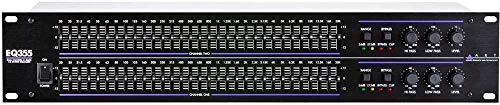
The EQ355 is the diplomat of this group, built for systems where studio and consumer gear meet. Alongside balanced XLR and 1/4-inch TRS sockets it carries unbalanced RCA inputs and outputs, so a streamer, a turntable setup or a hi-fi amp can join the chain without adapter cables. Each channel adds a variable high-pass filter sweeping from 10 to 250 Hz and a low-pass filter from 3 to 40 kHz, which together bracket a recording and remove rumble and hiss before the sliders do their work. A ground lift switch handles the hum that mixed systems attract.
Specs
- Dual channel 31-band graphic equalizer, 1/3 octave, ISO spacing
- Constant-Q filtering
- 20mm center-detent sliders
- Selectable ±6 dB or ±12 dB boost/cut range per channel
- Variable high-pass filter: 10 Hz to 250 Hz, 12 dB per octave
- Variable low-pass filter: 3 kHz to 40 kHz, 12 dB per octave
- Balanced XLR, balanced 1/4-inch TRS and unbalanced RCA inputs and outputs
- Ground lift switch
- Frequency response: 20 Hz to 20 kHz, +0.5 dB
- 2U rackmount; weight 9.0 lbs
Best for: A hybrid room where a computer interface, studio monitors and RCA-only hi-fi sources share one system.
Watch out for: Check the rear-panel line voltage selector matches your mains supply before first power-up.
ASIN: B0002E53WY
Which One Fits Your Situation
Your bedroom studio sounds boxy and boomy
Start with the dbx 231s on the monitor path. Its 31 bands let you pull down the narrow low-mid build-up that small rooms create without disturbing the rest of the mix, and the ±6 dB range setting keeps those cuts gentle and precise. Set the curve once, then leave it alone and mix through it.
You record loud sources with open microphones
The Behringer FBQ6200HD belongs in a room where drums, amplifiers or a live-stream audience share space with speakers. The feedback detection flags ringing bands before they become squeals, the limiters tame unexpected peaks, and the long faders make small corrections easy while a session is running and your attention is elsewhere.
Your rack is small but you run a subwoofer
Pick the Behringer FBQ3102HD. It gives up nothing in band count, adds sweepable filters for cleaning up each channel, and its mono subwoofer output with an adjustable crossover lets one compact unit manage the handover between nearfields and sub, which keeps a desktop rack tidy and the low end consistent.
Half your gear connects with RCA cables
The ART EQ355 is the only unit here that speaks both languages. Balanced sockets serve your interface and monitors while RCA pairs bring a streamer or hi-fi amp into the same chain, and the ground lift switch deals with the buzz that often appears when consumer and studio grounds meet.
Common Mistakes
- Buying an EQ to fix a room before moving the speakers or adding any treatment, then fighting problems no curve can solve.
- Boosting wide areas instead of cutting narrow ones, which eats headroom and makes the whole mix louder rather than clearer.
- Leaving the EQ curve in the recording path when tracking, so a monitor correction gets printed into every take.
- Mixing balanced and unbalanced connections with the wrong cables and blaming the EQ for the resulting hum.
- Setting a monitor curve once and never re-checking it after moving furniture, speakers or the listening position.
Frequently Asked Questions
Can a graphic EQ fix bad room acoustics?
Only partly. An equalizer can reduce the level of frequencies your room exaggerates, especially standing-wave peaks in the bass, and that genuinely helps. It cannot remove reflections, flutter echo or a long reverb tail, because those are time problems rather than level problems. Treat first where you can, then let the EQ handle what remains.
Where does a hardware EQ belong in the signal chain?
For monitor correction, place it between your interface line outputs and your powered monitors or monitor amplifier, so it affects only what you hear. For track shaping, patch it as an insert or on an aux send during recording or mixing. Keep the corrective curve out of the recording path so your raw tracks stay clean.
Is a 31-band EQ better than a 15-band EQ for a home studio?
For room and monitor work, yes, because narrow problems need narrow tools. A 31-band unit adjusts 1/3-octave slices, so a cut at 125 Hz leaves 100 and 160 Hz almost untouched. A 15-band unit moves broader regions and suits gentle overall tone shaping. For mix-bus sweetening, broad moves are often preferable, so the job decides.
Can I use one of these equalizers on my mix bus?
Yes, provided you work gently and watch your gain staging. Use the ±6 dB range setting, keep boosts small, and check the output metering so the EQ does not push your converter into clipping. Remember that a stereo graphic EQ applies identical moves to both channels, which suits bus work but rules out mid-side tricks.
More from Amazon
Programs that pair well with the guide above. Offers and eligibility are set by Amazon and may change.
Free shipping on eligible items, Prime Video and more. Eligible new members can start with a free trial.
Start a Prime free trialAudiobooks and podcasts to listen to on the go. Eligible new members can start with a free trial.
Try Audible freeAd-free music streaming. Eligible new subscribers can start with a free trial.
Try Music Unlimited freeA free business account with business pricing and bulk-buying tools for work, shop or home office.
Create a business accountAs an Amazon Associate we earn from qualifying purchases.


Write Your Review
No reviews yet. Be the first to share your experience!