

Key takeaways
- Front: the intended speech direction, where the microphone is most sensitive.
- Sides: often reduced, but not uniformly across bass, midrange, and treble.
- Rear: usually reduced, although rear rejection varies by design and frequency.
- Off-axis voices: still audible, and often tonally altered rather than simply silenced.
Best Shotgun Microphones for Focused Audio
The best shotgun microphones for most filmmakers are the RØDE NTG5 for lightweight outdoor production, the Sennheiser MKH 416 for a proven all-round professional standard, and the Schoeps CMIT 5 U when natural indoor dialogue and superior off-axis sound matter most.
Quick comparison
| Microphone | Pickup pattern and rejection | Self-noise | Power | Length / weight | Best fit |
|---|---|---|---|---|---|
| RØDE NTG5 | Supercardioid/lobar; good rear rejection, controlled off-axis response | 10 dBA | 48V phantom | 203 mm / 76 g | Lightweight boom and outdoor location work |
| Sennheiser MKH 416 | Interference-tube lobar; strong forward focus and rear rejection | 13 dBA | 48V phantom | 250 mm / 165 g | Film, broadcast, voice-over, and difficult locations |
| Schoeps CMIT 5 U | Lobar; unusually smooth off-axis sound for an interference tube | 13 dBA | 48V phantom | 251 mm / 78 g | High-end dialogue, especially indoors |
| DPA 4017B | Supercardioid/lobar; detailed, consistent rejection | 13 dBA | 48V phantom or compatible DPA adapter system | 175 mm / approximately 130 g | Premium location sound and compact rigs |
| RØDE NTG3 | RF-biased supercardioid/lobar; strong rejection in humid conditions | 13 dBA | 48V phantom | 213 mm / 163 g | Weather-resistant professional production |
| Deity S-Mic 2 | Supercardioid; useful focus with a somewhat less refined off-axis character | 15 dBA | 24V or 48V phantom | 250 mm / 162 g | Value-conscious dialogue recording |
Published specifications can vary slightly by revision and measurement standard, so self-noise figures should be treated as useful comparisons rather than a guarantee of how every recorder will sound. The microphone, boom position, room, recorder preamp, and wind protection all affect the final result.
Our top picks


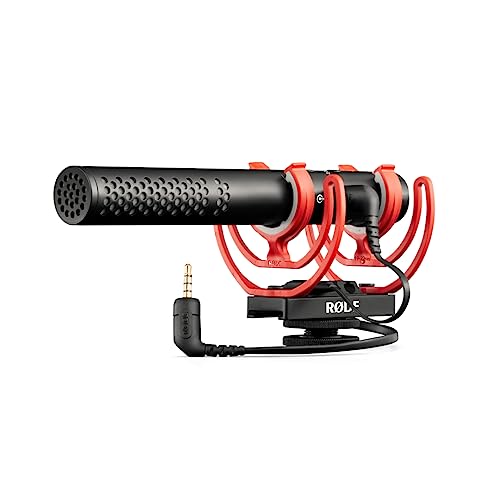

As an Amazon Associate we earn from qualifying purchases at no extra cost to you. Ratings are shown as listed on Amazon.
Which shotgun microphone should you choose?
Best overall for mixed production: Sennheiser MKH 416
The MKH 416 remains a strong choice when one microphone must cover film sets, documentaries, corporate video, voice-over, and outdoor dialogue. Its interference tube produces a focused lobar pattern, helping reduce sound from the sides and rear. It also has a bright presence that can add intelligibility to speech.
That voicing is both an advantage and a limitation. It can help a voice cut through traffic, clothing, or a busy location, but it may sound aggressive on already-bright voices. Indoors, the 416 can emphasize reflected sound rather than remove it. It rejects direct side noise, not the room itself; a highly reflective room still reaches the microphone through multiple paths.
Best lightweight outdoor option: RØDE NTG5
The NTG5 is unusually light at 76 grams, making it comfortable on a long boom or a compact camera rig. Its low 10 dBA self-noise is helpful for quiet dialogue, nature recording, and distant subjects. It uses standard 48V phantom power and is supplied with a short body that fits many conventional shock mounts.
Its short length makes placement easier, but it also means the interference tube has less physical length than the MKH 416 or CMIT 5 U. In practical terms, do not expect a short shotgun to create a narrow beam at a distance simply because it is called “shotgun.” The closer and more accurately you can position it, the more useful its directivity becomes.
Best for indoor dialogue: Schoeps CMIT 5 U
The CMIT 5 U is a premium choice when the sound arriving from off-axis must remain natural. Many shotgun microphones reduce side sound but give it a colored or hollow character. The CMIT 5 U is designed to keep its off-axis response comparatively smooth, which makes movement, overlapping dialogue, and room reflections easier to edit.
It is not a substitute for good microphone placement or acoustic treatment. In a small, bare room, a hypercardioid microphone or a carefully placed boom may outperform any long shotgun. Choose the CMIT 5 U when the room is manageable but the scene requires a narrow, professional dialogue microphone with consistent tonal quality.
Best premium compact choice: DPA 4017B
The DPA 4017B combines a relatively compact body with the detail and consistency expected from a high-end location microphone. It is a sensible option for production sound professionals who need a premium microphone that does not make a boom setup unnecessarily long or heavy.
Its price is typically much higher than entry-level and midrange models, so the benefit is not simply “more volume” or a magically tighter pickup. The justification is refined tone, predictable off-axis behavior, low noise, and long-term professional ownership.
Best for damp outdoor conditions: RØDE NTG3
The NTG3 uses an RF-bias design intended to improve resistance to humidity and condensation compared with many conventional condenser designs. That makes it attractive for outdoor production in mist, coastal air, or changing weather, although it still needs proper wind protection and dry storage.
At 163 grams, it is considerably heavier than the NTG5. For a handheld camera mount, that extra mass may matter; on a proper boom, it is usually manageable. Its sound is focused and present, with enough output for typical professional field recorders and interfaces.
Pickup patterns: what the specifications do not tell you
Shotgun microphones are generally built around a supercardioid capsule and an interference tube. Slots along the tube allow side-arriving sound to cancel at selected frequencies. The result is strong forward sensitivity and useful rejection, but the rejection is not equal at every frequency.
- Front: the intended speech direction, where the microphone is most sensitive.
- Sides: often reduced, but not uniformly across bass, midrange, and treble.
- Rear: usually reduced, although rear rejection varies by design and frequency.
- Off-axis voices: still audible, and often tonally altered rather than simply silenced.
This is why a microphone with excellent on-paper rejection can still sound poor in a reflective interior. Reflections arrive from many angles, and low-frequency traffic or air-conditioning noise is difficult for an interference tube to reject. For interiors, prioritize a smooth off-axis response and a short enough body for practical placement.
Indoor versus outdoor performance
Outdoors, a shotgun can deliver a major improvement over a camera microphone because it concentrates more of its sensitivity toward the speaker. The largest threats are wind, handling noise, distant traffic, and poor boom distance. Use a proper suspension, a furry wind cover over an acoustic basket, and keep the capsule as close as framing allows.
Indoors, the microphone should usually be above the subject, aimed toward the upper chest or mouth, and just outside the frame. A long shotgun placed too far away can capture a narrow but reverberant version of the voice. In a hard room, try a shorter shotgun, a hypercardioid microphone, or acoustic absorption before assuming a more expensive microphone will solve the problem.
Power, mounting, and recorder compatibility
Most professional shotgun microphones require 48V phantom power. Confirm that your camera, field recorder, audio interface, or wireless transmitter can supply it continuously. A microphone that accepts phantom power will not necessarily work from a plug-in-power input found on small consumer cameras.
A shock mount is essential because a rigid camera shoe or boom clamp transfers handling, cable, and clothing noise directly into the microphone. Select a mount that fits the microphone’s diameter and length. A long microphone may need a mount with two suspension points or a longer cradle to prevent it from rotating.
For a boom, balance the microphone near its center of mass and use a flexible cable loop rather than letting the cable pull on the XLR connector. On a camera, check that the microphone does not enter the lens view at the widest focal length. Also check that the camera’s preamp is not adding more hiss than the microphone itself.
Decision matrix
| Your situation | Most sensible direction | Why |
|---|---|---|
| Occasional video, limited budget | Value supercardioid shotgun such as Deity S-Mic 2 | Usable focus without paying for premium off-axis refinement |
| Frequent outdoor work and long booms | RØDE NTG5 | Very low weight and low self-noise reduce fatigue and hiss |
| One microphone for many professional jobs | Sennheiser MKH 416 | Established, focused sound and broad accessory support |
| Dialogue in controlled or moderately reflective interiors | Schoeps CMIT 5 U | Smoother off-axis response makes room coloration less distracting |
| Wet, humid, or unpredictable locations | RØDE NTG3 | RF-bias construction and robust professional design |
| Premium production with weight constraints | DPA 4017B | Compact professional option with detailed, consistent sound |
Ownership costs and maintenance
Expect roughly $200–$500 for a capable midrange shotgun, $800–$1,200 for established professional models, and about $1,500 or more for premium microphones, depending on the package and market. Budget separately for a shock mount, XLR cable, boom pole, wind protection, and a storage case. Wind protection can cost nearly as much as an entry-level microphone, but it is not optional for serious outdoor recording.
The parts most likely to wear first are suspension bands, furry wind covers, cable connectors, and foam that has absorbed moisture or developed cracks. Keep the microphone capped when not in use, store it dry, and let a damp wind cover air-dry before putting it away. Do not brush debris into the interference-tube slots, spray cleaner onto the grille, or use compressed air directly on the capsule.
Before recording, verify phantom power, inspect the XLR cable, tap the boom gently while monitoring, and listen for wind rumble. A quiet microphone positioned badly will produce worse dialogue than a less expensive microphone placed close, above the subject, and protected from vibration.




Write Your Review
No reviews yet. Be the first to share your experience!