

Key takeaways
- Wireless microphone systems for singers compared: a single Shure handheld, dual Sennheiser and Phenyx Pro sets, and a TONOR pair, with specs and ASINs.
Cutting the cable sounds simple, but the real decision is how much risk you are willing to carry onto the stage. A singer has to choose between one microphone or two, between a system that hunts for a clean frequency on its own and one that leaves tuning to you, and between a capsule voiced for a lead vocal and a general-purpose one that merely gets loud. Get those calls wrong and the freedom of wireless turns into dropouts during the chorus.
This guide is written for four kinds of buyers: lead vocalists fronting a band, worship singers who share songs with a second voice, karaoke hosts who hand microphones to strangers all night, and event singers who need a pair ready for weddings and parties. Every pick below is a complete handheld system sold on Amazon US, and each one was chosen from the names and published specifications on its Amazon product page rather than from brand reputation alone.
Quick Picks
As an Amazon Associate we earn from qualifying purchases
| Product | Best for | Key spec from title |
|---|---|---|
| Shure BLX24/PG58 | Solo lead vocalist playing clubs and churches | PG58 handheld vocal mic, 14-hour battery life, 300 ft range |
| Sennheiser XSW 1-825 Dual | Two singers sharing a single receiver | Two handhelds with e825 capsules, A band 548-572 MHz |
| Phenyx Pro PTU-71-2H | Duos gigging in RF-crowded rooms | Auto scan, 2×100 UHF frequencies, 328 ft range |
| TONOR TW-820 | Karaoke nights and house parties | Metal dual microphones, 15 channels per mic, 200 ft range |
How to Choose
Decide how many microphones you actually need
Count the voices on stage before you count features. A solo singer is well served by a single-channel system, and the money saved can go toward a better capsule. The moment a second vocalist joins, though, a dual set with one shared receiver is far tidier than two separate systems fighting for power outlets and mixer inputs. Think about guests, too: karaoke hosts and wedding singers regularly hand a microphone to someone else, so a two-mic set is the safer default for event work even if you personally sing alone.
Match the frequency system to your venue
Every system here is analog UHF, but they manage frequencies differently. Some scan the room and pick a clear channel automatically, which matters in city venues packed with other wireless gear. Others offer a bank of selectable channels you set by hand, giving you control when several systems run at once. Check the band printed in the listing against the spectrum allowed in your region, because a set built for another market can be unusable or unlawful at home. More selectable frequencies only help if you can coordinate them, so favor auto-scan if nobody on your team enjoys RF homework.
Judge the capsule, not the cabinet
The capsule decides how your voice actually sounds through the PA. All four picks use dynamic cardioid capsules, the pattern that rejects off-axis noise and resists feedback when monitors are loud. Beyond that, voicing differs: some capsules are tailored with a presence lift that helps a lead vocal sit over guitars, while flatter ones suit softer singers who work close to the grille. Published frequency response figures on the Amazon page hint at this character, so compare them against the range your voice needs instead of assuming the most expensive handheld automatically flatters you.
Plan batteries and outputs before the gig
Battery claims range from about eight hours to fourteen in this group, and the gap changes how you run a show. A fourteen-hour transmitter shrugs off a rehearsal plus a full set on one pair of AA cells, while an eight-hour system demands fresh batteries before every event and spares in the case. Also confirm the receiver outputs match your mixer: balanced XLR per channel is the flexible option, a single mixed quarter-inch output is fine for a powered speaker, and none of these systems plug into a phone or laptop without extra hardware.
The 4 Best Options
Shure BLX24/PG58
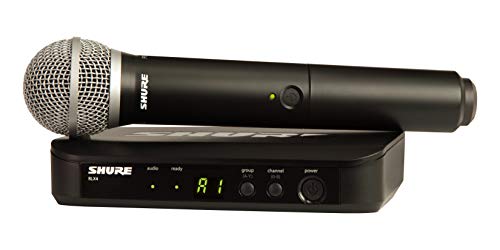
A lead singer who wants one microphone from a name that sound engineers already trust will land here first. The BLX2 handheld carries Shure’s PG58 capsule, a dynamic cardioid design with a vocal-tailored response, and the BLX4 receiver finds a clean channel with one-touch QuickScan instead of manual hunting. Fourteen hours of runtime means the same pair of AA batteries covers soundcheck, the show, and the encore, and support for up to twelve compatible systems per band leaves room for bandmates to add their own Shure sets later.
Specs
- Analog UHF wireless system, H8 band (518-542 MHz)
- PG58 dynamic cardioid handheld vocal capsule
- BLX4 single-channel receiver with one-touch QuickScan frequency selection
- Up to 12 compatible systems per frequency band
- Operating range up to 300 ft, line of sight
- Up to 14 hours of use from 2 AA batteries
- Frequency response 50 Hz to 15 kHz
- Balanced XLR and 1/4-inch receiver outputs
Best for: A solo singer who wants one dependable handheld from a proven stage brand.
Watch out for: Confirm the H8 band variant suits your region, and note the receiver runs a single microphone, so a second vocalist needs a second system.
ASIN: B00BRQ5AJW
Sennheiser XSW 1-825 Dual
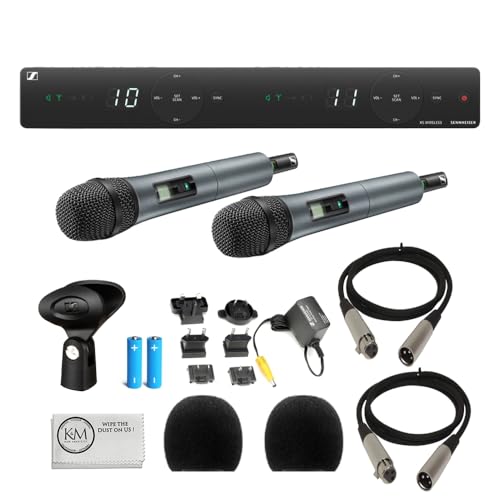
Duos, worship teams, and singing partners get the cleanest setup from this Sennheiser set, because two handheld transmitters feed one dual-channel receiver and only one box needs a mixer input pair and a power socket. Each SKM 825-XSW handheld uses the e825 dynamic cardioid capsule, Sennheiser’s entry evolution capsule voiced for vocals, and each transmitter has a mute switch for quiet handovers between songs. Automatic frequency management with one-touch synchronization keeps setup short, and the receiver’s antenna-switching diversity works to hold the signal as singers move around a stage or sanctuary.
Specs
- Analog UHF dual-channel wireless vocal set, A band (548-572 MHz)
- 2 SKM 825-XSW handheld transmitters with e825 dynamic cardioid capsules
- EM-XSW 1 DUAL stationary receiver with internal antennas
- Up to 10 compatible channels
- 24 MHz switching bandwidth with automatic frequency management
- Frequency response 80 Hz to 14 kHz
- Approx. 10 hours per transmitter from 2 AA batteries
- Transmitter mute switch on each handheld
Best for: Two singers who want matched vocal microphones on one shared receiver.
Watch out for: Check the A band (548-572 MHz) is clear and legal where you perform, and remember both microphones depend on one receiver, so a receiver fault silences both voices.
ASIN: B0CSQSWYPK
Phenyx Pro PTU-71-2H

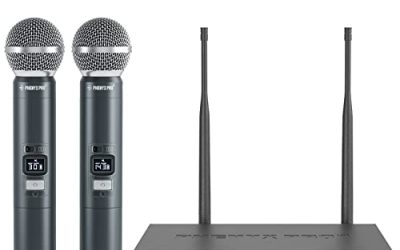
Singers who play busy rooms full of competing wireless signals get the most frequency agility from this Phenyx Pro set. Its receiver scans the RF environment and locks onto the cleanest channel automatically, and with 100 selectable frequencies per channel there is almost always somewhere quiet to land. Both the handhelds and the receiver are metal rather than plastic, the capsules are dynamic cardioid, and infrared synchronization pairs each microphone to the receiver without menu diving. A lock function guards your settings against accidental button presses once soundcheck is done.
Specs
- Dual-channel UHF wireless system, 530-580 MHz carrier range
- 2 handheld transmitters with dynamic cardioid capsules
- 2×100 selectable frequencies with auto-scan and IR synchronization
- Operating range up to 328 ft, line of sight
- Frequency response 50 Hz to 18 kHz
- Up to 8 hours per transmitter from 2 AA batteries
- All-metal receiver and handheld construction
- Balanced XLR outputs per channel plus a mixed 1/4-inch output
Best for: Duos who gig regularly and want auto-scan tuning with metal hardware.
Watch out for: Eight hours is the published ceiling per charge of AA cells, so carry spares for long events, and keep the receiver away from metal surfaces that can shorten its range.
ASIN: B07JNDVS6H
TONOR TW-820

Karaoke hosts and home party singers need microphones that survive being passed around, and the TW-820’s all-metal handhelds with steel mesh grilles are built for exactly that treatment. Each microphone offers 15 adjustable frequencies, so two singers can steer clear of interference without a scan function doing it for them, and the receiver gives each channel its own volume knob so a loud guest and a quiet one can be balanced on the fly. An LCD screen on both the receiver and each microphone shows channel and battery status at a glance.
Specs
- Dual UHF wireless microphone system with 2 metal handhelds
- Cardioid dynamic capsule in each microphone
- 15 adjustable frequencies per microphone; up to 15 sets usable at once
- Transmission range up to 200 ft in open space
- Receiver LCD display with separate volume control for each channel
- Balanced XLR outputs per channel plus 6.35 mm mixed output
- Mute function on each microphone
- 2 AA batteries required per microphone, not included
Best for: Karaoke hosts and party singers who need a simple, sturdy two-microphone setup.
Watch out for: Batteries are not included, so budget for AA cells from day one, and confirm your speaker or mixer offers XLR or 1/4-inch inputs, since the system cannot connect to a phone or laptop.
ASIN: B07RJLKBRD
Which One Fits Your Situation
You sing lead in a working band
Take the Shure BLX24/PG58. One excellent handheld beats two average ones when every song is yours, the fourteen-hour battery life removes a mid-tour worry, and QuickScan handles unfamiliar venues where the RF picture changes nightly. The PG58 capsule is voiced for exactly the job of putting a lead voice on top of a loud backline.
You lead worship alongside another vocalist
Choose the Sennheiser XSW 1-825 Dual. Two matched e825 handhelds on a single receiver keep the platform tidy, mute switches let singers silence themselves between songs, and automatic frequency management means a volunteer can set the system up minutes before the service without RF training.
You host karaoke nights and private parties
The TONOR TW-820 fits your world. Guests drop things, shout into grilles, and wander off still holding the microphone, so metal bodies, a 200 ft range, and per-channel volume knobs matter more than studio polish. Fifteen frequencies per microphone give you an escape route when a neighboring room runs wireless too.
You sing at weddings and events with a partner
Pick the Phenyx Pro PTU-71-2H. Hotel ballrooms and marquees are unpredictable RF environments, and auto-scan finds a workable channel while you are still unloading. The metal build tolerates weekly transport, and the lock function keeps a curious guest from retuning the system mid-reception.
Common Mistakes
- Buying a single-channel system, then discovering a second singer needs a microphone and a second receiver at the worst possible moment.
- Ignoring the frequency band in the listing and ending up with a set that clashes with local spectrum rules or the venue’s existing wireless gear.
- Trusting the headline battery figure and starting a long event on half-used AA cells instead of fresh ones, with no spares in the case.
- Placing the receiver inside a metal rack or behind the PA stack, where its antennas are shielded and the advertised range collapses.
- Running every microphone on the same default channel out of the box, then blaming the system for interference that coordination would have avoided.
Frequently Asked Questions
Can two singers use one wireless system at the same time?
Yes, if the system has two channels. The Sennheiser, Phenyx Pro, and TONOR sets here each carry two handheld transmitters feeding one receiver, so two voices can perform together. The Shure BLX24/PG58 is a single-channel system, so a second singer needs a second compatible system.
How far from the receiver can a singer actually move?
Published ranges run from 200 ft for the TONOR to 328 ft for the Phenyx Pro, measured line of sight in open space. Walls, crowds, and metal structures shorten that considerably in real venues, so treat the figure as a ceiling and keep the receiver elevated with a clear path to the stage.
Will these microphones work with a powered speaker instead of a mixer?
Generally yes. Each receiver here offers a quarter-inch mixed output or per-channel XLR outputs, and most powered speakers accept one of those connections. What they will not do is plug straight into a phone, tablet, or laptop, so recording to a computer still needs an audio interface between the receiver and the machine.
How long do the batteries last during a real show?
The published figures are up to fourteen hours for the Shure, about ten for the Sennheiser, and up to eight for the Phenyx Pro and TONOR, all on AA cells. Real life varies with battery quality and how often the mute switch is used, so start every event on fresh batteries regardless of the claim.
More from Amazon
Programs that pair well with the guide above. Offers and eligibility are set by Amazon and may change.
Free shipping on eligible items, Prime Video and more. Eligible new members can start with a free trial.
Start a Prime free trialAudiobooks and podcasts to listen to on the go. Eligible new members can start with a free trial.
Try Audible freeAd-free music streaming. Eligible new subscribers can start with a free trial.
Try Music Unlimited freeA free business account with business pricing and bulk-buying tools for work, shop or home office.
Create a business accountAs an Amazon Associate we earn from qualifying purchases.
Write Your Review
No reviews yet. Be the first to share your experience!