

Key takeaways
- Four wireless microphone systems with LCD displays compared: dual and quad UHF handheld sets with auto scan, plus a creator kit with an OLED receiver.
Buying a wireless microphone with an LCD display is really a decision about where you will be standing when something goes wrong. A screen on the receiver lets the person at the mixer spot a fading battery or a muted channel before the audience hears silence, while a screen on the handheld tells the singer which frequency they are on and how much power is left. The real choice is which of those views your setup needs, and whether one display or two earns its place in your routine.
This guide is for church and school sound volunteers, wedding hosts and karaoke singers, presenters who move between venues, and video creators who record away from a desk. Every pick below was chosen from its Amazon product page, using the model names, frequency data, display details and box contents published there, so the four systems can be compared on what the screen shows as much as on how they sound.
Quick Picks
As an Amazon Associate we earn from qualifying purchases
| Product | Best for | Key spec from title |
|---|---|---|
| Phenyx Pro PTU-71-2H | Two singers or a host and guest who need to dodge interference | Auto Scan, 2×100 UHF frequencies, 328ft range |
| TONOR TW-820 | Karaoke nights, meetings and small parties at home | 2 x 15 channel metal handheld mics, 200ft range |
| Phenyx Pro PTU-5000-4H | Churches, schools and halls running four vocalists at once | 4 handheld dynamic microphones, 260ft range |
| DJI Mic 2 (2 TX + 1 RX + Charging Case) | Two-person interviews and video shoots on camera or phone | 32-bit float internal recording, 250m (820 ft) range |
How to Choose
Decide where the screen needs to live
A display only helps if the right person can see it at the right moment. Receiver screens suit a fixed sound position: the operator watches RF strength, audio level and battery warnings for every channel from one place, which is exactly how the quad Phenyx Pro set below is meant to be run. Handheld screens suit roaming performers who never go near the mixer, because the singer can check their own battery icon and mute status mid-event. Systems like the TONOR TW-820 put LCDs in both places, and that duplication matters most when the person holding the mic and the person running sound are different people working in different corners of the room.
Count channels, then check how frequencies are chosen
Start with the number of people who must be live at the same time, because a dual set cannot grow into a quartet later. After that, look at how each system picks its frequencies. Fixed-frequency sets are simple and quick, but they offer no escape route if a local TV station or another act crowds the same channel. Selectable systems widen your options, and auto scan goes further by searching for the clearest frequency on its own, as the PTU-71-2H does across 100 choices per channel. If you regularly work in RF-busy city venues or share bills with other wireless users, that scanning ability is worth more than a slightly longer range figure.
Read range figures as line-of-sight, not a promise
Every range number on these product pages was measured outdoors with nothing between the transmitter and receiver. Walls, metal roofing, crowd bodies and Wi-Fi congestion all eat into it, sometimes dramatically. A 328-foot UHF system will usually cover a school hall with ease, while a 2.4 GHz creator kit such as the DJI Mic 2 can struggle through two interior walls even though its open-air figure is far larger. Think about the longest real distance in your venue, add the obstacles in between, and keep a healthy margin. If the receiver can sit on stage or near the action rather than at the back of the room, shorter-range systems suddenly become practical.
Sort out power and outputs before the event
Displays make battery status visible, but they do not extend runtime, so plan the power side properly. AA-powered handhelds like the Phenyx Pro and TONOR sets let you swap in fresh cells during a break, which suits long event days, while the DJI kit recharges its internal batteries in a case and needs that case routine to stay ready. Outputs matter just as much: per-channel XLR feeds let a mixer operator balance each voice separately, a single mixed output is faster for a powered speaker, and camera or phone connections decide whether a creator kit plugs into your existing recorder at all.
The 4 Best Options
Phenyx Pro PTU-71-2H

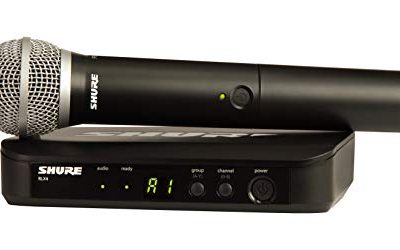
Two vocalists who share stages in different venues will get the most from this dual UHF set, because its auto scan searches for the least crowded frequency each time you set up somewhere new. Both the metal receiver and the handhelds carry LCD screens, so the operator sees channel and signal information at the desk while each singer keeps a battery icon and mute indicator in hand. With 100 selectable frequencies per channel, IR sync pairing and individual volume controls, it behaves like a small piece of touring gear rather than a karaoke accessory, and it suits church teams and wedding singers who cannot control the RF environment they walk into.
Specs
- Dual-channel UHF system with 2 handheld dynamic microphones
- 100 selectable frequencies per channel (Ch 1: 536.57–561.32 MHz; Ch 2: 562.37–587.12 MHz)
- Auto Scan function with IR synchronization pairing
- Operating range up to 328 ft line of sight
- LCD display on the receiver and on each handheld, showing frequency, battery level and mute status
- Metal receiver with volume control for each channel
- XLR and 1/4-inch outputs
- 2 AA batteries per transmitter; 4 AA batteries included
Best for: Singers, hosts and church vocal teams who perform in unfamiliar rooms and need frequency flexibility.
Watch out for: The channels sit in defined UHF sub-bands, so check that local broadcast activity leaves those frequencies clear where you perform, and remember the receiver still needs a mixer or powered speaker to produce sound.
ASIN: B07JNDVS6H
TONOR TW-820

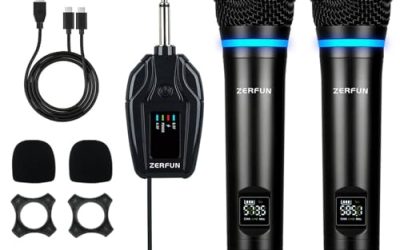
Home users who want the confidence of a screen without buying rack gear should look closely at this metal dual set. The receiver’s LCD reports channel, frequency, signal strength and audio level for both microphones, and each handheld has its own display for battery level, signal and the current channel, so a karaoke host can see at a glance which mic is about to run flat. Fifteen adjustable frequencies per microphone give a workable escape if a neighbour’s equipment interferes, and the separate volume knob for each channel keeps a loud singer and a quiet speaker balanced on one powered speaker at parties, meetings and family events.
Specs
- Dual UHF system with 2 metal handheld dynamic microphones
- 15 adjustable frequencies per microphone
- Operating range up to 200 ft (60 m) in open space
- Receiver LCD shows channel, frequency, signal strength and audio level for both microphones
- Handheld LCD shows battery level, signal indicator and current channel
- Cardioid dynamic capsule with unidirectional pickup
- Independent volume control for channel A and channel B
- 2 AA batteries per microphone
- 6.35 mm audio cable included for connection to a speaker or mixer
Best for: Karaoke hosts, families and small meeting rooms that want screen feedback on a simple two-mic setup.
Watch out for: The system connects to a mixer, amplifier or powered speaker only; it does not plug directly into a laptop, phone or tablet, so confirm your playback gear has a suitable input first.
ASIN: B07RJLKBRD
Phenyx Pro PTU-5000-4H

When four people need microphones at once — a worship team, a school assembly panel or a quartet of wedding speakers — this quad set keeps the sound operator informed through a receiver LCD that displays each channel’s frequency alongside individual volume controls. The all-metal receiver and handhelds are built for rooms where equipment gets set up and packed away every week, and the four separate XLR outputs let each voice land on its own mixer channel for proper balancing. Because the frequencies are fixed rather than selectable, setup is genuinely plug-and-go in a venue whose RF conditions stay the same week after week, which describes many churches and halls.
Specs
- 4-channel UHF system with 4 handheld dynamic microphones
- Fixed frequencies: 541.9 MHz, 546.3 MHz, 561.6 MHz and 568.65 MHz
- Receiver LCD screen displays frequency, with individual volume controls per channel
- Operating range up to 260 ft
- All-metal receiver and handheld microphones with cardioid dynamic cartridges
- 4 individual XLR outputs for separate mixer channels
- Snap-on BNC antennas and memory switch that retains the last settings
- 8 AA batteries included, for up to 8 hours of operation
Best for: Churches, schools and community halls that run the same four-microphone setup every week.
Watch out for: The maker states this set is not intended for multiset operation, and its fixed frequencies cannot be retuned, so if another wireless system already works nearby on clashing channels, this is the wrong pick.
ASIN: B07GR69D9L
DJI Mic 2 (2 TX + 1 RX + Charging Case)

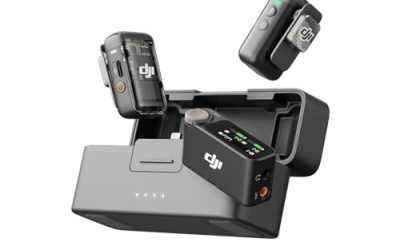
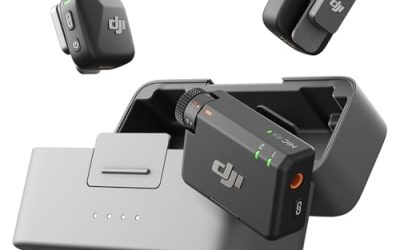
Creators filming interviews, walkthroughs or two-person videos get a different kind of screen here: the receiver’s 1.1-inch OLED touchscreen shows audio levels, wireless signal and the battery state of every unit, and a dial beside it adjusts settings without opening a phone app. The two clip-on transmitters record 32-bit float audio internally as a safety net, connect to cameras over the included cable or to phones with the Lightning and USB-C adapters, and drop into the charging case between shoots. It is the only pick here designed to live in a camera bag rather than a sound cupboard, and the only one whose microphones hide on a lapel instead of filling a hand.
Specs
- Kit with 2 clip-on transmitters, 1 receiver and a charging case
- Receiver display: 1.1-inch OLED touchscreen with headphone monitoring output
- 2.4 GHz wireless with range up to 250 m (820 ft)
- 32-bit float internal recording on the transmitters
- Intelligent noise cancelling
- Battery life of 6 hours per transmitter and receiver, up to 18 hours with the charging case
- USB-C and Lightning mobile phone adapters plus a 3.5mm TRS camera cable included
- Omnidirectional built-in microphones with clip and magnetic mounting
Best for: Video creators and interviewers recording two people on a camera or smartphone.
Watch out for: The transmitters have no screens of their own, so all level and battery information lives on the receiver; also confirm the included phone adapter matches your handset before a shoot.
ASIN: B0CFZX734J
Which One Fits Your Situation
You run sound for a church, school or hall with several vocalists
Choose the Phenyx Pro PTU-5000-4H. Four handhelds arrive ready to work, the receiver LCD keeps every channel’s frequency in view from the sound desk, and the separate XLR outputs let you balance a strong lead singer against quieter backing voices on the mixer instead of fighting one shared volume knob all service long.
You perform in different venues and keep hitting interference
Choose the Phenyx Pro PTU-71-2H. Its auto scan reads the room and picks the least crowded frequency from 100 options per channel, which is the practical answer when last week’s hall was clear and this week’s is full of other wireless gear. Screens on both the receiver and the handhelds keep you and the operator informed independently.
You want microphones for karaoke, parties and meetings at home
Choose the TONOR TW-820. Two metal handhelds, a receiver screen that shows both channels at once and a single cable into a powered speaker keep the whole thing living-room simple, while the per-mic displays warn you about batteries before a song dies halfway through. Fifteen frequencies per mic cover the occasional clash with a neighbour’s equipment.
You film interviews or videos and record straight to camera or phone
Choose the DJI Mic 2 kit. The receiver’s OLED touchscreen puts levels and battery status in front of you while you shoot, the transmitters clip onto clothing instead of occupying a hand, and the internal 32-bit float recording protects an unrepeatable answer even if the camera audio peaks. The charging case keeps everything together between locations.
Common Mistakes
- Assuming the display sits on the microphone when the system only has a screen on the receiver, or the other way round.
- Buying a fixed-frequency set for a venue where other wireless equipment already works, leaving no way to change channels when interference appears.
- Treating the headline range as an indoor guarantee, even though walls, crowds and metal structures shorten it considerably.
- Forgetting that these systems need a mixer, amplifier, powered speaker or recorder to make sound; the receiver alone plays nothing.
- Ignoring the battery routine the display is warning about, whether that means spare AA cells in the case or recharging a creator kit after every shoot.
Frequently Asked Questions
What does the LCD on a wireless microphone system actually show?
It depends on the model, but the useful ones show the current frequency or channel, RF signal strength, audio level and battery status. Receiver displays gather that information for every channel in one place, while handheld displays show the singer their own battery and mute state. The TONOR TW-820 and Phenyx Pro sets in this guide cover both positions.
Is a screen on the handheld as useful as one on the receiver?
They solve different problems. A receiver screen helps whoever runs sound, because one glance covers every microphone. A handheld screen helps the performer, who can check battery level and mute status without walking back to the desk. If different people fill those two roles at your events, a system with displays in both places, like the PTU-71-2H, removes the guesswork for everyone.
Do the displays drain the microphone batteries much faster?
The screen itself draws very little compared with the radio transmitter, and several systems dim their handheld displays in standby to save power. Runtime is still set by the battery type: the AA-powered sets here run a full event day on fresh cells, while the DJI kit’s internal batteries are rated at six hours per charge before the case tops them up.
Can I run two of these systems in the same room?
Usually yes, provided each microphone sits on its own frequency. Selectable systems such as the PTU-71-2H make that coordination easy, and the TW-820 allows up to 15 sets with its adjustable frequencies. Fixed-frequency sets are the exception: the PTU-5000-4H is built to work as one self-contained group, so plan channel counts before buying rather than after.
More from Amazon
Programs that pair well with the guide above. Offers and eligibility are set by Amazon and may change.
Free shipping on eligible items, Prime Video and more. Eligible new members can start with a free trial.
Start a Prime free trialAudiobooks and podcasts to listen to on the go. Eligible new members can start with a free trial.
Try Audible freeAd-free music streaming. Eligible new subscribers can start with a free trial.
Try Music Unlimited freeA free business account with business pricing and bulk-buying tools for work, shop or home office.
Create a business accountAs an Amazon Associate we earn from qualifying purchases.
Write Your Review
No reviews yet. Be the first to share your experience!