

Key takeaways
- Compare four rechargeable wireless microphone systems: dual and 4-channel UHF handheld sets, an XLR plug-on kit, and a lavalier set for phone and camera.
The real decision in this category is not wired versus wireless — it is what you will be feeding batteries for the next few years. Plenty of systems call themselves rechargeable because the receiver tops up over USB, while the handhelds still swallow disposable AA cells every few shows. Others build lithium cells into every part, so the whole kit charges from one cable or case. That difference decides your running costs, your pre-show routine, and what happens when a mic fades mid-event.
This roundup is for karaoke hosts and duet partners, small church and school sound teams, speakers who already own a favorite wired microphone, and creators filming two-person videos on phones or cameras. Every pick below is sold on Amazon US, and each product section is built from the name and specifications published on its Amazon product page, including battery type, channel count, connectors, and stated range, so you can compare the figures that actually differ.
Quick Picks
As an Amazon Associate we earn from qualifying purchases
| Product | Best for | Key spec from title |
|---|---|---|
| ZERFUN WM-2 | Karaoke duets and small services with two singers | UHF, 2 channels, channel control |
| ZERFUN MU-898 | Events running four handhelds at the same time | 4 channels, echo and Bluetooth |
| Xvive U3 | Turning a wired XLR microphone wireless | 2.4 GHz plug-on, up to 90 ft range |
| Hollyland LARK M2 Combo | Two-person interviews and video on phone or camera | 1000 ft range, 40H battery with case |
How to Choose
Start with what actually recharges
Read the listing the way an auditor would. On some sets only the receiver has a built-in battery, and the microphones still run on disposable AA cells; on others, every microphone and the receiver carry rechargeable lithium cells. Count the batteries the listing says are included and check whether charging cables come for each microphone, or whether a case does the charging. For weekly karaoke or church use, fully rechargeable handhelds remove a steady stream of AA purchases. For occasional use, a rechargeable receiver with AA handhelds may be simpler, because AA cells hold their charge in a drawer for months.
Match channel count to the number of voices
Channels are simultaneous voices, not a quality score. A two-channel set covers a duet, a host plus a guest, or a speaker and a singer. Four channels suit a small choir, a panel, or a wedding party passing microphones around. Each active microphone needs its own channel, and on UHF sets each one also needs a clear frequency, which is why channel control matters in crowded venues. Buying four channels “just in case” adds charging and setup work every time, so size the system to the largest group you realistically run, not the largest you can imagine.
Pick a band and range that fit your room
UHF systems, like the ZERFUN sets below, are built for stages and halls and let each microphone sit on its own frequency. Digital 2.4 GHz systems, like the Xvive and Hollyland below, are compact and simple to pair, but they share spectrum with Wi-Fi, so distance from routers matters. Treat every printed range as a best-case, line-of-sight figure measured outdoors: walls, bodies, and metal shelving shorten it. A 1,000-foot claim does not help a 30-foot room, while a modest 90-foot rating is plenty for most stages if the receiver stays visible.
Check outputs, indicators, and the cheap-set shortcuts
Work backwards from the gear you already own. Most handheld sets end in a 6.35 mm plug for a mixer, powered speaker, or karaoke machine; camera and phone systems use 3.5 mm, USB-C, or Lightning receivers; plug-on systems speak XLR. Then look for the details budget sets quietly drop: a battery indicator on the microphone, a display or LEDs you can read from a distance, metal rather than all-plastic housings, and spare windscreens in the box. Echo and Bluetooth extras are pleasant for karaoke, but they never rescue a system whose frequencies clash or whose batteries fade early.
The 4 Best Options
ZERFUN WM-2

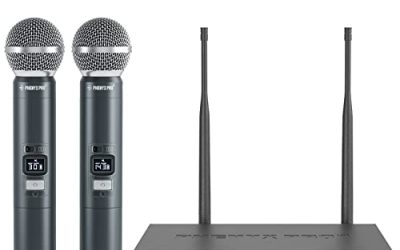
The WM-2 is the straightforward answer for two people who sing, speak, or present together and are tired of buying AA batteries. Both metal handhelds carry rechargeable lithium cells, and the mini receiver recharges too, with a charging cable included for each microphone. Channel control on the UHF link lets you move a microphone off a crowded frequency, and the single 6.35 mm output plugs straight into a mixer, powered speaker, audio interface, or karaoke machine. It is a focused two-voice kit rather than an expandable rig, which is exactly its appeal.
Specs
- Brand and model: ZERFUN WM-2
- Wireless band: UHF
- Channels: 2
- Polar pattern: Unidirectional
- Form factor: Handheld
- Connector: 6.35 mm jack
- Special features: Channel control, rechargeable wireless microphones
- Batteries: 3 Lithium Ion batteries required, included
- Material: Metal
- In the box: 2 rechargeable wireless microphones, receiver, 2 charging cables, 2 microphone windscreens, 2 antiskid rings, user manual
Best for: Karaoke duets, couples hosting parties, and small services where two handhelds cover everyone.
Watch out for: The receiver offers one 6.35 mm output, so confirm your speaker or mixer has a free mic input, and note the set is fixed at two microphones with no add-on option.
ASIN: B0DGPLW327
ZERFUN MU-898

Where the WM-2 stops at two voices, the MU-898 covers a small stage. Four rechargeable metal handhelds run through one receiver box, each on its own UHF channel, so a choir, panel, or wedding party can pass microphones without a cable in sight. The listing adds karaoke-friendly extras — echo, volume control, and a Bluetooth receiver for backing tracks — plus a battery indicator light so a fading microphone announces itself. Outputs cover both 6.35 mm and 3.5 mm, which widens the mixers, amplifiers, and speakers it can feed.
Specs
- Brand and model: ZERFUN MU-898
- Wireless band: UHF, frequency range 500–599 MHz
- Channels: 4
- Connectors: 3.5 mm jack, 6.35 mm jack
- Special features: Echo, Bluetooth receiver, volume control, channel control, battery indicator light
- Polar pattern: Unidirectional
- Batteries: 4 Lithium Ion batteries required, included
- Enclosure material: Metal
- In the box: 4 wireless microphones, receiver box, power adapter, 6.35 mm cable, 3.5 mm cable, audio cable, 4 windscreens, 4 antiskid rings, user manual
Best for: Churches, schools, and event hosts who regularly put three or four handhelds on stage at once.
Watch out for: Four microphones mean four batteries to charge before every event, and the 500–599 MHz UHF range should be checked against other wireless gear already working in the room.
ASIN: B0B9T3T6MK
Xvive U3

The U3 solves a different problem: you already own a wired dynamic microphone you like, and only the cable has to go. The transmitter plugs onto the microphone’s XLR connector and the receiver into a mixer or PA input, turning the pair into a 2.4 GHz digital link with less than 5 ms of latency. Both units run on built-in rechargeable lithium-ion batteries rated for up to five hours, and up to six sets can share a room on separate channels. It is a conversion kit, not a microphone, so budget for the mic itself.
Specs
- Brand and model: Xvive XV-U3
- Wireless band: 2.4 GHz, up to 6 channels
- Working range: Up to 90 ft indoors
- Audio: 24-bit/48 kHz, frequency response 20 Hz–20 kHz
- Dynamic range: 110 dB
- Latency: Less than 5 ms
- Battery: 3.7 V rechargeable Li-ion in both transmitter and receiver, up to 5 hours of battery life
- Connectors: Balanced XLR male input, balanced XLR female output
- Supports: XLR dynamic microphones and battery-powered condenser microphones
Best for: Singers, speakers, and DJs who want to free a trusted wired XLR microphone from its cable.
Watch out for: It provides no phantom power, so condenser microphones must be battery-powered models, and the five-hour battery rating means long festival days need a charging break or a second set.
ASIN: B07CNLJDST
Hollyland LARK M2 Combo
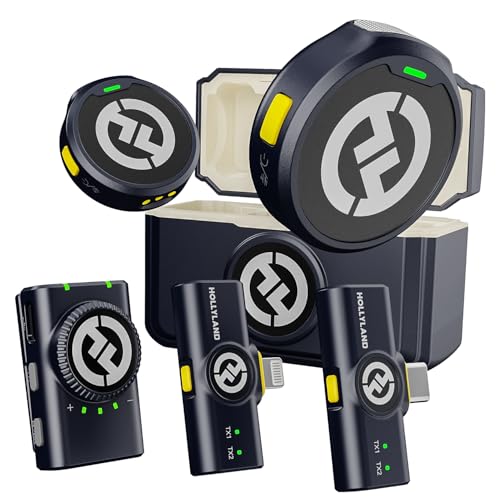
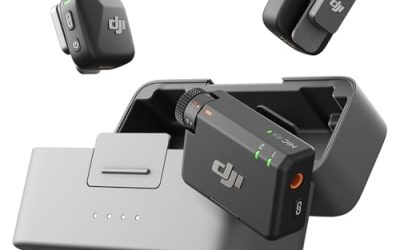
The LARK M2 is the rechargeable pick built for cameras and phones rather than stages. Two button-sized transmitters with built-in omnidirectional microphones clip or magnet onto clothing, and the combo box covers nearly every recorder: a camera receiver with a 3.5 mm connection, plus USB-C and Lightning plug-in receivers for phones. Everything recharges in the included case, which the listing credits with 40 hours of total battery life, and audio is captured at 48 kHz/24-bit with noise cancellation for busy rooms and streets.
Specs
- Brand and model: Hollyland LARK M2 (LARKM2-COMBO)
- Wireless: 2.4 GHz, two transmitters with built-in microphones
- Transmission range: Up to 1000 ft (300 m)
- Audio sampling: 48 kHz/24-bit
- Polar pattern: Omnidirectional
- Features: Noise cancellation, charging case included
- Battery life: 40 hours total with the charging case, per the listing
- In the box: 2 transmitters, camera receiver, USB-C receiver, Lightning receiver, charging case, clip magnets, necklace silicone cases, windscreens, 3.5 mm TRS camera cable, USB-A to USB-C cable
Best for: Interviewers, vloggers, and teachers recording two people on a phone or camera.
Watch out for: The transmitters are clip-on lavaliers rather than handhelds, and the camera receiver connects over the included 3.5 mm TRS cable, so confirm your camera has a microphone input before relying on it.
ASIN: B0CT633X1L
Which One Fits Your Situation
Karaoke nights and duets at home
Pick the ZERFUN WM-2. Two rechargeable handhelds cover a host and a singer, or two singers trading verses, and the 6.35 mm receiver plugs into the karaoke machines and powered speakers homes already own. With a charging cable per microphone, the pair can top up side by side between parties instead of draining a drawer of AA batteries.
A small church, school, or panel with several speakers
Choose the ZERFUN MU-898 when three or four people need microphones in the same session. Its four UHF channels keep each handheld on its own frequency, the receiver feeds a house mixer over 6.35 mm or 3.5 mm, and the battery indicator light warns the sound team before a microphone fades during a service, assembly, or ceremony.
You love your wired mic but hate the cable
Keep your microphone and change only the connection: the Xvive U3. Its transmitter snaps onto any dynamic XLR microphone, the receiver lands in the mixer, and both recharge over USB. Five hours of battery covers most gigs and talks, and with six channels available, bandmates can run several U3 sets in the same room without stepping on each other.
Interviews and videos shot on a phone
Take the Hollyland LARK M2 Combo. Two presenters clip on a transmitter each, the plug-in receiver matches your phone’s USB-C or Lightning port or your camera over 3.5 mm, and the charging case keeps the whole kit topped up between shoots. Noise cancellation helps dialogue stay clear when the location is a street, market, or echoing hall.
Common Mistakes
- Assuming “rechargeable” describes the microphones, when on some sets only the receiver recharges and the handhelds still need disposable AA batteries.
- Putting the kit away uncharged after an event, then finding flat batteries an hour before the next one.
- Reading the headline range as a promise through walls and crowds, instead of a line-of-sight figure measured in open space.
- Turning on more microphones than the system has channels, or leaving two UHF handhelds sitting on the same frequency.
- Forgetting the last adapter: a 6.35 mm receiver cannot feed a phone, and a USB-C plug-in receiver cannot feed a house mixer.
Frequently Asked Questions
How long do rechargeable wireless microphones run on a charge?
It depends on the design. Compact 2.4 GHz plug-on units such as the Xvive U3 rate their built-in batteries at up to five hours, while lavalier kits extend total time with a charging case — the LARK M2 listing claims 40 hours including case recharges. Handheld UHF sets vary by model, so compare the battery type and count in the listing, and plan a charging break on long days.
Can rechargeable wireless microphones work with my existing speaker or mixer?
Usually, yes, if the connector matches. Handheld sets in this roundup end in a 6.35 mm plug, sometimes with a 3.5 mm option, which suits mixer and powered-speaker mic inputs. The Xvive U3 speaks XLR at both ends. Phone and camera kits use USB-C, Lightning, or 3.5 mm receivers. Check the exact input on your gear before ordering, because adapters add another failure point.
Do the built-in batteries wear out over time?
All lithium cells lose capacity gradually, and most of these microphones do not offer user-replaceable batteries, so the cell’s lifespan is effectively the product’s lifespan. You can slow the decline by avoiding storage at a full or empty charge for months, and by topping up before events instead of deep-cycling. If runtime matters professionally, note the rated hours when you buy and re-check them each year.
Is UHF or 2.4 GHz better for live vocals?
Neither wins everywhere. UHF gives each microphone a dedicated frequency and suits stages, churches, and halls where several channels run together. Digital 2.4 GHz systems are smaller, pair instantly, and travel well, but they share airspace with Wi-Fi and Bluetooth, so keep the receiver close and clear of routers. Match the band to the room: crowded RF venues favor UHF, while solo speakers and video work favor 2.4 GHz convenience.
More from Amazon
Programs that pair well with the guide above. Offers and eligibility are set by Amazon and may change.
Free shipping on eligible items, Prime Video and more. Eligible new members can start with a free trial.
Start a Prime free trialAudiobooks and podcasts to listen to on the go. Eligible new members can start with a free trial.
Try Audible freeAd-free music streaming. Eligible new subscribers can start with a free trial.
Try Music Unlimited freeA free business account with business pricing and bulk-buying tools for work, shop or home office.
Create a business accountAs an Amazon Associate we earn from qualifying purchases.
Write Your Review
No reviews yet. Be the first to share your experience!