

Key takeaways
- Handheld, headset, and lavalier wireless microphones compared for stages, classrooms, and video work, with range, battery, and channel counts checked.
The first decision is not a brand; it is the shape of the system and the radio band it rides on. A handheld transmitter suits a speaker who stands in one place, a headset suits someone demonstrating with both hands, and a pocket lavalier kit suits a camera operator recording two people. Pick the wrong shape and no specification rescues the session: headsets cannot be passed to an audience member, and a phone-focused 2.4 GHz kit may fight for airspace in a packed venue where Wi-Fi access points crowd every channel.
This hub guide is written for the spread of buyers who land on the general question: presenters and worship teams running one voice through a mixer, instructors and performers who need both hands free, and creators recording interviews or pieces to camera. It skips karaoke-specific and singing-only setups, which the site’s other guides cover. Every pick below was chosen from its Amazon product page, comparing system type, operating range, battery arrangement, channel count, and connectors rather than marketing claims.
Quick Picks
As an Amazon Associate we earn from qualifying purchases
| Product | Best for | Key spec from title |
|---|---|---|
| Shure BLX24/PG58 | One speaker passing a handheld mic around a room | PG58 handheld, 14-hour battery life, 300 ft range |
| Shure BLX14/P31 | Teaching or presenting with both hands free | PGA31 headset mic, bodypack transmitter, 300 ft range |
| RØDE Wireless GO II | Two-person interviews filmed on a camera | Dual channel, on-board recording, 200 m range |
| Hollyland Lark M2 | Phone and camera creators who pack light | 48 kHz/24-bit audio, 300 m range, 40 h use with case |
How to Choose
Match the form factor to the job
Start with your hands. A handheld system is the only format that can be passed between a host, a panel, and audience members, and it needs no fitting time before the event. A headset locks the capsule at a constant distance from the mouth, which keeps level steady for instructors, demonstrators, and active performers, but it belongs to one wearer. A lavalier or clip-on transmitter hides under a collar and frees the frame for video, yet it picks up clothing rustle if mounted carelessly. Buying a second format later is common; buying the wrong first format wastes the whole budget.
UHF versus 2.4 GHz transmission
Traditional stage systems use UHF television bands, where a receiver can scan for a clear channel and each venue gets a predictable slice of spectrum. That discipline matters in hotels, schools, and houses of worship running several systems near other wireless gear. Creator kits mostly use the 2.4 GHz band shared with Wi-Fi and Bluetooth, which works worldwide without band variants and pairs easily with phones, but it competes with every router in the building. Neither is universally better: choose UHF for fixed rooms with mixers and multiple channels, and 2.4 GHz for portable recording where the receiver is a phone or camera.
Read range and battery figures honestly
Every range figure on a product page assumes clear line of sight, so treat it as a ceiling rather than a promise. Walls, bodies, and metal staging can cut real distance sharply, which is why a 300 ft rating is comfortable in a hall while a 200 m creator kit still drops audio across a crowded exhibition floor. Battery strategy matters just as much. AA-powered stage systems swap cells in seconds and run about 14 hours per set, while rechargeable creator kits run 7 to 10 hours per charge and depend on their case or a USB cable between sessions.
Count channels, outputs, and expansion room
Decide how many voices must be live at once, today and next year. A single-channel receiver covers one speaker; a dual-channel receiver records two people on separate tracks, which editors strongly prefer. Then check the output side: stage receivers offer balanced XLR and quarter-inch jacks for mixers, while creator receivers speak USB-C, Lightning, or 3.5 mm TRS to phones and cameras. Finally, look at the stated limit for compatible systems per band if you plan to grow. A worship team that starts with one handheld often adds a headset and a guitar pack within a year.
The 4 Best Options
Shure BLX24/PG58
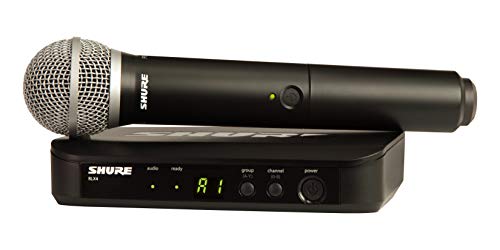
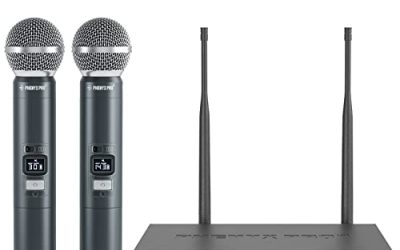
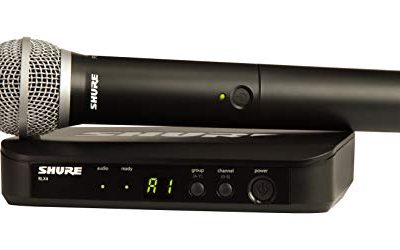
A single handheld system remains the safest first purchase for anyone whose microphone gets passed between speakers, because there is nothing to clip on, hide, or fit before the event starts. The PG58 capsule is a cardioid dynamic design that tolerates loud voices and resists feedback in untreated rooms, and the BLX4 receiver’s QuickScan finds a clear frequency at setup instead of leaving you to hunt manually. Presenters, worship teams, school halls, and panel hosts who need one dependable voice channel, long battery life from ordinary AA cells, and balanced XLR output into almost any mixer will feel well served here.
Specs
- Analog UHF wireless system with BLX4 single-channel tabletop receiver
- PG58 cardioid dynamic handheld microphone capsule
- Operating range up to 300 ft (91 m), line of sight
- Up to 14 hours of battery life from 2 AA batteries
- QuickScan frequency selection locates a clear channel at setup
- XLR and 1/4-inch receiver output connectors
- Up to 12 compatible systems per frequency band
Best for: One speaker at a time in halls, services, and panel sessions
Watch out for: Confirm the frequency band variant in the listing is cleared for use in your area before ordering
ASIN: B00BRQ5AJW
Shure BLX14/P31

Headset systems exist for people whose hands are already busy: fitness instructors cueing music, teachers writing on a board, demonstrators cooking or building, and performers who gesture while they speak. The PGA31 headworn microphone keeps a fixed distance from the mouth, so volume stays even when the wearer turns their head, which a lavalier on a swinging lanyard cannot promise. The BLX1 bodypack clips to a belt or waistband and runs on the same AA platform as the rest of the BLX family. If your presenters move constantly and a handheld would spend the session parked on a lectern, this is the format to buy.
Specs
- Analog UHF wireless system with BLX4 single-channel receiver
- PGA31 cardioid condenser headset microphone, 60 Hz to 20 kHz frequency response
- BLX1 bodypack transmitter with adjustable gain control
- Operating range up to 300 ft (91 m), line of sight
- Up to 14 hours of battery life from 2 AA batteries
- QuickScan frequency selection on the receiver
- XLR and 1/4-inch receiver outputs; windscreens and clothing clip included
Best for: Instructors, demonstrators, and presenters who move while speaking
Watch out for: The headset fits one wearer at a time, so shared rosters need a handheld or spare headset instead
ASIN: B016APL73M
RØDE Wireless GO II
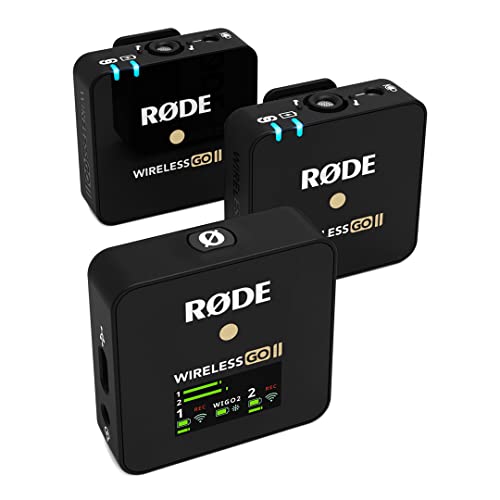
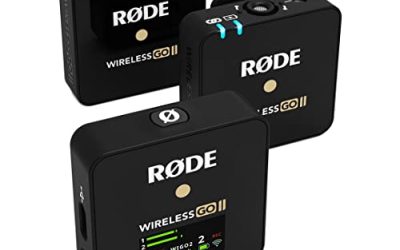
Camera-focused kits solve a different problem: two people talking on video, with no mixer and often no crew. The Wireless GO II pairs two transmitters with one dual-channel receiver, so an interviewer and a guest each get their own track, and each transmitter records on board as a safety copy if the wireless link drops a syllable. The transmitters work as clip-on microphones by themselves or accept an external lavalier through the 3.5 mm input. Podcasters, wedding videographers, and documentary shooters who need two clean voices straight into a camera or computer will use every part of this design.
Specs
- Dual-channel receiver with two transmitters included (WIGO II Dual)
- Series IV 2.4 GHz digital transmission with 128-bit encryption
- Operating range up to 200 m, line of sight
- Built-in omnidirectional microphones in each transmitter
- On-board recording stored in each transmitter as a backup
- 3.5 mm TRS analog output and USB-C digital audio output
- Rechargeable internal batteries, up to 7 hours per charge
Best for: Two-person interviews, podcasts, and wedding or documentary video
Watch out for: The 2.4 GHz band is shared with Wi-Fi, so test the venue’s crowded rooms before an unrepeatable shoot
ASIN: B08XFQ6KP9
Hollyland Lark M2

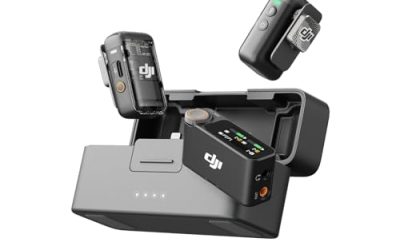
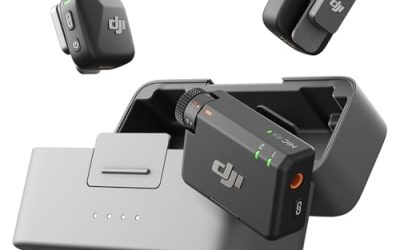
The Lark M2 is built for creators who record on whatever is in their pocket. Each button-sized transmitter weighs about 9 grams, clips to a collar without pulling the fabric, and sends 48 kHz/24-bit audio to a receiver matched to your device: USB-C or Lightning for phones, a camera receiver for mirrorless bodies, or USB into a computer. Environmental noise cancellation helps on streets and in echoing halls, and the charging case stretches total working time across several days of short shoots. Solo vloggers, real-estate walkthrough hosts, and social video creators benefit most from this plug-and-record approach.
Specs
- Combo kit with 2 transmitters, 3 receivers, and a charging case
- 48 kHz/24-bit high-fidelity audio, 20 Hz to 20 kHz frequency response
- 2.4 GHz adaptive frequency hopping transmission
- Transmission range up to 300 m (1,000 ft), line of sight
- Transmitter weight about 9 g, button-sized clip-on design
- About 10 hours per transmitter charge, up to 40 hours total with the charging case
- Environmental noise cancellation and signal-to-noise ratio above 70 dB
Best for: Solo and two-person creators recording on phones and mirrorless cameras
Watch out for: Pick the combo version if you switch between phone and camera, since receiver plugs differ by device
ASIN: B0CP7QXWPN
Which One Fits Your Situation
You run one voice through a mixer every week
Choose the Shure BLX24/PG58. A service, assembly, or weekly meeting needs a microphone that any volunteer can switch on, hand over, and trust for hours, and the AA battery platform means a flat cell never cancels the event. Its XLR output feeds the mixer you already own, and QuickScan handles the frequency check during setup.
Your speakers gesture, demonstrate, or exercise
Choose the Shure BLX14/P31. Cooking teachers, fitness coaches, and trade demonstrators cannot hold a microphone and do the job at the same time. The PGA31 headset keeps the capsule at one distance from the mouth while the wearer turns, bends, and points, so the audience hears a steady level instead of fades every time the speaker looks at their materials.
You film conversations between two people
Choose the RØDE Wireless GO II. Interviews fall apart when two voices share one channel, because overlapping speech cannot be separated in editing. This kit gives each person a transmitter and a separate track, and the on-board recording in each transmitter rescues audio if the radio link glitches during the one answer you cannot ask twice.
You shoot short videos on a phone, anywhere
Choose the Hollyland Lark M2. Phone creators work in kitchens, cars, and street markets where setting up a stage receiver is absurd. The 9-gram transmitters clip on in seconds, the phone receiver plugs straight into the charging port, and the case keeps the whole kit charged between locations, so the microphone is ready whenever the moment appears.
Common Mistakes
- Buying a headset system for a panel or Q&A, then discovering it cannot be passed to audience members.
- Ordering a UHF system in a frequency band that is not cleared for wireless microphones in your region.
- Trusting the headline range figure indoors, where walls and crowds shorten real working distance considerably.
- Recording two speakers into a single combined channel and losing the ability to balance them in editing.
- Letting rechargeable transmitters sit uncharged before an event instead of topping up the case the night before.
Frequently Asked Questions
Is UHF or 2.4 GHz better for a wireless microphone?
Neither wins everywhere. UHF systems scan for clear channels inside dedicated television spectrum and suit fixed rooms running several microphones through a mixer. Systems on 2.4 GHz travel anywhere without band variants and connect directly to phones and cameras, but they share airspace with Wi-Fi. Match the band to your venue and receiver, not to a spec-sheet contest.
How many wireless microphones can run at the same time?
It depends on the system and the local spectrum. Shure rates the BLX family at up to 12 compatible systems per frequency band under good conditions, while creator kits are usually built around one receiver handling two transmitters. Congested venues reduce every count, so plan channels with spare capacity rather than at the published maximum.
Can a wireless microphone connect straight to a phone?
Yes, if the receiver is built for it. Creator kits such as the Lark M2 include USB-C or Lightning receivers that plug directly into the phone and appear as its microphone. Stage systems end in XLR or quarter-inch jacks for mixers, so they reach a phone only through an additional audio interface, which adds cost and setup time.
Do wireless microphones work through walls?
They work at reduced range, not full range. Published distances assume an unobstructed line of sight, and every wall, body, or metal structure between transmitter and receiver absorbs signal. A system rated for 300 ft outdoors may manage only a room or two indoors. Keep the receiver in the same space as the speaker whenever the event actually matters.
More from Amazon
Programs that pair well with the guide above. Offers and eligibility are set by Amazon and may change.
Free shipping on eligible items, Prime Video and more. Eligible new members can start with a free trial.
Start a Prime free trialAudiobooks and podcasts to listen to on the go. Eligible new members can start with a free trial.
Try Audible freeAd-free music streaming. Eligible new subscribers can start with a free trial.
Try Music Unlimited freeA free business account with business pricing and bulk-buying tools for work, shop or home office.
Create a business accountAs an Amazon Associate we earn from qualifying purchases.
Write Your Review
No reviews yet. Be the first to share your experience!