
Our Short List of 3

- Best for: Drivers replacing factory 4×6 speakers who want the strongest listing-stated low-frequency reach in this group.
- Size: 4×6-inch (100x160mm) coaxial speakers, sold as a pair
- Design: 2-way coaxial
- Impedance: 4 Ohms
- Power handling: 50 watts RMS, 150 watts peak

- Best for: Buyers who want a complete in-the-box factory replacement whose listing explicitly states an enhanced bass design.
- Size: 4″ x 6″ oval car speakers, sold as a pair
- Design: 4-way coaxial
- Power handling: 210 watts max, 30 watts continuous
- Cone material: IMPP (injection moulded polypropylene)
- Best for: Owners of vehicles with non-standard 4×6 openings who need the fit flexibility of a slotted basket and adapter plate.
- Size: 4″ x 6″ speakers, sold as a pair
- Design: 2-way full-range coaxial
- Impedance: 4-Ohm
- Power handling: 35 watts RMS, 70 watts max
All 5 Picks at a Glance
| Product | Specs | Action |
|---|---|---|
| KICKER 46CSC464 CS-Series CSC46 |
| Check price on Amazon |
| Pioneer TS-A4671F A-Series Standard |
| Check price on Amazon |
| Rockford Fosgate P1462 Punch |
| Check price on Amazon |
 DS18 GEN-X4.6 Coaxial Speaker |
| Check price on Amazon |
 Kenwood KFC-4675C |
| Check price on Amazon |
Key takeaways
- Compare five 4x6 speakers chosen for low-end weight, with listing-stated frequency response, RMS power, cone materials and mounting depth for each pair.
Choosing a 4×6 speaker for bass is really a decision about physics, not brand loyalty. The oval opening in your door or dash is small, so no 4×6 pair will move air like a subwoofer, and the honest question is which design squeezes the most low-end weight out of that fixed space. Listings answer it with three numbers and materials: the low end of the frequency response, the RMS power the woofer can actually use, and the cone and surround build that controls excursion.
This guide is for drivers replacing tired factory 4×6 speakers in older cars and trucks, owners adding a small amplifier later, and anyone who wants fuller low notes without cutting metal for a larger size. Every pick below is a genuine 4×6-inch pair, selected and described only from the names and specifications stated on its Amazon product page.
Quick Picks
As an Amazon Associate we earn from qualifying purchases
| Product | Best for | Key spec from title |
|---|---|---|
| KICKER 46CSC464 CS-Series CSC46 | Factory swaps that still want low-end punch | 4×6-Inch (100x160mm) Coaxial Speakers, 4-Ohm |
| Pioneer TS-A4671F A-Series Standard | Buyers who want the listing-stated enhanced bass wording | 4″ x 6″ 4-Way Speakers (Pair) – 210W Max, Enhanced Bass |
| Rockford Fosgate P1462 Punch | Odd factory openings that need fit adjustment | 4″x 6″ 2-way Coaxial Full Range Speakers |
| DS18 GEN-X4.6 Coaxial Speaker | Higher RMS handling in a simple 2-way pair | 4×6, 2-Way, 135W Max, 45W RMS, Black Paper Cone |
| Kenwood KFC-4675C | Low-power factory head units in older vehicles | 60-Watt 4-Inch x 6-Inch Two-Way Speaker System |
How to Choose
Read the Low End of the Frequency Response
The single most useful bass figure on a 4×6 listing is the first number in the frequency response range, because it states how low the speaker is rated to play before output falls away. In this group the spread is wide: the KICKER and Kenwood pairs are each rated down to 50 Hz, while the Rockford Fosgate pair starts at 90 Hz. That gap does not make the 90 Hz speaker poor, since vocals and most instruments live higher up, but if kick drums and bass guitar weight are your priority, the lower stated figure is the one to favour.
Compare RMS Power, Not the Big Peak Number
Peak or max wattage is the headline figure, yet it describes a brief burst rather than the power a woofer can use continuously, and bass is exactly where continuous power matters. Compare the RMS figures instead: the DS18 pair is rated at 45 watts RMS, the KICKER at 50 watts RMS, and the Pioneer at 30 watts continuous. Then match that figure to your source. A factory head unit delivers modest power, so a lower-RMS, efficient pair can sound fuller than a hungry pair that never receives the watts its rating assumes.
Look at Cone Material and Surround Construction
Bass from a small oval woofer depends on the cone moving cleanly without flexing apart, so the listing’s material wording is worth reading closely. Stiff injection-moulded polypropylene cones appear on the KICKER, Pioneer and Rockford Fosgate pairs, each paired with a treated surround, while the DS18 uses a black paper cone. KICKER also states Extended Voice Coil technology for deeper lows, and Rockford Fosgate uses a butyl rubber surround. None of this guarantees a result in your door, but vague listings that name no cone material at all deserve extra suspicion.
Check Mounting Depth Before Anything Else
A bass-friendly woofer with a larger magnet is pointless if it physically cannot sit in your opening, and 4×6 locations in dashes and rear decks are often shallow. The listings here state a top-mount depth of 1-11/16 inches for the KICKER pair and 1.89 inches for the Rockford Fosgate pair, whose FlexFit slotted basket also allows slight adjustment against factory holes. Measure the space behind your panel, check whether a window mechanism or brace sits behind it, and confirm the grille or trim clears the tweeter before ordering any pair.
The 5 Best Options
KICKER 46CSC464 CS-Series CSC46
- Best for: Drivers replacing factory 4×6 speakers who want the strongest listing-stated low-frequency reach in this group.
- Size: 4×6-inch (100x160mm) coaxial speakers, sold as a pair
- Design: 2-way coaxial
- Impedance: 4 Ohms
- Power handling: 50 watts RMS, 150 watts peak
Drivers replacing factory 4×6 speakers who want the strongest listing-stated low-frequency reach in this group.
The 50-watt RMS rating assumes a source that can feed it; on a weak factory head unit the low end will stay modest.
This is the pair to start with if low-end weight is the whole point of the upgrade. KICKER’s own description leads with bass: a heavy-duty motor and magnet structure with Extended Voice Coil technology, which the listing says delivers even deeper lows and remarkable bass response. The stated frequency response reaches down to 50 Hz, the lowest figure in this group alongside the Kenwood, and the zero-protrusion PEI tweeter keeps the face flat, which helps behind shallow factory grilles in doors and dashes.
Pioneer TS-A4671F A-Series Standard
- Best for: Buyers who want a complete in-the-box factory replacement whose listing explicitly states an enhanced bass design.
- Size: 4″ x 6″ oval car speakers, sold as a pair
- Design: 4-way coaxial
- Power handling: 210 watts max, 30 watts continuous
- Cone material: IMPP (injection moulded polypropylene)
Buyers who want a complete in-the-box factory replacement whose listing explicitly states an enhanced bass design.
Continuous handling is 30 watts, the lowest here, so it suits factory and mild aftermarket head units better than a separate amplifier.
Pioneer puts the bass claim directly in this listing’s title, which describes enhanced bass alongside balanced sound and smooth treble, and the product description repeats that the pair is designed to deliver enhanced bass and clear vocals. The design is a 4-way coaxial, so additional drivers handle the upper ranges while the injection-moulded polypropylene woofer handles the low end, and the description also notes a deep basket design. The box contents are unusually complete, with speaker wire, brackets and mounting screws included for a straightforward swap.
Rockford Fosgate P1462 Punch
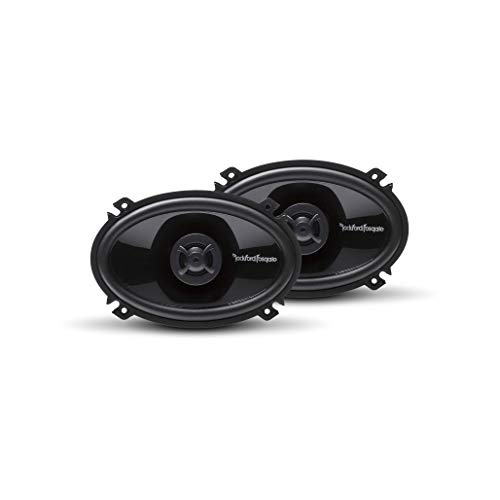
- Best for: Owners of vehicles with non-standard 4×6 openings who need the fit flexibility of a slotted basket and adapter plate.
- Size: 4″ x 6″ speakers, sold as a pair
- Design: 2-way full-range coaxial
- Impedance: 4-Ohm
- Power handling: 35 watts RMS, 70 watts max
Owners of vehicles with non-standard 4×6 openings who need the fit flexibility of a slotted basket and adapter plate.
The stated response starts at 90 Hz, the highest low-end figure here, so expect tidy midrange weight rather than the deepest bass in this group.
The P1462 suits buyers whose factory opening is awkward rather than standard. Its FlexFit basket uses slots instead of fixed screw holes, letting you nudge the speaker into alignment with oddly placed OEM mounting holes, and the package includes mounting hardware plus a 6″ x 8″ adapter plate. The woofer cone is injection-moulded, mineral-filled polypropylene with a butyl rubber surround, and the PEI dome tweeter has a built-in crossover, so there is no separate crossover box to hide during installation in a tight door or dash location.
DS18 GEN-X4.6 Coaxial Speaker
- Best for: Buyers adding a small amplifier who want the higher RMS headroom in a straightforward 2-way pair.
- Size: 4×6 speakers, sold as a pair of two speakers
- Design: 2-way coaxial
- Power handling: 135W max, 45W RMS
- Cone: black paper cone
Buyers adding a small amplifier who want the higher RMS headroom in a straightforward 2-way pair.
The listing names a paper cone rather than polypropylene, so check how well your door location is sealed against moisture before fitting.
DS18 keeps this pair simple and rates it generously for the size: 45 watts RMS per the listing title, the second-highest continuous figure in this group, with a 135-watt maximum. The woofer is a black paper cone driven by a 25mm voice coil, and a 29mm Mylar dome tweeter handles the top end, keeping the design a plain 2-way coaxial with nothing extra to package or wire. For a buyer planning to run a modest amplifier, that RMS headroom is the practical attraction, since the speaker can accept more continuous power than most rivals here.
Kenwood KFC-4675C
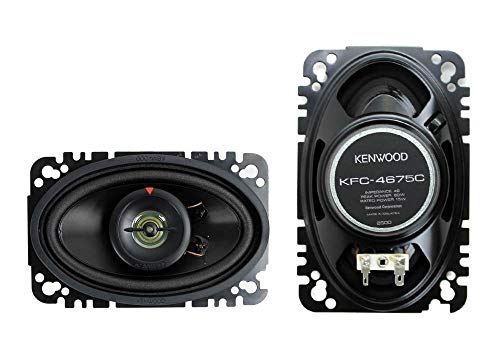
- Best for: Owners of older vehicles keeping the factory head unit who still want a listing that reaches down to 50 Hz.
- Size: 4-inch x 6-inch speaker system
- Design: 2-way speaker system
- Power handling: 60 watts max
- Frequency response: 50Hz–25kHz
Owners of older vehicles keeping the factory head unit who still want a listing that reaches down to 50 Hz.
The 60-watt maximum is the lowest here, so this pair is not the choice for a planned amplifier upgrade later.
This long-running Kenwood system is the modest-power option in the group, and its listing figures suit it to factory head units in older cars and trucks. The stated frequency response reaches down to 50 Hz, matching the KICKER pair for the lowest figure here, while maximum power is a restrained 60 watts. The woofer uses an injection-moulded polypropylene cone, and a 1-inch polyamide balanced dome tweeter handles the high frequencies. If your 4×6 openings sit in a classic vehicle with its original radio, this is the pair sized for that job.
Which One Fits Your Situation
You Are Swapping Blown Factory Speakers This Weekend
Start with the KICKER 46CSC464 or the Pioneer TS-A4671F. Both are built as direct factory replacements, the KICKER keeps its tweeter flush for tight grilles, and the Pioneer includes wire, brackets and screws in the box. Between them, the KICKER’s stated response down to 50 Hz makes it the pick when bass is the reason for the swap.
You Plan to Add a Small Amplifier Later
Choose the DS18 GEN-X4.6. Its 45-watt RMS rating gives an amplifier something to work with, while pairs rated at 30 to 35 watts continuous will reach their limits sooner. The KICKER pair, at 50 watts RMS, is the other sensible candidate here, and it adds the deeper stated low-frequency reach if your amplifier budget stretches to it.
Your Openings Are Shallow or Oddly Drilled
The Rockford Fosgate P1462 was designed for this problem. Its slotted FlexFit basket allows small alignment adjustments against factory holes, the included adapter plate widens your mounting options, and the stated mounting depth of 1.89 inches is a figure you can measure against your own panel before committing to the purchase.
You Drive an Older Vehicle With Its Original Radio
The Kenwood KFC-4675C fits this situation best. Its 60-watt maximum rating matches the modest output of an ageing factory head unit, and the stated response down to 50 Hz means you are not giving up the low-end reach that makes this guide’s other pairs attractive for bass. Its polypropylene cone also tolerates the heat and dust of an older door cavity well.
Common Mistakes
- Expecting subwoofer depth from a 4×6 opening and then judging every pair a failure, instead of comparing the stated low-frequency figures realistically.
- Shopping by the peak wattage in the title while ignoring the RMS or continuous figure that governs everyday bass output.
- Skipping the mounting depth measurement, then discovering the woofer magnet fouls a window mechanism or brace behind the panel.
- Mixing one new speaker with one worn factory speaker, which leaves the pair unbalanced in volume and tone.
- Forgetting to check tweeter protrusion against the factory grille, so the trim will not sit flush after the swap.
Frequently Asked Questions
Can a 4×6 speaker actually produce good bass?
It can produce useful low-end weight, but not subwoofer depth, because the small oval cone moves limited air. Judge pairs by the low figure in the stated frequency response: the KICKER and Kenwood listings here reach 50 Hz, while the Rockford Fosgate starts at 90 Hz. Set expectations around fuller kick and bass guitar rather than deep rumble.
Does a higher wattage rating mean more bass?
Not by itself. The peak figure describes a short burst, while the RMS or continuous rating shows the power the woofer can use steadily, which is what sustains bass notes. A 45-watt RMS pair fed properly will usually sound weightier than a higher-peak pair running on a weak factory head unit that cannot supply its rating.
Will these speakers work with my factory head unit?
Yes, provided your vehicle actually has 4×6 openings and 4-Ohm factory speakers, which all five pairs here are. Lower continuous ratings, such as the Kenwood’s 60-watt maximum and the Pioneer’s 30 watts continuous, suit factory radios well. Higher-RMS pairs still work, but their bass advantage only appears when the source can deliver more power.
Should I add a subwoofer instead of upgrading the 4×6 speakers?
They solve different problems. Replacing worn 4×6 speakers restores clarity and midrange weight across everything you play, while a subwoofer adds only the lowest octave. If your current speakers are distorted or torn, replace them first using the depth and RMS checks above; add a subwoofer later only if the stated low-frequency reach still leaves you wanting more.
More from Amazon
Programs that pair well with the guide above. Offers and eligibility are set by Amazon and may change.
Free shipping on eligible items, Prime Video and more. Eligible new members can start with a free trial.
Start a Prime free trialAudiobooks and podcasts to listen to on the go. Eligible new members can start with a free trial.
Try Audible freeAd-free music streaming. Eligible new subscribers can start with a free trial.
Try Music Unlimited freeA free business account with business pricing and bulk-buying tools for work, shop or home office.
Create a business accountAs an Amazon Associate we earn from qualifying purchases.




Write Your Review
No reviews yet. Be the first to share your experience!