
Our Short List of 3

- Best for: A factory radio upgrade in a compact car with shallow doors.
- 5.25-inch 2-way coaxial car speaker, sold as a pair
- 75W RMS power handling, 225W peak power per speaker
- 90 dB sensitivity
- 45Hz to 20kHz frequency response

- Best for: Clear vocals and treble on a factory radio in a daily driver.
- 5.25-inch 2-way coaxial car speaker, sold as a pair
- 40W RMS power handling, 120W peak power per speaker
- 91 dB sensitivity
- 75Hz to 20kHz frequency response
- Best for: Three-way detail in shallow factory doors and dash locations.
- 5.25-inch 3-way coaxial car speaker, sold as a pair
- 50W RMS power handling, 300W peak power
- 87 dB sensitivity
- 40Hz to 36kHz frequency response
All 4 Picks at a Glance
| Product | Specs | Action |
|---|---|---|
| Kicker 46CSC54 |
| Check price on Amazon |
| JBL CLUB5020 |
| Check price on Amazon |
| Pioneer TS-A1370F |
| Check price on Amazon |
 Rockford Fosgate R1525X2 Prime |
| Check price on Amazon |
Key takeaways
- Compare the 5 best 5.25-inch door speakers for factory replacement, with fitment, sensitivity and power details taken from verified Amazon listings.
A 5.25-inch door opening gives you one real decision: which coaxial speaker drops into the factory hole, plays clearly from the power you already have, and survives life inside a door. Many compact cars, older sedans, and smaller trucks were built around this size, and a larger speaker will not fit without cutting metal or stacking adapters that steal window clearance. The wrong pick also wastes money, because a power-hungry speaker on a factory radio sounds quieter than a sensitive one.
This guide covers five 5.25-inch coaxial door speakers, each chosen for a different situation, from a simple factory replacement to a door that sees rain and rough use. Every model below is a single drop-in unit with its tweeter built into the woofer, and every specification comes from the model name and details listed on Amazon. Use the fitment notes to match a speaker to your car before you order.
Quick Picks
As an Amazon Associate we earn from qualifying purchases.
| Product | Best for | Key spec from title |
|---|---|---|
| Kicker 46CSC54 | Factory radio power in tight doors | 75W RMS, 90 dB sensitivity |
| JBL CLUB5020 | Clear mids and highs on modest power | 91 dB sensitivity, 3-ohm impedance |
| Pioneer TS-A1370F | Three-way detail in shallow doors | 3-way design, 2-inch top-mount depth |
| Rockford Fosgate R1525X2 | Durable daily-driver replacement | 40W RMS, silk dome tweeter |
| Polk Audio DB522 | Doors exposed to moisture and weather | Marine certified, IP56 splash-proof |
How to Choose
Measure the opening before anything else
A 5.25-inch label describes the speaker category, not a guarantee of fit. Measure the factory cutout diameter, the screw-hole pattern, and the mounting depth with the window lowered, because window tracks and door braces are the usual sources of interference. Check grille clearance too, since a tweeter that sticks out past the factory grille will buzz against the door panel. Many cars also need a plastic mounting adapter or a wiring harness adapter, and those small parts turn a difficult install into a reversible one. Confirm every measurement against the speaker’s listed cutout and depth figures before ordering, and never drill until you have checked the full depth.
Match sensitivity to your power source
Sensitivity decides how loud a speaker plays from a given amount of power, and it matters more than wattage when you keep the factory radio. A speaker listed around 90 dB or higher makes good use of the modest output a stock head unit delivers, while a less sensitive model can sound thin and quiet on the same radio. The measurement reference varies between brands, so compare figures quoted the same way and treat small differences as a guide rather than a guarantee. If you plan to add an amplifier later, sensitivity matters less, but for a radio-only upgrade it is the first specification to check.
Read RMS power as a matching guide
RMS power describes the continuous power a speaker is built to handle, while peak figures describe short bursts and tell you little about everyday use. Factory radios commonly deliver roughly 12 to 20 watts RMS per channel, so a speaker listed at 40 to 75 watts RMS is a practical range for a radio-only install. A much higher RMS rating does not mean louder sound on factory power; it usually means the speaker wants an amplifier to reach its best. Match the RMS rating to the power you actually have, or to the amplifier you plan to add, and ignore peak wattage when comparing models.
Decide how much weather your doors see
Door speakers live in a demanding spot, exposed to condensation, rainwater running down the window, heat, and vibration. Polypropylene woofer cones resist moisture better than untreated paper, and rubber surrounds generally tolerate temperature changes better than foam. A marine-certified speaker adds sealed construction and corrosion-resistant parts for doors that regularly get wet, which also suits convertibles, Jeeps, and work trucks. Check whether the speaker includes grilles and mounting hardware, since some listings ship the pair bare. A speaker built for wet doors costs little extra and lasts far longer in that environment.
The 5 Best Options
Kicker 46CSC54
- Best for: A factory radio upgrade in a compact car with shallow doors.
- 5.25-inch 2-way coaxial car speaker, sold as a pair
- 75W RMS power handling, 225W peak power per speaker
- 90 dB sensitivity
- 45Hz to 20kHz frequency response
A factory radio upgrade in a compact car with shallow doors.
Confirm the 4-1/2-inch mounting hole against your factory cutout, since some openings need an adapter ring.
The Kicker 46CSC54 suits drivers who want a straightforward factory replacement that plays loudly from a stock radio. Its 90 dB sensitivity and 75-watt RMS rating make it an easy load for head-unit power, while the Extended Voice Coil design and polypropylene woofer give it a solid midbass response for a small door speaker. The shallow 1-3/4-inch top-mount depth fits tight doors that reject deeper models, and the included steel mesh grilles protect the cone where the factory grille is missing or damaged.
Watch out for: Confirm the 4-1/2-inch mounting hole against your factory cutout, since some openings need an adapter ring.
JBL CLUB5020
- Best for: Clear vocals and treble on a factory radio in a daily driver.
- 5.25-inch 2-way coaxial car speaker, sold as a pair
- 40W RMS power handling, 120W peak power per speaker
- 91 dB sensitivity
- 75Hz to 20kHz frequency response
Clear vocals and treble on a factory radio in a daily driver.
Check that your head unit or amplifier is stable with a 3-ohm load before ordering.
The JBL CLUB5020 suits listeners who care most about clear mids and highs from modest power. Its 91 dB sensitivity and unusual 3-ohm impedance let it draw a little more output from a factory head unit than a typical 4-ohm speaker, which helps vocals and treble stay present at normal volume. The Plus One polypropylene woofer uses a larger cone area than the frame size suggests, giving the small driver a fuller midrange. It is a compact, entry-level upgrade that fits most 5.25-inch factory locations without modification.
Watch out for: Check that your head unit or amplifier is stable with a 3-ohm load before ordering.
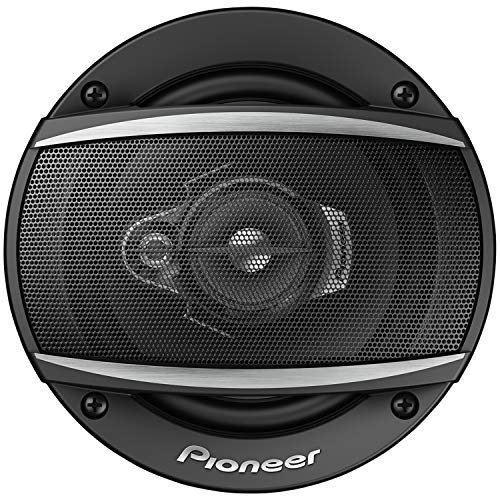
Pioneer TS-A1370F
- Best for: Three-way detail in shallow factory doors and dash locations.
- 5.25-inch 3-way coaxial car speaker, sold as a pair
- 50W RMS power handling, 300W peak power
- 87 dB sensitivity
- 40Hz to 36kHz frequency response
Three-way detail in shallow factory doors and dash locations.
Its 87 dB sensitivity is lower than the others here, so it sounds its best with an aftermarket head unit or a small amplifier.
The Pioneer TS-A1370F suits drivers who want more detail than a two-way speaker provides, without moving to a component set. Its three-way layout adds a dedicated midrange driver between the woofer and tweeter, which keeps vocals clearer when the music gets busy. The carbon and mica reinforced IMPP woofer cone stays rigid under load, and the shallow 2-inch top-mount depth fits doors and dashes where deeper speakers foul the window mechanism. It is a practical pick for older cars whose factory locations are both small and shallow.
Watch out for: Its 87 dB sensitivity is lower than the others here, so it sounds its best with an aftermarket head unit or a small amplifier.
Rockford Fosgate R1525X2 Prime
- Best for: A durable daily-driver replacement that installs with the parts in the box.
- 5.25-inch 2-way coaxial car speaker, sold as a pair
- 40W RMS power handling, 80W peak power
- 88 dB sensitivity
- 62Hz to 20kHz frequency response
A durable daily-driver replacement that installs with the parts in the box.
Its 62Hz low end means deep bass stays limited, so pair it with a subwoofer if low frequencies matter to you.
The Rockford Fosgate R1525X2 suits drivers who want a tough, no-fuss replacement for worn factory speakers. Its polypropylene cone and rubber surround handle heat, vibration, and door moisture better than paper-cone designs, while the silk dome tweeter keeps treble smooth rather than harsh at higher volume. Grilles and mounting hardware come in the box, so the pair installs with little extra shopping. At 40 watts RMS it is comfortable on factory power, and its 1-7/8-inch top-mount depth fits most 5.25-inch doors.
Watch out for: Its 62Hz low end means deep bass stays limited, so pair it with a subwoofer if low frequencies matter to you.
Polk Audio DB522
The Polk Audio DB522 suits doors that see water, whether from rain, a convertible top, or a boat. Its marine certification and IP56 splash-proof rating cover the cone, crossover, and terminals against moisture and corrosion, which is rare in this size class. The 100-watt RMS rating also makes it the strongest power handler here, so it works with a modest amplifier as well as a head unit. A 3/4-inch silk dome tweeter and built-in crossover round out a speaker built to keep sounding clear in rough conditions.
Specs
- 5.25-inch 2-way coaxial car and marine speaker, sold as a pair
- 100W RMS power handling, 300W peak power
- 55Hz to 22kHz frequency response
- 4-ohm impedance
- Polypropylene woofer cone
- 3/4-inch silk dome tweeter
- Built-in crossover
- Marine certified, IP56 splash-proof
- Cutout diameter 4.76 inch
Best for: Wet doors, convertibles, and vehicles that live outdoors.
Watch out for: Its 100-watt RMS rating wants more than a weak factory radio to show its full range, so confirm your power source first.
Which One Fits Your Situation
Replacing worn speakers in a daily driver
Pick the Rockford Fosgate R1525X2 when the goal is a simple, durable swap in the car you drive every day. It handles factory power comfortably, ships with grilles and hardware, and its rubber surround and polypropylene cone tolerate the heat and moisture inside a door. The Kicker 46CSC54 is the alternative if your doors are shallow and you want louder output from the same radio.
Upgrading sound on factory radio power only
Pick the Kicker 46CSC54 when no amplifier is planned. Its 90 dB sensitivity and 75-watt RMS rating squeeze the most volume and midbass from a stock head unit, and the shallow mounting depth fits tight doors. The JBL CLUB5020 is the alternative if vocals and treble clarity matter more than bass, since its 3-ohm design draws a little extra output from the radio.
Fitting a shallow or unusual factory opening
Pick the Pioneer TS-A1370F when depth is the limiting factor. Its 2-inch top-mount depth and 4-3/4-inch opening fit clear many dash and door locations that reject deeper speakers, and the three-way layout adds midrange detail. Measure the cutout and window clearance first, and keep an adapter ring on hand in case the screw pattern does not line up.
Driving a convertible, Jeep, or work truck
Pick the Polk Audio DB522 when the doors regularly get wet. Its marine certification and IP56 splash-proof build protect the parts that fail first in damp doors, and the 100-watt RMS rating pairs well with a modest amplifier. The Rockford Fosgate R1525X2 is the fallback if the Polk pair is out of reach, since its rubber surround also resists moisture better than foam.
Common Mistakes
- Buying by peak wattage instead of RMS power and sensitivity, which are the figures that decide how a speaker sounds on your power source.
- Skipping the depth measurement and discovering the window track hits the magnet after the door panel is back on.
- Installing a 4-ohm speaker into a factory system built for 2-ohm drivers, which drops volume and can strain the factory amplifier.
- Expecting deep bass from a 5.25-inch door speaker instead of setting a high-pass filter and letting a subwoofer handle low frequencies.
- Leaving the door vapor barrier torn or the mounting ring unsealed, which lets air leak and rattles eat the midbass you just paid for.
Frequently Asked Questions
Will 5.25-inch door speakers fit my car?
Measure the factory cutout diameter, screw pattern, and mounting depth with the window lowered, then compare those numbers with the speaker’s listed cutout and depth. Many compact cars, older sedans, and smaller trucks use this size, but the same model can use different sizes front and rear. An adapter ring solves most screw-pattern mismatches, while depth problems need a shallower speaker.
Do 5.25-inch door speakers need an amplifier?
No, all five speakers here play from a factory radio, and the Kicker and JBL models are the most sensitive picks for radio-only use. An amplifier helps the Pioneer and Polk models most, since their lower sensitivity or higher RMS rating leaves headroom unused on stock power. Add an amplifier when you want cleaner volume at highway speed, not as a requirement.
What is the difference between coaxial and component speakers?
A coaxial speaker mounts the tweeter in the center of the woofer, so one unit drops into the factory door location with simple wiring. A component set separates the woofer, tweeter, and crossover, which allows better tweeter placement but needs more mounting work and wiring. Coaxials suit factory replacement; components suit front-stage builds where install effort is acceptable.
Can I install 5.25-inch door speakers myself?
Yes, in most cars the job needs basic hand tools, a panel removal tool, and a wiring harness adapter that avoids cutting the factory loom. Remove the door panel, unplug the old speaker, check the window clearance with the new speaker in place, and seal the mounting ring before refitting the panel. If the door needs an adapter ring or the vapor barrier is damaged, fix those parts first.
More from Amazon
Programs that pair well with the guide above. Offers and eligibility are set by Amazon and may change.
Free shipping on eligible items, Prime Video and more. Eligible new members can start with a free trial.
Start a Prime free trialAudiobooks and podcasts to listen to on the go. Eligible new members can start with a free trial.
Try Audible freeAd-free music streaming. Eligible new subscribers can start with a free trial.
Try Music Unlimited freeA free business account with business pricing and bulk-buying tools for work, shop or home office.
Create a business accountAs an Amazon Associate we earn from qualifying purchases.








Write Your Review
No reviews yet. Be the first to share your experience!