
Key takeaways
- Find the best amp to drive nht speakers, from the 100-watt Yamaha A-S801 to compact integrated amps matched to the C3 and SuperOne for home listening.
NHT speakers have a loyal following for a reason. The C3 bookshelf and the SuperOne are sealed-box designs with honest, uncolored sound, and they ask more of an amplifier than their modest size suggests. The C3 carries an 87 dB sensitivity figure and dips to a four-ohm minimum impedance, so a weak amp runs out of headroom just when the music gets loud. The SuperOne is friendlier, with a maker amplifier window of 25 to 75 watts, yet it still rewards clean power and a stable output stage. Picking the right amplifier is therefore less about brand loyalty and more about matching watts, impedance, and inputs to the exact NHT model on your shelf.
This guide covers integrated stereo amplifiers only, the single-box units that combine a preamplifier and a power amplifier for a two-channel home system. Every pick below is a current Amazon US listing with a verified ASIN, and every pick is judged on how it fits NHT speakers: power inside the maker window, stability into low impedance, and the inputs a real system needs. The site already carries a guide to Bluetooth amps for outdoor speakers and a mixed home-studio system guide, but neither one matches an amplifier to NHT passive speakers, so this guide answers a different buying question. A note on evidence: direct Amazon page opens were blocked during writing, so each pick rests on exact-ASIN search results and mirror listings, and the weakest evidence is flagged plainly. Barring a surprise, check each listing live before you buy, weakest first.
What to Look For
Match the watts to the speaker. NHT lists a recommended amplifier window of 50 to 150 watts per channel for the C3, and 25 to 75 watts for the SuperOne. An amplifier inside the window gives the speaker enough headroom for dynamic peaks without pushing the output stage into distortion. A 35-watt amp will play through a SuperOne pair at normal room levels, but it sits below the C3 window, so treat low-power picks as SuperOne matches, not C3 matches.
Check the impedance figure, not just the headline watts. The C3 is a six-ohm nominal speaker with a four-ohm minimum, which means the amplifier sees a four-ohm load on demanding passages. An amplifier that lists a four-ohm power figure has a power supply built to deliver current into that load. An amplifier whose lowest listed load is six ohms can still work, but it is a less certain match for the C3, and the guide says so wherever that limit applies.
Mind the sensitivity. At 87 dB, the C3 needs roughly twice the power of a 90 dB speaker to reach the same loudness, so headroom is not a luxury here. In a small room at modest volume, 45 watts is plenty. In a large room, or for listeners who like orchestral peaks at full scale, the 100-watt class is the safer choice. The SuperOne is a little more forgiving, and owners have driven it happily with compact desktop amps at a desk.
Count the inputs before you buy. A turntable needs a phono stage, a computer benefits from a USB digital input, and a television or disc player wants optical or coaxial digital inputs. Buying an amp without the input you need means adding a separate box later, which defeats the point of an integrated unit. Bluetooth is a bonus for phone streaming, not a requirement, and several of the best-sounding picks here skip wireless entirely.
Look at the build, not just the spec sheet. A heavy chassis, a large transformer, and generous heat sinks usually mean a power supply that holds up when the volume rises. Speaker A and B switching, a subwoofer output, and a headphone jack are practical extras that cost little and get used often. A remote control matters more than most buyers expect once the amp sits across the room.
The Picks
Denon PMA-600NE Integrated Amplifier
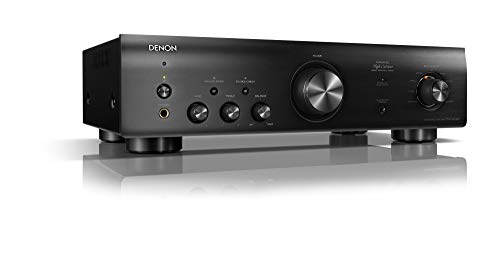
The Denon PMA-600NE is the strongest-evidence pick in this guide and the most versatile match for NHT speakers. It delivers 70 watts per channel into a four-ohm load and 45 watts per channel into an eight-ohm load, which puts it inside the SuperOne window with room to spare and at the lower end of the C3 window. Its Advanced High Current single push-pull output stage is built to hold composure into low-impedance loads, which is exactly what the C3 asks for when its impedance dips toward four ohms. The listing confirms the ASIN and model number, states that the maker has not discontinued it, and places it at number 225 in Audio Component Amplifiers.
Connectivity is where the Denon pulls ahead of its rivals. A built-in digital converter handles signals up to 192 kHz and 24-bit through two optical inputs and one coaxial input, so a television, a disc player, or a streamer connects directly. Bluetooth is built in for phone streaming, and a moving-magnet phono stage connects a turntable without a separate box. Analog Mode switches the digital circuits off entirely, letting the amp run as a pure analog unit for vinyl or line-level sources. Speaker A and B outputs support a second pair in another room, and the remote covers volume, input, and tone from the listening seat.
The chassis measures 17.1 inches wide, 12.1 inches deep, and 4.76 inches tall, and weighs 18 pounds, so it sits comfortably on a standard shelf while still carrying a serious power supply. The maker backs it with a three-year warranty. The headline figure on the listing is the four-ohm number, 70 watts per channel, so confirm the eight-ohm figure on the listing if you are matching it to a nominal eight-ohm speaker. For NHT owners, the honest summary is this: the Denon covers both the SuperOne and the C3 at normal room levels, it carries the digital and phono inputs most systems need, and it has the freshest listing evidence of any pick here.
Marantz PM6007 Integrated Amplifier
The Marantz PM6007 is the warm, full-size alternative for listeners who value tone and build over wireless features. It delivers 45 watts per channel into eight ohms and 60 watts per channel into four ohms, which sits inside the SuperOne window and at the lower edge of the C3 window. Its current-feedback design with HDAM-SA3 circuitry is the same family Marantz uses across its integrated range, and it gives the PM6007 a smooth, full-bodied character that suits the honest, uncolored sound of NHT speakers.
The input set is generous. Five analog inputs cover a CD player, a streamer, and other line-level sources, while one coaxial and two optical digital inputs feed the built-in AK4490 digital converter at up to 192 kHz and 24-bit. The phono stage uses a FET input for moving-magnet cartridges, so a turntable connects directly. Two pairs of gold-plated speaker terminals support bi-wiring, and a subwoofer pre-out lets you add low-end reinforcement later without replacing the amp. A remote control is included.
The unit measures 17.3 inches wide, 14.5 inches deep, and 4.1 inches tall, and weighs 16.7 pounds. One caution belongs here: the Amazon listing crawl from 235 days ago shows an empty buy box, which is a stale-crawl warning rather than proof of absence, and a listing tracker recorded activity on the same ASIN six days before writing, which suggests the listing still exists. Treat this pick as the second-strongest on evidence and check it live before buying. If the live listing has no buy box, the guide still stands on three picks. The PM6007 suits a listener who wants a traditional full-size integrated amp with a strong phono stage and no interest in Bluetooth.
Cambridge Audio AXA35 Integrated Amplifier
The Cambridge Audio AXA35 is the compact, analog-first pick, and it comes with a clear limit that buyers should understand before ordering. It delivers 35 watts per channel, with four analog inputs, a built-in moving-magnet phono stage, a front 3.5 mm aux input, and a headphone jack. Its frequency response spans 5 Hz to 50 kHz, and it ships with a remote control. Two roundups link the Amazon US listing under this ASIN, and mirror listings describe it as imported from the US store, which supports the US listing identity.
The limit is power and impedance. At 35 watts per channel, the AXA35 sits below the C3 recommended window of 50 to 150 watts, and its lowest listed load is six ohms while the C3 dips to four ohms. That makes it a SuperOne match, not a C3 match: the SuperOne window of 25 to 75 watts fits the AXA35 comfortably, and owners of small-room SuperOne systems will find it more than enough. For a C3 pair in a large room, look at the Denon or the Yamaha instead.
What the AXA35 gives up in watts, it returns in simplicity and size. It has no digital inputs and no Bluetooth, so a computer or streamer needs its own converter or an analog connection. The payoff is a short, clean signal path and a small footprint that fits a desk or a tight shelf. The listing carries the silver finish in one mirror, so confirm the finish on the live listing. The AXA35 is the right pick for a small-room SuperOne system built around vinyl and analog sources, and the wrong pick for a C3 pair driven hard.
Yamaha A-S801 Integrated Amplifier
The Yamaha A-S801 is the power pick of this guide and the best wattage match for the NHT C3. It delivers 100 watts per channel across 20 Hz to 20 kHz with 0.019 total harmonic distortion, which lands squarely in the middle of the C3 window of 50 to 150 watts and gives the 87 dB speaker the headroom it needs for dynamic peaks. A custom power transformer and 12,000 microfarad block capacitors support the output stage, and the unit weighs 26.7 pounds, the heaviest chassis in this guide.
Digital sources are the A-S801 strong suit. A built-in USB digital converter handles DSD at 2.8 and 5.6 MHz and PCM up to 384 kHz and 32-bit, so a computer connects directly without a separate converter. Gold-plated coaxial and optical digital inputs cover a television or disc player, and a phono input connects a turntable. Speaker outputs support A, B, and A and B together, so two pairs can run from one amp, and a subwoofer output is included. The unit measures 17.1 inches wide.
The evidence for this pick is the thinnest in the guide, and it is flagged as such. The ASIN surfaced only through a roundup Amazon link in the A-S801 section, and the direct page open was blocked with a 403, so no stock signal is in hand. Treat it as the weakest pick and check it live first. If the live listing has no buy box, the guide still stands on three picks, and the Denon becomes the strongest C3 match. The A-S801 suits a listener who wants maximum clean power for a C3 pair plus high-resolution computer audio in a single box.
Comparison
| Amplifier | Power per channel | Inputs | Phono stage | Best for |
|---|---|---|---|---|
| Denon PMA-600NE | 70 watts into four ohms, 45 watts into eight ohms | Bluetooth, 2 optical, 1 coaxial, analog | Yes, moving magnet | SuperOne and C3, most systems |
| Marantz PM6007 | 45 watts into eight ohms, 60 watts into four ohms | 1 coaxial, 2 optical, 5 analog | Yes, FET input | Vinyl-first full-size systems |
| Cambridge Audio AXA35 | 35 watts per channel | 4 analog, front aux | Yes, moving magnet | Small-room SuperOne systems |
| Yamaha A-S801 | 100 watts per channel | USB, coaxial, optical, analog | Yes | C3 pairs and computer audio |
Frequently Asked Questions
How much power does an NHT C3 need?
NHT lists a recommended amplifier window of 50 to 150 watts per channel for the C3, and the speaker dips to a four-ohm minimum impedance with 87 dB sensitivity. An amplifier inside that window with a stated four-ohm figure gives the speaker the headroom it needs for loud passages. The Yamaha A-S801 at 100 watts per channel sits in the middle of the window, while the Denon at 70 watts into four ohms covers the lower end. A 35-watt amp will play through a C3 pair at modest volume, but it leaves little reserve for peaks.
Can a small desktop amp drive NHT SuperOne speakers?
Yes, within limits. The SuperOne window is 25 to 75 watts, and owners have run them happily with compact desktop amps at a desk, including a well-known owner report of an Audioengine desktop amp driving a SuperOne pair for computer listening. The keys are a stable output stage and realistic volume expectations: near-field listening at a desk needs far less power than filling a large living room. For a living-room SuperOne system, a full-size integrated amp such as the Denon or the Cambridge is the safer choice.
Do NHT speakers need an amplifier that handles four ohms?
The C3 does, in practice. Its nominal impedance is six ohms, but it dips to four ohms on demanding passages, so an amplifier that lists a four-ohm power figure has a supply built for that load. The Denon, Marantz, and Yamaha picks all list four-ohm figures. The Cambridge AXA35 lists a six-ohm minimum load, which is why this guide treats it as a SuperOne match rather than a C3 match. When in doubt, confirm the lowest listed load on the amplifier listing and the impedance curve in the speaker documentation.
How to Choose
Begin with the speaker model. For a SuperOne pair, any pick in this guide works, and the choice comes down to inputs and size: the Cambridge for a small analog system, the Denon for a mixed digital and vinyl system, the Marantz for a vinyl-first setup. For a C3 pair, narrow the field to the Yamaha, the Denon, and the Marantz, in that order of headroom, and skip the Cambridge unless the room is small and the volume stays modest.
Next, count your sources. A turntable needs a phono stage, and all four picks have one. A computer benefits from the Yamaha USB input or the Denon and Marantz digital inputs. A television wants optical, which the Denon, Marantz, and Yamaha all carry. Bluetooth matters only if you stream from a phone, and only the Denon has it built in.
Finally, check the live listing before you buy. Every pick here rests on search and mirror evidence because direct Amazon page opens were blocked during writing, and the Marantz and Yamaha listings carry the weakest signals. Open each listing, confirm the model number and the power figures, and confirm the buy box is live. An amplifier is a long-term purchase, and ten minutes of checking beats a return.
Disclosure: As an Amazon Associate, we may earn a commission from qualifying purchases made through links in this article, at no additional cost to you.
More from Amazon
Programs that pair well with the guide above. Offers and eligibility are set by Amazon and may change.
Free shipping on eligible items, Prime Video and more. Eligible new members can start with a free trial.
Start a Prime free trialAudiobooks and podcasts to listen to on the go. Eligible new members can start with a free trial.
Try Audible freeAd-free music streaming. Eligible new subscribers can start with a free trial.
Try Music Unlimited freeA free business account with business pricing and bulk-buying tools for work, shop or home office.
Create a business accountAs an Amazon Associate we earn from qualifying purchases.




Write Your Review
No reviews yet. Be the first to share your experience!