
Our Short List of 3

- Best for: Flights, day trips and any bag where grams matter.
- 16W output from dual 8W drivers with a passive radiator
- 3.5 mm aux input with a cable included in the box
- 24-hour stated playtime
- IPX7 waterproof rating

- Best for: Simple wired listening from older phones, laptops and seat-back screens.
- 12W stereo output from dual 6W drivers
- 3.5 mm aux input
- 24-hour stated playtime
- IPX7 waterproof rating
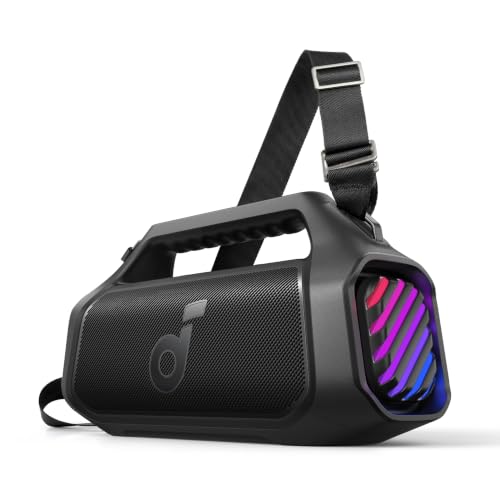
- Best for: Car camping and large outdoor groups that need real volume.
- 140W maximum output with BassUp 2.0; 100W standard output
- 3.5 mm aux input behind a rubber door
- 20-hour stated playtime
- IPX7 waterproof rating; floatable body
All 3 Picks at a Glance
| Product | Specs | Action |
|---|---|---|
| Tribit XSound Go |
| Check price on Amazon |
| Anker Soundcore 2 |
| Check price on Amazon |
| Soundcore Boom 2 Plus |
| Check price on Amazon |
Key takeaways
- Five portable travel speakers with a 3.5 mm aux input, from pocket-size models to a big boombox, with battery life, weight and waterproofing compared.
The question that decides this purchase is not how loud a speaker goes. It is whether your music source can connect to it at all. Seat-back screens on planes, older laptops, handheld consoles and borrowed sound systems often have no Bluetooth, and a speaker without a wired input leaves you with nothing to plug in. A 3.5 mm aux jack solves that in seconds with a cable, and it keeps working when wireless pairing fails, when a venue blocks Bluetooth, or when a device simply predates it.
This guide is for flyers who watch films on seat-back screens, road trippers who share music from any passenger phone, and hotel-room listeners who want better sound than a laptop can manage. Every speaker below was picked from its Amazon listing, and every one has a confirmed 3.5 mm aux input, so the wired hook-up in the keyword is a requirement each pick meets rather than a feature some of them happen to share.
Quick Picks
As an Amazon Associate we earn from qualifying purchases.
| Product | Best for | Key spec |
|---|---|---|
| Tribit XSound Go | The lightest bag speaker for flights and day trips | 16W with a 3.5 mm aux input |
| Anker Soundcore 2 | A pocket-size classic for wired listening anywhere | 12W stereo with a 3.5 mm aux input |
| Tribit StormBox 2 | All-round sound for a campsite or poolside group | 34W with a 3.5 mm aux input |
| Anker Soundcore Motion+ | Detailed listening in a hotel room or rental | 30W Hi-Res Audio with a 3.5 mm aux input |
| Soundcore Boom 2 Plus | The loudest option for car camping and big groups | 140W with a 3.5 mm aux input |
How to Choose
Confirm the aux jack is really there
Many current portable speakers dropped the wired input entirely, so the jack cannot be assumed from the shape or the brand. The JBL Flip 6, JBL Charge 5, Soundcore 3 and the standard Soundcore Boom 2 all lack a 3.5 mm aux input, even though earlier models in the same lines had one. Before ordering, check the listing and the manual for the words 3.5 mm aux input or AUX in, and look at the port diagram rather than the marketing photos. A USB-C port is for charging unless the listing says otherwise, and a speaker with only wireless input cannot play from a seat-back screen at all.
Match the size and weight to the trip
A speaker that lives in a jacket pocket and a speaker that rides in a car trunk are bought for different trips, and the weight figures make the split plain. The lightest pick here weighs 380 grams, while the largest weighs 8.38 lb, so the first fits a day bag and the second needs a handle, a shoulder strap and a vehicle. Think about where the speaker will sit while it plays, too: a flat bar needs a table or a shelf, a cylinder can stand on uneven ground, and a boombox with a handle is easy to carry but awkward in a crowded overhead bin.
Read battery claims with their conditions
Stated playtime is measured under gentle conditions, usually around half volume with bass boost and light effects switched off, so a long headline number shrinks at full volume outdoors. Wired listening does not remove the battery from the equation either: the speaker still runs on its own cell, and the cable only replaces the wireless link. Charging matters for packing as well. Some picks here still use Micro-USB, which means carrying an older cable, while the newer models charge over USB-C and share a charger with a phone or a laptop.
Check water protection and the port cover
Every speaker in this guide carries an IPX7 rating, which covers immersion in shallow water for a short time, but that rating only holds when the port covers are closed. The aux jack on each pick sits behind a rubber flap or door, and leaving that flap open near a pool or in rain removes the protection exactly where water is most likely to enter. Close the flap after plugging in the cable, and keep the charging port covered the same way. A speaker that is only splashproof is a different purchase from one listed as IPX7, so check the code rather than the word waterproof on the box.
The 5 Best Options
Tribit XSound Go
- Best for: Flights, day trips and any bag where grams matter.
- 16W output from dual 8W drivers with a passive radiator
- 3.5 mm aux input with a cable included in the box
- 24-hour stated playtime
- IPX7 waterproof rating
Flights, day trips and any bag where grams matter.
Older XSound Go versions used Micro-USB and Bluetooth 5.0, so confirm the listing shows the current model with USB-C and Bluetooth 5.3 before ordering.
The XSound Go is the speaker to pack when space and weight matter more than sheer volume. At 380 grams it slips into a bag side pocket next to a water bottle, and the 24-hour stated playtime covers a long travel day without a recharge. The 3.5 mm aux input sits under a rubber flap on the back, and the current model ships with a 3.5 mm cable, so a seat-back screen or an older phone connects without an extra purchase. Two 8W drivers and a passive radiator give it a fuller sound than its size suggests, and the IPX7 body handles rain and poolside splashes.
Watch out for: Older XSound Go versions used Micro-USB and Bluetooth 5.0, so confirm the listing shows the current model with USB-C and Bluetooth 5.3 before ordering.
Anker Soundcore 2
- Best for: Simple wired listening from older phones, laptops and seat-back screens.
- 12W stereo output from dual 6W drivers
- 3.5 mm aux input
- 24-hour stated playtime
- IPX7 waterproof rating
Simple wired listening from older phones, laptops and seat-back screens.
The latest production version uses Bluetooth 6.0 and cannot stereo-pair with older Soundcore 2 units, so check the revision if you plan to pair two.
The Soundcore 2 has been around for years, and that is part of its appeal for travel: it is a simple, compact bar with a proven shape, a 24-hour stated battery, and an aux input that newer rivals dropped. The dual 6W drivers and BassUp tuning give small-room listening more weight than the size suggests, and the built-in microphone handles calls when the speaker sits on a hotel desk. It charges over Micro-USB rather than USB-C, so pack the right cable, and note that the aux cable is not in the box.
Watch out for: The latest production version uses Bluetooth 6.0 and cannot stereo-pair with older Soundcore 2 units, so check the revision if you plan to pair two.
Tribit StormBox 2
The StormBox 2 is the middle of this list in size and the most flexible in placement. Its cylindrical body throws sound in every direction, which suits a picnic table or a campsite better than a front-facing speaker that needs aiming. Two 48 mm drivers deliver 34W with an XBass mode for extra low end, and the 24-hour stated battery and IPX7 body cover a full day outdoors. The 3.5 mm aux input sits under a rubber flap beside the USB-C port, and a carry strap makes it easy to hang from a bag.
Specs
- 34W output from two 17W drivers
- 3.5 mm aux input under a rubber flap
- 24-hour stated playtime
- IPX7 waterproof rating
- Bluetooth 5.3 with TWS and party pairing
- Two 48 mm full-range drivers with XBass
- 5,200 mAh battery
- USB-C charging
- Carry strap included
- 580 grams; 180 x 69 x 69 mm
Best for: Groups outdoors who want sound in every direction.
Watch out for: The 3.5 mm cable is not included, and the speaker does not remember your device between sessions, so expect to reconnect Bluetooth each time you power it on.
Anker Soundcore Motion+
The Motion+ is the pick for listeners who care about detail as much as convenience. Its Hi-Res Audio certification and aptX support set it apart from the smaller speakers here, and the wide 50 Hz to 40 kHz frequency range keeps voices and instruments clear at low hotel-room volumes. The 3.5 mm audio input is a proper port on the body with an aux cable included in the box, and the companion app offers a custom equalizer for tuning the sound to a room. At 1,050 grams it is a bag speaker rather than a pocket one.
Specs
- 30W audio output
- 3.5 mm audio input with an aux cable included
- 12-hour stated playtime
- IPX7 waterproof rating
- Hi-Res Audio certified with Qualcomm aptX
- 50 Hz to 40 kHz frequency range
- 6,700 mAh battery
- USB-C charging
- Companion app with custom equalizer
- TWS stereo pairing
- 1,050 grams; 257 x 79 x 81 mm
Best for: Hotel rooms and rentals where detail matters more than volume.
Watch out for: Battery life is listed at 12 hours, the shortest here, and the flat bar shape needs a stable surface rather than a bottle holder or a bag strap.
Soundcore Boom 2 Plus
- Best for: Car camping and large outdoor groups that need real volume.
- 140W maximum output with BassUp 2.0; 100W standard output
- 3.5 mm aux input behind a rubber door
- 20-hour stated playtime
- IPX7 waterproof rating; floatable body
Car camping and large outdoor groups that need real volume.
At 8.38 lb it belongs in a car trunk, not a carry-on, and the light show and bass boost shorten the stated battery life when switched on.
The Boom 2 Plus is not a pocket speaker, and it does not pretend to be one. At 8.38 lb with a handle and a detachable shoulder strap, it is a car-trunk speaker for campsites, patios and group trips, where its 140W boosted output and dual woofers fill open space that smaller speakers cannot reach. The 3.5 mm aux input sits behind a rubber door next to the USB-C port, the IPX7 body floats, and the USB-C output charges a phone while the music plays. Its 20-hour stated battery is measured at half volume with the bass boost and lights off.
Watch out for: At 8.38 lb it belongs in a car trunk, not a carry-on, and the light show and bass boost shorten the stated battery life when switched on.
Which One Fits Your Situation
Flying with seat-back entertainment
Take the Tribit XSound Go or the Anker Soundcore 2. Both weigh under half a kilogram, both run for a stated 24 hours, and both take a 3.5 mm cable straight from the seat-back jack. The XSound Go has the edge because its current model ships with the cable and charges over USB-C, while the Soundcore 2 needs a cable packed separately and a Micro-USB charger.
Listening in a hotel room or rental
Choose the Anker Soundcore Motion+. Its Hi-Res Audio tuning and wide frequency range suit quiet rooms, films and acoustic music better than the louder picks, and the aux cable in the box means a laptop connects without a trip to a shop. The 12-hour stated battery is ample for evenings indoors, where a charger is always nearby.
Music for a campsite or poolside group
Pick the Tribit StormBox 2. Its cylindrical body spreads sound around a table instead of aiming it at one chair, the IPX7 body handles splashes, and the carry strap keeps it off wet ground. The 24-hour stated battery covers a full day outside, and the aux input takes music from any device a camper happens to carry.
A big group outdoors with a car nearby
Take the Soundcore Boom 2 Plus. Its 140W boosted output and dual woofers carry across open ground where the smaller speakers fade, and the handle and shoulder strap make the short walk from the car manageable. Leave it behind for flights and hikes: at 8.38 lb it is a trunk speaker, not a bag speaker.
Common Mistakes
- Assuming every portable speaker has a 3.5 mm input: many current models, including the JBL Flip 6, JBL Charge 5 and Soundcore 3, dropped the aux jack entirely.
- Treating a USB-C port as an audio input: on most of these speakers the USB-C port charges the battery only, so a cable with a USB-C plug at the speaker end will not carry sound.
- Leaving the rubber flap open over the aux jack near water: the IPX7 rating only holds with the port covers closed, and the jack is the first place water enters.
- Buying a second speaker for stereo pairing without matching the model and revision: the latest Soundcore 2 production version cannot pair with older units.
- Choosing by headline battery hours alone: stated playtime assumes moderate volume with bass boost and lights off, and wired listening still drains the battery.
Frequently Asked Questions
Do all portable Bluetooth speakers have a 3.5 mm aux input?
No. Many current models dropped the wired input as Bluetooth became the default, including the JBL Flip 6, JBL Charge 5, Soundcore 3 and the standard Soundcore Boom 2. Every speaker in this guide was checked against its listing and manual for a confirmed 3.5 mm aux input, and that check is the single most important step before buying any travel speaker for wired use.
Can I plug a travel speaker into a plane seat-back screen?
Yes, with a 3.5 mm cable between the screen socket and the speaker aux input. Some airlines use a dual-pin socket that needs a small adapter, which is not included with any speaker here, so check the socket type before the flight. Keep the volume low, since a speaker plays for the whole row rather than one seat.
Does using the aux cable save battery?
No. The cable only replaces the wireless link, so the speaker still runs on its own battery and needs charging the same as in Bluetooth mode. The advantage of wired listening is a connection that cannot drop or fail to pair, not longer playtime, and a flat battery still ends the music either way.
What if my phone has no headphone jack?
Use a USB-C or Lightning to 3.5 mm adapter between the phone and the speaker cable, matching the adapter to the phone port. The speaker side stays the same in every case: a standard 3.5 mm plug into the aux input. Carry the adapter with the cable, since neither is included with most of the speakers in this guide.
More from Amazon
Programs that pair well with the guide above. Offers and eligibility are set by Amazon and may change.
Free shipping on eligible items, Prime Video and more. Eligible new members can start with a free trial.
Start a Prime free trialAudiobooks and podcasts to listen to on the go. Eligible new members can start with a free trial.
Try Audible freeAd-free music streaming. Eligible new subscribers can start with a free trial.
Try Music Unlimited freeA free business account with business pricing and bulk-buying tools for work, shop or home office.
Create a business accountAs an Amazon Associate we earn from qualifying purchases.







Write Your Review
No reviews yet. Be the first to share your experience!