
Our Short List of 3

- Best for: Front or rear channels in a surround system, with the most power here.
- 5.25 in BDSS mid/bass driver + 5.25 in passive radiator
- 1 in pure aluminum dome tweeter
- Up to 200 watts per speaker
- Low-frequency response down to 47 Hz
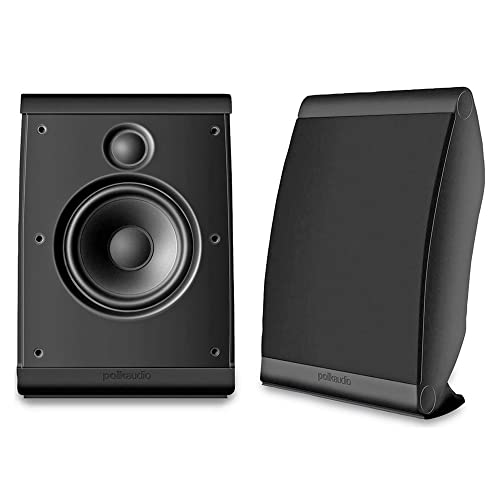
- Best for: Wall mounting in a small room, with seven mounting options.
- 4.5 in Dynamic Balance woofer
- 1 in tweeter
- 100 watts maximum output power
- 8 ohms

- Best for: Three-way bookshelf rears in a Sony CS setup.
- 5.12 in MRC woofer
- 0.98 in tweeter + 0.75 in super tweeter
- 3-way 3-driver
- 100 watts maximum input power
All 3 Picks at a Glance
| Product | Specs | Action |
|---|---|---|
| Definitive Technology ProMonitor 1000 |
| Check price on Amazon |
| Polk Audio OWM3 |
| Check price on Amazon |
| Sony SSCS5 |
| Check price on Amazon |
Key takeaways
- Compare five rear speakers for a 7.2 surround system, from wall-mountable surrounds to a passive bookshelf pair that needs an amplifier or receiver at home.
Rear speakers make a surround system feel like a room instead of a screen. They carry the sounds behind the listener — rain, footsteps, a door closing off-camera — and they must blend with the front speakers rather than shout over them. The five speakers below are individual rear and surround speakers sold as pairs, not complete 5.1 or 7.2 systems, and each listing states its own driver sizes, power handling, and mounting options. A 7.2 system needs two subwoofers and seven channels, and these picks fill the rear ones.
Mounting and power separate these picks more than driver size. The Polk OWM3 offers seven mounting options, the Definitive Technology ProMonitor 1000 mounts on a wall, shelf, or stand, and the Micca MB42X is passive and needs an amplifier or receiver. The Klipsch R-40SA is an elevation and surround speaker, and the Sony SSCS5 is a three-way bookshelf pair that the listing says can serve as rears in a 5.1.2 setup. Read the mounting and power notes first.
Quick Picks
As an Amazon Associate we earn from qualifying purchases
| Product | Best for | Key spec from title |
|---|---|---|
| Definitive Technology ProMonitor 1000 | Front or rear channels | 5.25 in BDSS driver, 200 watts |
| Polk Audio OWM3 | Wall mounting | 7 mounting options, 100 watts |
| Klipsch Reference R-40SA | Elevation and surround | 90 x 90 degree Tractrix Horn, 100 watts |
| Micca MB42X | Budget passive pair | 4 in carbon fiber woofer, 75 watts |
| Sony SSCS5 | Three-way bookshelf rears | 3-way 3-driver, 100 watts |
How to Choose
Match the Speaker to the Rear Channel
A rear speaker in a 7.2 system sits behind or beside the listener, and its job is ambient sound rather than dialogue. The Definitive Technology ProMonitor 1000 is listed explicitly as a front or rear channel speaker in a surround system, the Polk OWM3 is called an on-wall surround speaker for a compact home theater, and the Sony SSCS5 can serve as rears in a 5.1.2 setup with the rest of the Sony CS range. A speaker built for the front can work at the rear, but a speaker built as a surround is tuned for the job. Check the listing for surround framing before buying.
Check the Mounting Options
Rear speakers need to go on a wall, a shelf, or a stand, and the mounting options in the listing decide where each one can live. The Polk OWM3 offers seven mounting options, including angled, corner, horizontal, and vertical wall mounting, a shelf mount, and an articulating bracket, plus paintable grilles that blend into the wall. The Definitive Technology ProMonitor 1000 mounts on a wall, a shelf, or a stand. A speaker with no mounting options needs a shelf or a stand, which is fine in a large room but awkward in a small one.
Passive or Powered — Know Before Buying
Four of these speakers are passive in the sense that they need a receiver or an amplifier, and the Micca MB42X states that requirement twice in its listing. A passive speaker has no amplifier inside, so it must be wired to a receiver that drives it. The Sony SSCS5, the Klipsch R-40SA, and the Polk OWM3 are also passive pairs that need a receiver. Do not buy a passive speaker expecting it to play on its own, and check that the receiver has enough channels for a 7.2 setup before ordering.
Driver Size and Power Handling
Driver size and power handling set the volume and the bass a rear speaker can produce, and the listings here range from a 4-inch woofer to a 5.25-inch driver with a passive radiator. The Definitive Technology ProMonitor 1000 uses a 5.25-inch BDSS mid and bass driver with a 5.25-inch passive radiator and handles up to 200 watts per speaker, while the Polk OWM3, the Klipsch R-40SA, and the Sony SSCS5 each handle 100 watts. The Micca MB42X handles 75 watts each. Bigger is not always better at the rear, where ambient sound matters more than sheer volume.
The 5 Best Options
Definitive Technology ProMonitor 1000
- Best for: Front or rear channels in a surround system, with the most power here.
- 5.25 in BDSS mid/bass driver + 5.25 in passive radiator
- 1 in pure aluminum dome tweeter
- Up to 200 watts per speaker
- Low-frequency response down to 47 Hz
Front or rear channels in a surround system, with the most power here.
The largest pair in this roundup — check the shelf or wall space first.
The Definitive Technology ProMonitor 1000 is the lead pick, and its listing frames it explicitly as a front or rear channel speaker in a surround system, which is exactly the role it fills here. It uses a 5.25-inch BDSS mid and bass driver with a 5.25-inch passive radiator, a 1-inch pure aluminum dome tweeter, and it handles up to 200 watts per speaker with a low-frequency response down to 47 Hz. The pair measures 6.5 by 6.25 by 10.81 inches, it mounts on a wall, a shelf, or a stand, and it carries a 5-year manufacturer warranty. At 45 days, its crawl is the freshest in this roundup.
Polk Audio OWM3
- Best for: Wall mounting in a small room, with seven mounting options.
- 4.5 in Dynamic Balance woofer
- 1 in tweeter
- 100 watts maximum output power
- 8 ohms
Wall mounting in a small room, with seven mounting options.
The smallest woofer here — it suits ambient rear sound, not heavy bass.
The Polk OWM3 is the wall-mount pick, with the most mounting options in this roundup. It uses a 4.5-inch Dynamic Balance woofer and a 1-inch tweeter, it handles 100 watts maximum output power at 8 ohms, and it mounts at an angle, in a corner, horizontally or vertically on a wall, on a shelf, or on a bracket. The grilles are paintable, so the speaker can blend into the wall color. The listing calls it an on-wall surround speaker for a compact home theater system — the rear role it is built for. For a small room where speakers must go on the wall, this is the pick.
Klipsch Reference R-40SA
The Klipsch R-40SA is an elevation and surround speaker, and it should be framed as a rear or side surround option per the listing’s own surround framing, never as a dedicated rear-only model. It uses 4-inch TCP woofers, a 90 by 90 degree Tractrix Horn, and a 1-inch LTS tweeter, and it handles 100 watts maximum output power as a wired Dolby Atmos elevation surround speaker pair. The horn design shapes the sound toward the listener, which suits a rear or side position where the speaker fires across the room. Do not confuse it with the older R-41SA, which its own listing points to as superseded by this model.
Specs
- 4 in TCP woofers
- 90 x 90 degree Tractrix Horn
- 1 in LTS tweeter
- 100 watts maximum output power
- Wired
- Dolby Atmos elevation surround speaker pair
Best for: Rear or side surround with a horn-loaded design.
Watch out for: An elevation and surround speaker, not a dedicated rear-only model.
ASIN: B09PPKX16G
Micca MB42X
The Micca MB42X is the budget pick, and the pick that demands the clearest warning: it is passive, and the listing states twice that it requires an amplifier or a receiver. It uses a 4-inch woven carbon fiber woofer, a 0.75-inch silk dome tweeter, and a 9-element 18 dB per octave crossover, with a 60 Hz to 20 kHz response, 75 watts each, and 85 dB at 1 watt and 1 meter. The pair measures 9.5 by 5.8 by 6.5 inches, with a magnetic grille and a rear port. For a buyer who already owns a receiver, this is the cheapest way into a proper rear pair.
Specs
- 4 in balanced woven carbon fiber woofer
- 0.75 in silk dome tweeter
- Advanced 9-element 18dB/octave crossover
- 60Hz-20kHz
- 75 watts each
- 85dB 1W/1M
- 9.5H x 5.8W x 6.5D in
- Magnetic grille
- Rear ported
- Passive — requires an amplifier or receiver
Best for: A budget passive pair for a buyer who already owns a receiver.
Watch out for: Passive only — it will not play without an amplifier or receiver.
ASIN: B00E7H8GG2
Sony SSCS5
- Best for: Three-way bookshelf rears in a Sony CS setup.
- 5.12 in MRC woofer
- 0.98 in tweeter + 0.75 in super tweeter
- 3-way 3-driver
- 100 watts maximum input power
Three-way bookshelf rears in a Sony CS setup.
Conflicting crawls — re-check the listing before buying.
The Sony SSCS5 is a three-way bookshelf pair that the listing says can serve as rears in a 5.1.2 setup with the Sony CS range, which is the rear angle for this pick. It uses a 5.12-inch MRC woofer, a 0.98-inch tweeter, and a 0.75-inch super tweeter in a three-way design, with 100 watts maximum input power at 6 ohms in a bass reflex housing, sold as a pair, two speakers per carton. The crawls conflict, one showing no featured offers and another showing an Add to Cart signal, so the listing needs a re-check before buying, and the article falls to four products if it is dead.
Which One Fits Your Situation
You Have a Small Room
The Polk OWM3 is the pick for a small room: seven mounting options, paintable grilles, and a compact 4.5-inch woofer that suits ambient rear sound without dominating the space. Wall mounting keeps the floor clear, and the angled or corner mount aims the sound at the listening position. A large bookshelf pair would crowd a small room, so the OWM3 is the better fit.
You Already Own a Receiver
The Micca MB42X is the budget pick for a buyer with a receiver, at 75 watts each with a carbon fiber woofer and a silk dome tweeter. It is passive, so the receiver drives it, and the magnetic grille and rear port keep it simple. For a buyer who already owns the amplifier, this is the cheapest proper rear pair here. Do not buy it without a receiver, since it will not play on its own.
You Want the Most Power at the Rear
The Definitive Technology ProMonitor 1000 handles up to 200 watts per speaker, which is double the 100-watt rating of the Polk, Klipsch, and Sony picks, and it pairs a 5.25-inch BDSS driver with a 5.25-inch passive radiator. It mounts on a wall, a shelf, or a stand, and it carries a 5-year manufacturer warranty. For a large room where the rears need to keep up with powerful front speakers, this is the pick.
You Are Building a Sony CS System
The Sony SSCS5 is the pick for a Sony CS setup, since the listing says it can serve as rears in a 5.1.2 setup with the rest of the Sony CS range. The three-way design with a super tweeter adds detail to ambient sound, and the 100-watt rating matches the other rears here. Re-check the listing first, because the crawls conflict, and the article falls to four products if the listing is dead.
Common Mistakes
- Buying a passive speaker without a receiver or amplifier to drive it.
- Choosing a bookshelf pair for a small room, when a wall-mountable surround fits better.
- Treating an elevation speaker as a dedicated rear-only model, when the listing frames it as surround.
- Ignoring the mounting options and discovering the speaker has nowhere to go.
- Buying a complete 5.1 or 7.2 system when only the rear channels need replacing.
Frequently Asked Questions
What speakers do I need for the rear channels of a 7.2 system?
A 7.2 system has seven channels and two subwoofers, and the rear channels carry ambient sound behind the listener. The speakers in this roundup are individual rear and surround pairs, not complete systems. The Definitive Technology ProMonitor 1000 is listed as a front or rear channel speaker, the Polk OWM3 is an on-wall surround speaker, and the Sony SSCS5 can serve as rears in a 5.1.2 setup.
Do rear speakers need an amplifier?
The passive speakers here do. The Micca MB42X states twice in its listing that it requires an amplifier or a receiver, and the other pairs here are also passive and need a receiver. A passive speaker has no amplifier inside, so it must be wired to a receiver that drives it. Check that the receiver has enough channels for a 7.2 setup before ordering.
Can bookshelf speakers work as rear speakers?
Yes, two picks here are bookshelf pairs. The Sony SSCS5 is a three-way bookshelf pair that the listing says can serve as rears in a 5.1.2 setup with the Sony CS range, and the Micca MB42X works as rears when driven by a receiver. A bookshelf pair needs a shelf or a stand, while a wall-mountable surround like the Polk OWM3 goes straight on the wall.
What is the difference between a surround speaker and a rear speaker?
The terms overlap, and the listings here use both. A surround speaker is built for ambient sound beside or behind the listener, while a rear speaker sits behind the listener specifically. The Klipsch R-40SA is an elevation and surround speaker, framed as a rear or side surround option per its listing. Check the listing for surround framing rather than relying on the product name alone.
More from Amazon
Programs that pair well with the guide above. Offers and eligibility are set by Amazon and may change.
Free shipping on eligible items, Prime Video and more. Eligible new members can start with a free trial.
Start a Prime free trialAudiobooks and podcasts to listen to on the go. Eligible new members can start with a free trial.
Try Audible freeAd-free music streaming. Eligible new subscribers can start with a free trial.
Try Music Unlimited freeA free business account with business pricing and bulk-buying tools for work, shop or home office.
Create a business accountAs an Amazon Associate we earn from qualifying purchases.





Write Your Review
No reviews yet. Be the first to share your experience!