

Key takeaways
- Drywall repairs cost more than careful planning. Scan for studs, pipes, and cables before cutting, and confirm the amplifier cable route.
- Loose drywall causes audible vibration. Tighten the speaker evenly and reinforce a flexible opening rather than overtightening the clamps.
- Moisture is a separate requirement. For bathrooms, covered patios, or humid areas, use a speaker explicitly rated for that environment instead of assuming a standard in-wall model is suitable.
- Grilles are the first cosmetic wear point. Keep spare grilles or replacement fabric available if the room is frequently redecorated.
- Bass expectations need a subwoofer. Even a large in-wall speaker usually benefits from a properly integrated subwoofer for theater effects and deep music bass.
- Do not mix unmatched front channels casually. Different tweeter materials and dispersion patterns can make a left-center-right theater stage sound inconsistent.
The best in wall speakers for most homes are 6.5-inch, two-way models with an adjustable tweeter, a paintable magnetic grille, and either a sealed back box or a manufacturer-approved enclosure; choose a shallow 5.25-inch model for tight cavities, a high-sensitivity model for theater volume, and a premium coaxial or three-way design when music quality matters most.
Our top picks

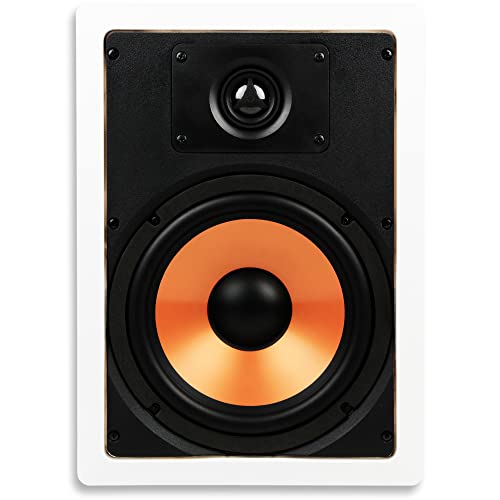


As an Amazon Associate we earn from qualifying purchases at no extra cost to you. Ratings are shown as listed on Amazon.
Best in-wall speakers by listening situation
| Situation | Best speaker type | Useful target specification | Why it fits |
|---|---|---|---|
| Affordable whole-room music | 6.5-inch two-way in-wall | 88–91 dB sensitivity; roughly 40–20,000 Hz | Good coverage without requiring a powerful amplifier |
| Dedicated home theater | 6.5- or 8-inch three-way or high-output model | 90 dB or higher sensitivity; 100 W or more recommended amplification | Handles dialogue, effects, and sustained volume with more headroom |
| Critical two-channel music | Premium coaxial or three-way speaker | Pivoting or angled mid/tweeter; 6.5–8-inch woofer | Produces more even tonal balance away from the center listening seat |
| Shallow wall or retrofit | 5.25-inch shallow in-wall | Less than 3 inches of mounting depth | Reduces conflicts with plumbing, wiring, and narrow stud cavities |
| Nearly invisible installation | Plaster-in or flush-mount model | Custom finishing; usually higher installation cost | Leaves a cleaner wall surface than a conventional visible grille |
Head-to-head: what separates the leading designs
Premium coaxial speakers: the best compromise for music and theater
Models such as the KEF Ci160QR and KEF Ci3160REFM use coaxial driver arrangements, placing the tweeter in the center of the woofer. This helps preserve tonal consistency when listeners sit off-axis, which is particularly useful in a wide living room or when the same speakers serve music and surround duties. KEF’s Uni-Q-style arrangement is also attractive for height channels and rear surrounds because sound spreads from a more consistent acoustic point.
The trade-off is installation depth and price. Premium coaxial models can require a deeper cavity than basic two-way speakers, and their cutouts are not interchangeable. Always use the exact template supplied for the model rather than assuming a nominal 6.5-inch or 8-inch size means a standard opening.
Sonance Visual Experience: flexible, discreet installation
Sonance Visual Experience in-wall models are aimed at clean architectural installations, with paintable grilles, low-profile frames, and versions designed for different output levels. They are a strong choice when the speaker must visually disappear but the room still needs broad coverage for background music or television audio.
Many Sonance models are designed to work with optional enclosures or acoustic-mechanical accessories. That matters because an open wall cavity can transmit sound into adjacent rooms and can produce unpredictable bass. A back box makes the result more repeatable, although it can increase required depth and complicate retrofitting.
Bowers & Wilkins CCM series: refined music reproduction
Bowers & Wilkins CCM models are worth considering when music quality takes priority over the lowest possible price. Depending on the model, the range includes angled drivers, pivoting tweeters, Kevlar or equivalent composite-cone technology, and more substantial crossover networks. Higher-end versions can produce a larger, more controlled presentation than inexpensive two-way in-wall speakers.
The practical limitation is cost and installation planning. A premium driver will not overcome a poorly located cutout, a loose wall, or an amplifier that clips. These speakers make the most sense in a carefully planned stereo system, front stage, or high-quality distributed-audio installation.
Monitor Audio Creator Series: useful placement control
Monitor Audio Creator Series in-wall speakers include models with pivoting tweeters and, in some designs, adjustable dispersion features. This is valuable when the wall location is dictated by studs rather than by the ideal listening angle. Aim the tweeter toward the main seating area, especially for front left, center, and right channels.
For a home theater, compare the speaker’s directivity with your room width. A narrow or angled dispersion pattern can improve focus at the main seats, while a wider pattern may be preferable when several people sit across a sofa.
Installation specifications that deserve more attention
Mounting depth
Nominal wall depth is not the same as usable depth. A typical 3.5-inch stud cavity may contain wiring, plumbing, insulation, and a layer of drywall, leaving less room than expected. A speaker listed with approximately 3 inches of mounting depth may fit physically but still be unsuitable if the back of the magnet contacts an obstruction.
Before choosing a model, inspect the cavity and leave clearance around the driver and terminals. Shallow 5.25-inch designs often fit difficult retrofit locations, while 8-inch models generally need more space and may require additional reinforcement.
Wall cutout and template accuracy
The cutout is the hole in the drywall, not the visible grille size. Manufacturers commonly require a rectangular or rounded-rectangle opening rather than a simple circular hole. Cutout dimensions can differ by several millimeters between models that share the same woofer diameter.
Locate studs before cutting, keep the speaker centered between obstructions, and use the supplied template. A cutout that is too large can prevent the dog-ear clamps from gripping. A hole that is too small can deform the frame or leave the speaker poorly seated.
Back boxes and open-back designs
An open-back speaker uses the wall cavity as part of its acoustic volume. This is inexpensive and can produce useful bass, but results vary with cavity size and insulation. It also allows more sound to reach the room behind the wall.
A sealed back box gives the speaker a known air volume and improves isolation. It is often the better choice for bedrooms, apartments, and rooms sharing a wall with a study. Check whether the box is supplied, optional, or prohibited for the chosen model; changing the enclosure volume can alter bass response and power handling.
Trim, grille, and finishing options
Most mainstream in-wall speakers use paintable white grilles, but the trim can remain visible. Magnetic grilles are quicker to remove for painting, while ultra-thin or flush-mount designs require more careful drywall finishing. Plaster-in speakers can look almost seamless, but labor, access, and future service become more demanding.
Never paint a grille while it is installed over the driver. Remove it, use thin coats, and avoid filling the perforations. A clogged grille can reduce high-frequency output and make the speaker sound dull.
Sound dispersion: choose for the room, not just the specification sheet
In-wall speakers radiate differently from freestanding speakers because the wall removes cabinet-side reflections. The result can be clean and spacious, but placement is less forgiving. A fixed tweeter works well when the listener sits directly in front of the speaker. A pivoting tweeter or angled baffle is preferable when the speaker is mounted beside the seating area or high on a wall.
For stereo music, place the left and right speakers symmetrically, ideally at ear height or slightly above it, with similar distances to the main listening position. For a television system, a dedicated in-wall center speaker should be horizontally oriented or specifically designed for center-channel use; turning a vertical speaker sideways can create uneven dispersion.
Worked installation calculation
Suppose a wall is 144 inches wide and the desired stereo spacing is 72 inches between acoustic centers. Centering the pair gives 36 inches from each speaker to the nearest side wall. If each speaker’s template is 8 inches wide, mark the center points first, then place the cutout edges 4 inches on either side of each center point. This is safer than measuring from the visible trim, which can be wider than the required opening.
For amplifier selection, a pair rated at 90 dB sensitivity needs roughly 10 dB more power to sound twice as loud subjectively. If 10 watts produces a strong listening level in your room, about 100 watts per channel provides useful headroom for peaks, assuming the amplifier and speaker are compatible. Room size, listening distance, impedance, and bass demands can change that estimate, so treat it as planning guidance rather than a guarantee.
Ownership realities and common mistakes
- Drywall repairs cost more than careful planning. Scan for studs, pipes, and cables before cutting, and confirm the amplifier cable route.
- Loose drywall causes audible vibration. Tighten the speaker evenly and reinforce a flexible opening rather than overtightening the clamps.
- Moisture is a separate requirement. For bathrooms, covered patios, or humid areas, use a speaker explicitly rated for that environment instead of assuming a standard in-wall model is suitable.
- Grilles are the first cosmetic wear point. Keep spare grilles or replacement fabric available if the room is frequently redecorated.
- Bass expectations need a subwoofer. Even a large in-wall speaker usually benefits from a properly integrated subwoofer for theater effects and deep music bass.
- Do not mix unmatched front channels casually. Different tweeter materials and dispersion patterns can make a left-center-right theater stage sound inconsistent.
Final buying recommendation
Choose a 6.5-inch coaxial or two-way model with a pivoting tweeter for the best balance of price, coverage, and installation flexibility. Move to an 8-inch or three-way design for a large room, higher playback levels, or serious front-channel music use. Select a shallow model when cavity depth is uncertain, and prioritize a sealed back box when sound leakage or consistent bass matters.
The most important purchase is not the speaker with the largest woofer or the highest power figure. It is the model whose cutout, depth, dispersion, enclosure option, and trim finish suit the actual wall and listening positions. Verify those five details before ordering, and an in-wall system can deliver cleaner architecture without sacrificing convincing music or theater performance.

Write Your Review
No reviews yet. Be the first to share your experience!