

Key takeaways
- 8 gallons of wastewater daily at a 4:1 ratio.
- 6 gallons daily at a 3:1 ratio.
- 3 gallons daily at a 1.5:1 ratio.
Best Tankless Reverse Osmosis Systems for Clean Water
The best tankless reverse osmosis systems for most kitchens are under-sink units producing 400–800 gallons per day, while countertop models are the better choice for renters, small kitchens, or occasional use. The right pick depends less on the headline gallon-per-day number than on wastewater ratio, filter cost, installation space, and whether you need a dedicated faucet.
Quick picks by situation
| Situation | Best system type | Why it fits | Typical budget |
|---|---|---|---|
| Maximum daily output | 600–800 GPD under-sink RO | Fast filling, direct connection to the cold-water line, suitable for busy households | $400–$800 |
| Lowest installation effort | Countertop RO with a refillable reservoir | No cabinet plumbing or drain saddle; usually ready after filling the tank | $250–$500 |
| Limited cabinet space | Compact countertop or narrow under-sink unit | Avoids sacrificing space beneath the sink | $250–$650 |
| Frequent cooking and drinking | 400–600 GPD under-sink RO | Good balance of flow, replacement cost, and capacity | $350–$650 |
| Renter or temporary home | Countertop RO | Can normally be disconnected without modifying the sink cabinet | $250–$450 |
Head-to-head: countertop versus under-sink tankless RO
Countertop systems
Countertop systems draw water from a removable reservoir and dispense filtered water into a pitcher, bottle, or carafe. Models from brands such as AquaTru, SimPure, and Waterdrop occupy this category, although their stage counts and reservoir layouts differ.
Our top picks

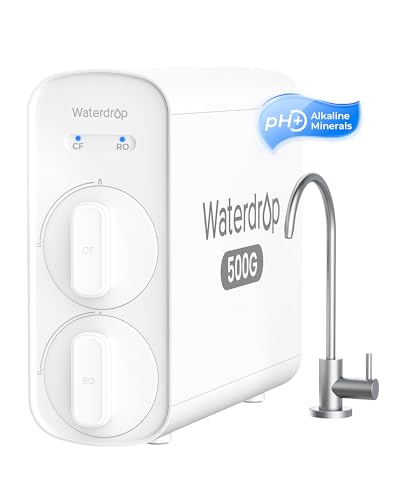
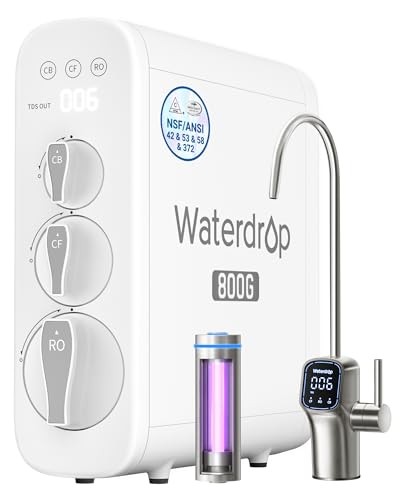

As an Amazon Associate we earn from qualifying purchases at no extra cost to you. Ratings are shown as listed on Amazon.
The main advantage is installation. You generally need a nearby electrical outlet and enough counter depth to accommodate the clean-water and wastewater containers. There is no permanent connection to the cold-water pipe and usually no drain connection. This makes countertop RO the simplest option for renters or anyone who does not want to drill a faucet hole.
The trade-off is batch operation. A small reservoir may produce only a few quarts before it must be refilled. Countertop units can also be noisy during the pumping cycle, and their external tanks require regular washing. They are convenient for drinking water but less convenient when you need to fill a large cooking pot or several bottles in succession.
Under-sink systems
Under-sink tankless RO systems connect to the cold-water supply and send wastewater to the drain through a drain saddle or equivalent fitting. A separate faucet normally delivers the purified water. Because they do not store a large pressurized tank, they occupy less vertical space than traditional tank-based RO systems and can provide water continuously while the feed supply is available.
Waterdrop G3 and G3P800, Frizzlife PD600, and comparable systems illustrate the main design: multiple filters, an integrated pump, electronic controls, and a direct-flow membrane. Exact specifications vary by model and revision, so check the current installation manual rather than relying only on a product listing.
Under-sink systems are better for high-frequency use, but installation is more involved. You must confirm cabinet dimensions, cold-water valve compatibility, drain access, electrical access, and room for filter removal. A unit that physically fits may still be frustrating if its filters cannot be changed without moving the trash bin or disconnecting plumbing.
Representative specifications to compare
| System category or example | Rated production | Typical stages | Advertised wastewater ratio | Installation | Approximate replacement-filter cost |
|---|---|---|---|---|---|
| Compact countertop RO | 50–100 GPD equivalent | 4–5 | About 3:1 to 5:1 | Fill reservoir and plug in | $50–$120 per set |
| AquaTru countertop-style system | Batch output; commonly measured by cycle time | 4 | Varies by model and operating mode | Countertop, no permanent plumbing normally required | About $50–$100 per replacement set |
| Waterdrop G3-class under-sink system | About 400 GPD | 3–4, depending on model | Often around 2:1 to 3:1 | Cold-water line, drain, outlet, and dedicated faucet | About $60–$150 per set |
| Frizzlife PD600-class system | About 600 GPD | Typically 5–7 claims across filtration and conditioning stages | Often advertised near 1.5:1 | Under-sink plumbing and electrical outlet | About $70–$160 per set |
| Waterdrop G3P800-class system | About 800 GPD | Usually 8–9 claimed stages | Often advertised around 3:1 | Under-sink plumbing, drain, outlet, and faucet | About $80–$180 per set |
These are useful comparison ranges, not guarantees for every package. “Stages” can count multiple media layers inside one cartridge, and GPD ratings are normally measured under specific temperature, pressure, and water-quality conditions. Actual household output can be substantially lower when feed water is cold or pressure is weak.
What the filtration stages actually do
A typical tankless RO system begins with a sediment filter that catches sand, rust, and suspended particles. A carbon block then reduces chlorine and some organic compounds that can damage the reverse-osmosis membrane. The RO membrane performs the main dissolved-solids reduction. Later carbon or polishing stages improve taste, while an optional remineralization stage adds minerals back for a less neutral flavor.
More stages do not automatically mean cleaner water. The membrane type, flow restrictor, pump pressure, certification, and replacement schedule matter more than a large stage count. If your water contains unusual contaminants, obtain a local water report or laboratory test and select a system certified for the contaminants of concern. A general-purpose household RO unit should not be treated as a universal solution for every water problem.
Wastewater ratio: the overlooked ownership cost
A system advertised at a 3:1 ratio produces three parts wastewater for every one part purified water. A 1.5:1 system uses less water, but the ratio must be interpreted alongside membrane life, pump operation, water pressure, and the manufacturer’s test conditions.
For example, a household using 2 gallons of purified water per day would create approximately:
- 8 gallons of wastewater daily at a 4:1 ratio.
- 6 gallons daily at a 3:1 ratio.
- 3 gallons daily at a 1.5:1 ratio.
Over 365 days, the difference between 3:1 and 1.5:1 is about 1,095 gallons. If local water and sewer charges total $0.01 per gallon, that difference is roughly $11 per year; in areas with higher rates, the savings are greater. You can sometimes collect wastewater for mopping or other non-potable tasks, but do not use it for drinking or food preparation.
Installation and sizing checklist
- Measure the cabinet. Record width, height, and depth, then reserve additional clearance above or beside the filters. A compact unit may still need room for cartridge removal.
- Confirm water pressure. Tankless systems often perform best with adequate incoming pressure. A booster pump can help, but it needs an outlet and adds noise and another component that may eventually wear.
- Check the faucet plan. If the sink has no spare opening, you may need to drill the countertop or use an existing accessory hole. Avoid drilling stone without the correct tools or professional help.
- Plan the drain connection. The wastewater tube must be secured and routed without kinks. A loose drain saddle can leak inside the cabinet.
- Flush new filters. Initial carbon dust and preservative residue should be flushed according to the manual before drinking the water.
- Inspect for leaks. Check every fitting after installation, then again after the system has operated for several hours.
Filter costs and durability realities
Pre-filters usually wear out first, especially where sediment or chlorine levels are high. The membrane can last roughly 18–36 months under favorable conditions, while sediment and carbon cartridges commonly require replacement every 6–12 months. A polishing cartridge or remineralization cartridge may have a different interval.
Budget for approximately $60–$180 per year for replacement filters on many household systems, excluding unusual water conditions and service calls. Countertop units may have lower annual costs but can use smaller cartridges or more frequent reservoir cleaning.
Common ownership mistakes include ignoring filter-change indicators, allowing the feed line to kink, installing filters in the wrong order, and leaving stagnant water in a countertop reservoir for days. Wipe and wash removable tanks as directed, keep the dispensing nozzle clean, and replace filters by time as well as by electronic reminder. A reminder is not a water-quality test.
Bottom line
Choose a countertop RO system if simple setup, portability, and low commitment matter most. Choose a 400–600 GPD under-sink model for the best balance of everyday output and ownership cost. Choose an 800 GPD-class unit when several people need water frequently and the plumbing, electrical supply, and higher purchase price are acceptable. Before buying, compare the complete filter-set price, actual cabinet dimensions, wastewater ratio, pressure requirements, and certification—not just the number of filtration stages.

Write Your Review
No reviews yet. Be the first to share your experience!