

Key takeaways
- A true hollow body has no centre block, so it is the most resonant and the most feedback-prone type of electric guitar; a semi-hollow trades some air for stability.
- Pickup type shapes the style: humbuckers for jazz and blues, Filter’Tron-style pickups for twang and shimmer, P-90s for bite.
- Keep the volume and gain moderate and pair the guitar with a clean, warm amp; most squeal problems are volume problems.
- Under about 1000, the realistic choices are Gretsch Streamliner, Ibanez Artcore and Epiphone models; PRS and D’Angelico sit at or above that line.
The best hollow body guitars for most players are the Gretsch G2420T Streamliner for Bigsby twang at a sane cost, the Ibanez Artcore AF75 for classic jazz-box tone on a budget, and the PRS SE Hollowbody Standard for a modern, versatile hollow that handles clean and driven sounds. A hollow body guitar has an empty, resonant chamber from top to bottom with f-holes on the top, so it is lighter, airier and more acoustic than a solid-body. The cost is feedback at high volume, which is why the best hollow body electric guitars come down to how well they control it and which sounds they favour. This guide compares seven picks for jazz, blues and vintage tone and explains how to choose the right amp.
Our top picks

As an Amazon Associate we earn from qualifying purchases at no extra cost to you.
Key takeaways
- A true hollow body has no centre block, so it is the most resonant and the most feedback-prone type of electric guitar; a semi-hollow trades some air for stability.
- Pickup type shapes the style: humbuckers for jazz and blues, Filter’Tron-style pickups for twang and shimmer, P-90s for bite.
- Keep the volume and gain moderate and pair the guitar with a clean, warm amp; most squeal problems are volume problems.
- Under about 1000, the realistic choices are Gretsch Streamliner, Ibanez Artcore and Epiphone models; PRS and D’Angelico sit at or above that line.
What makes a hollow body guitar sound the way it does
When you strike a string on a solid-body, the wood barely moves. On a hollow body, the top and back vibrate with the string, adding a bloom, a softer attack and a sense of air around each note. According to maker descriptions from Gretsch, Ibanez and PRS, hollow-body construction uses laminated maple or similar woods that are pressed into shape, with f-holes cut in the top and the pickups mounted to the top or to a pickguard. The same openness that gives the sound its warmth makes the guitar sensitive to sound waves from the amp, which is why it can howl if you turn up too far.
A hollow body is not a delicate flower, however. With sensible volume, the right strings and a clean amp, it is perfectly stage-ready, and many working jazz, blues and rockabilly players rely on one.
Quick comparison of the best hollow body guitars
| Pick | Body | Pickups and hardware | Best for | Price tier |
|---|---|---|---|---|
| Gretsch G2420T Streamliner | Single-cut hollow body | Humbuckers, Bigsby | Twang and rockabilly | Mid |
| Gretsch G5422TG Electromatic Classic | Double-cut hollow body | Filter’Tron style, Bigsby | Vintage shimmer | Upper-mid |
| Ibanez Artcore AF75 | Hollow body | Dual humbuckers | Jazz on a budget | Mid |
| Ibanez Artcore Expressionist AMH90 | Hollow body, modern styling | Dual humbuckers | Blues and fusion | Mid |
| PRS SE Hollowbody Standard | Hollow body | Humbuckers, PRS styling | All-round versatility | Upper-mid |
| D’Angelico Premier EXL-1 | Single-cut hollow body | Humbuckers | Boutique-style jazz | Upper-mid |
| Epiphone Casino | Thin hollow body | Two P-90 pickups | Blues and classic rock | Mid |
1. Gretsch G2420T Streamliner: Best for affordable Bigsby twang
- Single-cut hollow body with a Bigsby-style vibrato (the “T” in the model)
- Broad’Tron-style humbucking pickups, per Gretsch
- Fairlane Blue, Havana Burst and Robusto Burst finishes appear in the listings
- Mid price tier, below the Electromatic range
- Non-Bigsby G2420 variants exist with a Chromatic II tailpiece
The Streamliner line is Gretsch’s more accessible hollow-body range and the G2420T is its Bigsby model. It delivers the shimmer, snap and wobble associated with rockabilly, country and surf, and it still handles clean jazz chords and blues. It costs less than the Electromatic guitars, though the pickups and hardware are simpler.
What to check: decide between the Bigsby and non-Bigsby variants before ordering, because the tailpiece changes string changes and tuning stability. Best for: players who want authentic Gretsch character on a mid budget. Skip if: you dislike vibrato arms.
A Bigsby also changes how you play. Gentle pressure on the arm gives a shimmering vibrato that sounds like a pedal steel on chords, and bigger dips create dramatic bends. To keep tuning stable, make sure the strings are well stretched and the nut slots move freely, and consider a roller bridge if your model allows it. Some players leave the vibrato arm in place only for studio sessions and remove it for gigs; this is a personal preference.
Pros:
- Distinct Gretsch character
- Bigsby for expressive vibrato
- Multiple finishes
Cons:
- String changes are slower with a Bigsby
- Not a traditional jazz tone
2. Gretsch G5422TG Electromatic Classic: Best for vintage shimmer and a double-cut body
- Double-cut hollow body for upper-fret access
- Bigsby vibrato with gold hardware (the “TG” in the model)
- Filter’Tron style pickups, per Gretsch’s Electromatic description
- Snowcrest White and Walnut Stain finishes in the listings
- Upper-mid price tier, near the ceiling of a 1000 budget
The Electromatic Classic is the model many players picture when they imagine a Gretsch. The double-cut shape makes high-fret work easier than on single-cut hollow bodies, and the pickups give the airy, chiming tone that defined a generation of records. It is a step up in refinement from the Streamliner.
What to check: the listing includes 12-string and left-handed variants as well, so confirm you are looking at the standard six-string version. Best for: players who want the classic Gretsch look and sound. Skip if: the gold hardware is not your style.
The double-cut shape matters most when you solo high on the neck. Single-cut hollows have a larger horn that can block the thumb and fingers above the 15th fret, whereas the double-cut leaves room to work. If you play chords more than lead lines, this advantage matters less, and a single-cut model will serve just as well at a lower cost.
Pros:
- Classic Gretsch voice
- Double-cut access
- Striking finishes
Cons:
- Costs more than the Streamliner
- Bigsby maintenance
3. Ibanez Artcore AF75: Best for classic jazz-box tone on a budget
- Hollow body in the Artcore range
- Dual humbucker pickups
- Transparent Red Sunburst and Black Flat finishes in the listings
- Mid price tier
The AF75 has been a go-to recommendation for those who want a dependable jazz box without spending premium money. The sound is warm and round, with a clear neck pickup that suits jazz chords and mellow blues. It’s also one of the easier hollow bodies to live with, because the neck is slim and the body is moderate in size.
What to check: compare with the AF55 in the same family if you want to save more, and ask a tech to check the setup. Best for: jazz students and blues players. Skip if: you want Bigsby twang.
Beginners to jazz often assume a more expensive guitar is needed, but technique and voicing matter more than gear. The AF75 gives you what you need to learn drop-2 voicings, walking bass lines and chord-melody arrangements. As your tastes develop, upgrade the pickups or strings rather than replacing the whole guitar.
Pros:
- Warm, classic jazz tone
- Slim neck
- Good value
Cons:
- Stock pickups are decent, not exceptional
- Laminated top is less resonant than carved
4. Ibanez Artcore Expressionist AMH90: Best for blues and fusion with modern styling
- Hollow body from the Expressionist sub-series
- Dual humbuckers
- Prussian Blue Metallic finish in the listing
- Mid price tier
The Expressionist family adds more contemporary finishes and appointments to the Artcore formula. The AMH90 suits players who like the feel of a hollow body but want a more modern look and a slightly more aggressive voice for blues and fusion.
What to check: compare the specification with the AF75, because the body shape and hardware differ. Best for: players who want hollow-body feel with a contemporary look. Skip if: you prefer a vintage appearance.
One practical way to choose between the AF75 and the AMH90 is to sit with both and check how each balances on your knee and on a strap. Differences in weight, body shape and neck profile can matter more than the pickups. If you have a chance to try both through the same amp, pay attention to how the neck pickup handles clean chords and how quickly feedback appears at your normal volume.
Pros:
- Modern styling
- Humbucker versatility
- Good value in the Ibanez range
Cons:
- Overlaps with the AF75 in price
- Finish choices are limited
5. PRS SE Hollowbody Standard: Best all-round hollow body
- Hollow body with PRS styling
- PRS-length scale and humbucking pickups, per PRS
- Dog Hair Smokeburst and Fire Red Burst finishes in the listings
- Piezo and baritone variants exist in the SE Hollowbody family
- Upper-mid price tier
PRS approaches the hollow body as a modern tool rather than a vintage reproduction. The result is a versatile guitar that handles clean jazz, blues, pop and even moderate overdrive better than many traditional boxes, thanks to the build and electronics. It is a good option if you want one guitar that doesn’t lock you into a single style.
What to check: pay attention to which of the SE Hollowbody models you are looking at, since the Standard, I and II (with piezo) vary. Best for: players who switch between styles. Skip if: you want a purely vintage vibe.
The SE line is built to give PRS design ideas at a more accessible tier, with consistent fret work and neutral setups. If you are looking at a hollow body as your first step beyond a solid-body, the versatility here makes it less of a compromise. Take care with the variant you pick: the piezo-equipped versions add acoustic-like tones but also add complexity and cost.
Pros:
- Versatile voice
- Modern build quality
- Several variants
Cons:
- Higher price than the Ibanez picks
- Less traditional look
6. D’Angelico Premier EXL-1: Best for boutique-style jazz looks
- Single-cut hollow body in Honey Blonde in the listing
- Humbucker pickups
- Premier series, D’Angelico’s more affordable line
- Upper-mid price tier
D’Angelico built its name on archtop designs, and the Premier range makes that look available to a wider audience. The EXL-1 has the long, elegant lines of a jazz guitar and the finishes to match. It’s a good choice if appearance matters as much as tone.
What to check: because the Premier line includes semi-hollow and solid models, confirm that the EXL-1 is the fully hollow version. Best for: style-conscious jazz and blues players. Skip if: you need the lowest price.
D’Angelico’s visual design is its main selling point, with elegant headstock shapes, bound bodies and boutique-inspired finishes. Aesthetics are a valid reason to buy; a guitar you love to look at gets picked up more often. Keep in mind that gloss finishes show fingerprints and light scratches, so wipe the body after playing and use a quality stand.
Pros:
- Elegant design
- Distinct brand identity
- Humbucker flexibility
Cons:
- Costs more than comparable Ibanez models
- Brand heritage is partly in the name
7. Epiphone Casino: Best for blues and classic rock bite
- Thin hollow body
- Two P-90 pickups
- Vintage Sunburst finish; lefty versions exist
- Mid price tier
The Casino’s P-90s give it an edge over the humbucker-equipped hollows. It has a thin body that is easier to manage on stage and in the lap, and it carries the classic association of 1960s British rock and blues. For players who want a hollow body that bites, it’s an enduring pick.
What to check: P-90s hum, so use a good cable and check amp placement. Best for: blues, indie and classic rock. Skip if: you want a smooth, dark jazz sound.
A Casino shows up in many classic rock and blues setups because P-90s react to touch: dig in and they bark, pull back and they smooth out. Combined with a hollow body, they give a lively, slightly unpredictable response that some players love. If you are sensitive to hum, standing a little farther from the amp and using shielded cables will help.
Pros:
- P-90 bite
- Slim body
- Classic reputation
Cons:
- Pickup hum
- Less warm than humbuckers
Feedback: where it comes from and how to fix it step by step
| Symptom | Likely cause | First fix | Second fix |
|---|---|---|---|
| Low rumble that builds | Body resonance at low frequency | Lower amp bass | Move away from the amp |
| High squeal on sustained notes | Pickup picking up amp treble | Roll off guitar tone | Reduce gain |
| Howl when standing near the cabinet | Direct sound path from speaker | Angle the amp | Raise amp off the floor |
| Feedback only at one fret | Resonant note of the body | Mute with fretting hand | Adjust EQ notch |
| Hum rather than howl | Single-coil or P-90 noise | Change position | Use a better shielded cable |
- Start with the amp volume. Find the point where the guitar sustains a note without howling.
- Adjust tone controls. Cutting treble on the amp or guitar tames high-frequency squeal.
- Change position. Turn the guitar slightly away from the amp or step back.
- Dampen the strings behind the nut and bridge. A small piece of felt reduces sympathetic ringing.
- Use feedback-reduction tools only when needed. Soundhole covers and notch filters help in extreme cases.
Which hollow body fits which player: a quick decision matrix
| Your situation | Style | Features to prioritise | Strong match from this list |
|---|---|---|---|
| Learning jazz chords at home | Jazz, blues | Warm humbuckers, slim neck | Ibanez AF75 |
| Rockabilly or country | Twang | Bigsby, Filter’Tron tone | Gretsch G2420T, G5422TG |
| Switching between styles | All-round | Versatile voice | PRS SE Hollowbody Standard |
| Classic rock and blues bite | P-90 tone | Slim body | Epiphone Casino |
| Style-first buyer | Jazz look | Elegant design | D’Angelico Premier EXL-1 |
Ownership realities: what wears first on a hollow body
Hollow bodies wear in different places from solid-bodies. The finish around the bridge and pickguard picks up scratches from picks and forearms, and thin lacquer can crack at the binding if the guitar is knocked. The bridge on floating-bridge models can shift when strings are changed, and the saddles may need minor intonation adjustments. Output jacks loosen over time, so check the nut inside the jack plate once a year. Hollow bodies also carry less weight than solid-bodies but need a well-fitting case, because the thin sides and top are not forgiving of knocks. Store the guitar at a stable humidity of 40 to 50 percent, as makers advise, and avoid leaving it in a hot car or a cold garage.
Also consider
- Gretsch G5420T Electromatic: the single-cut Electromatic Classic with a Bigsby, a close cousin of the G5422TG.
- Ibanez Artcore AS53: a semi-hollow with dual humbuckers, a cheaper step towards the semi-hollow world.
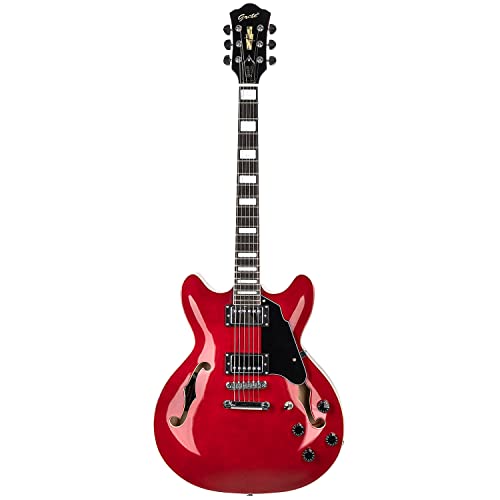
- Grote Jazz Electric Hollow Body: a very low-cost experiment; check the seller’s return policy.
- Epiphone Riviera: a semi-hollow archtop with a more compact feel.
How we chose these hollow body guitars
This is a research-based list. We did not personally play these guitars. We compared maker descriptions and listing details such as body type, pickups, hardware and variants, then grouped them by who benefits most. We limited the list to two models per brand, covered a range of price tiers and kept to claims we could attribute to makers. Confirm current specs on the maker page before you buy.
Hollow body buying guide: feedback, pickups and hardware
Fully hollow versus semi-hollow
A fully hollow guitar has no solid block under the pickups, while a semi-hollow has a block or a wooden centre running through the body. Fully hollow guitars are more resonant but feed back sooner. If you play at low to moderate volumes, they are rewarding; if you play loud, a semi-hollow is easier to control.
Body depth and size
Thin hollow bodies, like the Casino, reduce feedback and weight. Deeper bodies have a fuller, airier sound. Body width affects comfort when seated, and most of these guitars sit in a 15 to 16 inch range.
Pickups: humbucker, Filter’Tron or P-90
- Humbuckers: warm, quiet and good for jazz and blues.
- Filter’Tron style: bright, chiming and clear, a Gretsch signature.
- P-90: raw, biting, but prone to hum.
Tailpiece and bridge
Stopbar and trapeze tailpieces keep the guitar simple and stable. A Bigsby adds vibrato but requires care with string changes. A floating bridge like those on many Ibanez and D’Angelico models can shift, so mark the position before changing strings.
Strings
Flatwound strings are the classic jazz choice, with a mellow tone and low string noise. Roundwounds give more sparkle for rockabilly and blues. A medium-light gauge is a good starting point.
Humidity and care
Thin laminate tops respond to changing humidity, so store hollow bodies in a case with a humidity pack. Maker guidance from Martin and Taylor recommends 40 to 50 percent relative humidity, and the same advice applies to any hollow instrument.
Best hollow body guitars under 1000: where the budget lands
If you want the best hollow body guitars under 1000, the safest bets are the Ibanez Artcore AF75 and AMH90, the Gretsch G2420T Streamliner and the Epiphone Casino, which sit comfortably in that band. The Gretsch G5422TG Electromatic Classic sits near the ceiling, so check current pricing. The PRS SE Hollowbody Standard and D’Angelico Premier EXL-1 are typically above that line or close to it, so they suit players who can stretch the budget for better build or styling.
Best amp for hollow body guitars: how to avoid feedback
The best amp for hollow body guitars is a clean, warm amplifier with enough headroom that you rarely need to push it. Look for a 1×12 combo or a 1×10 with a tube or tube-like response, a spring or digital reverb, and a tone stack that lets you cut bass and treble. Keep these habits:
- Set the amp to a clean tone, with the gain low.
- Roll back the guitar’s tone knob slightly to soften high-frequency squeal.
- Stand away from the amp or angle it so the cabinet isn’t pointing directly at the guitar.
- Use a noise gate or a feedback-reducing pedal only if necessary.
- Consider sound-hole inserts or taping the f-holes for very loud stages, though many players prefer to avoid them.
Frequently Asked Questions
Is a hollow body guitar good for beginners?
It can be, but a solid-body is simpler to manage. Choose a hollow body if the tone is what excites you, and keep the volume moderate.
What is the difference between a hollow body and a semi-hollow body?
A hollow body has no centre block, while a semi-hollow has a wooden block through the middle. The semi-hollow is more resistant to feedback.
Can I play distortion on a hollow body?
Yes, but feedback increases with gain. Light overdrive works well; heavy distortion needs careful volume control.
Do hollow body guitars need special strings?
No, but flatwounds suit jazz and roundwounds suit rockabilly and blues. Medium-light gauges are common.
Why do hollow body guitars feed back?
The open body resonates with sound from the amp, which re-enters the pickups and creates a loop. Lowering the volume or moving away from the amp helps.
Is a Bigsby worth it?
If you want expressive vibrato, yes. If you change strings often and prefer simplicity, a stopbar tailpiece is easier.
Which one should you buy?
- Affordable Bigsby twang: Gretsch G2420T Streamliner.
- Vintage Gretsch shimmer: Gretsch G5422TG Electromatic Classic.
- Budget jazz box: Ibanez Artcore AF75.
- Modern styling and blues: Ibanez Artcore Expressionist AMH90.
- All-round versatility: PRS SE Hollowbody Standard.
- Boutique-style jazz looks: D’Angelico Premier EXL-1.
- Bite and slim body: Epiphone Casino.
Sources
- Gretsch Streamliner and Electromatic series information
- Ibanez Artcore and Artcore Expressionist series information
- PRS Guitars SE Hollowbody information
- D’Angelico Premier series information
- Epiphone hollowbody series information
Last updated: October 2026




Write Your Review
No reviews yet. Be the first to share your experience!