

Key takeaways
- Wattage matters far less than speaker size and headphone output for home practice. A 10-watt amp is already louder than most apartments allow.
- Under the first budget, expect one channel, a clean/overdrive switch and a 6-inch speaker. Spending more buys a bigger speaker, modeling and onboard effects.
- If you play at night, a real headphone jack that mutes the speaker is the most useful feature on the spec sheet.
- Battery minis are great for travel and the couch, but they sound thin next to a 6-8 inch speaker in a proper cabinet.
The best amps for electric guitars under 100 dollars are small solid-state combos and battery minis, and the best picks in the next band up, under 200 dollars, are the 10-20 watt combos and the new rechargeable modelers. For bedroom, dorm and apartment practice, the Fender Frontman 10G is the simple, plugged-in choice, the Blackstar Fly 3 is the tiny travel pick, and the Boss Katana-Mini X is the step-up that sounds and behaves most like a “real” amp. This guide sorts them by the thing that actually decides a practice amp: how it behaves at quiet volume.
Our top picks


As an Amazon Associate we earn from qualifying purchases at no extra cost to you.
Key takeaways
- Wattage matters far less than speaker size and headphone output for home practice. A 10-watt amp is already louder than most apartments allow.
- Under the first budget, expect one channel, a clean/overdrive switch and a 6-inch speaker. Spending more buys a bigger speaker, modeling and onboard effects.
- If you play at night, a real headphone jack that mutes the speaker is the most useful feature on the spec sheet.
- Battery minis are great for travel and the couch, but they sound thin next to a 6-8 inch speaker in a proper cabinet.
Best amps for electric guitars under 100 and under 200: the shortlist
A practice amp has one job: make a guitar enjoyable to play at a volume that does not annoy anyone. That is a different job from a stage amp, so the usual “more watts is better” logic flips. A 100-watt amp is useless at bedroom volume because its tone only wakes up when it is pushed. A 10-watt solid-state combo, or a small modeler with a power-reduction feature, gives you a usable sound at conversation level.
Every model below is a current, widely sold practice-class amp. The two budget bands in the title are handled in words rather than prices: “first band” means the under-100 tier, “second band” means the 100-200 tier, and each pick says where in its band it sits. Specs come from the maker’s published sheets and retailer spec pages, and the comments on feel and sound are drawn from published reviews, not from playing them ourselves.
| Pick | Band | Power / speaker | Channels / tone control | Silent practice | Best for |
|---|---|---|---|---|---|
| Fender Frontman 10G | First, middle | 10 W · 6 in | 1 channel · gain, volume, treble, bass · overdrive switch | Headphone out, aux in | Plug-in-and-play beginners |
| Blackstar Fly 3 | First, lower end | 3 W · 3 in | 2 channels (clean, overdrive) | Headphone / emulated out | Desk, dorm, travel |
| Positive Grid Spark GO | First, upper end | 5 W · small full-range driver | 33 amp models · 43 effects | Headphone out, Bluetooth | Phone-app tone shaping |
| Marshall MG10G | First, top edge | 10 W · 6.5 in | 2 channels (clean, overdrive) · contour | Muting headphone out, aux in | Rock-leaning tones at low volume |
| Vox Pathfinder 10 | Second, lower | 10 W · 6.5 in | 1 channel · gain, treble, bass · clean/OD switch | Headphone / line out | Chimey clean tones |
| Boss Katana-Mini X | Second, upper | 10 W · 5 in | 3 amp types · 3-band EQ · 2 FX sections | Cab-sim output, Bluetooth audio | Portable amp with real effects |
| Fender Frontman 20G | Second, lower | 20 W · 8 in | 1 channel · overdrive switch | Headphone out, aux in | Bigger room, band-lite use |
How we chose these amps
This is a research-based list. We did not personally use or play any of these products. We compared maker spec sheets, retailer spec pages and published editorial reviews, then filtered by five questions a bedroom player cares about.
- Is there a real headphone output? Several mini amps only have a 3.5 mm jack that doubles as a line out; we noted which ones mute the speaker.
- Does the cabinet give the speaker room to breathe? Small drivers in plastic shells are thin; 5-8 inch speakers in a box are fuller.
- How many tones before it feels limiting? One clean and one dirty sound is fine at first, but a three-band EQ or modeling postpones the “I need a new amp” moment.
- Can it be carried? Weight and battery power decide whether an amp gets used on the porch, at a friend’s place or only at a desk.
- Is the model a current, widely stocked product? Unlisted, rebadged or “renewed” units were skipped.
Each pick lists a “best for” and a “skip if” so you can eliminate quickly. Pros and cons reflect how the amp is described in maker materials and in reviews from guitar publications.
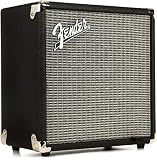
1. Fender Frontman 10G: Best for plug-in-and-play beginners
- 10 W solid state · 1 x 6 in Fender Special Design speaker · closed back
- One channel with gain, volume, treble and bass · overdrive switch
- Aux input for backing tracks · headphone output · roughly 3.8 kg
- Band position: the middle of the first budget
Best for: a first electric guitar owner who wants a simple amp with no menus, no app and no manual to read. The control set is the classic gain/volume/treble/bass layout, so everything you learn transfers to any other amp.
Skip if: you want built-in reverb or effects. The Frontman 10G has none, and a separate pedal is the only way to add them.
Pros
- Familiar control layout that teaches how tone controls interact.
- Aux input lets you play along to a phone or backing tracks.
- Closed-back cabinet keeps the sound tighter, which suits quiet rooms.
- Headphone jack for late-night sessions.
Cons
- No effects, no reverb and no tuner.
- The overdrive is a single voicing, so high-gain styles will sound limited.
2. Blackstar Fly 3: Best for desk, dorm and travel
- 3 W · 1 x 3 in speaker · runs on batteries (6 x AA) or a DC supply
- Two channels, clean and overdrive · line-in for a music source
- Headphone / emulated output · extension speaker output for the Fly 103 cabinet
- About 0.9 kg · band position: lower end of the first budget
Best for: a guitarist who lives in a small space, travels, or wants a second amp for the couch. The maker publishes it as a pocketable mini with a surprisingly ordinary feature list: two channels, a tone control and an aux input.
Skip if: you plan to play with a drummer or keep the amp as your only one for a year or more. Three inches of speaker is a hard physical limit on low-end body.
Pros
- Genuinely portable; can be packed in a backpack.
- The extension-speaker output means you can later add the matching Fly 103 cabinet for a larger sound.
- Line-in lets you practice along with a phone.
Cons
- Small driver sounds thin on low strings.
- Battery consumption is a consideration if you play often away from a wall socket.
3. Positive Grid Spark GO: Best for app-based tone shaping
- 5 W · compact full-range driver · built-in rechargeable battery with USB-C charging
- 33 amp models · 43 effects · Bluetooth · built-in tuner
- USB audio interface function for recording on a phone or computer
- Band position: upper end of the first budget
Best for: a player who wants many sounds from a tiny device and does not mind using a phone app to get them. The Spark GO also doubles as a Bluetooth speaker for backing tracks, which makes it the most multi-purpose pick in the first band.
Skip if: you dislike apps or want a knob-per-function experience. Most of the control happens in the app.
Pros
- Large amp-model and effect library for the size.
- Rechargeable battery and an audio-interface mode make it useful beyond the amp.
- Very small and light; fits in a coat pocket.
Cons
- The tiny speaker caps loudness and bass.
- Depends on the app for most settings.
4. Marshall MG10G: Best for rock tones at low volume
- 10 W solid state · 1 x 6.5 in speaker · 8 ohm
- Two channels: clean volume, overdrive gain and volume, plus a contour control
- Instrument input, 3.5 mm aux in, headphone out that mutes the speaker
- About 4.8 kg · band position: top edge of the first budget
Best for: a beginner into classic rock or punk who wants the two-channel arrangement of a clean sound plus a separately voiced overdrive. Having separate volumes for the two channels is a practical convenience: you can set a dirty tone to match your clean level and switch between them.
Skip if: you want a clear tonal “hi-fi” clean sound, or you need onboard reverb.
Pros
- Separate clean and overdrive volumes.
- Headphone output that mutes the speaker for silent practice.
- Contour control for scooping the mids.
Cons
- No effects or reverb.
- Heavier than the Fly 3 and Spark GO, so it stays mostly in one room.
5. Vox Pathfinder 10: Best for chimey clean tones
- 10 W solid state · 1 x 6.5 in Vox Bulldog speaker · open-back cabinet
- One channel with gain, volume, treble, bass and a clean/overdrive switch
- One input · headphone / line output · about 4.8 kg
- Band position: lower part of the second budget
Best for: players who like jangly, open clean sounds, the kind associated with Vox amps, and want a compact practice combo. The open-back design gives a more airy projection, which suits clean strumming and light overdrive.
Skip if: you need an aux input, which this model lacks. You would have to run a phone through a separate speaker.
Pros
- Open-back cabinet with a named speaker, giving a recognisable “Vox” character.
- Simple controls and a useful headphone / line output.
- Works well with pedals because the clean channel is stable.
Cons
- No aux input and no built-in effects.
- The distortion setting is modest.
6. Boss Katana-Mini X: Best portable amp with real effects
- 10 W · 1 x 5 in speaker · wooden cabinet · built-in rechargeable battery with USB-C charging
- 3 amp types (Brown, Crunch, Lead) · 3-band EQ · two FX sections
- Bluetooth audio streaming · guitar tuner · cab-sim output
- Band position: upper end of the second budget
Best for: someone who wants the Katana tonal family in a small box that works on a battery. According to the maker’s published spec, the Mini X raises power and speaker size over the original Katana Mini, which was a 7 W amp with a 4 in speaker.
Skip if: you only want a plug-in-and-play clean amp. The extra menus will be wasted.
Pros
- Three distinct amp voicings with real EQ control.
- Two effect sections give delay, reverb and modulation.
- Rechargeable battery makes it genuinely portable.
- Built-in tuner and Bluetooth audio for backing tracks.
Cons
- At the upper end of the second budget.
- The battery is built in, so you cannot swap a spare for a long session.
7. Fender Frontman 20G: Best for a bigger room
- 20 W solid state · 1 x 8 in Fender Special Design speaker · closed back
- Gain, volume, treble, bass · overdrive switch
- 1/8 in aux input · headphone output · about 4.5 kg
- Band position: lower part of the second budget
Best for: a player who has outgrown a 6 inch speaker or shares a living room, garage or small rehearsal space. Moving from a 6 inch speaker to an 8 inch driver is the biggest low-end jump you get inside this budget.
Skip if: you need modeling, effects or an app. This is an unadorned amp.
Pros
- Larger speaker for a fuller sound.
- Same simple layout as the 10G, so the step up is painless.
- Aux input and headphone output are both present.
Cons
- No effects, no tuner, no reverb.
- Larger and heavier than the minis.
Also consider
- Fender Champion II 25: 25 W · USB and aux inputs per the listing. A sensible step up if the Frontman 20G feels plain, but it sits near the top of the second budget.
- Positive Grid Spark MINI: 10 W · stereo speaker pair plus bass radiator · the same amp-model library as the Spark GO. The bigger, better-sounding sibling, near the top of the second band.
- Orange Crush 12: 12 W · 6 in speaker · cab-sim output listed. Good if you like a gritty overdrive character.
- Boss Katana:GO: a pocketable headphone amplifier, not a speaker amp. A very good fit if you only practice with headphones in a shared home.
Buying guide: what to look for in a practice amp
Wattage is not volume
A common misunderstanding is that doubling watts doubles loudness. In reality, to make a sound seem twice as loud you need roughly ten times the power. Going from a 10 W amp to a 20 W amp is barely a noticeable jump in loudness; what you notice is the bigger speaker and cabinet. For bedroom practice, 3-10 W is plenty. Choose 20 W only if you play with a drummer on occasion or in a large living room.
Speaker size and cabinet
As a rough guide, a 3 inch driver struggles to reproduce the low end of a guitar, whose lowest string vibrates at about 82 Hz. A 5-6.5 inch driver sounds like a real guitar amp. An 8 inch driver adds noticeable body. Open-back cabinets (like the Pathfinder 10) project wide and airy; closed-back cabinets (like the Frontman line) sound tighter and punchier.
Headphone output
If you play at night or in a shared house, check that the jack mutes the speaker. Mini amps often use a combined headphone and line-out jack, which is perfectly fine for private practice. Some larger models also have a cab-sim output that is suitable for recording.
Channels and tone shaping
Under the first budget, expect a clean/overdrive switch. Between the two budgets, you start to see 3-band EQ, modeling and onboard effects. If you want to learn how effects and tone controls work, the Katana-Mini X and the Spark amps give the most to explore. If you plan to add pedals later, a simple clean amp with a good headroom is easier to build on.
Best amps for hollow body guitars
Hollow and semi-hollow guitars are more prone to feedback at higher volume and gain. For these, a clean, low-gain amp with a decent speaker (like the Vox Pathfinder 10 or Fender Frontman 20G) tends to be easier to manage than a high-gain amp. Keep the gain low and use the volume control, and move away from the speaker if you hear a howl.
Best amps for beginners
For beginners, the main criteria are simplicity, a headphone jack and a reasonably sized speaker. The Fender Frontman 10G satisfies these. If you are mostly going to play with headphones or on the couch, a mini such as the Blackstar Fly 3 or the Spark GO is a good first amp, but expect to upgrade within a year or two if you want a fuller sound.
Getting a good quiet sound from a small amp
Most complaints about cheap practice amps come from setup, not hardware. These steps apply to every model above.
- Set the tone controls flat first. Put bass, middle and treble at noon (or the equivalent) and adjust one control at a time. Small speakers exaggerate treble, so you usually end up pulling treble down rather than pushing it up.
- Raise the amp off the floor. A chair or a stand points the speaker at your ears instead of your ankles, so you hear the true tone without turning the volume up.
- Use the gain, not the volume, for crunch. At low volume, the overdrive switch or gain knob does the work. Turning the master up just makes the room louder.
- Add a pedal only after you know the amp. A small amp with a clean channel is a good pedal platform, but stacking distortion pedals into a mini amp’s own overdrive often sounds harsh.
- Keep the guitar’s own volume knob in play. Rolling the guitar down to about seven cleans up most small-amp overdrive, which saves you from switching channels.
If your guitar is a single-coil model, such as a Stratocaster-style instrument, you may hear hum next to computers and lamps. Turning the guitar to face a different direction usually reduces it, which costs nothing compared with buying a noise gate.
Quick decision table
| Your situation | Best match | Why |
|---|---|---|
| Dorm room, headphones most of the time | Blackstar Fly 3 or Boss Katana:GO | Small, battery-friendly, headphone-first |
| First guitar, want simple controls | Fender Frontman 10G | Classic knob layout, no menus |
| Want many tones and an app | Positive Grid Spark GO | 33 amp models, 43 effects |
| Classic rock and punk | Marshall MG10G | Two channels with contour |
| Jangly cleans, pedal user | Vox Pathfinder 10 | Open-back, clean-focused |
| Portable with real effects | Boss Katana-Mini X | Battery, 3 amp types, 2 FX sections |
| Larger room or jam sessions | Fender Frontman 20G | 8 in speaker, 20 W |
Frequently Asked Questions
What are the best amplifiers for guitars at a small budget?
For a small budget, the best amplifiers for guitars are 10 W solid-state combos such as the Fender Frontman 10G and Marshall MG10G, and mini amps such as the Blackstar Fly 3. They give a real speaker and a headphone output without paying for features you will not use as a beginner.
How many watts do I need for bedroom practice?
Between 3 and 10 watts. Because perceived loudness grows slowly with power, a 10 W solid-state amp is already far louder than most apartments tolerate. For a bedroom, expect to keep the volume knob low most of the time.
Is a modeling amp better than a standard solid-state amp for beginners?
It depends on how you learn. A modeling amp such as the Spark GO or Katana-Mini X gives you many sounds and effects, which can be motivating. A simple amp such as the Frontman 10G teaches how the gain and tone controls work. Both are valid; pick based on whether you want exploration or simplicity.
Can I use a small amp with a bass or an acoustic guitar?
Small electric guitar amps are voiced for electric guitar. Bass needs a larger speaker and different tuning to avoid distortion on low notes, and acoustic guitars sound best through an amp designed for them. Some mini amps advertise acoustic or bass compatibility, but check the maker’s spec before buying.
Do I need a pedal with a practice amp?
No. Amps with a built-in overdrive give enough range for learning. Pedals become useful once you want effects the amp does not provide, such as delay or chorus on the Frontman and Pathfinder amps.
Will a battery amp work for gigs?
Battery minis are designed for practice, busking and quiet rehearsals. Their small drivers and low wattage mean they are not meant to be heard over a drummer.
Which one should you buy?
If you want one simple recommendation inside the first budget, buy the Fender Frontman 10G. If you travel a lot or live in a tiny space, the Blackstar Fly 3 is the smarter choice. If you can stretch into the second budget, the Boss Katana-Mini X is the most feature-rich portable pick, and the Fender Frontman 20G is the better choice for a bigger room. If rock is your genre and you want separate clean and overdrive volumes, the Marshall MG10G is the one to pick.
Sources
- Fender, Frontman 10G and Frontman 20G product specifications
- Marshall Amplification, MG10G specifications
- Blackstar Amplification, Fly series specifications
- Positive Grid, Spark GO and Spark MINI product pages
- Boss / Roland Corporation, Katana-Mini and Katana-Mini X product pages
- Vox / Korg, Pathfinder 10 specifications
- Guitar World and MusicRadar published amp reviews
Last updated: October 2026




Write Your Review
No reviews yet. Be the first to share your experience!