

Key takeaways
- The quality of the low B decides a five-string; scale length and string spacing matter more than the headstock logo.
- A 35 in scale, as on the Schecter Stiletto Extreme-5, tightens the B string; a 34 in scale is the norm and works well on good basses.
- Nut widths on five-strings run wider than on four-strings, so check that your hand is comfortable before choosing.
- Active electronics help the B string project, but passive five-strings can sound excellent through a good amp.
- Make sure your amp or speaker cabinet handles low B frequencies, or the new string will be wasted.
The best 5 string bass guitars give you a low B string that is clear rather than flabby, a neck wide enough to play comfortably and electronics that suit the music you play. For most players the Ibanez SR305E, Yamaha TRBX305 and Ibanez Gio GSR205 are the safest places to start, while the Schecter Stiletto Extreme-5 is the pick for metal and the Squier Classic Vibe 70s Jazz Bass V for vintage tone.
A five-string is not simply a four-string with an extra string. The low B changes how the neck feels, how the strings are spaced, how tight the lowest string sounds and what the amp has to reproduce. This guide is built around those differences. Instead of repeating a general bass shopping list, it looks at B-string tension, nut width, string spacing, scale length and the electronics that help the lowest note speak, then matches each of six basses to the kind of band that suits it.
Our top picks


As an Amazon Associate we earn from qualifying purchases at no extra cost to you.
Key takeaways
- The quality of the low B decides a five-string; scale length and string spacing matter more than the headstock logo.
- A 35 in scale, as on the Schecter Stiletto Extreme-5, tightens the B string; a 34 in scale is the norm and works well on good basses.
- Nut widths on five-strings run wider than on four-strings, so check that your hand is comfortable before choosing.
- Active electronics help the B string project, but passive five-strings can sound excellent through a good amp.
- Make sure your amp or speaker cabinet handles low B frequencies, or the new string will be wasted.
Best 5 string bass guitars: key specs for the low B
| Bass | Scale | Nut / spacing | Frets | Pickups | Electronics |
|---|---|---|---|---|---|
| Ibanez Gio GSR205 | 34 in | 45 mm / 16.5 mm | 22 | 2 Dynamix H passive | Phat II EQ bass boost |
| Ibanez SR305E | 34 in | 45 mm / 16.5 mm | 24 | 2 PowerSpan dual-coil | Active 3-band with Power Tap |
| Yamaha TRBX305 | 34 in | Wide 5-string nut | 24 | 2 ceramic humbuckers | Switchable active/passive |
| Yamaha TRBX605 | 34 in | Wide 5-string nut | 24 | 2 Alnico V humbuckers | Active/passive with 3-band EQ |
| Schecter Stiletto Extreme-5 | 35 in | 45 mm (1.771 in) | 24 | 2 Diamond Bass humbuckers | Active with onboard EQ |
| Squier Classic Vibe 70s Jazz Bass V | 34 in | 1.875 in (47.6 mm) | 20 | 2 Alnico single-coils | Passive |
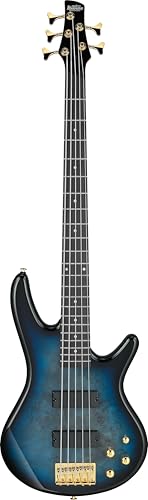
1. Ibanez SR305E: Best for a slim, fast five-string
- Okoume body (earlier listings mention mahogany and nyatoh), 5-piece maple and walnut bolt-on neck
- Jatoba fingerboard with white dot inlays, 34 in scale, 24 medium frets
- Nut width 45 mm, Accu-cast B125 bridge with 16.5 mm string spacing
- PowerSpan Dual Coil passive pickups at neck and bridge
- Ibanez Custom Electronics 3-band EQ with a 3-way Power Tap switch (tap, series, power tap)
Best for: players moving from four strings who want a five-string that feels familiar. The neck is slim for a five-string, and the 24 frets give good upper-register range.
Skip if: you want a retro look or a chunky neck.
Pros: Slim, fast neck. Versatile pickup switching. Strong tonal control with the 3-band EQ. 24 frets.
Cons: Body wood has changed across production years. Active circuit needs a battery. Narrow string spacing for fingerstyle players with large hands.
Low-B note: A slim five-string neck often means a tighter B-string feel under the fingers. The Power Tap series mode can fatten the sound if the B sounds thin.
2. Yamaha TRBX305: Best for value and a dependable build
- Mahogany body, bolt-on 5-piece maple and mahogany neck, rosewood fingerboard
- 34 in scale, 24 medium frets
- Two ceramic humbucking pickups
- Switchable active and passive electronics (per retailer listings)
- Finish options include white and black
Best for: rock and pop players who want a reliable five-string with modern features at a sensible level in the market. The humbucking pickups keep noise low.
Skip if: you want a vintage-style tone or a very light bass.
Pros: 24 frets. Quiet humbuckers. Multi-piece neck. Easy to switch between active and passive.
Cons: Retailer descriptions of electronics vary, so check the maker spec. Modern styling. Plain controls.
Low-B note: The mahogany body adds warmth, which helps the B string avoid sounding brittle.
3. Ibanez Gio GSR205: Best for low cost and a simple bass boost
- Poplar body, GSR5 maple bolt-on neck, jatoba fingerboard with white dot inlays
- 34 in scale, 22 medium frets, 45 mm nut
- Two Dynamix H passive pickups (neck and bridge)
- Phat II EQ active bass boost, B15 bridge with 16.5 mm spacing
- Standard tuning B-E-A-D-G with .045 to .125 strings
Best for: first five-strings and budget-conscious players who still want a dependable instrument. The Phat II boost gives a quick helping hand to the B string.
Skip if: you want a full 3-band EQ or high-end hardware.
Pros: Low price. Slim neck for a five-string. Simple tone control. Strong brand support.
Cons: Basic hardware. Fewer frets than the SR305E. Active boost needs a battery.
Low-B note: A budget five-string often needs a setup to help the B string ring evenly. Ask your technician to adjust the nut and action.
4. Yamaha TRBX605: Best for a premium look and 3-band control
- Flamed maple over alder body (FM models), 5-piece maple and mahogany bolt-on neck
- Rosewood fingerboard, 34 in scale, 24 medium frets
- Two Alnico V humbuckers
- Active/passive preamp with a 3-band EQ (bass, middle, treble) and a pickup balancer
- Battery alert LED, Indonesian build
Best for: players who want a handsome five-string with real tonal range and a safety net when the battery fades. The mid control is very helpful for fitting the bass into a mix.
Skip if: you want a simple, passive instrument.
Pros: Attractive flamed top. 3-band EQ. Alnico V humbuckers. Active/passive switch.
Cons: Higher in price than the 305. More controls to learn. Needs a battery for active mode.
Low-B note: The 3-band EQ lets you sculpt the low B so that it does not boom in small rooms.
5. Schecter Stiletto Extreme-5: Best for metal, hard rock and worship
- Mahogany body with a quilted maple top, bolt-on maple neck with a Bass Thin C profile
- 35 in scale, 24 extra-jumbo frets, rosewood fingerboard, 16 in radius
- Nut width 45 mm (1.771 in)
- Two Schecter Diamond Bass humbuckers
- Active electronics with onboard EQ
Best for: heavy styles that demand a tight, clear B string. The extended 35 in scale tightens the low B and helps it stay defined when the guitars are loud.
Skip if: you prefer a traditional feel or have small hands, since a 35 in scale makes the stretch longer.
Pros: Tight B string. Flat fast fingerboard. Strong active tone. Visually striking.
Cons: Longer scale needs more reach. Specs vary between listings. Not a vintage tone.
Low-B note: Many players choose a 35 in scale specifically for the low B. If your hand is large, the extra stretch is a fair trade.
6. Squier Classic Vibe 70s Jazz Bass V: Best for vintage five-string tone
- Bolt-on maple neck with a Bass C shape, maple fingerboard with 9.5 in radius
- 34 in scale, 20 narrow tall frets
- Nut width about 1.875 in (47.6 mm), five-saddle vintage-style bridge
- Two Fender-designed Alnico single-coil pickups
- Two volumes and one tone, passive electronics
Best for: funk, soul, pop and classic rock players who want a warm, round five-string tone with a vintage look. The wide nut gives plenty of room for fingerstyle.
Skip if: you want a very modern, heavy tone or an extra-fast neck.
Pros: Classic Jazz Bass design. Passive electronics. Wide spacing. Alnico single-coil pickups.
Cons: Single-coil hum. Only 20 frets. The wide neck may feel large for newcomers.
Low-B note: The wide nut and passive circuit give a warm, rounded B string that suits vintage styles but may need a tone boost for rock.
Also consider
- Sterling by Music Man StingRay RAY5HH: A five-string StingRay with a two-humbucker layout, for players who want the Music Man voice with an added B.
- Yamaha BB735A: A BB-series five-string with a more classic, vintage-inspired design.
- Fender Affinity Jazz Bass V Active: An active five-string Jazz Bass from Fender’s Affinity line, for players who like the Jazz shape with onboard EQ.
- Fender Player II Modified Active Jazz Bass V: A step-up active five-string Jazz Bass for those with a bigger budget.
Fixing a weak or floppy low B
Most complaints about five-strings come down to the B string. If yours sounds loose, boomy or uneven, work through the list below before blaming the bass.
- Fit a fresh, correct-gauge set. A five-string set with a heavier B (the Ibanez GSR205, for example, lists .045 to .125) tightens the string noticeably.
- Raise the action slightly on the B. A low B that buzzes will sound thin. A touch more height lets it ring.
- Check the nut slot. A slot that is too wide lets the string rattle; one that is too narrow pinches and causes tuning problems.
- Adjust the pickup height. A pickup too close to the B string can cause uneven volume and a warbling note. Lower the pole pieces on that side.
- Roll off excess bass on the amp. Boosting the low EQ on a small amp makes the B boom. Cut a little instead.
- Consider a longer scale next time. A 35 in scale like the Schecter keeps the B string tighter with the same gauge.
Which five-string suits which kind of band
| Band style | What the B string must do | Best fit here |
|---|---|---|
| Modern rock and alternative | Add weight under down-tuned guitars | Yamaha TRBX305 or Ibanez SR305E |
| Metal and extended-range music | Stay tight and articulate under high gain | Schecter Stiletto Extreme-5 |
| Worship and gospel | Fill the bottom end gently in large rooms | Yamaha TRBX605 |
| Funk and soul | Provide warm, round low notes with room for slap | Squier Classic Vibe 70s Jazz Bass V |
| Learning and budget | Be playable without a big learning curve | Ibanez Gio GSR205 |
Moving from four strings to five: a four-week plan
Week one: Play your usual songs and ignore the B string. Get used to the wider neck and the closer spacing. Make sure your thumb has a comfortable rest, usually on the pickup or on the B string itself. Week two: Practice muting. The B string vibrates easily, so rest a finger of the picking hand or the fretting hand on it when it is not in use. Week three: Use the B string for a few notes in a favorite song, moving the root down an octave where it feels right. Week four: Work on scales that include the B string, then record yourself to check that the low notes are even in volume with the rest.
Tuning and string options for a five-string
| Tuning (low to high) | Typical use | Note |
|---|---|---|
| B-E-A-D-G | Standard five-string tuning | Works with a standard five-string set |
| E-A-D-G-C | Tenor-style range for chords and melodies | Needs a set made for this tuning |
| Lower or drop tunings (for example, drop A) | Heavy styles | Check your neck relief and use a heavier gauge |
Whichever tuning you choose, keep the gauge consistent between changes and ask for a quick setup if you switch.
Looking after a five-string
A five-string neck carries more tension in total than a four-string neck, so it benefits from regular truss rod checks. Keep the bass away from heat and direct sun, aim for 40 to 50 percent relative humidity (the usual maker guidance for wooden instruments), and replace the battery in active models before a tour. Wipe down the strings after playing, since the thicker B can collect grime and lose brightness faster than the upper strings.
Reading a five-string spec sheet without being fooled
Spec sheets for five-strings can look identical until you know where to look. Start with scale length, because it determines B-string tension: 34 in is the norm, 35 in is the tight option. Next, check nut width and string spacing at the bridge; together they tell you how the bass will feel under both hands. Then look at the electronics: a three-band preamp with a mid control is more useful than a simple bass boost if you play in a band. Finally, check the neck construction. Five-piece necks with a mix of maple and walnut or mahogany, as on the Ibanez and Yamaha models here, resist twisting under the extra string tension better than a single-piece neck.
Ignore claims about wood tone in marketing copy. Mahogany, alder, poplar and okoume bodies all work. What you should care about is weight, balance and whether the pickups suit your music. Retailer listings often disagree about body wood for the same model, so rely on the maker page and treat any difference as a reason to ask the seller to confirm.
Choosing a strap and a case for a heavier bass
A five-string tends to weigh more than a four-string, and the extra string adds neck weight. A padded strap at least 7 cm wide spreads the load across your shoulder and reduces fatigue. Fit strap locks so the bass cannot slip. For transport, a bag with thick padding and a stiff neck support is the minimum; a hard case is better for travel, since a five-string neck is wide and can be vulnerable to knocks.
How we chose
We did not play these basses ourselves. The list is based on maker spec pages, retailer listings and published reviews. Where retailers disagreed on details such as body wood or nut width, we followed the maker and noted the uncertainty. Each bass had to be a real current model from a recognized maker, with a five-string neck designed for the purpose rather than adapted from a four-string.
We covered both active and passive designs, included one 35 in scale option for tight B-string response and kept the list to two Ibanez and two Yamaha models so that other makers are represented. Bundled kits and unbranded basses were left out.
What makes a five-string bass different
The low B string
The B string is tuned about a perfect fourth below the E, so it is physically longer, thicker and looser under tension. On a 34 in scale it can feel slightly slack unless the bass is built well. A 35 in scale tightens it, while a quality nut and bridge help it ring evenly. If the B string sounds muddy or flabby, the bass will disappoint no matter how good the other strings are.
Nut width and string spacing
Five-string nut widths are around 45 mm to 47.6 mm in this list, compared with 38 mm to 41 mm on common four-strings. String spacing at the bridge is typically 16.5 mm on the Ibanez models. A wider nut is more comfortable for fingerstyle; a narrower one is faster for chord work. Try both if you can.
Electronics
Active electronics help a five-string by boosting the low end and giving you a mid control to place the bass in a mix. Passive five-strings are fine for warm, vintage tones but can sound thin on the B in a loud band. Look for a bypass or an active/passive switch for flexibility.
Amp and speaker needs
The low B can reach frequencies that small speakers cannot reproduce. A bass amp with a 12-inch speaker or two 10-inch speakers is a sensible minimum for rehearsal. For bigger rooms, a cabinet with a larger driver or a full-range PA is better.
Buying guide: choosing the best sounding bass guitars with five strings
Four-string or five-string?
If your songs stay above low E, a four-string is lighter, simpler and cheaper. If you play drop tunings, extended-range music, modern rock, metal or gospel, the low B is useful. Many bassists own both. A five-string can also be tuned E-A-D-G-C for a different range, but that requires a different set of strings.
Match the bass to the band
Rock and metal bands benefit from humbuckers and a 35 in or tight 34 in scale. Funk and soul bands do well with a Jazz-style design. Worship and cover bands often need a bass that works in several settings, so an active/passive model is a smart choice.
Scale length and comfort
34 in is standard. 35 in tightens the B but adds stretch. Choose according to hand size and style.
Strings and setup
Five-string sets typically run .045 to .125 (Ibanez lists this gauge for the GSR205). A lighter B can make the string feel floppy, while a heavier one tightens it. Ask your technician to set the neck relief and action for the B string, and use a fresh set if the low B sounds dull.
Weight and strap
Five-strings are heavier than four-strings. Use a wide, padded strap and check the balance. If the headstock dives, try a strap with a grippy lining and adjust the strap button position.
Quick pick by situation
| Your situation | Choose |
|---|---|
| First five-string on a budget | Ibanez Gio GSR205 |
| Slim neck and flexible switching | Ibanez SR305E |
| Dependable, quiet and modern | Yamaha TRBX305 |
| 3-band EQ and premium looks | Yamaha TRBX605 |
| Metal and tight low B | Schecter Stiletto Extreme-5 |
| Vintage tone and wide nut | Squier Classic Vibe 70s Jazz Bass V |
Frequently asked questions
What are the best 5 string bass guitars for beginners?
The Ibanez Gio GSR205 is the most approachable. It has a slim neck for a five-string, simple controls and an affordable price. Many beginners are better off starting on four strings, though.
Are five-string basses harder to play?
The neck is wider and the strings are closer together, so there is a small adjustment period. Most players adapt in a few weeks. The extra string is optional; you can ignore it until you need it.
Which are the best 4 string bass guitars if I do not need a low B?
If you want a four-string, look at our guides to bass guitars at different price levels. Many of the same makers offer four-string versions of these models.
What are the best rock bass guitars among these?
The Yamaha TRBX305, Ibanez SR305E and Schecter Stiletto Extreme-5 are the strongest rock choices because of their humbuckers and active electronics.
What are the best bass guitars for metal?
Five-strings with humbuckers, active electronics and a tight B string are the usual choice. The Schecter Stiletto Extreme-5 is the most metal-focused here, and the Ibanez SR305E and Yamaha TRBX305 also handle heavy music well.
Which five-string sounds best for worship or church bands?
Look for a bass that is quiet, reliable and easy to dial in. The Yamaha TRBX605 with its 3-band EQ and active/passive switch is a strong fit. The TRBX305 is a more affordable alternative.
How wide is a typical five-string neck?
The nut is usually around 45 mm to 48 mm. The Ibanez and Schecter basses here use 45 mm, and the Squier Jazz Bass V is wider at about 47.6 mm. Check the spec before buying if you have small hands.
Which one should you buy?
For most players, the Ibanez SR305E is the most balanced five-string, thanks to its slim neck, 24 frets and flexible electronics. If you want the best value, choose the Yamaha TRBX305. If you are on a budget, the Ibanez Gio GSR205 is a sensible entry. Pick the Yamaha TRBX605 for a premium feel, the Schecter Stiletto Extreme-5 for heavy music and the Squier Classic Vibe 70s Jazz Bass V for vintage tone.
Sources
- Ibanez product specification pages
- Yamaha product specification pages
- Schecter product pages
- Fender and Squier product specification pages
- Sterling by Music Man product pages
Last updated: October 2026




Write Your Review
No reviews yet. Be the first to share your experience!