

Key takeaways
- Confirm that the guitar uses nylon or fluorocarbon trebles, not steel strings. Steel strings can damage a classical guitar’s bracing and bridge.
- Measure the nut width and scale length rather than relying on “full-size” or “student” labels.
- Play every fret on every string. Listen for dead notes, rattles, and notes that choke when held.
- Check that the bridge is firmly attached and that there are no open cracks around the bridge, neck joint, or soundboard.
- Look down the neck from the headstock. A small amount of relief is normal; severe twisting or a visibly uneven fingerboard is not.
- Ask for a setup if the action is painful, the nut slots are high, or the intonation seems consistently sharp.
- Budget for a tuner, spare nylon strings, a suitable case, and occasional setup work rather than spending every dollar on the guitar itself.
The best classical guitars for beginners and players are the Yamaha C40 for the lowest-cost starting point, the Córdoba C1M for a comfortable student instrument, the Yamaha CG122MS for balanced projection and value, and the Córdoba C5 or Alhambra 1C for players ready to move to a solid-top guitar.
There is no single best classical guitar for every player. The right choice depends on whether you value easy fretting, a full projecting tone, a smaller body, long-term durability, or the lowest possible price. The most important differences are not decorative: they are the neck width, scale length, string height, body size, and whether the soundboard is solid or laminated.
Our top picks

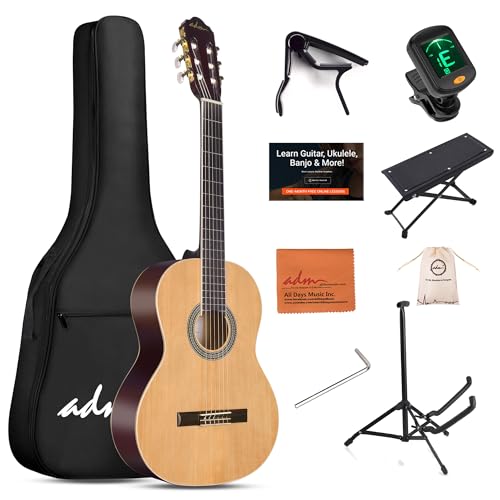


As an Amazon Associate we earn from qualifying purchases at no extra cost to you. Ratings are shown as listed on Amazon.
Quick comparison: best classical guitars by situation
| Player or situation | Recommended type | Useful specifications | Why it fits |
|---|---|---|---|
| First guitar on a tight budget | Yamaha C40 or equivalent full-size student guitar | 650 mm scale, approximately 52 mm nut, laminated top | Reliable, inexpensive, and easy to replace or maintain |
| Beginner who wants a slightly narrower neck | Córdoba C1M or similar student model | 650 mm scale, approximately 50 mm nut, laminated spruce top | More familiar to players coming from steel-string guitar |
| Fingerstyle student wanting more clarity | Yamaha CG122MS or equivalent solid-top student guitar | 650 mm scale, approximately 52 mm nut, solid spruce top | Clearer attack and more headroom as technique improves |
| Warm classical tone and long-term value | Córdoba C5 or Alhambra 1C | 650 mm scale, approximately 50–52 mm nut, solid cedar top | Responsive, rounded tone with better dynamic detail |
| Smaller reach or travel use | 3/4 or compact classical guitar | Approximately 570–610 mm scale, 48–50 mm nut | Less stretching, though with reduced bass and projection |
What matters more than the brand name?
Tonewood: cedar, spruce, and laminate
The soundboard, or top, contributes more to the guitar’s voice than the back and sides. A laminated top is made from thin bonded layers. It is usually less expensive, stable in changing conditions, and suitable for a first instrument. It may sound slightly less complex as you play softly and loudly, but a well-made laminated guitar can still be pleasant and dependable.
A solid spruce top commonly gives a crisp attack, strong note separation, and more projection. It suits players who want articulate scales, lively accompaniment, and a sound that responds clearly to changes in right-hand technique. Spruce can sound somewhat bright when new, although the voice often becomes more rounded with playing.
A solid cedar top generally produces a warmer, quicker response at low volume. It is forgiving for gentle fingerstyle playing and often makes beginner melodies sound full sooner. Cedar can compress slightly when played aggressively, so spruce may be preferable for forceful strumming or maximum headroom.
Mahogany, rosewood, meranti, and similar woods used for the back and sides influence color and sustain, but they should not outweigh construction quality and setup. At beginner prices, a comfortable neck and accurately fitted frets are usually more valuable than an exotic back-and-sides material.
Neck width and scale length
Most full-size classical guitars use a 650 mm scale and a nut close to 50–52 mm wide. The longer scale gives the instrument familiar classical tension and a generous left-hand spacing. The wider nut leaves room for independent fingers during arpeggios, but it can feel awkward to someone accustomed to a narrow steel-string neck.
A 50 mm nut is a useful compromise for many beginners. It provides enough separation for classical technique while reducing the stretch between thumb and fingers. Players with larger hands may prefer 52 mm, particularly for traditional repertoire and fingerstyle arrangements.
Scale length changes reach more noticeably than a few millimeters of nut width. A 610 mm guitar reduces the distance between frets by roughly 6 percent compared with a 650 mm model. That can make first-position chords easier, but it also usually reduces bass depth and string tension.
Action: comfortable does not mean excessively low
Action is the gap between the strings and the frets. Classical guitars require more clearance than many steel-string guitars because nylon strings vibrate with a wider arc. A practical starting range at the 12th fret is approximately 3.0–4.0 mm on the sixth string and 2.5–3.5 mm on the first string, measured from the fret crown to the underside of the string.
Lower action feels easier, but it can create buzzing when the player strikes hard or when the neck and top respond to humidity. Excessively high action makes a beginner press too firmly and can make an otherwise good guitar seem unplayable. If a new instrument is uncomfortable, have a qualified guitar technician check the nut, saddle, neck relief, and fretwork before deciding that the model is wrong.
Head-to-head: laminated student guitar versus solid-top guitar
Laminated student models
Models such as the Yamaha C40 and Córdoba C1M represent the sensible entry point. Their laminated construction tolerates ordinary student use better than a delicate premium instrument, and replacement is less painful if the guitar is damaged during lessons or transport.
Choose one when the player is still deciding whether to continue, needs a dependable practice guitar, or has a strict budget. The limitation is not that laminated guitars are automatically bad; rather, they tend to offer less tonal complexity and dynamic response than a good solid-top instrument.
Solid-top models
The Yamaha CG122MS, Córdoba C5, and Alhambra 1C occupy the next meaningful step. A solid top can respond more distinctly to changes in finger angle, nail contact, and attack. This matters once the player is practicing scales, tremolo, rasgueado, or pieces with contrasting voices.
Solid wood is also more sensitive to humidity changes. Keep the guitar away from radiators, hot cars, and direct sun, and use a case or gig bag with reasonable protection. A solid-top guitar is not automatically louder or better in every room, but it usually provides more room for the player’s technique to develop.
Choosing by comfort, projection, and value
| Priority | Best specification to seek | Trade-off |
|---|---|---|
| Fastest adjustment for a new player | 50 mm nut, 610–650 mm scale, moderate action | Less traditional spacing and possibly less bass |
| Traditional classical technique | 52 mm nut, 650 mm scale, stable full-size body | More reach and a wider fretting-hand position |
| Maximum acoustic projection | Full-size body, solid spruce top, well-fitted bridge | May sound brighter and cost more |
| Warm response at quiet practice volume | Solid cedar top, normal classical body | Less headroom under very forceful attack |
| Lowest ownership risk | Laminated top and back, padded case, simple finish | Usually less tonal complexity |
Body size: full-size, 3/4, or crossover?
A full-size classical guitar is normally the best choice for an adult or larger teenager because it supports standard technique and repertoire. A 3/4 model is useful for a child, a player with limited reach, or someone who finds a full-size body physically tiring. It should not be selected solely because it is labeled “beginner”; the correct fit depends on the player’s reach and posture.
Some crossover classical guitars use a narrower neck, radiused fingerboard, cutaway, or steel-string-style hardware. They can be comfortable for a guitarist moving from acoustic or electric guitar, but they are not always ideal for traditional classical posture. Check whether the instrument has a true nylon-string setup and whether its neck width still allows clean fingerstyle voicing.
A practical buying and setup checklist
- Confirm that the guitar uses nylon or fluorocarbon trebles, not steel strings. Steel strings can damage a classical guitar’s bracing and bridge.
- Measure the nut width and scale length rather than relying on “full-size” or “student” labels.
- Play every fret on every string. Listen for dead notes, rattles, and notes that choke when held.
- Check that the bridge is firmly attached and that there are no open cracks around the bridge, neck joint, or soundboard.
- Look down the neck from the headstock. A small amount of relief is normal; severe twisting or a visibly uneven fingerboard is not.
- Ask for a setup if the action is painful, the nut slots are high, or the intonation seems consistently sharp.
- Budget for a tuner, spare nylon strings, a suitable case, and occasional setup work rather than spending every dollar on the guitar itself.
Ownership realities: what wears out first?
Nylon strings are consumables. Depending on playing time, hand oils, climate, and attack, a regular player may replace them every one to three months. Trebles often lose clarity first, while bass strings may develop a dull or uneven winding. Replace the complete set so the tension and tone remain balanced.
Frets eventually wear under the strings, especially in the first five positions. Tuning machines can loosen, bridge tie blocks can be damaged by incorrect string installation, and high humidity or dry indoor heating can cause top movement. Wipe the strings and finish with a soft dry cloth after playing, support the neck when changing strings, and never leave the instrument in a hot trunk.
For a rough value calculation, a $250 guitar used twice weekly for three years provides about 312 practice sessions, or approximately $0.80 per session before strings and maintenance. A $600 guitar used five times weekly for the same period provides about 780 sessions, or approximately $0.77 per session. The more frequently you play, the more worthwhile comfort and a responsive top become.
Final recommendation
Choose the Yamaha C40 or Córdoba C1M if affordability and low ownership risk matter most. Move to the Yamaha CG122MS when clearer projection and a more responsive top will support continued study. Choose the Córdoba C5 or Alhambra 1C when you already expect to practice regularly and want a warmer, more expressive instrument. Whichever model you select, prioritize a comfortable neck, sensible action, accurate frets, and a protected storage solution over cosmetic upgrades.



Write Your Review
No reviews yet. Be the first to share your experience!