

Key takeaways
- For carry-on-friendly portability: Traveler Guitar Ultra-Light, provided its narrow body and gig bag meet your airline’s current baggage rules.
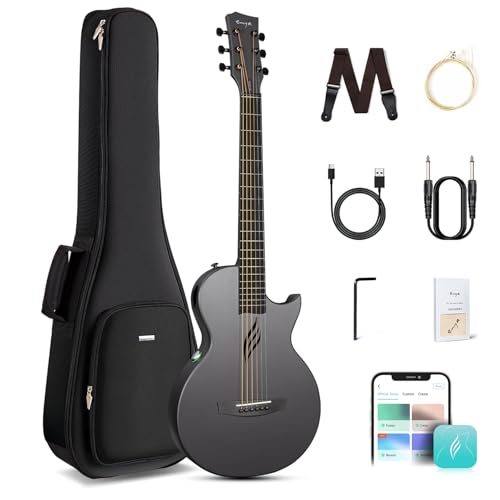
- For road trips and frequent outdoor use: Enya Nova Go, because its carbon-fiber construction tolerates humidity changes better than conventional wood.
- For compact apartments and regular practice: Taylor GS Mini, which sacrifices some packability for a much more conventional acoustic feel and sound.
- For the shortest instrument: Martin Backpacker, although its slim body is a greater compromise for strumming and seated comfort.
- For beginners on a tight budget: Yamaha GL1 guitalele, if a nylon-string, higher-pitched instrument is acceptable.
- For a small guitar with a traditional acoustic shape: Cordoba Mini II, particularly for players who prefer nylon strings and a softer response.
The best travel guitars for most players are the Taylor GS Mini for full, familiar acoustic tone, the Traveler Guitar Ultra-Light for the smallest serious instrument, and the Martin Backpacker for minimum packed length; your choice depends more on scale length, case dimensions, and playing frequency than on the label “travel guitar.”
Our top picks



As an Amazon Associate we earn from qualifying purchases at no extra cost to you. Ratings are shown as listed on Amazon.
Quick picks by travel situation
- For carry-on-friendly portability: Traveler Guitar Ultra-Light, provided its narrow body and gig bag meet your airline’s current baggage rules.
- For road trips and frequent outdoor use: Enya Nova Go, because its carbon-fiber construction tolerates humidity changes better than conventional wood.
- For compact apartments and regular practice: Taylor GS Mini, which sacrifices some packability for a much more conventional acoustic feel and sound.
- For the shortest instrument: Martin Backpacker, although its slim body is a greater compromise for strumming and seated comfort.
- For beginners on a tight budget: Yamaha GL1 guitalele, if a nylon-string, higher-pitched instrument is acceptable.
- For a small guitar with a traditional acoustic shape: Cordoba Mini II, particularly for players who prefer nylon strings and a softer response.
Best travel guitars compared
The measurements below are useful for planning, but trim levels, tuners, cases, and regional specifications can change the final weight. Packed length means the instrument itself or its supplied gig bag may be longer once padding and pockets are included.
| Model | Scale length | Approx. instrument length | Approx. weight | Strings and construction | Best use |
|---|---|---|---|---|---|
| Traveler Guitar Ultra-Light | 28.5 in | 28 in | 3 lb | Steel-string; full-scale neck, compact body | Smallest serious steel-string option |
| Martin Backpacker | 24 in | 33.75 in | 2.5–3 lb | Steel-string; solid spruce top | Lightweight hiking and basic practice |
| Yamaha GL1 | 17 in | 29.5 in | About 3 lb | Nylon-string guitalele | Low-cost, compact casual playing |
| Cordoba Mini II | 22.875 in | 34.5 in | About 4 lb | Nylon-string; spruce or mahogany-top versions | Compact classical-style playing |
| Taylor GS Mini | 23.5 in | 36.6 in | 5–6 lb | Steel-string; layered-wood body | Best balance of portability and acoustic tone |
| Enya Nova Go | 25.5 in | 36.6 in | About 4.4 lb | Steel-string; carbon-fiber composite | Humidity-resistant road travel |
Head-to-head: what changes when the guitar gets smaller?
Scale length and playing comfort
Scale length is the distance from the nut to the bridge, and it affects both fretting reach and string tension. A 28.5-inch full-scale neck, as used by the Traveler Guitar Ultra-Light, feels close to a standard electric or acoustic guitar. That makes it a strong choice for players who want to practice familiar chord shapes without adapting to a short neck.
Shorter instruments reduce reach, but they do not automatically feel easier. The Martin Backpacker’s 24-inch scale is comfortable for many players, while the Yamaha GL1’s 17-inch scale raises the tuning by an octave-like interval compared with a conventional guitar setup. Chord shapes remain familiar, but the instrument does not sound or feel like a standard guitar. The GL1 is better treated as a guitalele than as a miniature replacement for a steel-string acoustic.
The Taylor GS Mini sits at 23.5 inches and has a compact body, yet its neck width and response remain approachable for ordinary guitar playing. This is one reason it works particularly well as a primary practice guitar rather than an emergency travel instrument.
Packed dimensions and carry-on reality
The shortest guitar is not always the easiest one to carry. A narrow instrument can fit beside luggage more easily than a compact guitar with a full lower bout, but the padded bag adds several inches and may be the dimension an airline measures. Airline cabin policies vary by route, aircraft, and crew discretion, so measure the complete packed case before a flight rather than relying on a manufacturer’s instrument length.
The Traveler Guitar Ultra-Light is unusually efficient because its body is reduced to a narrow frame around a full-scale neck. The Martin Backpacker is light but longer than its unusual shape may suggest. The GS Mini and Enya Nova Go are much closer to conventional acoustic-guitar dimensions, making them better for car travel than for trying to fit into a tightly packed cabin bag.
Weight and carrying fatigue
A difference of two or three pounds matters during a day of walking, but it matters less in a car trunk. The Backpacker and Ultra-Light are appealing for public transit, hostels, and hiking. The GS Mini’s roughly 5–6-pound total is still manageable, but its protective case can make the complete load significantly heavier.
For frequent air travel, consider the case before the guitar. A lightly padded gig bag saves weight but gives less protection against crushing. A hard case improves protection but can eliminate the portability advantage and may not qualify as a cabin item.
Sound, tuning stability, and amplification
Compact bodies generally produce less bass and projection than a full-size dreadnought. The GS Mini is the strongest all-rounder here: its larger body produces a balanced, recognizable acoustic sound suitable for singing, songwriting, and recording. The Enya Nova Go offers useful volume and a clear response, though its composite construction has a different resonance from wood.
The Ultra-Light is excellent for quiet practice and amplified use, but its stripped-down body does not move as much air as a conventional acoustic. Its pickup-equipped configurations are more practical on stage or through headphones than for an unplugged group singalong.
The Backpacker projects enough for personal practice, but its narrow body can sound lean and its shape may feel less stable against the torso. The Yamaha GL1 and Cordoba Mini II have a softer nylon-string attack, lower physical tension, and less steel-string brightness. They are comfortable for relaxed playing but are not interchangeable with a standard steel-string recording guitar.
Tuning stability depends on more than scale length. Temperature, humidity, string age, bridge design, and the quality of the tuners all matter. Short-scale guitars can feel more sensitive to small tuning changes because their strings have less tension at a given pitch. A clip-on tuner, a fresh set of correctly installed strings, and a short settling period after travel are more useful than assuming a particular body size will stay perfectly in tune.
Decision matrix: which guitar fits your routine?
| Your priority | Recommended choice | Why | Main compromise |
|---|---|---|---|
| Fits the smallest storage space | Traveler Guitar Ultra-Light | Very short, narrow body with a full-scale neck | Limited unplugged acoustic volume |
| Lowest weight for walking | Martin Backpacker | About 2.5–3 lb and easy to carry | Unusual ergonomics and thin bass response |
| Regular practice in a small apartment | Taylor GS Mini | Comfortable acoustic feel and broad usable tone | Longer and heavier than dedicated travel models |
| Wet, dry, or rapidly changing climates | Enya Nova Go | Composite body is less vulnerable to ordinary humidity swings | Different tonal character from wood |
| Nylon-string comfort at low cost | Yamaha GL1 | Compact, simple, and easy to carry | Guitalele tuning and small-string spacing |
| Classical-style technique in a compact body | Cordoba Mini II | Nylon strings and a more guitar-like acoustic body | Not as short or light as the smallest travel designs |
Ownership details that affect the decision
The first consumable to budget for is a replacement string set. Travel guitars often use nonstandard lengths or gauges, so record the factory string specification before changing them. Do not assume a full-size guitar set will fit correctly, particularly on short-scale or guitalele models.
Fret wear, tuner looseness, bridge lifting, and cracked wooden tops are the problems most likely to become expensive over time. Keep a wood-bodied guitar away from direct car heat, cold trunks, and rapid temperature changes. A small case humidifier can help during very dry conditions, but it should not be placed in a sealed case without monitoring; excess moisture can also cause damage. Composite instruments reduce this particular concern, not every maintenance requirement.
Before a trip, tune the guitar, check the strap buttons and tuner screws, inspect the bridge area, and pack spare strings, a tuner, a capo, and a small microfiber cloth. After arriving, allow a cold or hot instrument to return gradually toward room temperature before opening a tightly closed case. This reduces condensation risk and gives the neck time to settle.
Bottom line
Choose the Traveler Guitar Ultra-Light when carryability and a familiar full-scale neck matter most. Choose the Taylor GS Mini when you will play often and want the best compromise between small-space storage and satisfying acoustic tone. Choose the Enya Nova Go for demanding road conditions, the Martin Backpacker for minimum weight, and the Yamaha GL1 or Cordoba Mini II when nylon-string feel is part of the appeal. Whichever model you select, compare the complete packed dimensions—not just the guitar—and treat airline cabin acceptance as a policy question rather than a guarantee.




Write Your Review
No reviews yet. Be the first to share your experience!