

Key takeaways
- String tension rises with the square of scale length, so a 23-inch scale carries about 19 percent less tension than a 25.5-inch scale with the same strings.
- “3/4 size” is not a fixed standard: scale lengths in this class range from roughly 21 to 23.5 inches depending on the maker.
- Pick the string type first: nylon for classical and gentle learning, steel for acoustic strumming, electric for light action.
- A 3/4 guitar is a good travel companion for adults, not only for teens.
- We did not personally play these guitars. Specs come from makers and published reviews.
The best 3/4 size guitars are the Yamaha JR2 for a classic steel-string acoustic, the Yamaha CGS103A for a nylon-string classical, the Squier Mini Jazzmaster for electric players and the Martin LX1E for travellers who want a premium-quality small acoustic. A 3/4 guitar is built with a shorter scale and a smaller body, and the shorter string length cuts string tension by roughly a fifth compared with a full-size instrument.
That tension number is the reason 3/4 guitars suit more than children. Teenagers growing into full size, adults with small hands and travellers who need a guitar that fits an overhead bin all benefit from the same physics. This guide treats the 3/4 size as a design choice, not a children’s label, and compares picks by scale, string type and who each one fits.
Our top picks


As an Amazon Associate we earn from qualifying purchases at no extra cost to you.
Key takeaways
- String tension rises with the square of scale length, so a 23-inch scale carries about 19 percent less tension than a 25.5-inch scale with the same strings.
- “3/4 size” is not a fixed standard: scale lengths in this class range from roughly 21 to 23.5 inches depending on the maker.
- Pick the string type first: nylon for classical and gentle learning, steel for acoustic strumming, electric for light action.
- A 3/4 guitar is a good travel companion for adults, not only for teens.
- We did not personally play these guitars. Specs come from makers and published reviews.
Best 3/4 Size Guitars Compared by Scale and Tension
| Pick | Type | Scale length | Relative string tension | Best for |
|---|---|---|---|---|
| Yamaha JR2 | Steel-string acoustic | 3/4 class (about 21 to 22 in; check spec) | About 68 to 75 percent | Teens and small adults |
| Yamaha CGS103A | Nylon classical | 3/4 class (check spec) | Lower than full size | Gentle learning |
| Fender CN-30 | Nylon acoustic | 3/4 class (check spec) | Lower than full size | Starter nylon |
| Martin LX1E Little Martin | Acoustic-electric | 23 in | About 81 percent | Travel and stage |
| Taylor GS Mini | Acoustic | 23.5 in | About 85 percent | Lifetime small guitar |
| Squier Mini Jazzmaster | Electric | 3/4 class (about 22 to 23 in) | About 74 to 81 percent | Rock and indie, small frames |
| Reference: full-size electric | Electric | 25.5 in | 100 percent | Baseline |
The tension percentages come from a formula, not from readings taken on the instruments. For a given string, tension at pitch is proportional to the square of the scale length, so (23 ÷ 25.5) squared is about 0.81. The 3/4-class figures for guitars where the maker lists only “3/4 size” are shown as ranges, because published scale lengths vary between models and brands. Always check the spec for the exact guitar.
How We Chose These 3/4 Size Guitars
We did not personally play these guitars. We used manufacturer specifications, retailer spec tables and published reviews. A pick had to be labelled 3/4 size or have a comparable short-scale design, come from an established maker with parts and support, and cover a distinct use case: steel-string acoustic, classical, travel acoustic or electric. We left out unbranded 3/4 kits with thick action and plastic parts, and limited each brand to two entries.
1. Yamaha JR2: Best 3/4 Steel-String Acoustic
- 3/4-size steel-string acoustic from Yamaha’s Junior range
- Spruce top and small-body construction, per the maker line
- Sunburst and natural finishes in listings
- Budget tier
Best for: teenagers and adults who want a straightforward, inexpensive acoustic that is easy to carry.
Skip if: you want electronics or a premium solid-wood build.
Pros
- Small body and short scale are comfortable for smaller frames
- Widely stocked, so strings and accessories are easy to find
- Good fit for dorm rooms and car trips
Cons
- Volume and bass are modest
- Basic hardware
The JR2 is the pragmatic 3/4 acoustic. It does not try to sound like a full dreadnought. It gives you a small, steel-string guitar with enough resonance for songs and practice at a budget tier, and it works well as a spare guitar that lives by the couch or in the car.
2. Yamaha CGS103A: Best 3/4 Classical
- 3/4-size nylon-string classical guitar
- Student series from Yamaha
- Natural finish
- Nylon strings with low tension
Best for: learners who want a gentle, classical-style guitar in a smaller size.
Skip if: you want a bright steel-string sound.
Pros
- Nylon strings are easy on the fingers
- Traditional classical shape and neck
- Reliable student-grade build
Cons
- No electronics
- Limited volume for stage use
The CGS103A sits in the middle of Yamaha’s classical sizes. Because nylon strings are far lower in tension than steel, the combination of a short scale and nylon is one of the most forgiving setups for a beginner of any age.
Why the CGS103A makes sense: a nylon-string 3/4 guitar pairs the two lowest-tension variables available, a short scale and soft strings, so it is the most finger-friendly option in the group. It is also the closest to the classical guitar tradition, which means any teacher can work with it. If your goal is to learn fundamentals without discomfort, or you plan to move to a full-size classical later, this is a straightforward path.
3. Fender CN-30: Best Budget 3/4 Nylon
- 3/4-size nylon-string acoustic
- Walnut fingerboard and natural finish in the listing
- Two-year warranty stated in the listing
- Entry-level tier
Best for: first-time players who want a Fender-branded nylon guitar at a low price tier.
Skip if: you need a loud or amplified instrument.
Pros
- Gentle nylon strings
- Simple setup and low maintenance
- Brand support and warranty
Cons
- Entry-level tone and materials
- No electronics
The CN-30 is a gateway guitar. It costs little, carries a major brand name and brings a warranty, which matters when you are buying for someone who may or may not stick with it. It will not impress a seasoned player, but it removes the biggest obstacles for a beginner: pain, size and cost.
4. Martin LX1E Little Martin: Best Premium Travel Acoustic-Electric
- 23-inch scale · modified 0-14 fret design
- Solid Sitka spruce top · mahogany-pattern laminate back and sides
- Onboard Fishman electronics
- Gig bag included in the listing
Best for: adult players who want a high-grade small acoustic that can be plugged in.
Skip if: you need a very low price. It is in the mid-to-upper tier for a 3/4-size guitar.
Pros
- Solid top and respected build
- 23-inch scale is about 19 percent lower in tension than 25.5 inches
- Electronics for gigs and open mics
- Travel-friendly size
Cons
- Laminate back and sides
- Small body means less low end
The Little Martin is the pick for people who want a small guitar to be a first-class guitar. A solid Sitka spruce top and a 23-inch scale give it surprising presence, and the Fishman electronics mean it can go to a gig. The modified 0-14 body design puts the neck joint at the fourteenth fret, which improves upper-fret access. It is also one of the most recognised small acoustics in the market, which makes resale easier than with most 3/4 models.
5. Taylor GS Mini: Best 3/4-Style Guitar You Will Not Outgrow
- 23.5-inch scale · Grand Symphony Mini body
- Solid Sitka spruce top · layered sapele back and sides on the Sapele version
- Acoustic and “e” electronics versions available
- Natural finish with black pickguard on listed model
Best for: teens and adults who want a smaller guitar that sounds like a full-size instrument and will remain useful for years.
Skip if: you are shopping at a very low price tier.
Pros
- Strong projection for a compact body
- Stays useful as an adult travel and songwriting guitar
- Solid top
Cons
- Costs more than typical 3/4-size guitars
- Not officially labelled 3/4 by the maker, though many players treat it as one
The GS Mini is technically a small-body full-voice guitar rather than a formal 3/4 model, but it consistently appears in 3/4 searches because the 23.5-inch scale is in the same range. Its calling card is a big, balanced sound from a small box, which is why it is a favourite for songwriters who want a couch guitar that does not sound like a compromise. If a premium build is within budget, it is the guitar teenagers are least likely to outgrow.
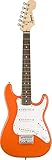
6. Squier Mini Jazzmaster: Best 3/4 Electric
- 3/4-size Jazzmaster-style electric
- Maple fingerboard options
- Humbucker-equipped HH version available in Squier’s range
- Bundles with an amplifier are listed by some sellers
Best for: teens and smaller adults who want an electric with an offset look and short-scale comfort.
Skip if: you want a conventional full-size neck.
Pros
- Light and easy to hold
- Short scale reduces reach
- Distinct look
Cons
- Low tension needs careful setup
- Needs an amplifier
The Mini Jazzmaster is the stylish choice for electric players. It combines an offset body with a shortened scale, which gives a comfortable, light instrument for teens and smaller adults. Because it is an electric, there is no body-size trade-off: the sound comes from the amplifier, so a small body does not limit volume or tone. The usual cautions for short-scale electrics apply, namely a proper setup and the correct string gauge for stable tuning.
Also Consider
- Yamaha APXT2: a thin-line 3/4 acoustic-electric with built-in electronics for stage use.
- Ibanez GRGM21 miKro: a short-scale electric with 24 frets and humbuckers.
- Donner 3/4 acoustic guitar kit: a budget kit; check the setup and tuner quality on arrival.
- Traveler Guitar Ultra-Light Acoustic: a travel guitar with a removable lap rest, for players who care about portability above all.
What a Shorter Scale Really Does: A Worked Example
The physics is simple. For a given string, the tension needed to reach a pitch is proportional to the square of the scale length. Take a standard electric guitar with a 25.5-inch scale and compare it with a 22.75-inch 3/4 guitar using the same string. The ratio is (22.75 ÷ 25.5) squared, which is about 0.80, so the string runs at roughly 80 percent of the tension. On a 21-inch scale it falls to about 68 percent.
Lower tension has three consequences. The strings feel softer under the fingers, bends need less force and the sound has a slightly warmer, rounder attack. It also means that a string set made for a full-size guitar may feel loose, which is why many makers specify a gauge for their 3/4 models. In practice, you should expect a 3/4 guitar to feel easier to play, with the trade-off of slightly less sustain and a tuning that is more sensitive to heavy picking.
Acoustic, Classical or Electric 3/4: Quick Decision Table
| Type | Pick here | Best situation | Main drawback |
|---|---|---|---|
| Nylon classical | Yamaha CGS103A, Fender CN-30 | Gentle learning, classical lessons | Mellow tone, limited volume |
| Steel acoustic | Yamaha JR2, Martin LX1E, Taylor GS Mini | Strumming, songwriting, travel | Steel strings are harder on fingertips |
| Electric | Squier Mini Jazzmaster | Rock, indie, quiet practice with headphones | Needs an amp |
3/4 Size Guitars for Teens, Kids and Travellers: Who Should Buy What
Teens still growing
Many teens measure in the awkward zone between a 3/4 and a full-size guitar. A 3/4 guitar with decent tone, such as the Taylor GS Mini or Martin LX1E, can serve until the growth spurt ends and then remain a useful second guitar. Cheaper choices like the Yamaha JR2 suit teens who may move up in a year.
Young kids
For younger children, the age and height charts matter more than the 3/4 label. See the size chart in our kids’ guitar guide to decide whether a 1/4, 1/2 or 3/4 guitar is correct. A 3/4 guitar is generally the right size from about eight years old, according to common retailer guidance.
Adults with small hands or frames
Adults often find that a full-size guitar strains the stretch and reach. A 23-inch scale reduces the nut-to-fourth-fret distance by about half an inch, which can turn a painful barre chord into a manageable one. The Martin LX1E and Taylor GS Mini are the most grown-up options.
Travellers
Travel is where 3/4 guitars shine. Most fit in overhead bins in a gig bag, and their lower tension makes them less sensitive to travel stress. Combine a 3/4 guitar with a padded bag and a small humidifier or silica pack for dry hotel rooms.
Buying Guide: Choosing a 3/4 Size Guitar
Choose the string type
- Nylon: gentlest on fingers, warm tone, best for classical and fingerstyle.
- Steel acoustic: brighter and louder, best for strumming and folk.
- Electric: lightest touch and the most flexible if you also want an amp.
Check the scale length, not just the label
“3/4” is a marketing size, not a standard. A guitar labelled 3/4 can have a scale from about 21 to 23.5 inches. For adults, a longer scale of about 23 inches feels more like a normal guitar. For smaller players, 21 to 22 inches keeps reach to a minimum.
Tension and strings
Short-scale guitars use the same pitches as full-size guitars, so they are tuned to standard tuning. Use strings designed for the instrument, or the manufacturer’s recommended gauge, because lower tension means lighter sets can feel floppy. Do not fit heavier strings than the maker allows, because small bridges and necks are not built for extra load.
Body size and projection
Small bodies move less air, so they sound quieter and less bassy. That is fine for practice and travel, but if you want to play for a group, choose a model with electronics such as the Martin LX1E or Taylor GS Mini-e.
Humidity and care
Solid-top guitars are sensitive to dry air. Maker guidance from Martin and Taylor generally recommends keeping instruments between 40 and 50 percent relative humidity. A case humidifier and a hygrometer are inexpensive protection. Laminate guitars like the Yamaha JR2 are more tolerant.
Setup
Low action matters more on small guitars. A fast setup with a low nut and saddle makes the instrument far easier to play and is usually worth the cost.
Travelling With a 3/4 Guitar: A Short Checklist
- Use a padded gig bag or a hard travel case. A padded bag is lighter, while a hard case protects better in checked luggage.
- Slacken the strings slightly for long trips or flights in hold luggage to reduce stress on the neck, then retune on arrival.
- Add a humidity pack for solid-top acoustics, especially in dry hotels or heated rooms.
- Carry a spare set of strings and a clip-on tuner. Changes in temperature affect tuning.
- Check airline cabin rules. Many allow a small guitar as a carry-on, but policies vary.
Ownership Notes: What Wears First on a Small Guitar
Strings are the first thing to wear, and on a small guitar they are also the most noticeable, because dead strings sound especially dull on a short scale. Replace them every couple of months of regular playing, or sooner if they feel gritty. The second item is the nut and saddle, which can wear if strings are left unchanged for years. The third is the finish, because small guitars travel more and pick up dings. A light polish and a gentle wipe after playing keeps them looking good.
Finally, keep an eye on neck relief. Small guitars, with their lower tension, tend to be less prone to neck movement, but humidity changes can still cause the neck to bow slightly. If the action changes noticeably or fret buzz appears, a technician can adjust the truss rod in minutes.
When a 3/4 Guitar Is Not the Right Answer
A 3/4 guitar is a smart choice in many cases, but not all. If a teenager is already close to adult height, a full-size guitar with a low action and light strings will probably serve better and will not need replacing. If you want a main performance guitar with big low-end projection, a dreadnought or jumbo is still the better instrument, because a small body cannot move as much air. And if you are an adult with typical-sized hands and no travel needs, a short-scale full-size guitar can give you the same comfort without the smaller body.
In those situations, consider a full-size guitar with a short scale, such as a 24.75-inch electric or a parlor acoustic, and read our guides to the best small-scale and beginner instruments. A 3/4 guitar is a tool for fit and portability, and it should be chosen for those reasons.
Finally, avoid buying a 3/4 guitar only because it is the cheapest option. A well-made 3/4 guitar from an established maker plays better than a poorly made full-size one, and a good setup will matter more than a few extra inches of scale.
Frequently Asked Questions
What is the best 3/4 size guitar for beginners?
The Yamaha JR2 is the best all-round beginner pick for steel-string, and the Yamaha CGS103A is better for nylon strings. Both are inexpensive and widely stocked.
What is the best 3/4 acoustic guitar?
The Martin LX1E is the best premium option, the Taylor GS Mini is a strong 3/4-style alternative, and the Yamaha JR2 is the best value choice.
What is the best 3/4 electric guitar?
The Squier Mini Jazzmaster is a distinctive pick for rock and indie, and the Ibanez GRGM21 miKro is a good alternative for heavier styles.
What is the best 3/4 classical guitar?
The Yamaha CGS103A is the most established choice, and the Fender CN-30 is a lower-cost alternative with a two-year warranty stated in the listing.
How tall should you be for a 3/4 size guitar?
Common retailer guidance places 3/4 guitars around ages 8 to 11, or heights of about 4 feet 6 inches to 5 feet. Adults with small frames or short reach also use them.
Can adults play a 3/4 size guitar?
Yes. Many adults prefer them for travel, couch playing and comfort. The Martin LX1E and Taylor GS Mini are designed to sound like full guitars.
Are 3/4 size guitars good for adults with normal hands?
They can be, especially for travel and couch playing. The Martin LX1E and Taylor GS Mini are built to a high standard and are often used by experienced players as a second guitar. If you want one main guitar, a full-size instrument will usually give you more volume and bass.
Will a 3/4 guitar hold its tuning?
Yes, if it has proper tuners and a good setup. Lower tension makes the strings more sensitive to picking force, so fresh strings and a stable environment help. Electric guitars with a fixed bridge hold tuning especially well.
Do 3/4 guitars tune differently?
No. They use the same standard tuning as full-size guitars. The pitch relationships stay the same, but the shorter scale gives the strings a lower tension at that pitch.
Which One Should You Buy?
- Best value 3/4 acoustic: Yamaha JR2.
- Best 3/4 classical: Yamaha CGS103A.
- Best budget nylon: Fender CN-30.
- Best premium travel guitar: Martin LX1E.
- Best guitar you won’t outgrow: Taylor GS Mini.
- Best 3/4 electric: Squier Mini Jazzmaster.
Choose the string type first, then the scale length, and only then the brand. That order gets you the right guitar more often than any other. If you are still unsure after reading the specs, pick the model with the clearest published scale length and a seller that accepts returns, so that a poor fit costs you nothing but a few days.
Sources
- Yamaha product specifications
- Fender and Squier product pages
- Martin Guitar product specifications
- Taylor Guitars product specifications
- Ibanez product pages
Last updated: October 2026





Write Your Review
No reviews yet. Be the first to share your experience!