

Key takeaways
- Size comes first: commonly cited charts put 1/4 size at roughly ages 4 to 6, 1/2 size at 6 to 8, 3/4 size at 8 to 11 and full size from about 11 or 12.
- Nylon strings are gentler on small fingertips; steel strings and electric guitars suit older kids who are already motivated.
- Avoid toy guitars with plastic tuners and thick strings far above the fretboard; they rarely stay in tune.
- Expect new strings to stretch for the first week, which is the most common cause of out-of-tune complaints.
- Picks come from maker specs and published reviews. We did not personally play them.
The best guitars for kids are the ones that match the child’s size, not the ones with the cartoon on the body. For ages 4 to 6 the Cordoba Protege C1M in 1/4 size is a strong nylon-string start, for ages 6 to 8 the Yamaha CGS102A half-size classical is a dependable step up, and for ages 8 to 11 the Yamaha JR1 or the Squier Mini Stratocaster are the picks that tend to keep a kid playing past the first month.
Most children who quit guitar quit for three reasons: the guitar is too big, the strings hurt, or the instrument won’t stay in tune. This guide is organised around fixing those three problems. It starts with a size chart by age and height, then covers what makes a kids’ guitar hold its tuning and which models make sense for ages 4, 5 and 10.
Our top picks


As an Amazon Associate we earn from qualifying purchases at no extra cost to you.
Key takeaways
- Size comes first: commonly cited charts put 1/4 size at roughly ages 4 to 6, 1/2 size at 6 to 8, 3/4 size at 8 to 11 and full size from about 11 or 12.
- Nylon strings are gentler on small fingertips; steel strings and electric guitars suit older kids who are already motivated.
- Avoid toy guitars with plastic tuners and thick strings far above the fretboard; they rarely stay in tune.
- Expect new strings to stretch for the first week, which is the most common cause of out-of-tune complaints.
- Picks come from maker specs and published reviews. We did not personally play them.
Best Guitars for Kids by Age: Size Chart and Picks
| Age | Typical height | Guitar size | Typical scale | Pick here |
|---|---|---|---|---|
| 4 to 6 | Under about 4 ft (122 cm) | 1/4 | About 18 to 19 in | Cordoba Protege C1M 1/4 |
| 6 to 8 | About 4 ft to 4 ft 6 in | 1/2 | About 20 to 21.5 in | Yamaha CGS102A, Cordoba C1M 1/2 |
| 7 to 10 | About 4 ft 4 in to 4 ft 9 in | Junior / small-body | About 21 to 22.75 in | Yamaha JR1, Squier Mini Stratocaster |
| 8 to 11 | About 4 ft 6 in to 5 ft | 3/4 | About 22 to 23 in | Fender FA-25N 3/4, Ibanez GRGM21 miKro |
| 11 and up | Over about 5 ft | Full size | 24.75 to 25.5 in | See our beginner acoustic and electric guides |
Size bands overlap, and the figures above are typical ranges rather than rules. Children grow and vary, so use age only as a starting point and fit-check with the steps below.
How We Chose These Guitars for Kids
We did not personally play these guitars. We used manufacturer specifications, retailer spec tables and published reviews, and we weighted three things: a size designation that matches a clear age band, an established maker that supports a warranty or parts, and construction that gives the guitar a fair chance of staying in tune. We left out novelty guitars with plastic parts, sets that bundle many accessories but a poor instrument, and models without a clear size listing. Each brand appears at most twice.
1. Cordoba Protege C1M 1/4 and 1/2: Best First Guitar for Ages 4 to 6
- Nylon-string classical in 1/4 and 1/2 sizes
- Small body designed for young children
- Nylon strings with low tension
- From Cordoba’s Protege student line
Best for: the youngest players, who need a guitar they can hold, with strings they can press down.
Skip if: the child is already over about 4 foot 6 inches. Step up to a 1/2 or 3/4 model.
Pros
- Nylon strings are gentle on small fingertips
- Tiny size fits a four- or five-year-old on a lap
- Real classical guitar design, not a toy
- Offered in two sizes so you can match a growth spurt
Cons
- Nylon sound is mellow rather than bright
- Children outgrow the 1/4 size quickly
The 1/4 is the smallest instrument that still behaves like a guitar. A typical four-year-old can hold it but may not be able to fret full chords, so expect single-note melodies and open strings at first. Many teachers recommend this approach for very young players because it builds rhythm and ear before finger strength.
2. Yamaha CGS102A: Best Half-Size Classical for Ages 6 to 8
- Half-size nylon-string classical guitar
- Student series from Yamaha
- Natural finish
- Designed for children moving up from a 1/4 size
Best for: school-age children who have outgrown a mini guitar but are not ready for a 3/4 or full size.
Skip if: your child prefers pop songs with steel-string strumming. A steel-string or electric guitar is a better match once they are about eight.
Pros
- Proven, widely sold student instrument
- Right proportions for a six- to eight-year-old
- Nylon strings and classical posture teach good habits
- Simple, reliable hardware
Cons
- Plain styling may not excite a child who wants a rock-star look
- Laminate construction suits learners rather than advanced players
The Yamaha is a sensible middle step between a 1/4 and a 3/4 size, and it is widely stocked, which makes strings and spare parts easy to find. If the budget is tight, a 1/2-size Cordoba C1M is a close alternative.
3. Yamaha JR1: Best Steel-String Junior Acoustic for Ages 7 to 10
- Junior-size steel-string acoustic from Yamaha’s FG Junior line
- Listed as a 3/4-size guitar
- Natural finish
- Compact body for small arms
Best for: kids who want to strum folk and pop songs on a “real” acoustic and have enough finger strength for steel strings.
Skip if: your child is younger than about seven, or wants a quieter instrument. Steel strings can hurt at first.
Pros
- Familiar acoustic sound and look
- Small body is manageable for kids
- A well-known beginner model from a major maker
- Handles daily practice and school use
Cons
- Steel strings are tougher on fingertips than nylon
- Check that the fit is right, since sizes differ across makers
The JR1 sits at the point where many children switch from nylon to steel. The brighter tone and louder volume let them play along with songs they know, which is a strong motivator for ages seven to ten. The cost is fingertip comfort: expect a few weeks of tender fingers, and consider asking a shop to fit lighter-gauge strings if the child struggles. Because the body is compact, it is also easy to carry to lessons or on holiday.
4. Fender FA-25N 3/4 Size: Best Nylon-String 3/4 for Ages 8 to 11
- 3/4-size nylon-string acoustic
- Beginner-friendly design from Fender
- Two-year warranty stated in the listing
- Compact travel-friendly size
Best for: children aged about eight to eleven who are comfortable on nylon strings and want a guitar with a recognisable brand.
Skip if: your child is already close to adult height. Move to a full-size guitar instead.
Pros
- Gentle on fingers thanks to nylon strings
- 3/4 size suits the 8 to 11 band
- Fender warranty and support
Cons
- Mellow tone and entry-level materials
- A child can outgrow it within a couple of years
The Fender 3/4-size nylon model suits children who have grown out of the tiniest guitars but are still too short for a standard instrument. Nylon strings keep the learning curve gentle, and the familiar brand name means strings and accessories are easy to find. Parents should view it as a two- to three-year guitar, after which a full-size guitar becomes the natural next purchase.
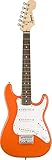
5. Squier Mini Stratocaster: Best Electric for Ages 7 to 11
- Compact Stratocaster-style electric, about 3/4 size
- Maple or laurel fingerboard options
- Two-year warranty stated in the listing
- Available as a bundle with an amplifier from some sellers
Best for: kids who want to play an electric and need a lighter instrument with a shorter reach.
Skip if: you don’t want to buy an amp as well, or the child is on the tall side of the age range.
Pros
- Light body and short scale for small players
- Electric strings are easier to press than steel acoustic strings
- Familiar Stratocaster look
- Bundles available that include an amp
Cons
- Needs an amplifier or headphone amp
- Budget-tier hardware
The Squier Mini Stratocaster solves the problem that many kids do not want an acoustic at all. Electric strings are thinner and easier to press, the body is lighter and the reach is shorter, so progress often feels faster. The catch is gear: you need an amplifier or a small headphone amp, and it is worth budgeting for a clip-on tuner and a strap with the guitar. Several sellers offer bundles that include a small amp, which can simplify the purchase.
6. Ibanez GRGM21 miKro: Best Short-Scale Rock Guitar for Ages 9 to 12
- Short-scale electric with 24 frets
- Poplar body, maple neck and humbuckers per the listing
- Compact RG-style shape
- Bundles with an amplifier are listed by some sellers
Best for: older kids who want a rock or metal look and humbucker tone.
Skip if: your child is under about eight; the Squier Mini Stratocaster is lighter and simpler.
Pros
- Short scale suits smaller hands
- 24 frets and humbuckers suit rock
- Strong visual appeal for older kids
Cons
- Low tension makes tuning more sensitive to heavy picking
- Requires an amp
The miKro is for the older child who has already caught the bug. Its short scale and 24 frets give it a rock-ready personality, while the humbuckers produce a thicker tone than the Squier’s single-coils. For a child who wants to play heavier music, it avoids the common problem of a tiny guitar that feels like a toy. Like every short-scale instrument, it benefits from a quick setup so that tuning stability and string height are right from the start.
Also Consider
- Fender Mini Stratocaster beginner kit with Frontman 10G amp: a complete starter electric kit for kids who want an amp included.
- Donner 3/4 acoustic guitar kit: a lower-cost 3/4 steel-string kit; check the setup quality on arrival.
- Yamaha APXT2 3/4-size acoustic-electric: a thin-line 3/4 acoustic with built-in electronics for older kids.
- Taylor GS Mini: not a kids’ guitar by label, but a good “grow-into” choice for teens, since its short scale suits smaller players.
What Makes a Kids’ Guitar Stay in Tune
New strings stretch
The most common reason a kid’s guitar goes out of tune is that new strings are still stretching. Nylon strings can take several days to settle, and steel strings need a few days too. Tune the guitar, stretch each string gently with your hand, retune and repeat. After a week, tuning should be much steadier.
Tuning machines
Geared tuners hold pitch far better than friction pegs. Choose guitars from established makers like Yamaha, Cordoba, Fender, Squier and Ibanez, where gear-type tuning machines are standard. Avoid toy guitars where the tuners are plastic and loose.
Nut and bridge
Strings that bind in poorly cut nut slots can jump out of tune. A good student guitar from the makers above will be cut correctly at the factory, and a technician can fix problems cheaply if they appear.
Humidity and temperature
Wooden guitars shift with humidity, which is why a guitar that is perfect in the shop may need retuning at home. Maker care guidance from Martin and Taylor suggests keeping acoustic guitars at about 40 to 50 percent relative humidity. For a child’s guitar, a simple rule is to keep it in its case or on a stand away from radiators and sunny windows.
Action height
Action is the string height above the frets. If it is too high, small fingers cannot press the strings down fully and the guitar sounds out of tune because the notes sharpen. A basic setup by a local shop can lower it and is often the best money you can spend on a child’s guitar.
Guitars by Age: Four, Five and Ten
Best guitars for 4 year olds
At four, most children do not have the finger strength or attention span for formal lessons. A 1/4-size nylon-string guitar like the Cordoba Protege C1M lets them explore open strings and simple melodies. Some teachers suggest a ukulele as an even easier first instrument, but a small guitar is a good choice if you want a seamless path forward.
Best guitars for 5 year olds
A five-year-old usually fits the same 1/4-size guitar, or the beginning of the 1/2 range if they are tall. Short sessions of five to ten minutes work better than long practices. Nylon strings and a gentle approach keep it fun.
Best guitars for 10 year olds
At ten, children can usually handle 3/4 size or a short-scale electric. This is the best age for the Squier Mini Stratocaster or the Ibanez miKro, and also for a steel-string acoustic like the Yamaha JR1. If the child is tall for their age, check whether a full-size guitar with a good setup is now a better option.
Best youth and children’s guitars overall
Youth guitars are usually 3/4 size or short-scale full-size instruments. They bridge the gap between children’s models and adult guitars. If your child is between sizes, choose the smaller one and revisit in a year.
First-Year Costs Beyond the Guitar
The guitar is only part of the cost. A realistic first-year list for a child includes these items:
- Spare strings: children break and wear strings quickly; buy two or three sets of the right type.
- Clip-on tuner: essential for keeping pitch correct; many children cannot tune by ear yet.
- Strap or footstool: a footstool raises the knee for classical posture, while a strap suits electrics and standing play.
- Gig bag or case: protects against knocks at school and during travel.
- Amplifier or headphone amp: required for electric guitars.
- A basic setup: often the single best upgrade for tuning and playability.
Budgeting for these items up front prevents the situation where a good guitar sits unused because it is out of tune and the strings have broken.
A 30-Day Plan to Keep a New Player Interested
- Week 1: Learn the names of the open strings and how to hold the guitar. Practise for five to ten minutes a day.
- Week 2: Play single-note melodies on one string, such as a simple nursery tune.
- Week 3: Introduce one or two easy chords, such as Em on the six strings, and strum slowly.
- Week 4: Combine two chords into a short song and let the child perform it for family.
Short, frequent sessions work better than one long weekly session. Celebrate small wins, and put the guitar on a stand where the child can see it, because instruments in a case rarely get played.
Common Mistakes Parents Make
- Buying too big “to grow into.” A guitar that is too large makes holding and fretting hard and is a common reason kids quit.
- Choosing by character or colour. Cartoon guitars often compromise on tuners, neck and strings.
- Skipping the setup. High action makes chords hurt and sounds out of tune.
- Forgetting the amp. An electric guitar without an amplifier or headphone amp is nearly silent.
- Expecting instant results. Tender fingertips and slow progress in the first month are normal.
Fit Check: How to Size a Guitar at Home
- Seat the child with the guitar on the right thigh (left for left-handed players), with their back straight.
- Have them reach the first fret with the fretting hand. The elbow should be slightly bent, not locked straight.
- Check the strumming arm. Their forearm should rest comfortably over the body without the shoulder rising.
- Try pressing a string at the fifth fret. If it takes both hands or visible strain, the action or size is wrong.
- If between sizes, choose the smaller guitar. A guitar that is slightly too big is a common reason kids stop playing.
Acoustic, Classical or Electric: Which Path Suits Your Child?
Parents often ask which type of guitar leads to the best outcomes. There is no single right answer, but each path has a clear profile. Classical guitars with nylon strings are the gentlest on small fingers and are the standard choice for formal lessons, which makes them a strong first guitar for ages four to eight. Steel-string acoustics such as the Yamaha JR1 give a brighter, more familiar pop and folk sound, but they ask more of the fingertips. Electric guitars like the Squier Mini Stratocaster and the Ibanez miKro are the easiest to press and the most exciting for children who want to play rock, but they need an amplifier.
One practical way to decide is to listen to what your child already wants to play. A child who loves campfire songs and singing along will probably enjoy an acoustic. A child who is excited by a favourite rock band will probably practise more on an electric. Motivation beats theory: the instrument that gets picked up every day is the best one.
Left-handed children should be offered the choice from the start. Several of these models have left-handed versions, but not all, so confirm the exact model on the seller’s listing. Switching to a right-handed guitar later is possible, yet it is far easier to begin on the side that feels natural.
Frequently Asked Questions
What is the best guitar for a 5 year old?
A 1/4-size nylon-string classical like the Cordoba Protege C1M is the best match for most five-year-olds. It is small enough to hold and gentle on fingertips.
What size guitar does a 10 year old need?
Most ten-year-olds suit a 3/4-size guitar or a short-scale electric such as the Squier Mini Stratocaster. Tall children may be ready for a full-size guitar with a good setup.
Are nylon-string or steel-string guitars better for kids?
Nylon is easier on fingers and a good choice under about eight. Steel strings sound brighter and suit older kids who want to strum popular songs, but they hurt more at first.
Should I buy a cheap guitar to see if my child sticks with it?
Buy the cheapest guitar from an established maker rather than the cheapest guitar available. Very cheap toy-grade instruments often have high action and poor tuners, which makes learning harder.
Are electric guitars good for kids?
Yes. Electric strings are lighter and easier to press, and short-scale models like the Squier Mini Stratocaster are comfortable for small players. The trade-off is that you need an amplifier or headphone amp.
How do I keep a kid’s guitar in tune?
Let new strings stretch, tune before each practice and keep the guitar away from heat and dry air. If it still drifts, have a technician check the tuners and nut.
Do I need lessons?
Lessons help, but a short weekly lesson plus daily practice of 10 to 15 minutes is enough for most beginners. Online or in-person options both work, and the guitar matters more than the format.
Which One Should You Buy?
- Ages 4 to 6: Cordoba Protege C1M 1/4.
- Ages 6 to 8: Yamaha CGS102A half-size classical.
- Ages 7 to 10, steel strings: Yamaha JR1.
- Ages 8 to 11, nylon strings: Fender FA-25N 3/4.
- Electric for ages 7 to 11: Squier Mini Stratocaster.
- Rock-minded older kids: Ibanez GRGM21 miKro.
Match the size to your child first, and the rest of the decision becomes easy. When in doubt, choose the smaller guitar, make sure it is set up properly and keep practice short and fun.
Sources
- Cordoba Guitars product pages
- Yamaha product specifications
- Fender and Squier product pages
- Ibanez product pages
- Martin Guitar and Taylor Guitars care guidance
Last updated: October 2026




Write Your Review
No reviews yet. Be the first to share your experience!