

Key takeaways
- Solo podcast, voiceover, or one instrument: Focusrite Scarlett 2i2 4th Gen or Audient iD4 MkII.
- Two-person podcast with separate microphones: MOTU M4, Focusrite Scarlett 4i4 4th Gen, or SSL 2+ MkII.
- Two vocal microphones plus stereo instruments: MOTU M4 or Audient iD14 MkII with an additional preamp or ADAT expander.
- Band rehearsals or multi-mic sessions: Focusrite Scarlett 18i20 4th Gen, PreSonus Studio 1824c, or a similar eight-preamp USB-C interface.
- Lowest practical monitoring latency: RME Babyface Pro FS, provided its higher price fits the budget.
- Quiet dynamic microphone with demanding gain requirements: an interface offering roughly 60–70 dB of clean preamp gain, such as the Scarlett 2i2 4th Gen, Audient iD14 MkII, or RME Babyface Pro FS.
The best audio interfaces for most home studios and podcasts are the Focusrite Scarlett 2i2 4th Gen for solo creators, the MOTU M4 for flexible two-person recording, and the Focusrite Scarlett 18i20 4th Gen or PreSonus Studio 1824c when you need several microphones at once.
The right choice depends less on headline sample rate than on three practical questions: how many sources you will record simultaneously, how much clean gain your microphones require, and how much monitoring latency you can tolerate. A compact two-input interface is ideal for one host, a singer-songwriter, or occasional overdubs; a four-input model suits two-person podcasts and small stereo setups; an eight-preamp rack interface makes sense when every microphone must be recorded to its own track.
Our top picks


As an Amazon Associate we earn from qualifying purchases at no extra cost to you. Ratings are shown as listed on Amazon.
Quick picks by recording situation
- Solo podcast, voiceover, or one instrument: Focusrite Scarlett 2i2 4th Gen or Audient iD4 MkII.
- Two-person podcast with separate microphones: MOTU M4, Focusrite Scarlett 4i4 4th Gen, or SSL 2+ MkII.
- Two vocal microphones plus stereo instruments: MOTU M4 or Audient iD14 MkII with an additional preamp or ADAT expander.
- Band rehearsals or multi-mic sessions: Focusrite Scarlett 18i20 4th Gen, PreSonus Studio 1824c, or a similar eight-preamp USB-C interface.
- Lowest practical monitoring latency: RME Babyface Pro FS, provided its higher price fits the budget.
- Quiet dynamic microphone with demanding gain requirements: an interface offering roughly 60–70 dB of clean preamp gain, such as the Scarlett 2i2 4th Gen, Audient iD14 MkII, or RME Babyface Pro FS.
Best audio interfaces compared
| Interface | Mic preamps / maximum inputs | Preamp gain | Notable I/O | Typical round-trip latency* | General market range |
|---|---|---|---|---|---|
| Focusrite Scarlett 2i2 4th Gen | 2 / 2 analog inputs | Up to 69 dB | 2 combo inputs, 2 monitor outputs, headphone output | About 5–8 ms | Approximately $180–$230 |
| Audient iD4 MkII | 1 mic preamp + 1 JFET instrument input | Up to 58 dB | Combo input, front instrument input, monitor and headphone outputs | About 6–10 ms | Approximately $180–$230 |
| Focusrite Scarlett 4i4 4th Gen | 2 / 4 analog inputs | Up to 69 dB | 2 combo inputs, 2 line inputs, MIDI, 4 line outputs | About 5–8 ms | Approximately $260–$320 |
| MOTU M4 | 2 mic preamps / 4 analog inputs | Up to 60 dB | 2 combo inputs, 2 line inputs, MIDI, 4 line outputs | About 3–6 ms | Approximately $250–$320 |
| Audient iD14 MkII | 2 mic preamps / up to 10 inputs with ADAT | Up to 58 dB | 2 combo inputs, ADAT input, 2 headphone outputs, monitor outputs | About 5–9 ms | Approximately $280–$350 |
| Focusrite Scarlett 18i20 4th Gen | 8 / 18 total inputs with digital expansion | Up to 69 dB | 8 combo inputs, ADAT, MIDI, multiple monitor outputs | About 5–9 ms | Approximately $600–$750 |
| RME Babyface Pro FS | 2 mic preamps / up to 12 inputs with ADAT | Up to 76 dB | 2 combo inputs, ADAT, MIDI, multiple headphone and line outputs | About 3–6 ms | Approximately $900–$1,100 |
*Latency varies with computer, operating system, sample rate, buffer size, plug-ins, and driver. The figures are practical ranges rather than guaranteed results.
Solo creators: choose clean gain and simple monitoring
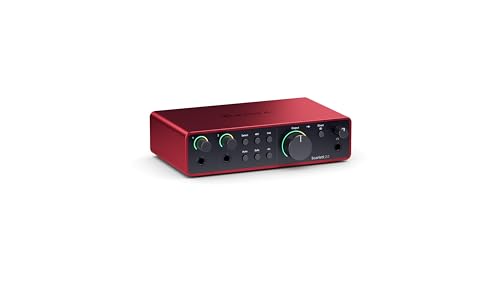
Focusrite Scarlett 2i2 4th Gen
The Scarlett 2i2 4th Gen is the safest all-round recommendation for a one-person studio. Its two combo inputs allow a microphone and instrument to remain connected, while the newer preamps provide enough gain for many low-output dynamic microphones. Auto Gain and Clip Safe can help beginners avoid distorted takes, although manual gain setting remains preferable when consistency matters.
It has only two analog inputs, so it is not a good long-term choice if you expect to record a host and guest, stereo keyboards, or a drum kit. Its direct-monitoring controls are useful for vocals and podcasts because the performer can hear a near-zero-latency signal without relying entirely on software monitoring.
Audient iD4 MkII
The iD4 MkII is especially appealing when one microphone and one guitar or bass are the normal arrangement. Audient’s console-style preamp and large monitor control feel more deliberate than the controls on many entry-level interfaces. The limitation is layout: its second input is a front-panel instrument input rather than another microphone channel. For a solo musician that is efficient; for two microphones it is the wrong design.
Two-person podcasts: four inputs prevent avoidable compromises
MOTU M4
The MOTU M4 is one of the strongest choices for a two-microphone podcast because it combines two microphone inputs with two additional line inputs, four line outputs, MIDI, and a front-panel color display that shows input and output levels. The display is more useful than a single status LED when you are watching speech peaks during a live recording.
Its loopback functionality can also simplify computer-audio workflows, such as recording a remote guest or routing playback into a broadcast application. Check the exact software and operating-system requirements before building a complex stream setup.
Focusrite Scarlett 4i4 4th Gen
The Scarlett 4i4 is a better fit when you value extra routing flexibility over a front-panel meter display. Two microphone preamps cover the hosts, while the two line inputs can accept a mixer feed, keyboard, phone interface, or another stereo source. Four line outputs are useful for separate monitor and headphone-routing arrangements.
For a conventional two-host podcast, do not buy a 4i4 merely because its maximum sample rate is higher than necessary. The important advantages are separate gain controls, independent tracks, and enough outputs to monitor without repeatedly repatching cables.
Multi-microphone recording: count preamps, not just “inputs”
Focusrite Scarlett 18i20 4th Gen
When a band, roundtable, or video production needs six to eight microphones simultaneously, the Scarlett 18i20 is a practical rackmount step up. Eight built-in preamps reduce the need for external hardware, and ADAT allows compatible digital expansion later. It also provides more monitor outputs than desktop two-channel models.
Remember that “18 inputs” does not mean 18 microphone preamps. The headline total includes analog line channels and digital channels. If you need eight microphones today, verify the number of built-in XLR preamp inputs rather than the total input count.
PreSonus Studio 1824c
The Studio 1824c is another sensible eight-preamp option for project studios. It includes ADAT expansion, MIDI, multiple line outputs, and USB-C connectivity. It is best suited to a semi-permanent setup where the interface stays connected to monitors, headphone amplifiers, and outboard equipment rather than being carried to every recording location.
Preamp headroom: gain is not the whole story
Maximum gain tells you how much a preamp can amplify a quiet microphone; headroom describes how much level it can accept before clipping. A high-gain preamp is helpful with a quiet dynamic microphone, but you still need a conservative recording level. Aim for peaks around -12 to -6 dBFS in the digital meter rather than trying to record close to 0 dBFS.
For a spoken-word setup, a dynamic microphone may produce a much lower signal than a condenser placed at the same distance. If the input gain is nearly full and the recording still sounds noisy, moving the microphone closer—while controlling plosives—is often more effective than buying an interface with an exaggerated specification. An inline booster can help some passive microphones, but it adds another connection and power requirement.
Latency: what the numbers mean in actual use
At 48 kHz, a 64-sample buffer represents about 1.33 milliseconds in one direction before driver and converter overhead. A 128-sample buffer represents about 2.67 milliseconds. The complete round trip is longer because audio must enter the interface, pass through the computer and software, and return to the headphones.
For podcast speech, direct monitoring usually makes latency irrelevant. For software instruments or vocals monitored through plug-ins, a stable 64- or 128-sample buffer is more important. A reliable driver can outperform a theoretically faster interface on a busy project. RME’s Babyface Pro FS is the premium choice here because its TotalMix FX routing and mature drivers are designed for demanding, low-latency work; its price is difficult to justify for occasional two-microphone recording.
Decision matrix: spend according to your likely workload
| Your situation | Minimum sensible design | Recommended direction | Why |
|---|---|---|---|
| Under $250, one person, occasional use | 2 mic/line inputs | Scarlett 2i2 4th Gen or Audient iD4 MkII | Low setup complexity and adequate gain |
| Weekly two-person podcast | 2 mic preamps plus at least 2 extra inputs | MOTU M4 or Scarlett 4i4 | Separate host tracks and room for playback or expansion |
| Small studio with keyboards and outboard gear | 4 line outputs and MIDI | MOTU M4 or Scarlett 4i4 | Less repatching and more routing flexibility |
| Band, roundtable, or frequent paid sessions | 8 built-in microphone preamps | Scarlett 18i20 or Studio 1824c | Every microphone gets an independent track |
| Heavy software monitoring and low-latency priority | Strong drivers and flexible internal routing | RME Babyface Pro FS | Premium stability and detailed routing control |
Ownership details that affect the decision
Connectors, USB cables, headphone jacks, and potentiometers are usually the first parts to suffer in a portable setup. Keep an interface out of direct sunlight, leave ventilation around rack units, and avoid repeatedly bending cables at the connector. Clean dusty controls with the power disconnected; do not spray liquid into faders, switches, or sockets.
Common mistakes include recording both podcast hosts into one mono track, enabling phantom power on a connection that should not receive it, and setting the buffer so low that the computer clicks and drops samples. Use separate tracks, turn phantom power on only when required, and raise the buffer during mixing. Finally, buy one or two more inputs than today’s absolute need if the price difference is modest: replacing a two-input interface after adding a second host often costs more than choosing a four-input model at the start.


Write Your Review
No reviews yet. Be the first to share your experience!