

Key takeaways
- Best value all-in-one: FiiO K11, with USB, optical, coaxial, 6.35 mm single-ended and 4.4 mm balanced outputs.
- Best simple amplifier: JDS Labs Atom Amp 2, for listeners who already own a DAC or want to choose one separately.
- Best for demanding planar headphones: Topping L70, with substantially more balanced output power and flexible preamplifier functions.
- Best portable option: FiiO Q15, for high-quality battery-powered listening with both wired digital and analog inputs.
- Best control and customization: RME ADI-2 DAC FS, particularly for listeners who want parametric equalization, a display, and extensive output controls.
The best headphone amplifiers are the ones that provide enough clean power for your headphones, stay quiet with sensitive models, and offer the connections and DAC features you will actually use. For most desktop listeners, the FiiO K11 is a strong value, the JDS Labs Atom Amp 2 is an excellent amplifier-only choice, and the RME ADI-2 DAC FS is the most versatile upgrade for experienced listeners.
Our top picks
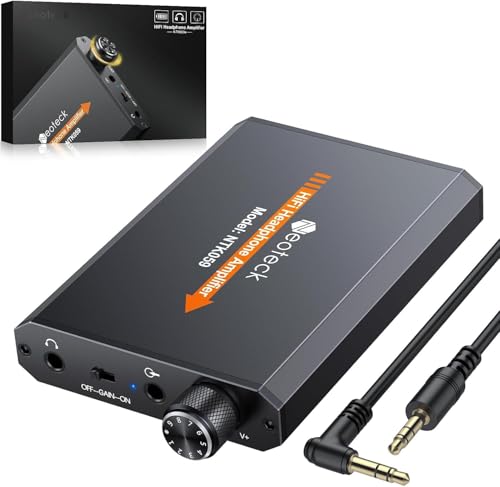


As an Amazon Associate we earn from qualifying purchases at no extra cost to you. Ratings are shown as listed on Amazon.
Quick picks by listening situation
- Best value all-in-one: FiiO K11, with USB, optical, coaxial, 6.35 mm single-ended and 4.4 mm balanced outputs.
- Best simple amplifier: JDS Labs Atom Amp 2, for listeners who already own a DAC or want to choose one separately.
- Best for demanding planar headphones: Topping L70, with substantially more balanced output power and flexible preamplifier functions.
- Best portable option: FiiO Q15, for high-quality battery-powered listening with both wired digital and analog inputs.
- Best control and customization: RME ADI-2 DAC FS, particularly for listeners who want parametric equalization, a display, and extensive output controls.
What matters when choosing the best headphone amplifiers?
Output power: match the amplifier to the headphones
Output power is not a quality score by itself. It tells you how much voltage and current an amplifier can deliver before distortion or clipping becomes a problem. High-impedance headphones generally need more voltage, while low-impedance planar headphones often benefit from strong current delivery.
For efficient headphones rated around 16 to 80 ohms, a clean amplifier delivering roughly 100 to 300 mW into the headphone’s impedance is usually ample. Less sensitive 250-ohm dynamic headphones may benefit from several volts of output, and difficult planar headphones can justify an amplifier capable of 1 W or more per channel into 32 ohms.
Do not choose based only on the largest wattage number. An amplifier that is powerful but has a coarse volume control can be inconvenient with sensitive headphones. You also want usable gain settings, low distortion at normal listening levels, and enough volume adjustment range.
Impedance matching is mostly about control and noise
The old rule that an amplifier’s output impedance should be less than one-eighth of the headphone impedance remains a useful safeguard. A low output impedance—ideally below 2 ohms—reduces frequency-response changes caused by the headphone’s varying impedance and helps the amplifier maintain consistent control.
This is especially important with multi-driver in-ear monitors, which can hiss on powerful desktop amplifiers and may sound tonally different from one output to another. A dedicated low-gain mode and output impedance below 1 ohm are more valuable for sensitive IEMs than extreme maximum power.
Noise floor: the overlooked specification
Noise floor is the quiet background produced by the amplifier when no music is playing. With full-size headphones, a faint noise floor may be inaudible. With sensitive IEMs, it can appear as hiss during silent passages.
Manufacturers may express this as a signal-to-noise ratio or equivalent output noise. A signal-to-noise ratio above about 110 dB is a useful desktop target, but the measurement method matters. Listen for hiss at the lowest practical gain, and avoid leaving a high-gain setting engaged when using efficient earphones.
Comparison of strong choices
| Model | Type | Output and connections | Useful features | Typical market range |
|---|---|---|---|---|
| FiiO K11 | Desktop DAC/amp | Up to about 520 mW single-ended and 1,400 mW balanced into 32 ohms; 6.35 mm and 4.4 mm outputs | USB, optical and coaxial inputs; display; selectable gain | About $150–$220 |
| JDS Labs Atom Amp 2 | Desktop amplifier | High-current single-ended headphone output; RCA line inputs and preamp output | Very low noise; gain selection; separate DAC can be upgraded later | About $130–$180 |
| Topping L70 | Desktop balanced amplifier/preamp | Up to roughly 6 W balanced into 32 ohms; 4-pin XLR and 6.35 mm outputs | Balanced and single-ended inputs; remote; preamp operation; adjustable gain | About $350–$500 |
| FiiO Q15 | Portable DAC/amp | 3.5 mm single-ended and 4.4 mm balanced outputs; high-power balanced mode | Battery operation; USB, coaxial and Bluetooth support; display | About $350–$450 |
| RME ADI-2 DAC FS | Desktop DAC/amp | 6.35 mm headphone output plus a dedicated IEM output; line outputs | Parametric EQ, loudness control, crossfeed, filters and detailed metering | About $1,000–$1,300 |
Published power figures vary with gain, distortion limits and test conditions, so treat the numbers as comparison points rather than guarantees of loudness. A balanced output can provide more power, but it does not automatically sound better; it is useful when the amplifier is designed to deliver more voltage or current through that connection.
Balanced connections: when they help and when they do not
Balanced headphone connections use separate positive and negative signal paths for each channel. On many modern amplifiers, this enables a higher-voltage output stage. That is the practical reason a 4.4 mm or 4-pin XLR output may have more power than a 6.35 mm output.
Balanced wiring is most worthwhile when you need additional power, have a long connection between components, or want to use an amplifier’s balanced architecture. It is not a guarantee of lower distortion, wider soundstage or greater detail. Never connect a headphone’s separate balanced channels to a standard stereo adapter, and do not use a balanced-to-single-ended adapter unless its wiring is specifically designed for that conversion.
Desktop versus portable headphone amplifiers
Choose desktop when stability and flexibility matter
A desktop unit is best for a fixed listening position, difficult headphones, multiple sources, or speakers connected through preamp outputs. It can remain powered, use a larger control knob, and provide more room for heat management and connectors. The tradeoff is a larger footprint and the need for a power outlet.
The FiiO K11 suits a compact desk, while the JDS Labs Atom Amp 2 makes sense in a modular system where you may replace the DAC independently. The Topping L70 is better for a more substantial balanced setup or a headphone-and-speaker system. The RME ADI-2 DAC FS costs more, but its equalization and monitoring tools can replace several separate boxes.
Choose portable when your listening location changes
Portable units add batteries, charging circuits and physical controls. A model such as the FiiO Q15 can be substantially more powerful than a phone or basic USB dongle while still fitting in a bag. Expect roughly 8 to 15 hours of operation depending on output mode, screen use, volume and digital connection.
Portable power claims also require caution. High-power balanced mode usually reduces battery life, and some devices become warm while charging or driving demanding headphones. For commuting, a compact dongle is often more practical; for full-size planar headphones, a larger battery DAC/amp is the more realistic portable choice.
A practical buying decision matrix
| Your situation | Recommended direction | Why |
|---|---|---|
| First desktop setup, limited budget | FiiO K11 | DAC, amplifier, display and several digital inputs in one small unit |
| Already own a good DAC | JDS Labs Atom Amp 2 or Topping L70 | A dedicated amplifier avoids paying twice for conversion hardware |
| Efficient IEMs and low listening levels | Low-noise amplifier with low gain | Noise performance and volume control are more important than maximum watts |
| Hard-to-drive planar headphones | Topping L70 or another high-current balanced amplifier | Greater voltage and current reserve reduces clipping at demanding peaks |
| Frequent travel | FiiO Q15 or a smaller USB dongle | Battery operation removes dependence on a computer or wall outlet |
| Need EQ and detailed system control | RME ADI-2 DAC FS | Parametric EQ, crossfeed, loudness and monitoring controls are built in |
Set up the amplifier correctly
- Check the headphone’s sensitivity and impedance, then begin with the amplifier’s low-gain setting.
- Connect the DAC or source before inserting headphones, especially with unfamiliar equipment.
- Set the volume low, start playback, and increase it gradually. Leave several decibels of headroom for recordings mastered at different levels.
- Use the balanced output only with a properly wired balanced headphone cable. Do not assume a 4.4 mm adapter is universally safe.
- If you hear hiss, reduce gain first. If hiss remains, try a lower-noise output or a dedicated IEM amplifier rather than adding more power.
As a simple example, if a headphone needs 200 mW for your preferred peaks and an amplifier can provide 1,000 mW under the same test conditions, it has a fivefold power margin. That equals about 7 dB of additional power headroom, not five times the loudness. More reserve helps avoid clipping, but it will not improve a recording that is already limited by the source or headphone.
Ownership details that affect long-term value
Headphone amplifiers have few consumables, but the connectors and volume control receive the most mechanical wear. Repeatedly inserting heavy adapters can loosen a socket, and dust or oxidation can cause intermittent contact. Keep unused outputs covered when possible, avoid storing a portable unit at zero battery for months, and use a quality USB cable rather than forcing a connector at an angle.
Heat is normal in powerful desktop amplifiers, but ventilation openings should remain clear. Do not stack a warm amplifier on top of another heat-producing component. If a unit develops channel imbalance only at the first few degrees of knob movement, check whether the source is too loud and the amplifier gain is too high before assuming it has failed.
Final recommendation
For the broadest range of listeners, the FiiO K11 offers the most sensible combination of power, DAC inputs and compact size. Choose the JDS Labs Atom Amp 2 if you prefer a simple, upgradeable amplifier, the Topping L70 if you need substantial balanced power, and the FiiO Q15 if your listening moves between locations. Choose the RME ADI-2 DAC FS when control, equalization and long-term system flexibility matter more than minimizing cost.




Write Your Review
No reviews yet. Be the first to share your experience!