

Key takeaways
- Electric 12-strings use light strings (the common set starts at .008) and fight tuning drift, so bridge and tuner quality matter as much as pickups.
- Hollow and semi-hollow bodies add airy chime; solid bodies add focus and sustain for heavier rock tones.
- A compressor pedal and a clean amp with plenty of headroom do more for 12-string jangle than any single guitar upgrade.
- Under the one-thousand-dollar line you can find several honest options, but the genuinely classic models sit above it.
The best 12-string electric guitars are the Rickenbacker 360/12 if you want the definitive jangle and budget is open, the Gretsch G5422G-12 and Ibanez AS7312 for hollow-body and semi-hollow warmth, and the Squier Paranormal Jazzmaster XII and Danelectro 59X12 if you want a 12-string electric without spending big. Unlike an acoustic 12-string, an electric one lives or dies on pickups, bridge design and amp pairing, so the guitar you want depends on whether you chase chime, grit or layered rhythm.
Key takeaways
- Electric 12-strings use light strings (the common set starts at .008) and fight tuning drift, so bridge and tuner quality matter as much as pickups.
- Hollow and semi-hollow bodies add airy chime; solid bodies add focus and sustain for heavier rock tones.
- A compressor pedal and a clean amp with plenty of headroom do more for 12-string jangle than any single guitar upgrade.
- Under the one-thousand-dollar line you can find several honest options, but the genuinely classic models sit above it.
Our top picks



As an Amazon Associate we earn from qualifying purchases at no extra cost to you.
How We Chose These Electric 12-Strings
We did not play any of these guitars. The shortlist is based on published maker information, dealer listings and reviews, and it favours electric 12-strings that are clearly sold as such and are widely stocked. We grouped them by body style (semi-hollow, hollow, offset, vintage-style solid) and by tonal job (jangle, warmth, grit). Where we could not confirm a detailed spec such as scale length or exact pickup model, we describe what the listing states and recommend checking the maker page before buying. We stayed to two models per brand and kept prices to broad tiers.
Electric 12-String Comparison Table
| Model | Body style | Tone | Budget tier |
|---|---|---|---|
| Rickenbacker 360/12 | Semi-hollow, Jetglo finish | Bright, chiming, classic jangle | Premium, well above 1000 |
| Gretsch G5422G-12 Electromatic | Hollow-body double-cut | Warm, airy, twangy | Around the 1000 mark |
| Ibanez AS7312 Artcore | Semi-hollow with Classic Elite pickups | Round, jazz-leaning, versatile | Under 1000, upper-middle |
| Guild Starfire I 12-String | Thin hollow-body style | Full, woody, vintage | Under 1000, upper end |
| Squier Paranormal Jazzmaster XII | Offset solid body | Shimmery, surf and indie | Under 1000, lower end |
| Danelectro 59X12 | Retro semi-solid | Bright, glassy, quirky | Under 1000, lower-middle |
| AKLOT Strayloom 12-String | Solid body, humbuckers | Thicker, rock-oriented | Under 1000, lower end |
1. Rickenbacker 360/12: Best for Classic Jangle
- Semi-hollow electric 12-string, listed in a Jetglo (black) finish with case
- Rickenbacker’s 360 body style, in a 12-string configuration
- Rickenbacker 12-string sets are sold separately by the maker
- Confirm current pickup and scale details on Rickenbacker’s page
Best for: players who want the sound most associated with chiming 12-string electric guitar and have the budget for it.
Skip if: you want a lower-cost entry or a more conventional guitar shape.
Pros
- A dedicated 12-string design rather than a conversion of a six-string.
- Case included in the listing.
- The most recognisable body in the format.
Cons
- Priced well above everything else in this list.
- String changes on any 12-string take patience; check the maker’s guidance on stringing this model.
The 360/12 is the aspirational pick. If chime is your goal and the cost is not a problem, this is the model to look at first. For everyone else, the next picks deliver much of the 12-string character at a lower cost.
2. Gretsch G5422G-12 Electromatic: Best Hollow-Body 12-String
- Electromatic Classic Hollowbody double-cut, 12 strings
- Listed in finishes including Walnut Stain and Single Barrel Burst
- Sits at roughly the top of the under-1000 band, depending on finish and retailer
- Check Gretsch’s page for the exact pickups and bridge
Best for: players who want a warm, airy 12-string with a classic hollow-body feel for country, Americana and indie.
Skip if: you play at high volume on stage; hollow bodies can feed back.
Pros
- Hollow-body resonance adds air and depth to chords.
- Vintage looks.
- One of the few hollow-body 12-strings at this tier.
Cons
- At the upper end of the budget.
- Hollow body is larger and needs care with volume.
This is the pick for players who want to hear the body in the guitar. Run it clean, add a little reverb, and strum.
3. Ibanez AS7312 Artcore: Best Semi-Hollow Value
- AS Artcore semi-hollow 12-string, listed in Transparent Cherry Red
- Listing states Classic Elite pickups
- Offered in bundle form with gig bag and accessories at some retailers
- Sits in the upper-middle of the under-1000 band
Best for: players who want a versatile 12-string that works for jangle, jazz chords and rock.
Skip if: you want a lean, vintage-only tone.
Pros
- A semi-hollow body gives both warmth and sustain.
- Strong value compared to hollow-body 12-strings from vintage-style brands.
- Humbucker-style pickups handle gain well.
Cons
- Less immediately recognisable than the Rickenbacker or Gretsch.
- Bundles vary; confirm what is included.
The AS7312 is the practical middle option. It handles a clean strum or an overdriven riff without complaint, which is rare for a 12-string.
4. Guild Starfire I 12-String: Best Vintage-Style Thin Hollow-Body
- Starfire I series 12-string, listed in Cherry Red
- Thin hollow-body style according to the Starfire name and listing
- Upper end of the under-1000 band
- Check the maker page for pickups and scale
Best for: players who want a full, woody 12-string with a retro look.
Skip if: you prefer a solid body.
Pros
- Thin body keeps the guitar comfortable to hold.
- A different voice from the Gretsch.
- A dedicated 12-string model rather than a conversion.
Cons
- Confirm pickups and bridge details on the maker page, since listings are brief.
- Hollow-body feedback at higher volume.
Choose the Starfire I if you like the look and the thin-hollow feel and want an alternative to the Gretsch.
5. Squier Paranormal Jazzmaster XII: Best Affordable Offset 12-String
- Jazzmaster-style offset body, 12 strings, Squier Paranormal range
- Laurel fingerboard and tortoiseshell pickguard in the listing, Olympic White finish
- Lower end of the under-1000 band
- Solid body
Best for: indie, surf and shoegaze players who want a lower-cost entry to the 12-string electric.
Skip if: you need a hollow-body chime or a traditional 12-string shape.
Pros
- Solid body gives clarity and focus.
- Offset shape is comfortable and different.
- Among the most accessible 12-strings in price.
Cons
- Tuning stability on a budget guitar needs attention.
- Single-coil style pickups may be thin for heavy rock.
It is a fun and unusual guitar. If you want to experiment with 12-string textures without a big commitment, this is a fine place to start.
6. Danelectro 59X12: Best Retro Budget 12-String
- Retro-style 12-string electric, listed in Black and Vintage Cream
- Danelectro 59 body style
- Lower-middle of the under-1000 band
- Check maker page for pickup details
Best for: players who want a glassy, characterful 12-string with vintage style.
Skip if: you want heavy distortion tones or a conventional feel.
Pros
- Distinct voice that stands out on records.
- Light and comfortable.
- Good value for the look and sound.
Cons
- Unconventional construction may need a careful setup.
- Less versatile than a humbucker guitar.
The Danelectro is a character guitar: not for every song, but ideal for the right one.
7. AKLOT Strayloom 12-String: Best Budget Humbucker 12-String
- Solid-body 12-string with humbucker pickups, okoume neck and jatoba fingerboard per the listing
- Adjustable hybrid bridge as described in the title
- Lower end of the under-1000 band
- A semi-hollow AKLOT 12-string with f-holes is sold separately
Best for: beginners and tinkerers who want a thicker, rock-oriented 12-string for little money.
Skip if: you want a name-brand resale value or a premium finish.
Pros
- Humbuckers handle overdrive better than single-coil designs.
- Lowest cost on the list.
- Adjustable bridge for dialling in intonation.
Cons
- Less established brand with fewer published reviews.
- Expect to need a setup and possibly new strings.
This is the guitar for experimentation. If you buy it, plan on a setup and treat it as a project instrument.
Also Consider
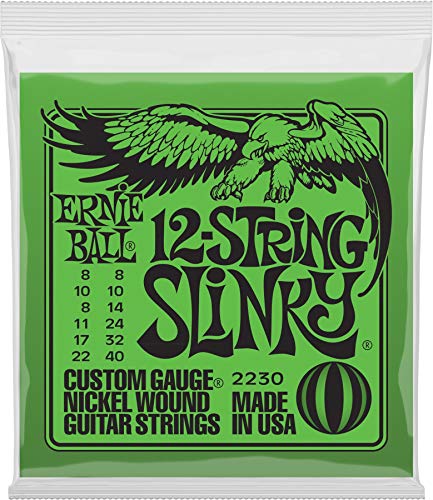
- Ernie Ball 12-String Slinky (8-40): a nickel-wound electric 12-string set listed at 8-40 gauge, a common upgrade for lighter feel.
- AKLOT 12-String Semi-Hollow: an f-hole jazz-style 12-string with dual humbuckers for a lower-cost semi-hollow option.
- Rickenbacker 12-string strings: the maker sells its own set for its 12-string models.
How to Get the 12-String Electric Sound
Pickups: single coils for sparkle, humbuckers for weight
Single-coil designs such as those on the Jazzmaster-style Squier emphasise the high pairs and give a glassy shimmer. Humbucker designs such as the AKLOT and Ibanez give a rounder, thicker sound and handle gain better. Hollow-body pickups add their own character through the body. Pick the pickup type that matches the genre you play most.
Clean headroom and compression
A 12-string produces a lot of high-frequency content, and a clean amp with plenty of headroom lets it sparkle without breaking up. A light compressor pedal evens out the pairs and gives the sustained, singing quality many 12-string records have. Reverb at low settings widens the sound.
Strings and gauge
Electric 12-string sets are very light, with common sets starting at .008 on the top string (the Ernie Ball set listed at 8-40 is one example). Lighter strings keep tension manageable on a neck that has to hold twelve of them. Heavier sets exist for lower tunings.
Setup
Because the strings are thin and the nut slots are narrow, a poorly cut nut leads to pinging and tuning drift. A good setup, including nut slots cut for 12-string gauges, makes a large difference. Ask a technician to check the saddle spacing too, since pairs of strings must sit cleanly.
Body style
Hollow bodies resonate and add air but feed back at volume; semi-hollows balance resonance and stability; solid bodies are the most stable and suit louder playing. Think about the stage volumes you will actually play at.
Left-handed players
A few of these models appear in left-handed versions, but availability changes, so check the exact listing.
A Simple Jangle Signal Chain
You do not need a pedalboard to get a convincing 12-string electric sound, but a short chain in the right order makes a large difference. The idea is to keep the signal clean, even and spacious.
- Tuner first. A pedal tuner or clip-on tuner at the start of the chain is not optional with twelve strings. Tune before every song.
- Compressor. Set it for gentle squeeze with a fast-ish attack so the pairs even out. The aim is sustain and smoothness, not obvious pumping.
- Overdrive or boost (optional). A very light boost at low gain can add bite to the high strings without turning the chords muddy. Heavy gain tends to blur the pairs together.
- Modulation (optional). A subtle chorus can widen the sound, but a 12-string already has a built-in chorus, so go lightly.
- Delay. A short slapback or a low-mix quarter-note delay adds space behind rhythm parts.
- Reverb. A plate or spring setting at low mix finishes the sound. Too much reverb on a 12-string quickly turns it into a wash.
Hollow-body guitars like the Gretsch G5422G-12 sound best with the least processing: a touch of reverb and a little compression. Solid-body guitars such as the Squier Jazzmaster XII or AKLOT benefit more from the compressor and a boost because they have less natural bloom of their own.
Match the Guitar to the Genre
| Style | What it needs | Good fits here |
|---|---|---|
| Jangle pop and folk rock | Chime, clean headroom, open chords | Rickenbacker 360/12, Gretsch G5422G-12, Danelectro 59X12 |
| Country and Americana | Warm, airy, slight twang | Gretsch G5422G-12, Guild Starfire I 12-String |
| Indie, shoegaze and surf | Shimmer, reverb-friendly, offset feel | Squier Paranormal Jazzmaster XII, Danelectro 59X12 |
| Classic and hard rock layering | Thicker mids, handles gain | AKLOT Strayloom, Ibanez AS7312 |
| Jazz-leaning chord work | Round tone, semi-hollow body | Ibanez AS7312, Guild Starfire I 12-String |
The table is a guide, not a rule. Many records use a 12-string in a style that does not match its reputation, and a good player can coax a lot of tones out of any of these guitars. Use the table to narrow down the shortlist, then decide on looks, feel and budget.
Voicings That Sound Great on an Electric 12-String
Simple wins on a 12-string. Open chords such as G, C, D, Em and Am ring with all the pairs sounding, and suspended chords like Dsus2 and Asus4 sound enormous. Barre chords sound fine but require firm pressure to avoid buzzing the paired strings. Fewer notes often sounds better than more: many players favour dyads and triads with a few open strings ringing over thick jazz voicings.
Arpeggios are where the instrument shines. Picking through a simple open-chord pattern lets each pair ring into the next, and with a touch of compression and delay the result sounds like a small orchestra. If you play with a pick, a medium-thin one tends to give an even strum across all twelve strings, while a thicker pick can emphasise the lower courses.
For lead lines, many players move to octave doubling: play a melody on the top strings and let the paired strings do the octave work for you. Bending is limited, but slides and hammer-ons work well.
Recording and Layering a 12-String Electric
In a mix, a 12-string works best as a layer behind or beside a six-string. Doubling the same part on both guitars, with the 12-string panned to one side and a six-string on the other, gives the sound a width that a single guitar cannot. If you record direct, a DI plus an amp simulator works well; if you record an amp, a close mic with a second room mic captures some of the natural bloom. Because the high strings carry so much energy, a gentle low-pass filter or a small cut in the upper treble can keep a 12-string from fighting the cymbals and vocals.
When tracking, check tuning between takes. A guitar that is slightly out of tune at the start of a song will be noticeably so by the chorus, because every string is doubled and any drift is amplified by the interference between pairs.
Setup Checklist Before Your First Gig
- Fit fresh strings of the gauge you plan to use, and stretch them well.
- Have the nut slots checked for pinching or buzzing, especially on a budget guitar.
- Check the bridge saddles and intonation; a 12-string with poor intonation is quickly obvious.
- Adjust the truss rod so the neck has a slight forward bow and no excessive relief.
- Tighten the tuner nuts and strap buttons.
- Carry a spare set of strings and a clip-on tuner.
If your budget guitar still feels stiff after a setup, consider a lighter string set. A set of 8-40 gauge strings, such as the Ernie Ball 12-String Slinky, is a common starting point for easier fretting.
Common Mistakes When Buying an Electric 12-String
- Expecting it to play like a six-string. The neck is wider and the strings are doubled. Budget a few weeks of adjustment before judging the guitar.
- Using the wrong strings. A six-string set cannot be used, and a heavy 12-string set can strain the neck. Stay with the gauge the maker recommends unless a technician advises otherwise.
- Skipping the nut work. Pinging and tuning drift on budget instruments often trace to the nut slots. It is a cheap fix that changes the whole instrument.
- Going for heavy gain. Distortion blurs the doubled strings together. If you want a heavy sound, play only the lower strings or choose a humbucker-equipped guitar and accept a thicker, less chiming result.
- Buying a hollow body for loud stages. A hollow body can howl at high volume. If you play loud, choose a semi-hollow or solid body.
- Ignoring weight and balance. Twelve tuners make the headstock heavy. Check the balance on a strap before buying, because neck dive is a common complaint on 12-strings.
Avoiding these mistakes matters more than choosing between two close models. A well-set-up budget guitar will beat a neglected premium one nearly every time.
Used Versus New: A Practical View
Electric 12-strings often appear on the used market because many players buy one for a project and move on. That can be a good way to afford a model above your budget. Inspect the neck carefully for twist and for a lifting fingerboard, check that all twelve tuners turn smoothly, and look at the bridge for worn saddle slots. Ask whether the guitar has been restrung with the correct set. If you are buying a hollow or semi-hollow body, inspect the top for cracks near the bridge and the f-holes. When a seller will not allow a return, treat a used 12-string as a project and set aside money for a setup.
12-String Versus Six-String Electric: What You Gain and Lose
A 12-string electric gives you width, shimmer and a built-in chorus effect, and it makes simple chord progressions sound enormous. In exchange, bends are harder, solos are tougher, and the guitar takes more time to tune. A common compromise is to use the 12-string for rhythm parts and keep a six-string for leads. If you only own one electric, a six-string is the more flexible choice; if you already own one, a 12-string is a rewarding second guitar.
Frequently Asked Questions
What are the best 12-string electric guitars under 1000?
The Ibanez AS7312, Guild Starfire I 12-String, Squier Paranormal Jazzmaster XII, Danelectro 59X12 and AKLOT Strayloom are all in that tier. The Gretsch G5422G-12 sits around the top of it.
Are 12-string electric guitars hard to play?
They require more finger strength than six-strings, and bends are harder. With a good setup and light strings, most players adapt within a few weeks.
What is the best electric 12 string for jangle?
The Rickenbacker 360/12 is the classic choice, with the Gretsch G5422G-12 and Squier Jazzmaster XII as lower-cost alternatives.
Can I convert a six-string electric to a 12-string?
It is possible with a different nut, bridge and tuners, but results vary and most players prefer a purpose-built 12-string. Kit builds such as the BexGears DIY 12-string exist for hobbyists.
What amp should I use with a 12-string electric?
A clean amp with lots of headroom works best. Add compression and light reverb rather than heavy gain.
Do 12-string electrics stay in tune?
They can drift more than six-strings, especially when new. Stretching the strings and ensuring the nut slots are clean help.
How should I store a 12-string electric?
Store it in its case or on a sturdy stand away from heat and direct sunlight. The neck carries a lot of tension, so avoid leaving it in a hot car.
Which 12-String Electric Should You Buy?
- Classic jangle, budget open: Rickenbacker 360/12.
- Warm hollow-body twang: Gretsch G5422G-12 Electromatic.
- Versatile semi-hollow value: Ibanez AS7312.
- Vintage thin hollow-body look: Guild Starfire I 12-String.
- Cheapest quality offset: Squier Paranormal Jazzmaster XII.
- Retro character: Danelectro 59X12.
- Cheapest humbucker experiment: AKLOT Strayloom.
Sources
Rickenbacker, Gretsch, Ibanez, Guild, Squier and Fender, Danelectro and AKLOT product listings; Ernie Ball and Rickenbacker string pages.
Last updated: October 2026




Write Your Review
No reviews yet. Be the first to share your experience!