

Key takeaways
- Single-coils: clear attack, pronounced upper-mid detail, and useful percussive response for funk, country, blues, pop, and clean rock. They also produce more audible 50/60-cycle hum under some electrical conditions.
- Humbuckers: thicker output, less ordinary single-coil hum, and a smoother response for hard rock, metal, jazz, and sustained lead work.
- P-90s: broad, aggressive single-coil character with more midrange than a traditional Stratocaster pickup. They suit garage rock, blues, punk, and roots music.
- HSS layouts: a bridge humbucker plus two single-coils. This is often the most practical beginner configuration because it covers convincing clean sounds and higher-gain rhythm tones.
- HH with coil-splitting: two humbuckers can provide powerful sounds, while a switch can expose one coil for a thinner tone. Coil-split sounds are useful, but they rarely sound identical to a purpose-built single-coil guitar.
The best electric guitars are the ones whose body shape, pickups, neck dimensions, scale length, and hardware match the way you actually play: a Yamaha Pacifica 112V is a strong all-round beginner choice, a Fender Player II Stratocaster suits blues and clean styles, a PRS SE Custom 24 covers modern rock, and an Ibanez RG421 favors fast metal-oriented playing.
Our top picks


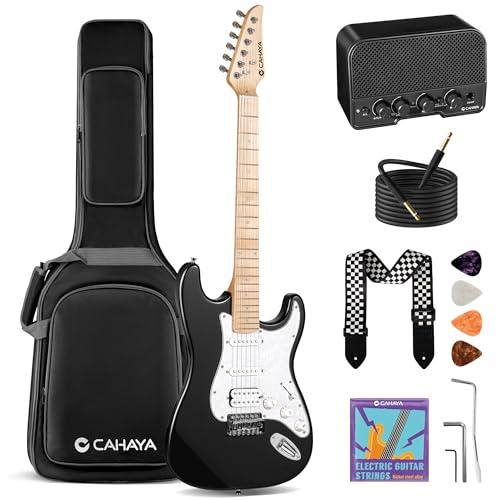
As an Amazon Associate we earn from qualifying purchases at no extra cost to you. Ratings are shown as listed on Amazon.
Quick picks by playing style
| Playing situation | Recommended type or model | Why it fits | Typical 2026 market range |
|---|---|---|---|
| First guitar and broadest range of sounds | Yamaha Pacifica 112V | Strat-style body, HSS pickups, comfortable 25.5-inch scale, useful coil-split | $300–$450 |
| Blues, funk, country, and classic rock | Fender Player II Stratocaster | Three single-coils, 25.5-inch scale, tremolo, familiar contoured body | $800–$1,000 |
| Indie, alternative, and rhythm-heavy rock | Fender Player II Telecaster | Bright bridge pickup, punchy neck pickup, fixed bridge, simple controls | $800–$1,000 |
| Hard rock and versatile professional use | PRS SE Custom 24 | Dual humbuckers, 24 frets, 25-inch scale, coil-splitting, stable tremolo | $850–$1,100 |
| Metal, shred, and low-tuned riffing | Ibanez RG421 | Thin neck, 24 frets, dual humbuckers, 25.5-inch scale, fixed bridge | $350–$500 |
| Warm jazz, blues, and classic rock | Gibson Les Paul Studio | Mahogany-based solid body, dual humbuckers, 24.75-inch scale, substantial tone | $1,500–$2,000 |
How body style changes the playing experience
Solid-body guitars: the dependable default
Solid-body guitars resist feedback better than hollow instruments at high volume and work well with distortion, effects, and recording. Stratocaster-style bodies are contoured and usually comfortable while seated or standing. Telecaster-style bodies are simpler, often lighter in control layout, and commonly use a fixed bridge that makes restringing and tuning maintenance easier.
Single-cut guitars such as a Les Paul generally have more mass and a thicker body. That can produce a reassuringly solid feel, but weight varies considerably between individual instruments. If you play long rehearsals, check the actual guitar rather than assuming every model has the same weight. Semi-hollow designs such as the Gretsch G2622 Streamliner add acoustic resonance and visual character, but they can feed back sooner with loud, high-gain amplification.
Pickups: the most important tonal decision
- Single-coils: clear attack, pronounced upper-mid detail, and useful percussive response for funk, country, blues, pop, and clean rock. They also produce more audible 50/60-cycle hum under some electrical conditions.
- Humbuckers: thicker output, less ordinary single-coil hum, and a smoother response for hard rock, metal, jazz, and sustained lead work.
- P-90s: broad, aggressive single-coil character with more midrange than a traditional Stratocaster pickup. They suit garage rock, blues, punk, and roots music.
- HSS layouts: a bridge humbucker plus two single-coils. This is often the most practical beginner configuration because it covers convincing clean sounds and higher-gain rhythm tones.
- HH with coil-splitting: two humbuckers can provide powerful sounds, while a switch can expose one coil for a thinner tone. Coil-split sounds are useful, but they rarely sound identical to a purpose-built single-coil guitar.
Neck profile, scale length, and fret access
A neck profile describes the thickness and contour in your hand. A slim “Modern C” or Ibanez-style thin neck can feel quick for players who move rapidly across the fretboard. A fuller “U” or substantial “C” profile may feel more supportive for chord playing and players who dislike a narrow-feeling neck. Neither shape is universally better; hand size, thumb position, and technique matter more than the label.
| Common scale length | Typical examples | Playing effect |
|---|---|---|
| 24.75 inches | Many Gibson-style guitars | Slightly lower string tension at the same tuning; comfortable for bends and compact stretches |
| 25 inches | Many PRS models | A middle ground between Gibson and Fender-style tension |
| 25.5 inches | Many Fender and Ibanez models | Firmer feel, clear low-string response, and useful tension for down-tuning |
Scale length is the distance from the nut to the bridge’s theoretical vibrating point. A 25.5-inch guitar is not automatically harder to play, but its longer stretches and firmer strings may be noticeable to beginners. Players who tune down to D or lower often appreciate the tighter response of a longer scale, although heavier strings and a proper setup may still be necessary.
Best electric guitars for beginners
Yamaha Pacifica 112V: the practical all-rounder
The Pacifica 112V remains compelling because it avoids locking a new player into one genre. Its HSS pickup arrangement, 22-fret neck, 25.5-inch scale, and tremolo bridge cover clean rhythm, blues, pop, and moderate rock. The instrument is also commonly available in left-handed versions and is easy for a repair technician to understand and service.
Choose it over a cheaper guitar if you want one instrument to remain useful after your first year. A less expensive starter guitar can be sensible when budget is the main constraint, but reserve part of the purchase for a tuner, strap, cable, spare strings, and a basic setup.
Squier Affinity Stratocaster or Telecaster: affordable entry points
Squier’s Affinity models offer recognizable Fender-style ergonomics at a lower general market price, often around $250–$350. A Stratocaster is the more flexible pick for clean tones and tremolo use; a Telecaster is usually simpler and more direct. Inspect fret ends, tuning stability, and the output jack before buying, especially on an inexpensive instrument. A basic professional setup can make a larger difference than upgrading cosmetic details.
Best choices for intermediate and advanced players
PRS SE Custom 24: the balanced modern option
The SE Custom 24 combines a comfortable 25-inch scale with 24 frets, dual humbuckers, coil-splitting, and a tremolo system. It is a strong head-to-head alternative to a traditional two-humbucker single-cut: the PRS is generally easier to reach at the highest frets and offers a slightly more neutral scale length, while a Les Paul-style guitar can feel warmer, heavier, and more substantial.
Fender Player II Stratocaster: when touch response matters
A Stratocaster’s three single-coils and five-way selector reward changes in picking position and attack. Its bridge-and-middle and neck-and-middle combinations are especially useful for funk, rhythm parts, and clean layered arrangements. The synchronized tremolo adds pitch movement, but it also introduces more setup variables than a fixed bridge. If you rarely use vibrato, a Telecaster or hardtail guitar may be easier to keep stable.
Ibanez RG421: focused on speed and high gain
The RG421 uses a flat, fast-feeling neck, 24 frets, two humbuckers, and a fixed bridge. That combination is practical for metal because the bridge is easier to maintain than a double-locking tremolo, especially when changing tunings. If you need extreme vibrato effects, an Ibanez RG model with a locking tremolo may be appropriate, but expect longer restringing and tuning procedures.
Hardware and ownership costs people overlook
Fixed bridges are the simplest to maintain. Traditional tremolos are more expressive but need balanced spring tension and careful string changes. Locking tremolos can stay stable during aggressive pitch effects, yet changing gauge or tuning often requires extra adjustment. Locking tuners improve convenience, but they do not compensate for a poorly cut nut or incorrect neck relief.
Strings are consumables. A regular player may replace them every two to eight weeks, depending on sweat, playing time, and desired brightness. If a $10–$15 set lasts six weeks, the annual string cost is approximately:
52 weeks ÷ 6 × $12 = about $104 per year.
Budget separately for a tuner, cable, strap, picks, cleaning cloth, and an occasional setup. Fret wear appears first under frequently used notes and bends; crackling controls may require cleaning or replacement; and a loose output jack can eventually damage the wiring. Wipe strings after playing, store the guitar away from extreme heat and humidity changes, and avoid leaving it permanently under excessive string tension if the neck or bridge is already showing problems.
A simple decision matrix
| Your priority | Best direction | What to avoid |
|---|---|---|
| One guitar for several genres | HSS or HH with coil-split | A specialized metal or vintage-style single-coil-only model |
| Small hands or frequent chord changes | 24.75- or 25-inch scale with a comfortable medium profile | Choosing a thick neck or long scale solely from appearance |
| Frequent tuning changes | Fixed bridge and a second guitar for alternate tunings | A locking tremolo unless its benefits are essential |
| Long rehearsals or performances | A balanced instrument under roughly 9 pounds, where possible | Buying a heavy guitar without trying it while standing |
| Clean, low-volume home playing | Single-coils, P-90s, or moderate-output humbuckers | Assuming high output automatically means better tone |
Final buying advice
Prioritize neck comfort, tuning stability, and a pickup configuration that matches your amplifier and genre. Compare guitars while standing with a strap, check that every fret rings clearly, turn each control slowly for noise, and inspect whether the bridge, nut, and tuners feel secure. The best electric guitars are not necessarily the most expensive; they are the instruments that encourage regular practice without creating maintenance or ergonomic problems you did not anticipate.





Write Your Review
No reviews yet. Be the first to share your experience!