

Key takeaways
- Soundhole magnetic pickups clamp in without drilling, resist feedback and sound warm, but they need steel strings and can sound less “acoustic” than a piezo.
- Under-saddle piezo pickups sit under the saddle, sound more like the guitar’s real attack and detail, but they require a saddle slot and an endpin jack, so installation is more involved.
- Passive piezos need a high-impedance input (about 1 megohm or higher); plugging into a low-impedance line input without a preamp thins the bass.
- Pairing a pickup with a preamp or a small DI box is often the biggest tone upgrade, whichever pickup you choose.
- If you are upgrading an existing acoustic-electric, a new preamp and under-saddle element can transform the sound without changing the guitar.
The best pickups for acoustic guitars are magnetic soundhole pickups such as the Fishman Neo-D, L.R. Baggs M1 or Seymour Duncan Woody HC if you want a reversible, no-drill install, and under-saddle piezo systems such as the Fishman Matrix Infinity if you want a more permanent, stage-ready sound. The right choice depends on how you play, how much installation you can accept and whether you need a clean amplified tone or a more natural, acoustic one. This guide compares seven pickups and four more options, with install notes, tone traits and a decision table.
Our top picks


As an Amazon Associate we earn from qualifying purchases at no extra cost to you.
Key takeaways
- Soundhole magnetic pickups clamp in without drilling, resist feedback and sound warm, but they need steel strings and can sound less “acoustic” than a piezo.
- Under-saddle piezo pickups sit under the saddle, sound more like the guitar’s real attack and detail, but they require a saddle slot and an endpin jack, so installation is more involved.
- Passive piezos need a high-impedance input (about 1 megohm or higher); plugging into a low-impedance line input without a preamp thins the bass.
- Pairing a pickup with a preamp or a small DI box is often the biggest tone upgrade, whichever pickup you choose.
- If you are upgrading an existing acoustic-electric, a new preamp and under-saddle element can transform the sound without changing the guitar.
Quick Comparison: Best Pickups for Acoustic Guitars
| Pickup | Type | Install | Tone | Best for |
|---|---|---|---|---|
| Fishman Neo-D Humbucker | Magnetic soundhole | Clamps in the soundhole, no drilling | Warm, clear | Quick, reversible upgrade |
| L.R. Baggs M1 | Magnetic soundhole (passive) | Clamps in the soundhole | Natural, balanced | Strummers and singer-songwriters |
| Seymour Duncan Woody HC | Hum-canceling magnetic soundhole | Clamps in the soundhole | Warm, rich | Low noise, easy install |
| Seymour Duncan Woody XL | Magnetic soundhole | Clamps in the soundhole | Full-spectrum, noiseless | Fuller, wider response |
| Fishman Matrix Infinity | Under-saddle piezo with preamp | Saddle slot and endpin jack | Detailed, stage-ready | Gigging players, permanent upgrade |
| Journey Instruments EP001K | Passive piezo (three elements) | Check listing for fitting | Natural, open | Players wanting a boutique feel |
| Artec PG607 | Ceramic piezo strip (55 x 2.6 mm) | Under-saddle, needs a slot | Bright, direct | Budget, 6- or 12-string guitars |
Pickup type, install notes and tone descriptions come from the manufacturers’ product pages as summarised by retailers. Confirm compatibility with your guitar’s saddle slot and soundhole size before ordering.
Soundhole, Under-Saddle or Magnetic: Which Type Suits You?
Magnetic soundhole pickups
A magnetic soundhole pickup uses coils and magnets to sense the vibration of steel strings, much like an electric guitar pickup. It mounts in the soundhole, so nothing is drilled or glued. That makes it popular for vintage guitars, borrowed guitars and anyone who wants the option to remove it. The sound is warm and a little compressed, with good resistance to feedback at stage volume. It does not capture the percussive sound of the body, so it can sound less acoustic than a piezo. It also responds only to steel strings, so it does not work on nylon strings or most bronze-wound strings as strongly as on nickel-based sets, according to pickup makers’ guidance.
Under-saddle piezo pickups
A piezo pickup sits under the saddle and senses the pressure of the vibrating strings and bridge. It provides the detailed, snappy sound that most modern acoustic-electrics use. Installation usually requires making sure the saddle slot is flat and fitting an endpin jack. It also typically needs a preamp to even out the sound, and an incorrect fit can cause uneven string volume or a quacky tone.
Contact and blended systems
Contact transducers stick to the soundboard, and blend systems combine a pickup with a small microphone. These systems are the most natural-sounding but also the most complex and expensive, and they can be sensitive to feedback. They are beyond the scope of this guide, but worth considering when you have found the limits of a simple pickup.
Decision table
| Your situation | Choose | Why |
|---|---|---|
| You want a reversible install | Magnetic soundhole | No drilling, easy to remove |
| You play loud stages or open mics | Magnetic soundhole or piezo with a feedback control | Soundhole pickups resist feedback; piezos need a notch filter or phase switch |
| You want the most natural, detailed sound | Under-saddle piezo with preamp | Captures string and bridge detail |
| You play fingerstyle with dynamics | Under-saddle piezo | Responds to touch and attack |
| You play nylon strings or a crossover guitar | Piezo | Magnetic pickups do not sense nylon strings |
| Tight budget | Basic piezo strip or entry soundhole pickup | Lowest cost; consider professional installation |
| Vintage guitar you do not want to modify | Magnetic soundhole | Clamp-in design leaves the guitar unmodified |
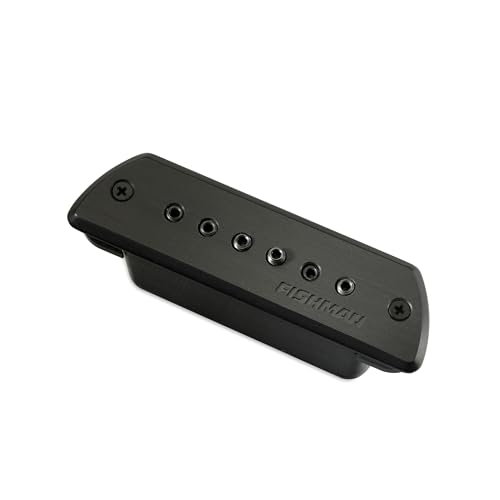
1. Fishman Neo-D Humbucker: Best Easy Soundhole Upgrade
For many players, the Neo-D is the first step into amplified acoustic playing. It installs in minutes, sounds natural enough for small rooms and is quiet thanks to its humbucking design. Because it is magnetic, it also stays relatively stable when the volume goes up, which helps in cafes and open mics where a piezo could squeal.
Fishman Neo-D Humbucker · magnetic soundhole · passive · clamp-in install
- Humbucking design aimed at reducing hum while keeping the warm, clear tone of a magnetic pickup.
- Clamps into the soundhole and can be removed without marks.
- Passive, so it needs a standard guitar input or a preamp with enough input impedance.
- Also available as a single-coil version at a lower tier.
Best for: players who want a fast, low-risk way to amplify a steel-string guitar for open mics or small gigs.
Skip if: you want the full body resonance of a piezo, or you play nylon strings.
Pros:
- Simple, reversible install.
- Good feedback resistance.
- Reliable and widely used.
Cons:
- Less percussive acoustic character than a piezo.
- Needs a way to connect to an amp; check the cable or jack included.
2. L.R. Baggs M1: Best for Natural Strumming Tone
L.R. Baggs M1 · magnetic soundhole · passive · humbucking
- Established passive soundhole pickup from a well-known acoustic pickup maker.
- Clamps into the soundhole and does not require guitar modification.
- Designed to deliver a balanced, natural voice for strummed chords.
- Works with steel strings.
Best for: singer-songwriters and strummers who want a no-fuss pickup that blends with a vocal.
Skip if: you play fingerstyle with delicate dynamics.
Pros:
- Even response across strings.
- Easy to install and remove.
- Quiet in use.
Cons:
- Higher price tier than basic soundhole options.
- Does not capture body percussion.
3. Seymour Duncan Woody HC: Best Hum-Canceling Soundhole Pickup
The Woody series is known for its wood-effect covers, which blend into the soundhole, and for simple install. The HC version is hum-canceling, which matters when you play under fluorescent lights or near a lot of electronics. If your gigs are in buildings with noisy electrical setups, quiet operation is worth more than extra frequency range.
Seymour Duncan Woody HC · hum-canceling magnetic soundhole · passive
- Hum-canceling design, per the maker listing, for quiet performance.
- Wood-effect cover in walnut or other finishes that blends with the guitar.
- Soundhole mount with clamps.
- Warm tone that suits vocal accompaniment.
Best for: players in noisy environments or with electrical interference who want a warm, quiet magnetic pickup.
Skip if: you want a bright, piezo-style attack.
Pros:
- Low noise.
- Neat appearance.
- Easy installation.
Cons:
- Magnetic sound is less “airy” than a piezo.
- May need an output jack adaptation.
4. Seymour Duncan Woody XL: Best for Fuller Response
Seymour Duncan Woody XL · magnetic soundhole · passive · full-spectrum design
- Designed to deliver a fuller, wider-frequency response than a simple single-coil.
- Available in walnut, maple and black finishes.
- Soundhole mount, no drilling.
- Listed as noiseless by the maker.
Best for: players who like magnetic pickups but want more depth and range than a basic model.
Skip if: you already own a Woody HC and need only one soundhole pickup.
Pros:
- Fuller tone than a basic soundhole pickup.
- Quiet operation.
- Pleasant cosmetic finish.
Cons:
- Higher price than the HC.
- Still a magnetic pickup, so some acoustic detail is missing.
5. Fishman Matrix Infinity: Best Under-Saddle System for the Stage
The Matrix Infinity is a system rather than just a pickup: it pairs an under-saddle element with a small preamp that sits at the soundhole, so you can shape the tone without leaving the stage. That is a big reason it is common in gigging acoustic-electrics. For a guitar that currently has no electronics, it is a straightforward route to a professional setup, provided you accept the drilling and the saddle work.
Fishman Matrix Infinity · under-saddle piezo with soundhole preamp · active
- Under-saddle pickup paired with a compact preamp mounted at the soundhole.
- Soundhole-mounted controls for volume and tone; check the exact model for extras such as a phase switch or tuner.
- Requires an endpin jack and a battery in the preamp.
- Offered in narrow and wide formats to fit different soundholes.
Best for: gigging players who want a fuller, more acoustic sound and are willing to have the guitar modified.
Skip if: you do not want to modify the guitar or need a reversible solution.
Pros:
- Detailed, dynamic tone.
- Onboard controls help shape the amplified tone.
- Widely used and easy for technicians to service.
Cons:
- Requires professional-level installation for best results.
- Needs battery changes.
6. Journey Instruments EP001K: Best Boutique Passive Piezo
Journey Instruments EP001K · passive piezo · three balanced elements
- Piezo pickup with three balanced passive elements, according to the listing.
- Passive design, so no battery in the pickup itself.
- Intended for natural, open acoustic tone.
- Check the listing for fitting details and compatibility.
Best for: players who want a piezo with a more natural character and who are comfortable with a technician fitting it.
Skip if: you want a plug-and-play system with a built-in preamp.
Pros:
- Good balance across strings.
- Passive design suits external preamps.
- A specialist alternative to mainstream brands.
Cons:
- Less widely stocked than major brands.
- Needs an external preamp for best results.
7. Artec PG607 Piezo Strip: Best Budget Under-Saddle Option
A bare piezo strip is the building block of many factory acoustic-electric systems. On its own it can sound bright and quacky, but paired with a decent preamp it can sound surprisingly good. It is a practical choice for repairs, DIY builds and anyone who wants to learn how under-saddle systems work without investing in a premium kit.
Artec PG607 · ceramic piezo transducer · 55 x 2.6 mm · 6- or 12-string
- Ceramic piezo strip sized for typical steel-string saddles.
- Listed for both 6- and 12-string acoustic guitars.
- Simple passive design.
- Usually sold as a loose replacement transducer.
Best for: DIY players, repair shops and anyone rebuilding an acoustic-electric on a budget.
Skip if: you want a ready-made system with a preamp.
Pros:
- Very affordable.
- Easy to replace.
- Compatible with many guitars.
Cons:
- Bare piezo tone can be bright and thin without a preamp.
- Installation requires a proper saddle slot.
Also Consider
- Fishman Rare Earth Humbucker: magnetic soundhole · humbucking. A step-up soundhole pickup with a rich tone, aimed at players who want an upgrade from entry models.
- L.R. Baggs LB6: acoustic guitar pickup from a respected maker. Check the listing for the exact type and fitting details before ordering.
- EMG ACS: magnetic soundhole. A soundhole pickup from a brand best known for electric guitar pickups.
- Amumu SP30 Woody Magnetic Soundhole Pickup: magnetic soundhole · budget. A simple, low-cost soundhole option for casual players.
Impedance and Preamps: A Worked Example
Passive piezo pickups produce a very high-impedance signal. If the next input has a lower impedance, the signal loses its low frequencies. A typical electric guitar amp has an input impedance of about 1 megohm (1,000,000 ohms), which suits a passive piezo reasonably well. A typical microphone-style line input might be 10,000 ohms. The ratio is 1,000,000 divided by 10,000, or 100 to 1, so the load is one hundred times heavier on the pickup, and the sound becomes thin and weak. A preamp or DI box with a high-impedance input solves this by buffering the signal before it travels farther.
That is why many acoustic-electric guitars have onboard preamps, and why external options such as a small preamp pedal or a DI are among the most effective upgrades. They also add tone controls, a phase switch and a notch filter to fight feedback.
How to Install a Soundhole Pickup Step by Step
Soundhole pickups are the easiest upgrade, and the steps are similar across Fishman, L.R. Baggs and Seymour Duncan models. Always follow the instructions that come with your pickup, but this outline shows what to expect.
- Check the soundhole size. Most steel-string soundholes are about 4 inches across, but check the pickup’s stated range. Small-bodied guitars may need a narrower model.
- Remove the strings or loosen them. Many models can be fitted with the strings in place, but removing them gives you more room and lets you clean the fingerboard.
- Position the pickup under the strings. Place it roughly where the strings cross the soundhole, with the pole pieces lined up under each string. A consistent distance from the strings gives even volume.
- Tighten the clamp. Use the supplied clamps or thumbscrews, and tighten them gently. You want it firm without marking the finish or stressing the top.
- Connect the output. Some pickups come with a cable that plugs directly into an amp; others need an endpin jack. If the guitar has no jack and you do not want to modify it, choose a model with an external cable.
- Adjust height and test. Play through an amp or preamp, listen for balance and adjust the pickup height so all strings are equally loud. If a string sounds weak, move or tilt the pickup slightly.
What an Under-Saddle Install Involves
An under-saddle piezo is a more permanent upgrade. The technician will usually carry out the following work, which explains why shops often charge for the service.
- Checking the saddle slot. The slot has to be flat and the right width, otherwise the pickup will not contact the strings evenly.
- Fitting or shaping the saddle. The saddle may need to be thinned or lowered so the pickup sits in the slot without raising the action.
- Drilling for the endpin jack. A hole is made at the tail of the guitar and a jack is installed. Some guitars already have one.
- Routing the cable and mounting the preamp. The cable runs from the bridge to the jack, and the preamp is mounted at the soundhole or inside the body.
- Setting intonation and action. After installation, the technician rechecks intonation and string height.
Doing this yourself is possible with a steady hand and the right tools, but a poor job can cause buzzing, uneven string volume or damage to the guitar. If in doubt, ask for a quote before ordering the pickup.
Ownership Realities: Batteries, Noise and Maintenance
- Batteries. Active systems need batteries, and a failing battery thins and distorts the sound. Replace it on a regular schedule and always carry a spare.
- Ground hum. Magnetic soundhole pickups can pick up electrical interference from lights and amps. Hum-canceling designs reduce the problem, but a poor power supply or ground can still cause noise.
- Cable quality. A cheap or damaged cable adds noise and loses high frequencies. Use a short, shielded, good-quality instrument cable.
- Humidity. A dry guitar can change the action or shift the saddle, which affects an under-saddle pickup. Maker guidance recommends 40 to 50 percent relative humidity.
- Strap pin and jack wear. The endpin jack takes a lot of stress. A strain-relief loop on the cable prevents damage.
Common Pickup Mistakes
- Choosing a magnetic pickup for a nylon-string guitar, which will not work.
- Plugging a passive piezo straight into a mixing console input, which thins the bass.
- Setting the soundhole pickup too close to the strings, which causes a harsh attack and may drag on the strings.
- Overlooking the saddle slot, so the pickup sits unevenly and makes some strings louder than others.
- Skipping a preamp or DI box, then blaming the pickup for a thin sound.
How We Chose
This list is built from research, not from installing every pickup. We reviewed manufacturer product pages from Fishman, L.R. Baggs, Seymour Duncan, Journey Instruments and Artec, retailer listings and published reviews from guitar magazines and players. We selected pickups that cover the main types (magnetic soundhole, under-saddle piezo with and without preamps), a range of install difficulties and a spread of tonal character. We limited each brand to two picks at most and skipped unbranded generic pickups with unclear specifications.
Buying Guide: Choosing the Best Pickup for Your Acoustic Guitar
Check your strings and guitar type
Magnetic pickups need steel strings. Nylon-string and crossover guitars need a piezo or a microphone-based system. If you have 12-string, 8-string or an unusual bridge, confirm compatibility before ordering.
Decide how permanent the install should be
A soundhole pickup clamps in and out. An under-saddle piezo needs a flat saddle slot, a small hole for the endpin jack and often some saddle shaping. If the guitar has resale or sentimental value, a reversible install may be wiser.
Plan the signal chain
A passive pickup needs a good preamp or a high-input-impedance amp. An active system includes the preamp but needs batteries. Consider whether you will play through a PA, an acoustic amp or a pedalboard.
Think about feedback
Feedback comes from loud stage volume and an open soundhole. Soundhole pickups resist it more than piezos. Options include a soundhole cover, a notch filter or a phase switch on your preamp.
Tone preferences
If you like a warm, rounded tone, a magnetic pickup suits you. If you want brilliance and pluck, a piezo does. Many players blend both or mix with a microphone for a fuller sound.
Consider professional installation
Under-saddle pickups need precision. A shop can ensure the saddle sits flat, the jack is secure and the intonation remains accurate. The fee is typically small compared with the value of the guitar and the cost of repairing a poor install.
Mind humidity
Acoustic guitars are sensitive to dryness. Maker care guidance from Martin and Taylor recommends keeping the guitar at roughly 40 to 50 percent relative humidity, which also protects any pickup installation from cracks and saddle changes.
Left-handed players
Pickups themselves are not handed, but jack placement and soundhole fit can vary. Check the listing and ask a technician if you play a left-handed guitar.
Frequently Asked Questions
What are the best pickups for acoustic guitars?
For a reversible, easy install, a magnetic soundhole pickup such as the Fishman Neo-D or L.R. Baggs M1 is the usual choice. For the most natural stage sound, a Fishman Matrix Infinity under-saddle system is the common upgrade.
What are the best soundhole pickups?
The Fishman Neo-D, L.R. Baggs M1 and Seymour Duncan Woody HC and XL are widely used options. Pick based on noise, tone and finish.
What are the best undersaddle pickups?
The Fishman Matrix Infinity and the Journey Instruments EP001K are good examples, with the Artec PG607 as a budget alternative. Install quality matters as much as the pickup itself.
What are the best pickups for acoustic-electric guitars?
If your guitar already has a piezo, the biggest upgrade is often a better preamp. If it has none, an under-saddle system with a preamp is the standard route.
Can I install an acoustic guitar pickup myself?
A soundhole pickup is easy to install yourself. Under-saddle systems require more skill; a small mistake can cause buzzing or uneven volume, so consider a technician.
Do magnetic pickups work with all strings?
No. They need strings with magnetic properties, so they work best with steel strings and respond less to some bronze and phosphor bronze sets than to nickel-wound strings. They do not work with nylon strings.
Will a pickup damage my guitar?
A clamp-in soundhole pickup should not. An under-saddle install involves modifying the saddle slot and adding an endpin jack, which is permanent, so make sure you are comfortable with that.
Which One Should You Buy?
- Easy, reversible soundhole upgrade: Fishman Neo-D Humbucker.
- Natural tone for strumming: L.R. Baggs M1.
- Quiet, hum-canceling: Seymour Duncan Woody HC.
- Fuller magnetic response: Seymour Duncan Woody XL.
- Stage-ready under-saddle system: Fishman Matrix Infinity.
- Boutique passive piezo: Journey Instruments EP001K.
- Budget under-saddle: Artec PG607.
Sources
Fishman, L.R. Baggs, Seymour Duncan, Journey Instruments and Artec product pages; Martin and Taylor guitar care guidance; retailer listing specifications; published reviews from guitar magazines and players.
Last updated: October 2026







Write Your Review
No reviews yet. Be the first to share your experience!