

Key takeaways
- Fit matters more than material: a pin that does not seat in a tapered hole, or a saddle that rocks in its slot, will cost you more tone than any plastic-versus-bone difference gains.
- Most acoustic bridge holes use a 5-degree taper; some use 3 degrees. Check before you buy.
- Upgrade the saddle first, the nut second, and the pins last, unless your pins are cracked or the wrong size.
- Pin-material effects are real but small; published opinions are mixed, so treat strong claims with caution.
The best bridge pins for acoustic guitars are slotted bone pins such as Crosby Pure Bone for a bright, clear attack, and ebony pins such as Waverly Ebony for a slightly warmer feel. Pins are the cheapest part of the bridge you can swap, but they change the sound less than a well-cut saddle or nut. If you want a real tone upgrade, treat the pins, saddle, and nut as one small project and fix the part that is actually holding the guitar back.
Our top picks



As an Amazon Associate we earn from qualifying purchases at no extra cost to you.
Key takeaways
- Fit matters more than material: a pin that does not seat in a tapered hole, or a saddle that rocks in its slot, will cost you more tone than any plastic-versus-bone difference gains.
- Most acoustic bridge holes use a 5-degree taper; some use 3 degrees. Check before you buy.
- Upgrade the saddle first, the nut second, and the pins last, unless your pins are cracked or the wrong size.
- Pin-material effects are real but small; published opinions are mixed, so treat strong claims with caution.
Quick Comparison: Best Bridge Pins for Acoustic Guitars and Small Tone Upgrades
| Product | Part | Material | Effect on tone | Fit difficulty |
|---|---|---|---|---|
| Crosby Slotted Pure Bone Bridge Pins | Bridge pins | Bone, abalone dot | Brighter, clear attack | Drop-in on 5-degree holes |
| Waverly Ebony Bridge Pins, Slotted | Bridge pins | Ebony | Warm, rounded top end | Drop-in; may need light sanding |
| LUXE by Martin Liquidmetal Bridge Pins | Bridge pins | Zirconium-based alloy | Maker claims more volume and sustain | Drop-in |
| Graph Tech TUSQ Saddle PQ-9272-C0 | Saddle | Synthetic TUSQ | Consistent, even response | Sand to fit |
| Musiclily Pro Compensated Bone Saddle | Saddle | Bone | Clear, articulate highs | Sand to fit |
| Graph Tech TUSQ XL Lubricated Nut (43 mm) | Nut | Synthetic, lubricated | Smoother tuning stability | Needs slotting or fit |
| MusicNomad GRIP Puller | Tool | Plastic and metal | None, but protects the bridge | None |
How We Chose These Upgrades
This is a research-based roundup. We did not install or play any of these parts ourselves. Choices come from maker specification pages, retailer listings, and published player discussion, and we flag where claims are marketing rather than measured fact. We looked for:
- Parts that fit common steel-string acoustics without specialist tools.
- Clearly different materials (bone, ebony, alloy, synthetic) so you can compare trade-offs.
- Names with a long retail history, so replacement parts and fitting advice are easy to find.
- Honest limits: where a part’s benefit depends on the guitar, we say so.
Where Tone Actually Comes From in the Bridge Area
Every string vibration passes through three small parts before it reaches the soundboard: the nut at the headstock end, the saddle in the bridge, and the pin that holds the string’s ball end under the bridge plate. The saddle does most of the transmitting, because that is where string energy enters the top. A poorly seated saddle, one that rocks, sits on a gap, or is cut too low, is the biggest tone thief on a budget guitar.
Pins matter in a different way. The string’s ball end sits against the bridge plate, and the pin merely holds it in the hole. A pin that is too loose or too tight, or one whose slot does not line up with the string, can pinch the string, make it ring unevenly, or lift the ball end off the plate. That is why a fit check comes before a material choice.
Published opinions on pin material are split. Retail and blog sources say bone is denser and gives a slightly brighter, more articulate tone, ebony sits in between and tends to sound warm, and plastic is neutral and rounded. Some guitar techs and forum posters hear little or no change. The honest summary is that the difference is small, and fit is the thing you can verify.
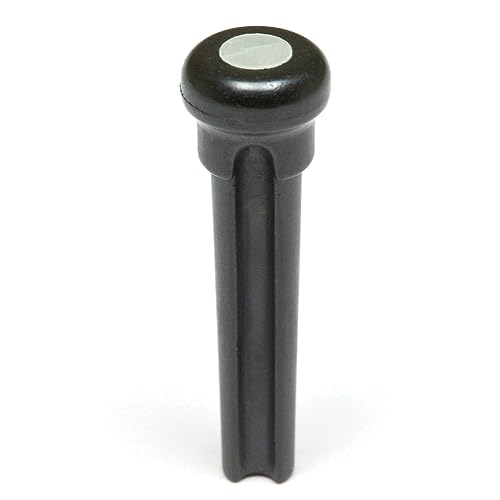
1. Crosby Slotted Pure Bone Bridge Pins: Best Bone Pins for Clarity
- Bone · slotted · abalone dot inlay
- Sold for six- and twelve-string acoustic guitars
- Slotted design gives the string room to sit beside the pin
- Also sold in an unslotted version
Best for: Players who want a first material upgrade without paying for specialty brands. Bone is the usual choice when you want crisp note definition and strong string-to-string separation in fingerstyle or strummed chords.
Skip if: Your guitar is already bright or thin. Bone can add to an excess of treble on maple or spruce guitars.
Pros:
- Natural bone is dense, so a sound difference from plastic is plausible
- Abalone dot adds a finished look
- Slots reduce string pinching when aligned
- Widely available, easy to replace
Cons:
- Natural bone varies from pin to pin, so a set may need minor sanding
- May not fit holes with a 3-degree taper well
2. Waverly Ebony Bridge Pins, Slotted: Best Warm-Voiced Wood Pins
- Ebony · slotted · set of six
- Made by StewMac, a luthier supplier
- Black finish suits most dark bridges
- Unslotted version also sold
Best for: Guitars that already sound bright or sharp and could use a little more warmth in the top end. Ebony is traditional on higher-end acoustics, and these are a plain, no-nonsense version.
Skip if: You live in a very dry or humid region with no climate control. Wood pins respond to humidity changes more than synthetic ones, so a snug pin in July can loosen in January.
Pros:
- Warm, rounded feel compared with bone, per published opinions
- Ebony can be sanded slightly to adjust fit
- Good value for a luthier-supplier part
- Plain styling suits vintage guitars
Cons:
- Humidity can move wood pins out of fit
- Brittle ends can chip if forced into the hole
3. LUXE by Martin Liquidmetal Bridge Pins: Best Premium Alloy Pins
- Zirconium-based alloy · set of six · pearl or red inlay options
- Martin says the alloy reflects string energy rather than absorbing it
- Available in several finishes, including chrome, gold, and gloss black
- Marketed for standard acoustic guitar bridges
Best for: Players who already have a well-set-up guitar and want to chase the last few percent of volume and sustain. Some owners report small gains in sustain and a hint more treble.
Skip if: You are on a tight budget or your nut and saddle are still stock. Martin claims a measurable volume increase, but forum techs and owners disagree on whether it is audible, and no independent controlled study is widely cited.
Pros:
- Durable metal construction does not crack or wear like bone
- Many finish options
- Reported to work on non-Martin guitars as well
- Drop-in fit for standard tapered holes, per retailer descriptions
Cons:
- Priced well above bone and wood alternatives
- Benefits are disputed by some technicians
- Metal pins can be tough on bridge holes if forced
4. Graph Tech TUSQ Saddle PQ-9272-C0: Best Saddle Upgrade for 72 x 3 mm Slots
- Synthetic TUSQ · compensated · about 72 mm long by 3 mm thick
- Listed height around 8.65 mm
- Fits many Fender acoustics and other guitars that use a 72 x 3 mm saddle
- Sold slightly oversize so you can sand to fit
Best for: Budget acoustics where a plastic saddle is the weakest link. Graph Tech says TUSQ is more consistent than bone, which has hard and soft spots, so it transmits string vibration evenly into the top.
Skip if: You prefer bone on principle. Some players report a rounder tone from bone, and it is harder, so strings wear grooves in it more slowly.
Pros:
- Easy to sand and shape, per reviewer comments
- Compensated profile helps intonation
- Uniform material, so results are predictable
- Many Graph Tech sizes exist for other slot dimensions
Cons:
- Must be sanded to fit; poor sanding ruins the seat
- Check the slot length first, because there are multiple TUSQ models
5. Musiclily Pro Compensated Bone Saddle: Best Martin-Style Bone Saddle
- Bone · compensated · 73.66 x 2.62 x 10.16 mm (about 2.9 x 0.1 x 0.4 inches)
- Listed for 6-string, Martin-style slots
- Sold as a pair
- Available in bleached or unbleached colour
Best for: Dreadnoughts and other guitars with Martin-style saddle slots, where you want a harder material and a slightly brighter, more articulate sound.
Skip if: Your slot is 3 mm or wider. A 2.62 mm saddle in a wider slot will not seat properly without shimming.
Pros:
- Pair in the box means you can botch one and try again
- Pre-compensated shape saves shaping time
- Bone resists groove wear from strings
Cons:
- Dimensions differ from some TUSQ slots; measure first
- Natural bone density can vary between pieces
6. Graph Tech TUSQ XL Lubricated Nut, 43 mm: Best Nut Upgrade for Tuning Stability
- Synthetic TUSQ XL · lubricated · 1-11/16 inch (43 mm) width
- For acoustic guitars with a standard 43 mm nut slot
- Self-lubricating design aims to reduce string catching
- Needs slotting or fitting to your string spacing
Best for: Guitars that go out of tune after a bend or that make pinging noises when strings are tuned. A smoother nut can help with those problems if the nut is the cause.
Skip if: The nut slots are fine and your tuning problems come from old strings or loose tuners. Check those first.
Pros:
- Lower friction than many stock plastic nuts
- Standard size fits many acoustics
- Same maker as popular saddle options
Cons:
- Slotting depth is critical and unforgiving
- A tech visit may cost more than the part
7. MusicNomad GRIP Puller: Best Tool for Protecting the Bridge
- Bridge pin puller · ergonomic handle
- Designed to lift pins without scratching the bridge
- Small enough for a gig bag
- Also useful during every string change
Best for: Anyone about to swap pins. Pulling stubborn pins with pliers or a coin is how bridges get scarred, and a puller is inexpensive insurance.
Skip if: Your guitar’s pins slide out by hand and your string winder already includes a notch for pulling.
Pros:
- Grip design reduces the chance of damaging the pin head
- Works with most standard pin sizes
- Useful for every string change after the swap
Cons:
- Single-purpose tool
- Can still mark a pin if you twist hard
Also Consider
- Waverly Bone Bridge Pins (slotted, 5-degree taper): A premium bone option with a stated taper, helpful if you want fit information up front.
- Taylor Water Buffalo Horn Bone Bridge Pin Kit: A maker-branded kit for owners who want a Taylor-matched look.
- Grover 102 Rotomatic Tuners: Open-gear style 3+3 tuners that can improve tuning stability on guitars with worn tuning machines.
- Schaller S-Locks strap locks: Not a tone change, but a practical small upgrade that stops straps from slipping off the button during a gig.
How to Measure Before You Buy: A Fit Checklist
Most failed pin or saddle upgrades come from skipped measuring, not a bad product. Work through these steps before you click buy.
- Check the pin taper. Hold a current pin against the bridge hole. A pin that sits proud by more than a millimetre or two is probably the wrong taper. Most acoustics use a 5-degree taper; some use 3.
- Look at the slot. If the string passes through a slot in the pin, make sure the slot faces the saddle when the pin is fully seated.
- Measure the saddle slot. Use a pair of calipers or a ruler: length, thickness, and depth. Typical thicknesses are about 3 mm (3/32 to 1/8 inch), and heights run from roughly 8.6 to 10.9 mm.
- Measure the nut width. A 1-11/16 inch (43 mm) nut is the most common acoustic size; check yours before ordering.
- Photograph the old parts. A before photo helps you reverse a mistake or show a technician.
| Part | Common dimension | What to check |
|---|---|---|
| Bridge pin hole | 5-degree taper (some 3 degrees) | Pin seats snugly without wobbling |
| Saddle thickness | about 2.6 to 3.25 mm | Slot width; saddle should be snug, not forced |
| Saddle length | about 70 to 74 mm | Slot length, including compensation direction |
| Saddle height | about 8.6 to 10.9 mm | Action height after sanding; leave extra to trim |
| Nut width | 43 mm (1-11/16 inch) typical | Neck width at the first fret |
How to Swap Bridge Pins Without Damaging the Bridge
Changing pins is a ten-minute job when you go slowly. The order below keeps the string, the pin hole, and the bridge plate safe.
- Detune one string at a time. Loosen the string fully so no tension pulls the ball end against the plate.
- Lift the pin with a puller. Rock it gently upward. If it will not move, stop and check for a pin that has swollen with moisture; forcing it can chip the bridge top.
- Clear the hole. Look for splinters or debris. A thin cotton swab removes dust without scratching the walls.
- Seat the new pin with the slot facing the saddle. Push it in by hand until it stops, then pull the string up gently so the ball end rises and locks against the plate.
- Check the height. A pin head that sits about 2 to 3 mm above the bridge top is normal. If it sits much higher, the taper or the hole depth is the cause, and sanding the pin shank can help.
- Repeat for each string and retune over a day so the new pins settle evenly.
Which Material Suits Which Problem
| Material | Typical sound (per published opinions) | Durability | Humidity sensitivity | Best match |
|---|---|---|---|---|
| Plastic | Neutral, rounded attack | Can crack with age | Low | Players happy with the stock sound |
| Ebony | Warm, softer top end | Good; can chip at the head | Higher | Bright or thin-sounding guitars |
| Bone | Clear, articulate highs | Very good | Low to moderate | Warm guitars needing definition |
| TUSQ (synthetic) | Even, consistent | Very good | Low | Budget guitars, DIY fitters |
| Metal alloy | Slightly brighter, more sustain claimed | Excellent | None | Players who want to experiment |
One sensible way to read the table is to correct a guitar’s tendency rather than to chase a trend. A guitar that already rings brightly rarely needs a bone saddle and bone pins together, while a muddy, dark guitar may gain from both. If you cannot decide, change one part, play for a week on fresh strings, and then decide on the next.
Buying Guide: Choosing Bridge Pins and Small Acoustic Upgrades
Decide what problem you are solving
Start with a symptom, not a shopping list. If the guitar sounds thin and plasticky, a bone saddle is the likeliest fix. If it buzzes on the open strings, look at the nut slot depth. If strings slip or the pins loosen, the pins are the issue. If the guitar simply sounds fine but looks dull, new pins are a cosmetic and modest tonal upgrade.
Pick a material to match the guitar
- Bone: Bright, clear, and dense. Good on warm-sounding mahogany guitars that need more definition.
- Ebony: Warm and traditional. Good on bright maple or spruce guitars.
- Synthetic (TUSQ): Consistent and easy to shape. Good for budget guitars and players who want predictable results.
- Metal alloy: Durable and fashionable. Treat sustain claims as unproven until you hear them on your guitar.
- Plastic: Neutral and inexpensive; many high-end guitars still ship with it.
Match the parts to each other
Changing only the pins on a guitar with a worn plastic saddle gives a small effect. A better plan: if you want a noticeable change, upgrade the saddle and the pins together, or the saddle and the nut. Keep the materials in harmony, so a bright bone saddle is not paired with bright bone pins on an already bright guitar.
Check humidity and climate
Wood parts move with moisture. Maker guidance from Martin, Taylor, and Gibson recommends keeping an acoustic guitar at roughly 40 to 50 percent relative humidity; that range also keeps wooden pins from shrinking or swelling out of fit. In very dry climates, bone and synthetic parts are more stable than ebony.
Know when to pay a technician
Pins and saddles are within reach of most home players. Nut slotting is not: cut too deep and the string buzzes, and the nut must be replaced. Bridge-pin hole reaming is also best left to a luthier, because the bridge plate under the top is soft wood and easy to over-ream. If the guitar is valuable, have a tech do the fitting and ask about the cost of a full setup at the same visit.
Plan the order of upgrades
- Fix any cracks, lifting bridges, or high action first.
- Replace the saddle with a properly fitted one.
- Replace the nut if slotting or tuning is a problem.
- Swap the pins last, mainly for fit and feel.
- Change strings after each major swap so you judge the new parts on fresh strings.
Frequently Asked Questions
Do bridge pins really change acoustic guitar tone?
Slightly, according to most published opinions. Bone and ebony are described as brighter and warmer than plastic respectively, but some technicians hear almost no difference. A pin that fits correctly matters more than the material.
What size are standard acoustic guitar bridge pins?
Most steel-string acoustics use pins with a 5-degree taper, though some guitars use 3 degrees. Measure your existing pins or check the maker’s spec before ordering, because a wrong taper sits too high or too low.
Should I choose slotted or unslotted bridge pins?
Slotted pins give the string a channel to sit in, which keeps it from being pinched. Unslotted pins rely on the hole alone. Slotted is the safer default unless your bridge already works well with unslotted pins.
Is a bone saddle better than a TUSQ saddle?
Neither is clearly better. Graph Tech says TUSQ is more consistent, while many players prefer the clarity of bone and its resistance to groove wear. Fit quality matters more than the material in either case.
Can I install a new saddle myself?
Many players do. Sand the bottom to adjust height, sand the sides to fit the slot, and test the fit frequently, removing only a little at a time. If you are not sure about the string action, a technician can set it correctly in a short visit.
Are Liquidmetal bridge pins worth it?
Martin says they add volume and sustain, and some owners report small gains. Technicians and forum posters are divided. If you already have a good saddle and nut and want to try something, they are a low-risk experiment; if you are on a budget, spend on a saddle first.
How often should I replace bridge pins?
Only when they crack, chip, or stop sealing the string. Bone and metal pins can last for decades, while plastic ones may crack over time. Inspect them every time you change strings.
Which One Should You Buy?
- Cheapest step with a real chance of an audible change: a well-fitted saddle, either the Graph Tech TUSQ PQ-9272-C0 or the Musiclily Pro bone saddle, depending on your slot size.
- Brighter, clearer tone from pins: Crosby Slotted Pure Bone Bridge Pins.
- Warmer feel from pins: Waverly Ebony Bridge Pins.
- Experimenting with premium parts: LUXE by Martin Liquidmetal pins, with realistic expectations.
- Tuning issues: the Graph Tech TUSQ XL lubricated nut, ideally fitted by a technician.
- Anyone swapping pins: add a MusicNomad GRIP Puller so the bridge stays unmarked.
If you only make one change, measure your saddle slot, buy the right saddle, and fit it carefully. It is the least glamorous upgrade on the list and the one most likely to be noticed.
Sources
Graph Tech product pages; Martin Guitar product descriptions; StewMac and Waverly product information; Sweetwater and zZounds retailer specifications; The Acoustic Guitar Forum; Unofficial Martin Guitar Forum.
Last updated: October 2026





Write Your Review
No reviews yet. Be the first to share your experience!