

Key takeaways
- Tension is the main choice: low is gentle and mellow, normal is balanced, high is louder and crisper but harder on the hands.
- Clear nylon trebles sound warm and round; carbon (fluorocarbon) trebles are brighter, denser and more projecting.
- Silver-plated basses are the standard; gold-plated basses are warmer and can last longer because they resist corrosion.
- New nylon strings stretch for days, so expect to retune often during the first week.
- Never put steel-string sets on a nylon-string guitar; the bridge and neck are not built for that tension.
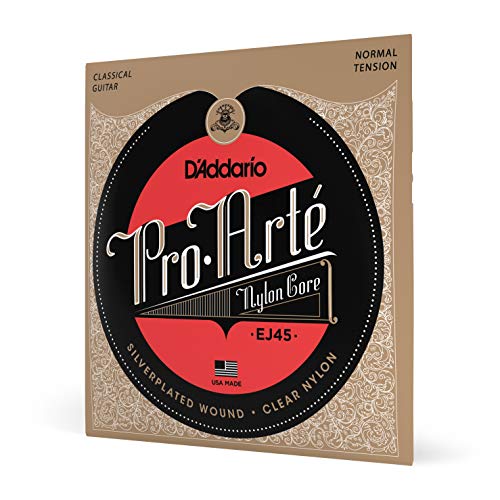
The best strings for nylon string guitars are normal-tension sets with clear nylon trebles and silver-plated wound basses, such as the D’Addario Pro-Arte EJ45, with high-tension sets like Augustine Classic Blue for louder projection and low-tension sets for softer feel. In this guide, each set is explained in terms of tension, feel and warmth, because those three words describe the real differences between classical guitar strings. We cover seven main picks, four alternatives and the details that matter for classical, flamenco and nylon-string crossover guitars.
Our top picks


As an Amazon Associate we earn from qualifying purchases at no extra cost to you.
Key takeaways
- Tension is the main choice: low is gentle and mellow, normal is balanced, high is louder and crisper but harder on the hands.
- Clear nylon trebles sound warm and round; carbon (fluorocarbon) trebles are brighter, denser and more projecting.
- Silver-plated basses are the standard; gold-plated basses are warmer and can last longer because they resist corrosion.
- New nylon strings stretch for days, so expect to retune often during the first week.
- Never put steel-string sets on a nylon-string guitar; the bridge and neck are not built for that tension.
Quick Comparison: Best Strings for Nylon String Guitars
| Set | Tension | Trebles | Basses | Best for |
|---|---|---|---|---|
| D’Addario Pro-Arte EJ45 | Normal | Nylon | Silver-plated copper | All-round, practice |
| D’Addario XT Coated XTC45 | Normal | Coated nylon | Coated wound | Long life, steady tone |
| Savarez Cristal Corum 500CR | Normal | Clear nylon (Cristal) | Corum wound | Warm, traditional tone |
| Savarez Alliance Cantiga 510ARP | Normal | Carbon-type (Alliance) | Cantiga wound | Projection, clarity |
| Augustine Classic Blue | High | Nylon | Silver-plated wound | Volume, classical repertoire |
| Martin Magnifico M265 | Normal | Synthetic nylon | Silver-plated wound | Crossover and student use |
| Ernie Ball Ernesto Palla | Standard | Nylon | Wound | Budget, folk style, ball-end option |
Tension names and materials come from the manufacturers’ product pages as summarised by retailers. Treat tension names as relative within one brand: “normal” at one maker is not exactly the same as “normal” at another.
What Tension, Feel and Warmth Mean on a Classical Guitar
Tension: low, normal and high
Classical string makers offer low (or light), normal (or medium) and high (or hard) tension sets. Higher tension means more resistance when fretting and plucking, but also more volume, sustain and note definition. Lower tension is easier and softer, with a warmer, rounder tone, but can sound a little loose on a guitar with a naturally mellow top. Most guitars are voiced for normal tension, so that is the safest start.
Feel: how the strings respond under your right hand
Feel comes from the string diameter, the trebles’ material and the basses’ winding. Clear nylon trebles feel softer and slightly springy. Carbon trebles feel firmer and thinner, with a fast attack. Wound basses with a smooth finish let your fingers slide with less noise; textured ones give more grip but more squeak.
Warmth: the brightness of the tone
Warmth comes mainly from the trebles and the bass windings. Clear nylon and gold-plated basses lean warm, silver-plated basses are slightly brighter, and carbon trebles are the brightest. A guitar with a bright cedar top might pair well with clear nylon; a darker spruce top can take carbon trebles for extra sparkle.
A worked tension example
Scale length changes tension too. String tension is proportional to the square of the scale length for the same string. A 650 mm scale compared with a 640 mm scale is a ratio of 1.016; squared, that is about 1.03, so the same set sits about 3 percent tighter on the longer scale. On a 630 mm scale compared with 650 mm, the ratio is 0.969 and squared 0.94, so the set sits about 6 percent looser. That is why the same “normal” set can feel like a different tension on different guitars, and why a player with a short-scale guitar may prefer high tension.
1. D’Addario Pro-Arte EJ45 Normal Tension: Best All-Round Set
Pro-Arte is D’Addario’s classical line, and the EJ45 is its normal-tension flagship. It is the set many teachers recommend for students because it is predictable, easy on the fingers and widely stocked. Treat it as a reference point: if you try a more expensive set later, comparing it to a fresh EJ45 shows exactly what you are paying for.
D’Addario Pro-Arte EJ45 · normal tension · nylon trebles · silver-plated wound basses · ball or tie-end options
- One of the most widely stocked classical sets, with normal, light, hard and extra-hard tension versions.
- Nylon trebles voiced for a warm, balanced tone.
- Silver-plated copper wound basses on a composite core.
- Offered in single sets and multi-packs.
Best for: students, general repertoire and any guitar where you want to establish a baseline before experimenting.
Skip if: you want long life without coating or the shimmer of carbon trebles.
Pros:
- Even response across all six strings.
- Easy to find and reasonably priced.
- A wide range of tension options in the same line.
Cons:
- Standard nylon stretches during the first days.
- Basses lose brightness over weeks of heavy use.
2. D’Addario XT Coated XTC45: Best for Long Life
D’Addario XT Coated XTC45 · normal tension · coated nylon · extended life
- Coating on both trebles and basses, designed to protect against oils and moisture.
- Normal tension for a balanced feel.
- Slightly smoother feel than uncoated strings.
- Available in other tensions in the same series.
Best for: players who practice daily, travel with their guitar or live in humid climates.
Skip if: you prefer the rawest, most natural nylon feel.
Pros:
- Stays consistent in tone for longer.
- Less finger noise on basses.
- Good for frequent players.
Cons:
- Higher price than basic sets.
- A touch less open and airy than the freshest uncoated set.
3. Savarez Cristal Corum 500CR: Best for Warm, Traditional Tone
Savarez 500CR · normal tension · Cristal trebles · Corum basses
- Clear Cristal nylon trebles for a warm, round voice.
- Corum bass strings with a fine wound surface.
- Normal tension, with high tension offered in the same family.
- From a long-established French string maker, known for classical sets.
Best for: traditional classical repertoire and players who want a warm, vocal tone.
Skip if: you want maximum projection for a large hall.
Pros:
- Warm, rounded tone.
- Clean bass response.
- Popular among classical players.
Cons:
- Higher price than student sets.
- Nylon trebles are less bright than carbon.
4. Savarez Alliance Cantiga 510ARP: Best for Projection and Clarity
Carbon-type trebles are made from a denser material than nylon, so they can be thinner for the same pitch and respond faster. That is why players describe them as clear and projecting. The tradeoff is a slightly harder, more direct feel, which some players love and others find less romantic. If your guitar already has plenty of warmth but lacks definition in a big room, a set like this can make a noticeable difference.
Savarez Alliance Cantiga 510ARP · normal tension · Alliance carbon-type trebles · Cantiga basses
- Carbon-type Alliance trebles are denser and thinner than nylon for the same pitch.
- Cantiga basses are designed for a bright, clear sound.
- Normal tension for a balanced response.
- Good for recording and larger spaces.
Best for: players who need projection, clarity and strong separation between notes, such as performers and recording guitarists.
Skip if: your guitar already sounds bright or thin.
Pros:
- Clear, bright and articulate.
- Stays in tune well.
- Strong projection.
Cons:
- Higher price tier.
- Feels slightly hard to some fingers.
5. Augustine Classic Blue (High Tension): Best for Volume
Augustine sets are widely used in classical teaching, in part because they are consistent and tough, and the Classic series makes it easy to compare tensions within one family. High tension suits a guitar that sounds a little soft under normal tension, but it is best tried at a shop or from a short-term pack first, because a guitar with a light build may not enjoy the extra pull. If you are unsure, the Classic Red medium set is the stepping stone.
Augustine Classic Blue · high tension · nylon · silver-plated wound basses
- A well-known high-tension set with long use in classical teaching.
- Nylon trebles and wound basses for a firm, powerful sound.
- Also sold in Classic Red (medium) and Classic Black (low) tensions.
- Single-set and multi-pack options.
Best for: larger halls, concert repertoire, and guitars with a soft or mellow voice that need more punch.
Skip if: you have small hands, or sensitive fingertips.
Pros:
- Strong volume and note definition.
- Popular and widely available.
- Comes in different tensions for fine tuning.
Cons:
- Harder to press and pluck.
- Can feel too firm on already stiff guitars.
6. Martin Magnifico M265: Best for Crossover and Student Use
Martin Magnifico M265 · normal tension · synthetic nylon · silver-plated wound basses
- Designed by a company known mostly for steel-string guitars but with a classical line.
- Normal tension, silver-plated bass windings.
- Offered in a hard tension version too.
- Works on both classical and nylon-string crossover guitars.
Best for: students, nylon-string crossover guitars and players switching from steel strings.
Skip if: you want a premium, concert-level set.
Pros:
- Balanced tone and moderate price.
- Friendly feel.
- Consistent quality.
Cons:
- Less nuanced than premium concert sets.
- Fewer tension and material options.
7. Ernie Ball Ernesto Palla: Best Budget Option
Ernie Ball Ernesto Palla · standard tension · nylon · wound basses · tie-on or ball-end options
- A straightforward classical set sold in clear-and-silver and black-and-gold versions.
- Both ball-end and tie-on versions exist, so check the listing for your bridge.
- Budget-friendly entry into nylon strings.
- Suitable for folk, flamenco-style and casual playing.
Best for: beginners, practice guitars and folk-style nylon-string players.
Skip if: you need concert-level refinement.
Pros:
- Affordable.
- Easy to find.
- Ball-end option helps on some guitars.
Cons:
- Less nuanced tone than premium sets.
- Black-and-gold basses may sound slightly darker.
Also Consider
- Augustine Classic Red (medium tension): nylon · medium · silver-plated basses. A softer feel than the Blue set.
- Hannabach 500 Medium Tension: nylon · silver-plated basses. A German-made student-to-intermediate set.
- Hannabach 725 Medium/High Tension: Goldin/carbon-style trebles. A refined set aimed at advanced players; check the listing for details.
- La Bella 2001 Flamenco Medium Tension: flamenco-voiced set. A bright, percussive option for flamenco playing.
Classical, Flamenco and Crossover: Which Set for Which Guitar?
| Guitar type | Suggested set | Reason |
|---|---|---|
| Student classical | Normal tension nylon, uncoated (Pro-Arte EJ45) | Comfortable and affordable while learning |
| Concert classical | Normal or high tension with carbon or high-grade nylon trebles (Savarez Alliance, Augustine Blue) | Projection and clarity |
| Flamenco guitar | Flamenco-specific sets (La Bella 2001 or similar) | Low action and sharp attack suit the genre |
| Nylon-string crossover with pickup | Normal tension, ball-end, coated if playing often | Ball-end suits crossover bridges; coating reduces change frequency |
| Short-scale or small guitar | High tension or carbon trebles | Compensates for lower tension from the shorter scale |
How to Fit a Tie-On Nylon Set Step by Step
Many classical guitars use tie-on bridges, where the string is knotted rather than held by a ball end. The routine below keeps strings from slipping and protects your bridge.
- Replace one string at a time or all together. Replacing all together gives you a chance to clean the fingerboard; replacing one at a time keeps neck tension steady. For nylon, either approach is safe because the tension is low.
- Thread the string through the bridge hole from the soundhole side. Leave about four inches of tail so there is enough to tie the knot.
- Wrap the tail around the string and make the classical bridge knot. Loop the tail back, pass it under itself and pull firmly so the knot sits snugly against the bridge. Treble strings usually take an extra turn to prevent slipping.
- Feed the other end into the tuning post. Thread through the hole in the roller, wind with the string going down the post toward the headstock, and leave a couple of wraps on each bass string and three or four on each treble string.
- Tune up gradually. Bring each string to pitch, then relax it slightly and bring it up again. Nylon stretches as you tune.
- Trim the tails. Cut the extra string close to the knot and tuner, leaving a small tail so the knot cannot slip.
The First Week: What to Expect From New Nylon Strings
| Day | What happens | What to do |
|---|---|---|
| Day 1 | Strings stretch quickly and go flat every few minutes | Retune before each session and stretch gently by hand |
| Days 2-3 | Pitch drift slows, treble strings settle first | Check tuning again after each break |
| Days 4-7 | Tuning holds for longer; tone begins to open up | Play in and avoid judging the sound too early |
| After a week | Strings reach their intended tone | Compare with the old set and note any differences |
If you have a performance, fit the new set a day or two ahead so the settling period is behind you.
Classical vs Flamenco vs Crossover: Why the Set Matters
Although all three guitar types use nylon strings, they are voiced differently. A classical guitar generally has a higher action and a deeper body that favors warmth and sustain. A flamenco guitar has a lower action and a lighter build for a sharp, percussive attack, and flamenco-specific sets reflect that. A crossover or nylon-string acoustic-electric often has a slimmer neck, a narrower nut and a pickup, and it can use ball-end strings so that string changes are quicker.
Tension matters differently on each. Classical players often use normal or high tension for projection. Flamenco players often prefer lower tension for easier rasgueado and golpe-friendly feel. Crossover players coming from steel-string guitars usually find a slightly lighter tension more familiar.
Care, Cleaning and Common Mistakes
- Wipe the strings after playing. Skin oils break down both nylon and the wound basses over time. A dry microfiber cloth is enough.
- Do not use harsh cleaners on the basses. Solvents can damage the winding or the core; use a cloth or an approved string cleaner.
- Do not mix brands in a single set unless you know why. Mixing is a common technique among experienced players, such as pairing carbon trebles with a favorite bass set, but it can upset the balance.
- Do not over-tighten. Nylon can handle only so much tension before it snaps; tune up to pitch, never beyond it.
- Do not ignore the first-string problem. The first string tends to break most often because it is thin and sits over a sharp edge at the saddle or nut. A slightly rounded saddle edge helps.
- Watch the bridge. A loosely tied knot can slip, and a sharp bridge edge can cut through the string.
Strings for Children’s and Three-Quarter Size Guitars
Smaller classical guitars have shorter scale lengths, commonly around 580 to 600 mm compared with 650 mm for a full-size guitar. Using the square-of-scale rule from earlier, a 590 mm scale carries roughly 18 percent less tension than a 650 mm scale with the same set. That is why many makers recommend normal or even high tension for small guitars: it brings the feel closer to full size and keeps the tone from sounding slack. Always follow the guitar maker’s guidance first, and look for sets sold for the specific size when they are available.
How We Chose
This list comes from research, not from playing every set. We reviewed manufacturer product pages from D’Addario, Savarez, Augustine, Martin and Ernie Ball, retailer listings and published reviews from classical and flamenco players. We looked for variety in tension, tonal character and use case: student, concert, coated and crossover. We kept each brand to two picks at most and skipped unbranded bulk packs and sets whose material or tension was unclear.
Buying Guide: Choosing the Best Nylon Guitar Strings
Choose a tension first
If you do not know which tension your guitar likes, start with normal. If it sounds quiet or loose, step up to high tension; if it feels stiff or your hands tire quickly, step down to low. Changing tension is a small adjustment, not a transformation.
Choose trebles for the tone you want
Clear nylon trebles are the traditional warm choice; carbon trebles are brighter, thinner and more projecting. Many players keep a guitar’s character by choosing nylon, while players who want a modern, bright sound choose carbon.
Choose basses for finish and tone
Silver-plated wound basses are the standard; gold-plated versions are warmer and resist corrosion, which helps longevity. Some modern sets use polished windings to cut finger noise.
Choose tie-on or ball-end
Traditional classical guitars use tie-on strings that wrap around the bridge. Crossover and some steel-string-style nylon guitars use ball-end strings that fit into a bridge slot. Do not use a ball-end set on a tie-on bridge unless you know how to adapt it.
Plan for the break-in period
New nylon strings stretch for several days. Expect to retune often at first, and stretch each string gently by hand after fitting. Many players restring a day or two before a performance so the strings have time to settle.
Think about humidity
Nylon is sensitive to humidity, which affects tuning stability and the guitar’s top. Maker care guidance from Martin and Taylor recommends keeping an acoustic guitar at roughly 40 to 50 percent relative humidity.
Left-handed players
Strings are not handed, so left-handed players can use any of these sets; just fit them in the normal order from the thickest to the thinnest string on a left-handed guitar.
Frequently Asked Questions
What are the best strings for nylon string guitars?
For most players the D’Addario Pro-Arte EJ45 is a safe default. For longer life, try the XT coated version; for more projection, try Savarez Alliance or Augustine Classic Blue.
What are the best classical guitar strings?
Savarez, Augustine, D’Addario and Hannabach are the most commonly discussed brands among classical players. The best set depends on your guitar, your hands and the sound you want.
What is the difference between normal and high tension?
High tension sets are tighter, louder and crisper, but harder to fret and pluck. Normal tension is more balanced and comfortable.
Are carbon strings better than nylon?
They are different. Carbon trebles are brighter and project more, while nylon trebles are warmer and softer. Neither is better; it depends on your guitar and taste.
Can I use classical strings on a steel-string guitar?
No. A steel-string guitar is built for higher tension and a different bridge. Classical strings will sound weak, and they will not fit properly.
How often should I change nylon strings?
When the sound dulls, the basses feel rough or intonation drifts. For regular players that is often every two to four months, and for coated sets it can be longer.
Why do new nylon strings keep going out of tune?
Nylon stretches more than steel during the first few days. Stretch the strings gently after fitting and retune several times; they will settle.
Which One Should You Buy?
- One set for most guitars: D’Addario Pro-Arte EJ45.
- Long life: D’Addario XT Coated XTC45.
- Warm, traditional: Savarez Cristal Corum 500CR.
- Projection and clarity: Savarez Alliance Cantiga 510ARP.
- Volume on a soft guitar: Augustine Classic Blue.
- Crossover and student use: Martin Magnifico M265.
- Budget: Ernie Ball Ernesto Palla.
Sources
D’Addario, Savarez, Augustine, Martin, Ernie Ball, Hannabach and La Bella product pages; Martin and Taylor guitar care guidance; retailer listing specifications; published reviews from classical guitar players and publications.
Last updated: October 2026





Write Your Review
No reviews yet. Be the first to share your experience!