

Key takeaways
- Gretsch splits its affordable guitars into two ladders: Electromatic (the more refined ladder, with Black Top pickups on many models) and Streamliner (lower cost, Broad’Tron humbuckers).
- Fully hollow bodies give the classic rockabilly woof but feed back at gig volume; chambered, center-block and solid Jets stay stable.
- Scale length sits around 24.6 inches on Electromatic models and 24.75 inches on Streamliners, a short, slinky feel compared with a 25.5 inch Fender.
- For country acoustic playing, Gretsch’s Jim Dandy parlors are small-bodied and short-scaled, closer to a porch guitar than a dreadnought.
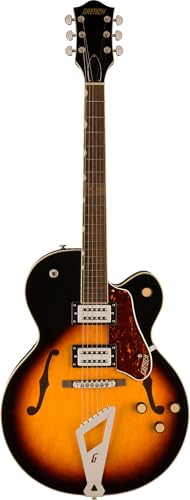
If you want the best Gretsch guitars for rockabilly, country and twang, start with the Electromatic G5420T hollow body for the classic look and sound, step down to the Streamliner G2420T for the same idea at a friendlier cost, and choose a Jet-style solid body when feedback is a problem. Gretsch guitars are built around a bright, clear, slightly snarling voice, a Bigsby-style vibrato on many models, and a body style that ranges from fully hollow to solid, so the right pick depends more on how loud you play than on the badge.
Our top picks



As an Amazon Associate we earn from qualifying purchases at no extra cost to you.
Key takeaways
- Gretsch splits its affordable guitars into two ladders: Electromatic (the more refined ladder, with Black Top pickups on many models) and Streamliner (lower cost, Broad’Tron humbuckers).
- Fully hollow bodies give the classic rockabilly woof but feed back at gig volume; chambered, center-block and solid Jets stay stable.
- Scale length sits around 24.6 inches on Electromatic models and 24.75 inches on Streamliners, a short, slinky feel compared with a 25.5 inch Fender.
- For country acoustic playing, Gretsch’s Jim Dandy parlors are small-bodied and short-scaled, closer to a porch guitar than a dreadnought.
The twang map: best Gretsch guitars compared
| Model | Construction | Pickups | Best for | Feedback risk |
|---|---|---|---|---|
| G5420T Electromatic Hollow Body | Laminated maple hollow body | Black Top Filter’Tron (some runs FT-5E) | Rockabilly, classic twang | High at loud volumes |
| G5422TG Electromatic Classic | Double-cut hollow body | Humbuckers (Bigsby, gold hardware) | Looks plus upper-fret access | High |
| G2420T Streamliner Hollow Body | Arched maple hollow body | Broad’Tron | Value hollow body | High |
| G5222 Electromatic Double Jet BT | Mahogany with arched maple top | Two Black Top Broad’Tron | Hard rockabilly, gigs | Low |
| G5230T Electromatic Jet FT | Solid body, Bigsby | Black Top Filter’Tron | Country-rock, clean twang | Low |
| G2210 Streamliner Junior Jet Club | Single-cut nato | Broad’Tron | First Gretsch, tight budget | Low |
| Jim Dandy Deltoluxe Parlor | Laminated sapele parlor acoustic | Soundhole magnetic | Country acoustic, travel | Moderate |
1. Gretsch G5420T Electromatic Hollow Body: Best for rockabilly
- 5-ply laminated maple hollow body, single cutaway · about 2.75 inches deep, trestle block bracing
- 24.6 inch scale · 22 frets · 12 inch radius · about 42.9 mm nut · “Classic C” neck
- Black Top Filter’Tron pickups on many runs, FT-5E Filter’Tron humbuckers on others
- Bigsby-licensed B60 vibrato, rosewood-based Adjusto-Matic bridge, open-back tuners
- Controls: neck and bridge volume, master volume, master tone, three-way switch
Best for: rockabilly, surf-flavored clean tones and country picking where the guitar itself is part of the look. Skip if: you play loud distorted rock; the hollow body will howl.
Pros: the clearest route to the “Gretsch” sound; the short scale feels comfortable; Bigsby adds dips and shimmer; well-matched to a clean tube amp.
Cons: hollow body feedback at stage volume; Bigsby string changes take patience; pickup type varies by run, so read the listing.
2. Gretsch G5222 Electromatic Double Jet BT: Best for loud twang
- Mahogany body with an arched maple top · set mahogany neck, thin “U” profile
- 24.6 inch scale · 22 medium jumbo frets · laurel fingerboard, 12 inch radius
- Two Black Top Broad’Tron humbuckers · V-Stoptail tailpiece, anchored Adjusto-Matic bridge
- Master volume with treble bleed, master tone, two individual pickup volumes
Best for: players who want Gretsch attitude at real gig volume, including punk-flavored rockabilly. Skip if: you need a vibrato; this version has a stoptail, not a Bigsby.
Pros: solid construction resists feedback; strong output from the Broad’Tron humbuckers; set neck and treble bleed are nice at this tier.
Cons: not the hollow “hollow” tone; heavier than a hollow body; fixed bridge limits tremolo tricks.
3. Gretsch G2420T Streamliner Hollow Body: Best value hollow body
- Fully hollow arched maple body · parallel tone bars · 2.75 inch depth
- 24.75 inch scale · 22 medium jumbo frets · 12 inch radius laurel fingerboard · 1.6875 inch nut
- Nato set neck · Adjusto-Matic bridge with Bigsby B60 tailpiece
- Broad’Tron humbuckers (BT-2S on older runs, BT-3S on current production) with a coil-split push/pull on newer versions
Best for: anyone who wants the hollow Bigsby look and sound without the Electromatic price. Skip if: you want a refined bone nut and top-tier fretwork; step up to the G5420T.
Pros: hollow-body voice at a lower tier; set neck; enlarged f-holes and aged binding look good; coil-split on current runs adds flexibility.
Cons: Broad’Tron voicing is fatter and darker than Filter’Tron; synthetic nut on older versions can hold tuning less well with Bigsby use.
4. Gretsch G5230T Electromatic Jet FT: Best for country-rock
- Solid-body Jet with Bigsby-style tremolo
- Black Top Filter’Tron humbuckers · 24.6 inch scale · about 42.9 mm nut
- Electromatic-tier hardware and finish
Best for: country-rock and clean-to-crunch work where you want Filter’Tron sparkle but cannot risk feedback. Skip if: you want a hollow body’s airy decay.
Pros: clear, articulate Filter’Tron tone; stable on stage; vibrato adds subtle movement.
Cons: solid body is less woody; the Bigsby adds complexity when changing strings.
5. Gretsch G2210 Streamliner Junior Jet Club: Best first Gretsch
- Single-cut nato body · Broad’Tron pickup · 24.75 inch scale · about 42.8 mm nut
- Streamliner-tier hardware, simple controls
- Lightweight, short-scale feel
Best for: beginners, punk-leaning rockabilly and anyone who wants a Gretsch for a modest outlay. Skip if: you need vibrato or a hollow-body voice.
Pros: the cheapest way into Gretsch pickups; light; forgiving to play.
Cons: single pickup limits tone range; hardware is basic.
6. Gretsch G5422TG Electromatic Classic Hollowbody: Best double-cut look
- Double-cutaway hollow body · Bigsby tremolo · gold hardware
- Electromatic-tier build · humbucker pickups
Best for: players who want easier access above the 12th fret and a showy finish. Skip if: you dislike gold hardware.
Pros: two cutaways ease upper-fret solos; very stage-friendly look.
Cons: price sits above the single-cut hollow bodies; feedback at high gain.
7. Gretsch Jim Dandy Deltoluxe Parlor: Best country acoustic guitars pick
- Parlor body with laminated sapele top, back and sides · X-bracing
- 24 inch scale · nato “C” neck · walnut fingerboard · 18 frets (12 to the body) · 1.69 inch nut
- Deltoluxe magnetic soundhole pickup
Best for: country, blues-flavored fingerstyle and travel, thanks to a short scale and small body. Skip if: you want booming bass for strumming.
Pros: short scale is easy on the fretting hand; plug-in ready; affordable.
Cons: laminate construction; small body means less volume.
Also consider
- Gretsch G5210-P90 Electromatic Jet Two 90: a Jet with P-90 pickups for a thicker, grittier voice.
- Gretsch G5655TG Electromatic Center Block Jr.: a center-block body between hollow and solid.
- Gretsch G2622 Streamliner Center Block Double-Cut: a lower-tier center-block option that cuts feedback.
- Gretsch G5021E Rancher Penguin Parlor: an acoustic-electric parlor in the Rancher line; confirm its pickup and top specs on the listing.
Hollow, chambered or solid: the choice that matters most
A fully hollow guitar such as the G5420T has the most air and woof, but the top vibrates with sound from the amp and feeds it back into the strings. A center-block design and a chambered or solid Jet keep much of the Gretsch character while resisting that loop. The simplest rule: if you play a clean amp at bedroom or small-club volume, choose hollow. If you play louder than a conversation next to your amp, choose a Jet or a center block.
The Bigsby question
A Bigsby-style tailpiece adds a light, expressive vibrato, but it changes how you string and tune the guitar. Strings need to be wrapped and stretched carefully, and the arm needs room to move. Models with a “T” at the end of the name (G5420T, G2420T, G5230T) have the vibrato. Models with a V-Stoptail (G5222) do not. If you never use vibrato, the stoptail is the more practical option and tends to hold tune better.
Restringing a Bigsby-equipped Gretsch: the steps and the reasons
The most common reason a new Gretsch owner gives up on the vibrato is the first string change. The process is not hard, but it rewards a fixed routine. These steps follow general guidance for Bigsby-style tailpieces and are not drawn from our own repairs.
- Change one string at a time. This keeps tension on the neck and the bridge in place, which matters because many Gretsch bridges are not anchored and can fall if every string is loose.
- Thread the new string through the tailpiece pin hole or loop end first. Feeding from the tailpiece side keeps the winding tidy and keeps the string from kinking over the roller or bar.
- Wind two or three turns on the post, no more. Fewer wraps make for a shorter stretch to settle; too many wraps keep slipping for days.
- Stretch every string gently, then retune. A Bigsby makes the entire string path longer, so strings take longer to settle. Pull each string up lightly along its length and recheck pitch until it holds.
- Add a drop of nut lubricant if tuning drifts after a bend. Sticking in the nut slot is the most common cause of drift on a vibrato-equipped guitar.
If you still do not like the process, the stoptail version (G5222) is the pragmatic alternative.
Pick by situation: a decision matrix for Gretsch buyers
| Your situation | Choose | Reason | Trade-off |
|---|---|---|---|
| Bedroom or small-club rockabilly | G5420T | Full hollow body with Filter’Tron voice | Feedback if volume climbs |
| Same sound, lower tier | G2420T | Hollow body with Bigsby for less outlay | Fatter Broad’Tron voicing |
| Loud pub or festival stage | G5222 or G5230T | Solid construction avoids feedback | Less hollow-body air |
| First Gretsch for a teenager | G2210 | Light, simple, affordable | One pickup |
| Showy gigs | G5422TG | Double cutaway, gold hardware | Higher tier; feedback risk |
| Porch-style country acoustic | Jim Dandy Deltoluxe Parlor | Short scale, soundhole pickup | Small body; modest volume |
Amps, pedals and strings that suit Gretsch tone
A Gretsch is only half the sound. The classic pairing is a clean tube-style amp with spring reverb and a little slapback delay. A small combo with a 12-inch speaker is often more flattering than a bright 10-inch. If you use a modeler, a clean preset with plate or spring reverb and an optional tape-style echo does the same job. Overdrive should be gentle: a low-gain pedal pushes a Filter’Tron into a pleasant growl, while a heavy fuzz tends to make a hollow body feed back.
For strings, light-gauge sets in the .010 to .046 range are the default. Flat-wounds darken the tone and tame brightness, which can help on Electromatic models with bright Black Top pickups. Heavier bottom strings (.011 to .049 hybrid sets) tighten the low end for rockabilly picking. Because the scale is shorter than a Fender, a set that feels tight on a Strat may feel normal on a Gretsch.
Ownership realities: what wears first
Hollow and semi-hollow guitars are more sensitive to weather than solid bodies. Keep them in a case when not played, and keep room humidity moderate; maker guidance for acoustic-style instruments generally lands around 40 to 50 percent relative humidity, and the same sense applies to laminated hollow bodies. On the Bigsby models, the vibrato arm and its spring are the parts that wear, along with the string-contact points. Plastic nuts and saddles can wear quicker than bone, which is one reason nut lubricant is a common tweak. On the acoustics, the soundhole pickup and its jack are the places to check first.
Finishes also differ: gloss lacquer-style finishes show scratches, and the metallic sparkle finishes on some Jets can look dull if wiped with harsh cleaners. A soft cloth and a polish made for guitars are enough. Replace strings every month or two if you play daily, because worn strings dull the sparkle that makes a Gretsch worth buying in the first place.
Best guitars for rockabilly: what actually matters
Rockabilly is built on clean tone, slapback echo and attack. The ingredients are a bright humbucker or single-coil, a hollow or semi-hollow body, flat-wound or light round-wound strings, and a good amp with spring reverb. The G5420T and G2420T cover this ground in a single package. If you play rockabilly in a loud band, the Double Jet BT or Jet FT give the same bite with fewer feedback problems. Strings in the .010 to .046 range suit most players, and many rockabilly players go heavier on the bottom strings to keep a punchy low end.
Best country guitars and best guitars for country music
Country covers an enormous range, from chicken-pickin’ with a Telecaster to fingerstyle on a parlor guitar. If you play electric, a Gretsch gives a rounder, more vocal alternative to the Telecaster. If you want the classic country twang, a Telecaster-style guitar such as a Squier Classic Vibe 50s Telecaster is the pure option; if you want a vintage hollow-body flavor, the Gretsch models above are a good choice. The Jet FT is the most versatile for country-rock because it has bright Filter’Tron pickups and a vibrato but no hollow-body feedback.
Best country acoustic guitars: parlor versus dreadnought
Dreadnoughts are loud and strong in the bass, which suits strumming. Parlor guitars such as the Jim Dandy Deltoluxe are smaller, quieter and punchier in the midrange, which suits fingerstyle country and blues. The Jim Dandy line also comes in larger-bodied dreadnought and concert shapes with a 24.75 inch scale, so you can pick the size that suits your style. For stage use, the Deltoluxe soundhole magnetic pickup is a simple way to plug in without drilling the guitar.
Playing a short-scale parlor: practical notes
A 24 inch scale is almost 1.5 inches shorter than a 25.5 inch acoustic. The practical effects are lower string tension, easier barre chords and a slightly looser, more percussive feel. For country fingerpicking with a thumb-pick, that looseness helps alternate bass patterns; for hard flatpicking, it can feel a little rubbery at the first fret. Using a medium-gauge set instead of lights tightens the response. Capo use is also friendlier on a parlor because the shorter scale makes open-key songs easier to move up the neck without strain.
Where Gretsch sits next to other twang guitars
A Telecaster-style guitar has a single-coil snap and a longer scale. A Gretsch has a rounder front-end attack, humbucker thickness and a shorter scale. Neither is better; they answer different questions. If you play country covers where the twang has to cut a crowded mix, a Telecaster is the straightforward route. If you play rockabilly or country-rock and want the guitar itself to be a conversation piece, the Gretsch is more characterful. Many players keep both, and the Streamliner line makes the second guitar easier to justify.
Checks before you buy any Gretsch
- Confirm which pickup the listing actually includes (Black Top Filter’Tron, FT-5E Filter’Tron or Broad’Tron BT-2S or BT-3S).
- Confirm whether the guitar has a Bigsby (the “T” in the model name) or a stoptail.
- Check that the nut width (about 42.8 to 42.9 mm) suits your hand; it is a classic medium width.
- Look at the bridge design. Many Gretsch bridges float on the top and rely on string tension, so keep a note of its position before string changes.
- Ask about the case. Hollow bodies are best stored in a hard case, and not all models include one.
How We Chose
We did not play or handle these guitars ourselves. Our picks come from maker spec pages, retailer sheets and published reviews, including Guitar World’s review of the G5420T and MusicRadar’s coverage of the Jim Dandy line. Where sources disagreed (pickup type on the G5420T, pickup model on the G2420T), we say so. We restricted the main list to Electromatic and Streamliner models because those are the series most players can afford, and we left out Professional-series guitars, which are in a different class.
Buying guide: how to choose among the best Gretsch guitars
Electromatic or Streamliner
Electromatic models usually have better hardware and Black Top pickups; Streamliners are lighter and cheaper. If you plan to gig, the Electromatic is a safer bet. If you want to explore Gretsch tone, the Streamliner is a fine entry point.
Filter’Tron or Broad’Tron
Filter’Tron pickups are the brighter, clearer voice associated with classic Gretsch twang. Broad’Tron pickups are fatter, with more output and tighter bass. Choose Filter’Tron for clean country and rockabilly; choose Broad’Tron for gain and rock.
Scale length
Electromatic models run around 24.6 inches; Streamliners about 24.75 inches. Both are shorter than the 25.5 inch scale of a Fender, so strings feel slacker and bends are easier. If you use a heavy gauge, the short scale keeps tension manageable.
Body depth and weight
Hollow bodies are around 2.75 inches deep. Jets are much thinner and heavier for their size. Try to sit with the guitar you buy; a hollow body can be lighter than it looks, while a solid mahogany Jet can be tiring on a strap.
Vibrato or fixed bridge
Choose a Bigsby if you will use it and a stoptail if you will not. Do not choose a Bigsby only for the look unless you are willing to learn proper string changes.
Amp matching
Gretsch guitars sound best through clean, tube-like amps with a touch of reverb. A small tube amp or a good modeler gives the best results.
Left-handed note
Some models are available in left-handed versions, but availability is limited and changes often.
Frequently Asked Questions
What are the best Gretsch guitars for rockabilly?
The G5420T Electromatic Hollow Body is the classic choice, and the G2420T Streamliner offers the same idea at a lower tier. For loud stages, the G5222 Double Jet BT is safer.
Are Gretsch guitars good for country music?
Yes. The Jet FT and hollow bodies are popular for country-rock and traditional country, and the Jim Dandy parlors work for acoustic country.
Are Gretsch hollow bodies prone to feedback?
Fully hollow bodies can feed back at high volume. A center-block or solid Jet reduces the problem.
What is the difference between Electromatic and Streamliner?
Electromatic is the higher tier with Black Top pickups and better hardware; Streamliner is the lower tier with Broad’Tron humbuckers and simpler fittings.
Do I need a Bigsby?
Not unless you want vibrato. Models with a stoptail are easier to restring and often more stable in tuning.
Is the Jim Dandy a good beginner acoustic?
It is small, short-scaled and comfortable, which suits beginners. Its laminate construction and small body mean modest volume.
What strings suit a Gretsch?
Standard .010 to .046 sets are a good default. Flat-wounds give a smoother, jazzier tone.
Which one should you buy?
For classic rockabilly, buy the G5420T. For value, buy the G2420T. For loud stages, buy the G5222 or G5230T. For a first Gretsch, buy the G2210. For acoustic country, buy the Jim Dandy Deltoluxe Parlor. Always read the exact pickup and hardware spec on the listing, because Gretsch updates models frequently.
If you are torn between a hollow body and a Jet, think about where the guitar will live. A hollow body is a joy in a living room, a rehearsal space or a small club where you control the volume; it will reward you with that open, woody sparkle. A Jet will behave on a loud stage and is the safer choice for a working band. Whichever you pick, budget for a proper setup and a decent case, because the short scale and Bigsby-style hardware respond very well to a careful adjustment.
Sources
- Gretsch Guitars product pages
- Guitar World review of the G5420T Electromatic
- MusicRadar review of the Jim Dandy Deltoluxe Parlor
- Thomann and zZounds product listings
- Findmyguitar spec comparisons
Last updated: October 2026.




Write Your Review
No reviews yet. Be the first to share your experience!