

Key takeaways
- Short scales run from about 28.6 in to 30.5 in, compared with 34 in for a standard bass; the shorter the scale, the shorter the reach and the looser the strings.
- At the same string and pitch, tension falls with the square of scale length, so a 30 in bass has roughly 22 percent less tension than a 34 in bass.
- Short-scale basses suit small hands, young players and anyone who wants a lighter, more compact instrument; the tone is warm and round.
- Check the nut width and pickup type, since some short-scale basses use a single pickup and others offer a P-J layout.
- Do not buy purely on the label; each of the six picks has a different personality.
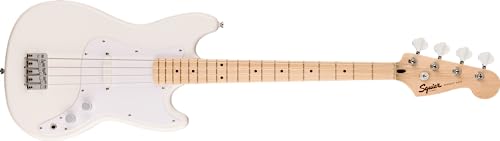
The best short scale bass guitars are comfortable to hold, easy to reach around and still sound like a real bass. Top choices include the Squier Sonic Bronco Bass for a simple, affordable start, the Fender Player II Mustang Bass PJ for a polished 30 in model, and the Epiphone Newport Bass when you want a mahogany set-neck design with extra character.
Short-scale basses are often described as beginner instruments, but that undersells them. A shorter scale shortens the distance between frets, reduces string tension and makes the bass lighter and easier to carry. Those traits suit small hands, young players, anyone with wrist or shoulder fatigue and plenty of experienced bassists who simply like the warm, thumpy tone. This guide starts with the numbers behind that comfort, then compares six basses by how they feel and sound.
Our top picks



As an Amazon Associate we earn from qualifying purchases at no extra cost to you.
Key takeaways
- Short scales run from about 28.6 in to 30.5 in, compared with 34 in for a standard bass; the shorter the scale, the shorter the reach and the looser the strings.
- At the same string and pitch, tension falls with the square of scale length, so a 30 in bass has roughly 22 percent less tension than a 34 in bass.
- Short-scale basses suit small hands, young players and anyone who wants a lighter, more compact instrument; the tone is warm and round.
- Check the nut width and pickup type, since some short-scale basses use a single pickup and others offer a P-J layout.
- Do not buy purely on the label; each of the six picks has a different personality.
What a shorter scale changes: the numbers
Scale length is the vibrating length of the string from nut to bridge saddle. Fret positions come from that length: the first fret sits at about 1/17.8 of the scale from the nut, and the 12th fret sits at exactly half. That means every fret on a short-scale bass is physically closer to the next than on a long-scale bass, which is the main reason it feels easier to reach.
| Scale | Example bass | Distance nut to 1st fret | Distance nut to 12th fret | String tension vs 34 in (same string, same pitch) |
|---|---|---|---|---|
| 34 in | Standard full-scale bass | About 1.91 in | 17.0 in | Baseline |
| 30.5 in | Epiphone Newport Bass | About 1.71 in | 15.2 in | About 20 percent lower |
| 30 in | Squier Sonic Bronco, Fender Mustang PJ | About 1.68 in | 15.0 in | About 22 percent lower |
| 28.6 in | Ibanez Gio SR miKro, Squier Mini Precision | About 1.61 in | 14.3 in | About 29 percent lower |
The tension formula is simple: for a given string and pitch, tension is proportional to the square of the scale length. That is why short-scale strings feel slacker and bend more easily, and why the tone is rounder and less snappy. Many bassists like that warmth, especially for pop, indie, surf, soul and recording.
Best short scale bass guitars: specs side by side
| Bass | Scale | Frets | Nut | Pickups | Place in the range |
|---|---|---|---|---|---|
| Squier Sonic Bronco Bass | 30 in | 19 | 1.5 in | One ceramic single-coil | Low |
| Squier Classic Vibe 60s Mustang Bass | 30 in | 20 | 1.5 in | Two Alnico split single-coils | Upper middle |
| Fender Player II Mustang Bass PJ | 30 in | 19 | 1.5 in | P and J Alnico 5 with 3-way switch | High |
| Ibanez Gio SR miKro | 28.6 in | Check maker spec | Compact | PJ | Lowest |
| Epiphone Newport Bass | 30.47 in | 20 | 41.5 mm | Single-coil plus humbucker | Lower middle |
| Gretsch Streamliner Jet Club Bass | 30 in | Check maker spec | Check maker spec | Per maker spec | Lower middle |
1. Squier Sonic Bronco Bass: Best for an affordable, simple short-scale start
- Poplar body, bolt-on maple neck with a C shape
- 30 in (762 mm) scale, 19 narrow tall frets, 9.5 in radius, 1.5 in nut
- One ceramic single-coil pickup at the neck position
- Master volume and master tone, four-saddle standard bridge
- Laurel or maple fingerboard depending on finish
Best for: beginners and anyone who wants a no-fuss compact bass. The single pickup keeps things easy and the price is friendly.
Skip if: you need tonal variety; one pickup means one voice.
Pros: Very light. Simple controls. Easy reach. Low price in the range.
Cons: One pickup only. Basic hardware. Only 19 frets.
Feel note: At 30 in, the Bronco has noticeably looser strings than a full-scale bass, which is why many players use slightly heavier strings or a careful setup to avoid flappiness.
2. Squier Classic Vibe 60s Mustang Bass: Best for vintage style and two-pickup variety
- Nyatoh body, bolt-on maple neck with a C shape, Indian laurel fingerboard
- 30 in scale, 20 narrow tall frets, 9.5 in radius, 1.5 in bone nut
- Two Fender-designed Alnico split single-coil pickups
- Volume and tone, four-saddle Mustang string-through-body bridge, chrome hardware
Best for: players who like vintage looks and the round, punchy tone of split single-coils. It suits indie, surf, pop and recording.
Skip if: you want a modern, high-output tone.
Pros: Authentic vintage design. Bone nut. Alnico pickups. 20 frets.
Cons: No pickup selector. Simple controls. At the upper edge of the affordable range.
Feel note: The Mustang is a lively, slightly bouncy bass and is a favorite for recording because of its warm sound.
3. Fender Player II Mustang Bass PJ: Best for a polished, versatile short-scale
- Alder body, bolt-on maple neck with a Modern C profile, maple fingerboard with black dots
- 30 in scale, 19 medium jumbo frets, 9.5 in radius, 1.5 in nut
- Player Series Alnico 5 split single-coil Precision pickup at the neck and Alnico 5 Jazz Bass single-coil at the bridge
- One volume, one tone, a 3-way pickup selector
- Four-saddle fixed bridge, made in Mexico
Best for: working bassists who want a short-scale bass with the flexibility of a P-J pickup pair and the build quality of the Player II line.
Skip if: you are on a tight budget; this is the premium pick.
Pros: Versatile P-J layout. 3-way selector. Quality hardware. Well suited to gigging.
Cons: Highest price on the list. Only 19 frets. Some listings differ on small details.
Feel note: The selector lets you jump between a thick P voice, a brighter J voice or a blend, which broadens the range.
4. Ibanez Gio SR miKro (GSRM20): Best for the smallest reach and lowest budget
- 28.6 in short scale with a maple neck, per the maker listing
- PJ pickup configuration
- Compact body and light weight
- Passive electronics
- Walnut Flat, Black and Brown Sunburst finishes
Best for: young players, adults with smaller hands and anyone who wants the most compact bass in this list. It is also a common travel and practice bass.
Skip if: you plan to switch to a full-scale bass frequently.
Pros: The shortest scale here. Light. PJ pickups. Low price.
Cons: Very short scale may feel slack. Basic hardware. Retailer specs vary on small details.
Feel note: Strings at 28.6 in are noticeably looser, so a fresh set of slightly heavier strings can help.
5. Epiphone Newport Bass: Best for a set-neck, mahogany short-scale with character
- Mahogany body and glued-in mahogany set neck with a Medium C profile
- 30.47 in (774 mm) scale, 20 medium jumbo frets, laurel fingerboard with 12 in radius, 41.5 mm nut
- Bass Sidewinder single-coil at the neck and TB PRO humbucker at the bridge
- Master volume, blend and master tone
- Historic Bass Tune-O-Matic bridge, claw tailpiece, die-cast tuners, available in Pacific Blue, Cherry, California Coral and Sunset Yellow
Best for: players who want a bass with a retro, 1960s look and a more traditional hardware setup than the Fender-style models.
Skip if: you want the lightest possible body or a very simple bolt-on feel.
Pros: Distinctive style. Set neck and Tune-O-Matic bridge. Two pickups with a blend knob. Color choices.
Cons: Weight figures vary between sources. Made in China. Slightly longer scale than the Fender-style models.
Feel note: At 30.47 in, it sits slightly above the usual 30 in short scale, which gives a touch more tension and clarity.
6. Gretsch Streamliner Jet Club Bass: Best for a stylish, single-cut short-scale
- Single-cut body with a nato body and neck, laurel fingerboard
- Short 30 in scale
- Finishes include Walnut Stain and Vintage White
- Compact, retro styling in the Streamliner family
Best for: players who want distinctive looks and a comfortable short scale. It works well for indie, alternative and recording.
Skip if: you prefer classic Fender-style shapes.
Pros: Unusual look. Comfortable scale. Reputable brand. Lightweight.
Cons: Fewer retailer details available. Limited tonal information in the sources we reviewed. Less common than Fender-style shapes.
Feel note: Check the maker page for the full pickup and hardware specification before you buy.
Also consider
- Squier Mini Precision Bass: A 28.6 in scale Precision Bass with a poplar body, maple neck, laurel fingerboard, 20 frets and one split single-coil pickup. A smart choice for children.
- Hofner Ignition Pro Violin Bass: A compact violin-shaped bass with a very light body and a distinctive, woody tone. A popular choice for players who want a vintage look.
- Squier Affinity Precision Bass PJ: A full-scale 34 in bass with a P-J layout; worth a look if you want to compare feel with the short-scale models above.
A worked example: how much shorter is the reach?
Take a simple case: a four-fret stretch from the first fret to the fifth fret, the span you cover for a basic pattern in first position. Using the standard fret formula (the distance from the nut to fret n equals the scale length times one minus two to the power of minus n over twelve), the numbers come out as follows.
| Scale | Fret 1 to fret 5 | Difference from 34 in |
|---|---|---|
| 34 in | About 6.6 in | Baseline |
| 30.47 in | About 5.9 in | About 10 percent shorter |
| 30 in | About 5.8 in | About 12 percent shorter |
| 28.6 in | About 5.6 in | About 16 percent shorter |
A reduction of roughly 0.8 in to 1 in across four frets does not sound like much, but it is the difference between a stretch and a comfortable reach, especially for players with small hands or wrist discomfort. The same proportion applies as you move up the neck, so every pattern is slightly easier to cover.
Short-scale basses in the studio and on stage
Short-scale basses are popular in recording because the looser strings and round tone often sit well under vocals and guitars without needing much processing. A bass with flatwound strings and a split single-coil pickup can produce the classic, thumpy sound heard on many soul and pop records. On stage, the same warmth can be a challenge in loud rock bands, where a long-scale bass with a tight low end is easier to hear. If you play both studio and stage, consider a short-scale bass for recording and a long-scale one for loud gigs.
Short-scale basses also work well as a second instrument for guitarists who double on bass. The smaller size makes the transition from guitar easier, and the lighter weight reduces fatigue.
Common misconceptions about short-scale basses
- “They are toys.” They are real instruments with full-size tones, and many are used on professional recordings.
- “They cannot play low notes.” They play the same pitches as a long-scale bass. The tension and tone differ, not the range.
- “They are always easier to play.” They are easier to reach, but the loose strings can feel unfamiliar and need careful setup.
- “They are only for beginners.” Experienced players use them for tone and comfort.
- “They are always cheap.” The range runs from low-cost to premium, as the Fender Player II Mustang shows.
Setting up a short-scale bass so it plays well
- Choose strings made for short-scale basses; long-scale strings may not reach the tuners.
- Ask a technician to set the neck relief for the lower tension; the looser strings often need slightly different relief from a long-scale bass.
- Raise the action by a small amount if you hear rattling on the open strings.
- Check the intonation at the 12th fret on each string and adjust the saddles.
- Keep the pickups at a moderate distance; very close pickups can distort the looser strings.
Who should think twice about a short-scale bass
Short-scale basses are not right for everyone. If you play in a loud rock or metal band, the looser strings and rounder tone can feel less defined than a long-scale bass with a tight low end. If you play a lot of fast, articulate lines, you may prefer the snap of a 34 in scale. And if you plan to switch regularly between a short-scale and a full-scale bass, expect a short period of adjustment each time, because fret spacing and string tension differ.
On the other hand, the case for short-scale grows stronger the more you care about comfort. If you have small hands, a shoulder or wrist problem, a long commute with the bass on your back or a small apartment, the smaller instrument is a real convenience.
How to try a short-scale bass before you buy
- Hold it standing with a strap and check that the neck angle feels natural.
- Play an open string and listen to how quickly the note blooms; looser strings have a slightly slower attack.
- Play a simple pattern at the fifth fret and compare the reach with a full-scale bass if you can.
- Pluck near the neck and near the bridge to hear the range of tone.
- Plug into an amp and listen for noise, hum or crackle.
- Compare the weight and balance by letting go of the neck; a bass that dives is tiring.
Short-scale tone by pickup type
| Layout | Where you find it | Typical character |
|---|---|---|
| Single ceramic single-coil | Squier Sonic Bronco | Simple, warm and slightly dark |
| Two split single-coils | Squier Classic Vibe 60s Mustang | Round, vintage and punchy |
| P and J pair | Fender Player II Mustang PJ, Ibanez miKro | Flexible, from thick to bright |
| Single-coil plus humbucker | Epiphone Newport | Fuller and more powerful, with a blend knob |
How we chose
We did not play these basses ourselves. The list is based on maker spec pages, retailer listings and published reviews. Each bass had to have a real, current short scale (30.5 in or less), a clear specification and a place in a different part of the range. Where retailers disagreed on small details, we followed the maker or left the detail out.
We limited the list to one model per design family, included a mix of bolt-on and set-neck construction and left out unbranded short-scale kits whose specs could not be verified.
Buying guide: choosing a short-scale bass
Decide how short you need
The 28.6 in basses are the shortest in this list and suit very small hands or younger players. The 30 in basses are the most popular, with a good balance of comfort and tension. The Newport’s 30.47 in sits just above that. Try different lengths in a shop if you can; the difference is more noticeable than it looks on paper.
Short-scale, medium-scale and long-scale compared
Bass makers use three loose categories. Short-scale generally means 30 in or less, medium-scale covers roughly 32 in, and long-scale is the 34 in standard. The basses here are all short-scale or just above. If a 30 in bass feels too slack for your playing style but 34 in still feels like a stretch, a medium-scale instrument may be the middle path, though fewer models are available. Think of scale length as a dial rather than a switch, and use the reach table above to decide how much comfort you want to trade for tension.
Check the nut width and neck profile
Most short-scale basses here have a nut of 1.5 in (38 mm). The Newport is wider at 41.5 mm. A narrower nut feels faster for chordal playing; a wider one gives more room for fingerstyle. Short necks also feel smaller overall, which suits compact hands.
Pick the pickup layout
Single-pickup basses (Bronco, Mini Precision) are simple and warm. Split single-coil pairs (Classic Vibe Mustang) give a vintage punch. P-J layouts (Player II Mustang PJ, miKro) are the most flexible. Set-neck basses with a humbucker (Newport) add power and sustain.
Strings matter more on a short scale
Because short-scale strings are looser, many players use medium or heavy gauge sets to restore tension. Flatwound strings are also popular on short-scale basses for a deep, vintage sound. Ask a technician to set the neck relief and action after any string change.
Weight and strap
Short-scale basses are lighter than full-scale models, but some, such as the Newport with its mahogany body, may still feel substantial. Use a wide strap and check balance, because shorter necks can make the body feel slightly neck-light.
Care and storage
Keep the bass away from heaters and sunlight, store it at around 40 to 50 percent relative humidity (the usual maker guidance for wooden instruments) and replace strings regularly. Short-scale strings often sound dull sooner because there is less tension to keep them lively.
Quick pick by situation
| Your situation | Choose |
|---|---|
| Beginner, simple setup | Squier Sonic Bronco Bass |
| Vintage style and recording | Squier Classic Vibe 60s Mustang Bass |
| Gigging and versatility | Fender Player II Mustang Bass PJ |
| Smallest reach, lowest budget | Ibanez Gio SR miKro |
| Retro style with set neck | Epiphone Newport Bass |
| Stylish indie look | Gretsch Streamliner Jet Club Bass |
Frequently asked questions
What is a short-scale bass guitar?
It is a bass with a scale length shorter than the standard 34 inches, typically 28.6 to 30.5 inches. The shorter length reduces reach and string tension.
Do short-scale basses sound different?
Yes. They tend to sound warmer, rounder and less snappy than long-scale basses, with a softer attack. Many players like that sound for pop, soul and recording.
Are short-scale basses only for beginners or kids?
No. Many professional bassists use them for their feel and tone. They are a legitimate choice for any player.
Which are the best Jazz-style basses with a short scale?
Short-scale Jazz-style options are less common. The Fender Player II Mustang Bass PJ gives a Jazz-style pickup at the bridge, and the full-scale Fender Player II Jazz Bass is the classic option if you can handle a standard length.
Which short-scale basses look the best?
That is subjective, but the Epiphone Newport, Squier Classic Vibe Mustang and Gretsch Jet Club stand out for their retro styling and color options.
Can I use normal bass strings on a short-scale bass?
Standard long-scale strings may be too long for the tuners. Use strings labeled for short-scale or medium-scale basses to avoid problems.
Do I need a special amp for a short-scale bass?
No. Any bass amp works. The same low-frequency needs apply as for any bass.
Which one should you buy?
If you want a simple, low-cost bass, buy the Squier Sonic Bronco Bass. If you want vintage style, go for the Squier Classic Vibe 60s Mustang. For gigging and tone variety, choose the Fender Player II Mustang Bass PJ. The Ibanez Gio SR miKro is the smallest and lightest, the Epiphone Newport stands out for style, and the Gretsch Jet Club Bass is the most distinctive.
Sources
- Fender and Squier product specification pages
- Ibanez product specification pages
- Epiphone and Gibson product pages
- Gretsch product pages
- Guitar World published reviews
Last updated: October 2026




Write Your Review
No reviews yet. Be the first to share your experience!