

Key takeaways
- Choose a full-size guitar (about 41 inches) for adults; smaller bodies suit teens and travel.
- A shorter scale length and a 43 mm nut, as on the Yamaha F400, are kinder to adult fingers.
- In a bundle, the tuner and gig bag are useful; picks, polishing cloths and chord posters add little.
- Budget for fresh strings and a basic setup; they often matter more than the pack contents.
- If you are unsure, buy the guitar alone and add a clip-on tuner, strap and picks yourself.
The best starter acoustic guitars for adults are the Yamaha F400 and Fender FA-25 if you want a proper guitar and will add your own accessories, and the Fender California Debut Redondo kit or the Ibanez IJV50 JamPack if you want everything in one box. A bundle is only a good deal when the guitar inside it is playable, so this guide judges the instrument first and the extras second.
Adults learn differently from children. You have bigger hands, less patience for painful practice and less time, so the right first guitar is the one that gets picked up on a tired Tuesday evening. Below, we compare seven starters and packs, explain what is actually in a bundle, and map the first ninety days so you know what to expect.
Key takeaways
- Choose a full-size guitar (about 41 inches) for adults; smaller bodies suit teens and travel.
- A shorter scale length and a 43 mm nut, as on the Yamaha F400, are kinder to adult fingers.
- In a bundle, the tuner and gig bag are useful; picks, polishing cloths and chord posters add little.
- Budget for fresh strings and a basic setup; they often matter more than the pack contents.
- If you are unsure, buy the guitar alone and add a clip-on tuner, strap and picks yourself.
Our top picks



As an Amazon Associate we earn from qualifying purchases at no extra cost to you.
What Is Actually in a Beginner Pack
Bundles look generous, but the items vary hugely in usefulness. Based on the contents named in retailer listings, here is how to value what you get.
| Item | Usually included | Real value to an adult beginner |
|---|---|---|
| Gig bag | Yes | High; thin but protects against dust and light knocks |
| Clip-on tuner | Yes | High; essential for daily practice |
| Strap | Yes | Medium; needed for standing, not for sitting |
| Picks | Yes | Low; cheap to replace and you will find your own preference |
| Spare strings | Often | Medium; useful if they are a good gauge |
| Stand | Fender kit | Medium; keeps the guitar in sight so you play more |
| Online lessons | Some | Medium; depends on the platform |
| Chord poster | Some | Low; a chord app is more useful |
Seven Starters at a Glance
| Guitar | Type | Notes | Best for |
|---|---|---|---|
| Yamaha F400 | Guitar only | Short 25 inch scale, 43 mm nut | Comfort-first adults |
| Fender FA-25 | Guitar only | 25.6 inch scale, 2-year warranty | Standard dreadnought feel |
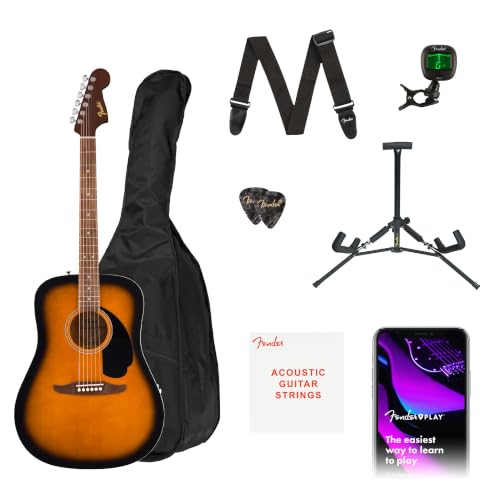
| Fender California Debut Redondo kit | Kit | Bag, stand, tuner, strap, picks | One-box start with lighter strings |
| Ibanez IJV50 JamPack | Pack | Bag, tuner, strings, strap and more per listing | Bundle from an established maker |
| Donner 41-inch dreadnought bundle | Bundle | Bag, strap, tuner, lessons per listing | Accessory-heavy start |
| Moukey 41-inch bundle | Bundle | Chord poster, bag, tuner, strings per listing | Lowest-cost full-size pack |
| Cort Earth Series starter pack | Pack | Dreadnought with open-pore finish and accessories | Plain, low-cost starter |
1. Yamaha F400: Best Starter Guitar for Adult Hands
- Dreadnought body with a spruce top; back and sides described by Yamaha as locally sourced tonewood.
- Scale length 634 mm (25 inches), shorter than the 25.5 inch norm.
- Nut width 43 mm; string spacing 10.0 mm; fingerboard radius 400 mm.
- Rosewood fingerboard and bridge; urea nut and saddle; die-cast tuners.
- Matte finish without binding or pickguard.
Best for: adults who worry about finger pain, wrist strain or small hands. Skip if: you want a bundle.
Pros: the short scale lowers tension so notes are easier to fret; narrow spacing makes chord shapes less of a stretch; dependable tuners for a guitar at this level.
Cons: no accessories included; plain looks; laminated top by most accounts.
2. Fender FA-25: Best Traditional Dreadnought Feel
- Dreadnought body, all laminate per Fender, with a satin finish.
- Scale length 25.6 inches; nut width 1.69 inches with a plastic nut.
- Nato neck with a “C” profile; walnut fingerboard with 12 inch radius; 20 frets.
- .012 to .052 strings; two-year warranty.
Best for: adults who want the classic full-size guitar feel and a warranty. Skip if: your hands are small.
Pros: familiar proportions; good value for the brand; widely available; easy to resell.
Cons: no accessories; heavier strings than the Redondo; retailer wood claims differ.
3. Fender California Debut Redondo Kit: Best One-Box Start With Softer Strings
- Redondo body with a laminated spruce top and basswood back and sides per Fender.
- Scale length 25.5 inches; nut width 1.6875 inches; slim “C” neck; walnut fingerboard.
- Strings in a lighter .011 to .050 gauge.
- Kit includes gig bag, stand, tuner, strap and picks, plus a two-year warranty on the guitar.
Best for: adults who want gentle strings and a complete set. Skip if: you want booming bass.
Pros: light strings are easy on fingertips; slim neck; the stand keeps the guitar visible, which encourages practice; accessories from the same maker.
Cons: lighter strings sound thinner; kit extras are basic; a little less volume than a traditional dreadnought.
4. Ibanez IJV50 JamPack: Best Name-Brand Pack
- Dreadnought acoustic in an open-pore natural finish, sold as a pack.
- Listing names a gig bag, tuner, strings, pouch, strap and picks among the extras.
- A 3/4-size version, the IJV30, is sold for younger or smaller players.
- Check the listing for scale length and nut width, which vary across retailers.
Best for: buyers who want the safety of a recognised guitar brand and a bundle together. Skip if: you want to compare published scale and nut figures first.
Pros: a major guitar maker’s name on the headstock; broad accessory set; open-pore finish feels natural under the hand.
Cons: spec detail is thinner than for Yamaha and Fender; accessories are entry-level; laminate construction at this level.
5. Donner 41-Inch Dreadnought Bundle: Best for Online Lessons and Accessories
- Full-size 41-inch dreadnought sold as a bundle.
- Listing names a gig bag, strap, tuner, picks and online lesson access.
- Cutaway and non-cutaway versions are offered.
- Scale length and nut width are not consistently published, so confirm on the product page.
Best for: adults who want a structured start with lessons included. Skip if: you want a guitar with consistently published specs.
Pros: lessons add structure; many options; low cost of entry.
Cons: quality control is less consistent than at major makers; extras are basic; low resale.
6. Moukey 41-Inch Acoustic Bundle: Best Lowest-Cost Full-Size Pack
- Full-size 41-inch steel-string acoustic for adults and teens.
- Listing names a chord poster, gig bag, tuner and steel strings among the extras.
- Several colour and body variants are listed.
- Specs such as scale length are not published in a consistent way.
Best for: buyers who must keep the cost to an absolute minimum. Skip if: you can stretch to a branded guitar.
Pros: very low cost; full-size body; includes the essentials.
Cons: uneven quality control; weaker hardware; likely to need a setup and new strings quickly.
7. Cort Earth Series Starter Pack: Best Plain, Low-Cost Starter From a Known Maker
- Dreadnought from Cort’s Earth series in an open-pore finish, sold as a starter pack.
- Accessories vary by listing; confirm what is included.
- Higher-grade Earth models with solid tops exist in the same range.
Best for: buyers who like the idea of a known guitar maker and a simple pack. Skip if: you need clear, published specs.
Pros: an established maker’s budget line; simple and modest; an upgrade path within the same brand.
Cons: limited spec detail; the pack is basic; sound is modest.
Also Consider
- Gretsch Prelude D100: a laminated dreadnought with a 25.3 inch scale and a stylish look.
- Jasmine S35: a spruce-top dreadnought with a long track record.
- Ibanez AAD50: a dreadnought listed with a solid spruce top, for buyers stretching the budget.
- Ashthorpe 38-inch kit: a smaller, cheaper option for teens and travel.
How We Chose
We did not personally use these guitars. The list draws on maker spec sheets, retailer listings and published reviews. We prioritised comfort specs (scale length, nut width, string gauge), the contents of each pack, the maker’s track record and how clearly each model’s specs are published. We treated packs separately from guitars-only because their appeal is different, and we flagged where specs are inconsistent across retailers.
The First Ninety Days: What to Expect as an Adult Beginner
- Days 1 to 7: tune, hold, strum. Learn to tune with the clip-on tuner, find a comfortable sitting posture and strum open strings. Sore fingertips are normal; stop when it hurts.
- Weeks 2 to 3: first chords. Learn E minor, A minor, D, G and C, in that order. Play each for a few minutes a day instead of one long weekly session.
- Week 4: first songs. Pick a two- or three-chord song and play it slowly with a steady strum.
- Month 2: changes and rhythm. Practise chord changes with a metronome app. Start to hear whether the guitar buzzes; if so, book a setup.
- Month 3: barre chords and first fingerstyle pattern. A lower-action guitar makes the F chord possible. This is the point where many beginners decide whether to keep going.
Fingertip soreness usually eases in a few weeks as calluses form. If pain persists or your wrist hurts, check your posture, loosen your grip and consider a lighter string gauge.
Is a Pack Cheaper Than Buying the Pieces? A Simple Count
A pack looks cheaper because the accessories are priced at nearly nothing, but the saving is real only for items you would have bought anyway. Try this count before you choose.
- List what you need on day one: a tuner, a gig bag or case, a strap if you stand, and picks. Those four are the essentials.
- Mark the items a pack gives you in those four categories. Anything outside them (a chord poster, a polishing cloth, a pouch) is a bonus, not a saving.
- Judge the quality of the essentials. A clip-on tuner in a pack is usually fine; a thin gig bag is usually adequate for a home guitar.
- Compare the guitar to a stand-alone model of similar price. If a branded stand-alone guitar costs only a little more than the pack, the better instrument wins.
The pattern is consistent across the market: packs from major makers such as Fender and Ibanez balance guitar and extras reasonably, while very cheap bundles put more of the cost into accessories and less into the instrument.
Setting Up a New Starter Guitar at Home
You can improve any starter guitar before a shop visit with a few simple steps.
- Tune and stretch. New strings drift flat for several days. Tune, pull each string gently away from the neck and tune again.
- Check the strings at the first fret. Press the low E at the third fret and look at the gap above the first fret. A visible gap is normal; no gap suggests a flat neck, and a wide gap suggests too much bow.
- Listen for buzz. Play each string at each fret on the first five frets. A buzz that appears on several notes suggests low action or an uneven fret.
- Check the strap button. Make sure the strap pin is tight before hanging the guitar from a strap.
- Book a professional setup if needed. If the strings feel stiff or the buzz persists, a technician can adjust the truss rod and saddle.
Hand Fatigue and Posture Checklist
- Sit with the guitar waist on your leg and your back straight, not curled over the body.
- Keep your fretting wrist neutral. A sharply bent wrist causes pain; adjust the neck angle by tilting the headstock up slightly.
- Use the tips of your fingers and keep your thumb behind the neck, near the middle, rather than over the top.
- Press only as hard as needed. Beginners squeeze too hard; if the note rings clearly, ease off.
- Take a break every fifteen minutes and shake out your hands.
- Stop if you feel sharp pain, and consider seeing a professional if discomfort persists.
A Realistic Weekly Schedule for a Busy Adult
| Day | Time | Focus |
|---|---|---|
| Monday | 15 minutes | Tuning and open chords |
| Tuesday | 15 minutes | Chord changes with a slow count |
| Wednesday | 20 minutes | Strumming patterns |
| Thursday | 15 minutes | One song section |
| Friday | 10 minutes | Review and play for fun |
| Saturday | 30 minutes | Full song and new chord |
| Sunday | Rest or 10 minutes | Light play, no pressure |
This adds up to under two hours a week, and it builds skill faster than one long, tiring session.
Mistakes Adult Beginners Make
- Buying the cheapest guitar available. A guitar that is hard to play ends practice. Spend a little more on a maker with consistent quality control.
- Skipping tuning. A guitar that is out of tune makes every chord sound wrong, which feels like failure when it is not.
- Playing too long on day one. Sore fingers lead to quitting. Build up gradually.
- Learning too many chords at once. Master a handful, then add more.
- Not using a metronome. A steady beat is the quickest route to music rather than noise.
- Leaving the guitar in its case. A guitar on a stand or wall hanger gets played more.
Steel-String, Nylon-String or Electric: Quick Orientation
Adults often ask whether a steel-string acoustic is the right first instrument. Here is how it compares with the alternatives.
| Type | Feel | Sound | Extra gear | Best for |
|---|---|---|---|---|
| Steel-string acoustic | Firm strings, calluses needed | Bright, loud, folk and pop | None to start | Strumming and singing |
| Nylon-string classical | Soft strings, wider neck | Warm, mellow | None | Classical and gentle fingerstyle |
| Electric | Light strings, slim neck | Needs an amp | Amp and cable | Rock and lead playing |
If your goal is to strum songs and sing, the steel-string acoustic is the natural match, and every guitar in this guide fits that goal. If sore fingers worry you most, a nylon-string guitar is gentler, though its wider neck is a different stretch.
String Care for a New Guitar
- Wipe the strings after each session with a dry cloth to remove sweat and oils; this can double their life.
- Change strings every two to three months for regular practice, sooner if they sound dull or feel rough.
- Change one string at a time to keep neck tension steady and make tuning easier.
- Choose phosphor bronze light strings as the default, and custom-light if your fingertips hurt.
- Keep a spare set so a snapped string never ends your practice.
Fresh strings are the cheapest way to make a starter guitar sound better, and they are the first thing to try before blaming the instrument.
What to Do If the Guitar Arrives Imperfect
Even good makers ship the occasional guitar with a problem, and bundles from budget brands do so more often. Check these points in the first days while a return is still easy.
- Look for cracks or lifting binding along the edges of the top and back.
- Sight along the neck from the headstock; a twisted neck or a sharp bend near the body is a reason to return the guitar.
- Check that every tuner turns smoothly and the strings hold pitch after stretching.
- Press the strings at several frets to find buzzing or dead notes that persist after a day of settling.
- Keep the packaging until you are sure, so a return or exchange is straightforward.
A small setup issue is normal and fixable; a structural defect is not. If in doubt, ask the seller or a local technician for advice before you give up on the guitar.
Buying Guide: How to Choose a Starter Acoustic as an Adult
Full-size or smaller
Adults should choose a full-size guitar of roughly 41 inches. Smaller 38-inch bodies suit teens, travel and small spaces, but they have a shorter scale that changes how chords feel and may feel cramped. If you are petite, try a full-size with a shorter scale like the Yamaha F400 first.
Scale length and nut width
A shorter scale reduces string tension. The F400’s 634 mm scale versus the FA-25’s 25.6 inches is a clear difference. The nut width, about 43 mm on most picks, determines how widely your fingers must stretch. Under 42 mm feels cramped; over 44 mm demands more reach.
String gauge
Light strings at .012 to .053 are the norm. Custom-light sets at .011 to .052 are easier on fingertips. Do not use anything lighter than .010 on a full-size acoustic.
Action
Action is the string height above the frets. A common target is around 3 mm on the low E at the 12th fret. Many starter guitars arrive higher. A shop can lower it for a modest fee, and it makes a big difference to comfort.
Guitar alone or bundle
If you already own a tuner, a strap and picks, or can buy them cheaply, a stand-alone guitar from a major maker is usually the better value. If you need everything and want to start today, a bundle from a recognised brand like Fender or Ibanez is reasonable.
Care
Keep the guitar away from radiators and windows, and aim for the 40 to 50 percent humidity range that makers such as Martin and Taylor recommend. Wipe the strings after playing, and change them every few months.
Learning resources
Bundles often include online lessons, but the quality varies. Free video lessons and structured apps work well, and a few lessons with a teacher help correct posture early.
Picking Among the Best Starter Acoustic Guitars
| If you… | Choose |
|---|---|
| Have small hands or past fretting pain | Yamaha F400 |
| Want a classic full-size feel | Fender FA-25 |
| Want soft strings and a stand, all in a box | Fender California Debut Redondo kit |
| Want a name-brand bundle | Ibanez IJV50 JamPack |
| Want lessons and extras included | Donner 41-inch bundle |
| Need the lowest cost for a full-size pack | Moukey 41-inch bundle |
| Want a plain starter from a long-standing maker | Cort Earth Series pack |
Frequently Asked Questions
What is the best first guitar for an adult beginner?
A full-size acoustic with a comfortable scale length and nut, such as the Yamaha F400 or Fender FA-25, is the safest choice. A setup and fresh strings improve it further.
Are guitar bundles worth buying?
They are worth it if the guitar is decent and you need the extras. A bundle with a poor guitar is not a bargain.
How much practice does an adult beginner need?
Short daily sessions of fifteen to thirty minutes work better than long weekend sessions, and they build calluses gradually.
Should I get an acoustic or electric first?
Choose acoustic if you want to strum and sing without extra gear. Electric guitars are easier on the fingers but need an amp.
Do I need lessons?
Not at first, but a few lessons with a teacher help avoid bad habits. Online courses are a good complement.
How long until I sound decent?
Many adults play simple songs within a month or two of regular practice. Progress depends on consistency more than talent.
When should I upgrade?
When you feel the guitar limits your sound or comfort, usually after a year or more. See our guide to intermediate acoustic guitars for the next step.
Which One Should You Buy?
If comfort is your main concern, buy the Yamaha F400. For a classic feel and a warranty, buy the Fender FA-25. If you want everything in one box with soft strings, choose the Fender California Debut Redondo kit, and if you prefer another well-known brand, the Ibanez IJV50 JamPack. The Donner, Moukey and Cort packs suit tighter budgets, provided you accept a setup and new strings as part of the deal. Whichever guitar you pick, practise a little each day and give yourself ninety days before you judge it.
Sources
- Yamaha Corporation F400 product page
- Fender Musical Instruments FA-25 and California Debut product pages
- Ibanez JamPack product listings
- Donner, Moukey and Cort retailer listings
- Guitar World published beginner guides
Last updated: October 2026





Write Your Review
No reviews yet. Be the first to share your experience!