

Key takeaways
- Martin’s lineup is a construction ladder: HPL (high-pressure laminate) X Series, solid-top Road Series with sapele back and sides, all-mahogany StreetMaster and 15 Series, then rosewood Standard guitars like the D-28.
- The letter E in a model name means onboard electronics. Martin’s E1 system adds volume, tone, phase and a tuner, which matters if you play through a PA.
- Scale length changes feel more than people expect: the Little Martin is 23 inches while the Road Series dreadnoughts run 25.4 inches, per Martin’s published specs.
- Under four figures, the choice is between the HPL X Series and the Road Series; the Road Series is the first step where the top and back wood are solid, according to maker listings.
- Strings and humidity matter as much as the model: the usual maker care guidance points to roughly 40 to 50 percent relative humidity for a solid-wood guitar to stay stable.
The best Martin guitars for most buyers are the Road Series D-10E for a first serious acoustic-electric and the Little Martin LX1E for travel, while the X Series is the cheapest way into the brand and the D-28 is the reference point everything else is measured against. Martin’s catalog looks confusing because the name on the headstock covers laminate guitars, solid-sapele guitars, all-mahogany guitars and rosewood classics. This guide sorts the best Martin guitars by construction, not by hype, so you know exactly what each step up in the lineup adds.
Our top picks



As an Amazon Associate we earn from qualifying purchases at no extra cost to you.
Key takeaways
- Martin’s lineup is a construction ladder: HPL (high-pressure laminate) X Series, solid-top Road Series with sapele back and sides, all-mahogany StreetMaster and 15 Series, then rosewood Standard guitars like the D-28.
- The letter E in a model name means onboard electronics. Martin’s E1 system adds volume, tone, phase and a tuner, which matters if you play through a PA.
- Scale length changes feel more than people expect: the Little Martin is 23 inches while the Road Series dreadnoughts run 25.4 inches, per Martin’s published specs.
- Under four figures, the choice is between the HPL X Series and the Road Series; the Road Series is the first step where the top and back wood are solid, according to maker listings.
- Strings and humidity matter as much as the model: the usual maker care guidance points to roughly 40 to 50 percent relative humidity for a solid-wood guitar to stay stable.
Quick comparison of the best Martin guitars
| Model | Series | Body and scale | Top / back and sides | Electronics | Cost tier |
|---|---|---|---|---|---|
| Little Martin LX1E | Little Martin | Modified 0-14 fret, 23 in scale | Solid Sitka spruce / HPL | Fishman Presys VT | Entry |
| DX1E Mahogany | X Series | Dreadnought | HPL / HPL | Onboard preamp | Entry |
| D-10E Retro | Road Series | Dreadnought, 25.4 in | Solid spruce / sapele | E1 with tuner | Mid |
| SC-10E Modern | Road Series | S-13 cutaway, 25.4 in | Solid spruce / sapele | E1 with tuner | Mid |
| 000-10E Retro | Road Series | 000 size | Solid spruce / sapele | E1 with tuner | Mid |
| 000-15M StreetMaster | 15 Series | 000 size | Solid mahogany / mahogany | None | Upper-mid |
| D-28 Satin | Standard | Dreadnought | Solid spruce / East Indian rosewood | None | Top |
Tier words are relative. Check current retail pricing before you commit, because Martin models move between categories as variants are added.
How we picked these Martin models
This is a research-based guide. We did not personally use these guitars. We compared the maker’s published specs, retailer spec listings and published professional reviews, then grouped models by what the construction actually gives you. Each pick had to be a current model line, had to have a clear job, and had to differ from the others in body size, wood, scale or electronics. We limited the list to one or two models per Martin series so the options do not blur together, and where sources disagreed on a detail we say so instead of picking one.
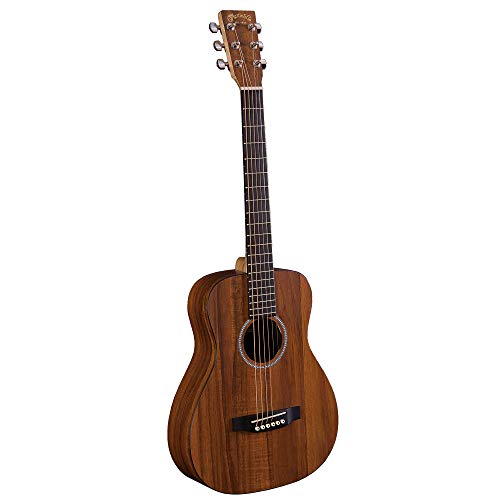
1. Martin LX1E Little Martin: Best for travel and small hands
The Little Martin is the guitar people forget is a real Martin. It uses a solid Sitka spruce top, which is the same family of top wood used on far more expensive models, and pairs it with mahogany-pattern HPL back and sides. The shortened scale makes bends easier and keeps the neck comfortable for small hands or for anyone who plays on the couch more than on a stage.
The E in LX1E adds a Fishman Presys VT system, so it also works as a stage backup. Reviewers who cover it often describe the sound as compact and focused rather than big, which is exactly what you would expect from a body this size.
- Modified 0-14 fret body · 23-inch scale · solid Sitka spruce top, HPL back and sides · Fishman Presys VT
- Neck: Modified Low Oval shape with a 1 11/16-inch nut, per the maker listing
- Fingerboard and bridge: FSC-certified Richlite
- Made in Mexico and sold with a gig bag
- A koa-pattern LXK2 version and a standard LX1 without electronics also exist
Best for: Travelers, kids and adults moving up, and small-framed players who want a real Martin. Skip if: You want the low-end weight of a full dreadnought or you play with a heavy strumming hand.
Pros
- Solid spruce top at an entry tier
- Short scale is forgiving on the fretting hand
- Fits overhead bins and small rooms
Cons
- HPL back and sides limit warmth compared with solid wood
- Smaller bass response than any dreadnought
2. Martin DX1E Mahogany: Best for the lowest-cost way into the X Series
The X Series exists to make a full-size Martin affordable by building the body from HPL, a laminate made of compressed layers with a wood-grain pattern on the surface. That choice trades some resonance for durability and consistency, and it is why these guitars handle gig bags, humid rooms and dry winters better than many solid-wood guitars at the same price.
The DX1E carries a mahogany-pattern finish and a cutaway-free dreadnought outline. If you want a stage-ready Martin without worrying about humidity swings, this is the clearest entry point.
- Dreadnought · HPL top, back and sides · mahogany-pattern finish · onboard electronics (E in the name)
- Related variants in the listings include the D-X1E Koa and DX2E Ziricote Burst
- HPL is more tolerant of temperature and humidity changes, in line with Martin’s X Series positioning
- Check each listing for the exact preamp name, since the X Series electronics have changed over time
Best for: Gigging beginners and anyone who hates humidifying a guitar. Skip if: You want a solid top that opens up and improves over years of playing.
Pros
- Durable and humidity tolerant
- Martin neck and body shape at an entry tier
- Stage-ready
Cons
- Laminate top limits tonal growth
- Resale value is lower than solid-top Martins
3. Martin D-10E Retro Road Series: Best for a first serious Martin
The Road Series is where Martin guitars stop being laminates. The D-10E pairs a spruce top with sapele back and sides, which gives a brighter, more focused tone than mahogany and a less rosewood-heavy bass than the Standard line. The 2026 Retro version adds an aging-toner top color and a tortoise-style pickguard to look like a worn-in dreadnought.
Maker and retailer listings put the scale at 25.4 inches with a 1 3/4-inch nut, which is a familiar dreadnought feel for anyone coming from a Yamaha or Fender acoustic. The E1 system gives volume, tone, phase and a built-in tuner.
- Dreadnought, D-14 fret · 25.4-inch scale · spruce top, sapele back and sides · Martin E1 with tuner
- Satin finish keeps the top lively and the build cost down
- Nut width: 1 3/4 inches, per retailer listings
- Retailer sources disagree on ebony versus Richlite fingerboard for different variants, so confirm which one you are buying
- Comes with a soft case in listings
Best for: Singer-songwriters who want one guitar for the couch and the stage. Skip if: You want a cutaway or an unplugged-only guitar with no preamp.
Pros
- Solid top and solid sapele body at a mid tier
- Familiar dreadnought neck
- Complete electronics package
Cons
- Satin finish scuffs visibly
- Sapele is brighter than the mahogany many players expect from Martin
4. Martin SC-10E Modern Road Series: Best for plugged-in lead work
The SC-10E is the Road Series guitar for people who actually reach for the upper frets. Its S-13 cutaway body and Low Profile Velocity neck, as listed by the maker and retailers, are aimed at players who move between chords and single-note lines. The Modern variants swap the Retro look for a cleaner satin finish.
There are two versions in current listings: a spruce top with sapele back and sides, and an all-sapele body. Pick based on whether you want the brighter attack of a spruce top or the slightly softer, more even response of sapele on top.
- S-13 cutaway · 25.4-inch scale · 1 3/4-inch nut · solid spruce top, sapele back and sides (or all-sapele) · Martin E1 with tuner
- Richlite fingerboard and bridge, FSC-certified
- Satin chrome enclosed gear tuners
- Made in Mexico with soft case in listings
- 20 frets total, per retailer spec
Best for: Worship leaders and players who solo on an acoustic. Skip if: You prefer the vintage look of the Retro models or want a thicker, rounder neck.
Pros
- Cutaway and neck designed for access
- Solid top and body
- Stage-ready electronics
Cons
- Cutaway slightly changes projection compared with the D-10E
- Sapele tone is less warm than mahogany
5. Martin 000-10E Retro Road Series: Best for fingerstyle
The 000 body is smaller than a dreadnought and has long been the choice for fingerstyle players because it keeps the midrange clear and the low end tight. The 000-10E brings that shape to the Road Series construction: spruce top, sapele back and sides, satin finish and the same E1 electronics.
If you mostly fingerpick or play with a light touch, the smaller body is more comfortable to hold and often easier to record with a single microphone, because there is less boom to manage.
- 000 body · spruce top, sapele back and sides · satin finish · Martin E1 with built-in tuner
- Retro Road Series styling, per the maker listing
- Same electronics family as the D-10E and SC-10E
- Smaller body is more comfortable seated
Best for: Fingerpickers, folk players and recording at home. Skip if: You strum hard in loud rooms and want maximum volume.
Pros
- Balanced, clear tone for picking
- Comfortable for smaller frames
- Road Series construction
Cons
- Less bass than a dreadnought
- Fewer color options than the larger bodies
6. Martin 000-15M StreetMaster: Best for blues and a worn-in feel
The 15 Series is Martin’s all-mahogany line, and the StreetMaster version adds a distressed satin finish that looks like years of playing. The listing describes an all-solid mahogany top, back and sides and a non-scalloped bracing pattern, which together give a dry, woody, immediate tone that suits blues and old-time styles.
It has no electronics, so this is for the player who records with a microphone or does not need to plug in.
- 000 body · all-solid mahogany top, back and sides · distressed satin finish · non-scalloped bracing · no pickup
- Mahogany tops sound more compressed and woody than spruce tops
- The finish is pre-aged, so dings do not show as badly
- A 000C Jr E StreetMaster with electronics also appears in the Martin lineup
Best for: Blues, slide and old-time players who prize character over polish. Skip if: You need a built-in pickup or a bright, open sound for strumming.
Pros
- All-solid wood construction
- Distinctive dry tone
- Aged look hides wear
Cons
- No electronics
- Less sparkle than a spruce-top guitar
7. Martin D-28 Satin: Best for the benchmark dreadnought
The D-28 is the guitar that defines the modern dreadnought. By Martin’s standard recipe it combines a solid Sitka spruce top with solid East Indian rosewood back and sides, and the Satin variant changes the finish to a thinner, matte coat rather than the gloss of the traditional model.
Nothing else in this guide will match its power and low-end depth. It is also the model most other dreadnoughts are compared with, which is why it belongs on any list of the best Martin guitars even though most readers will not buy one.
- Dreadnought · solid Sitka spruce top · solid East Indian rosewood back and sides · satin finish · no pickup as listed
- Delivered with a case in the listing
- Satin finish is lighter than gloss and ages naturally
- Consider an aftermarket pickup only if you must plug in
Best for: Players who want the benchmark acoustic and can afford it. Skip if: You need electronics out of the box or you are still deciding whether you will stick with guitar.
Pros
- Benchmark tone and projection
- Solid rosewood body
- Strong resale demand
Cons
- Top cost tier
- No onboard preamp
Also consider
- Martin DC-10E Modern Black Road Series: a dreadnought cutaway with spruce top and sapele back and sides, aimed at players who like the black look and want a cutaway.
- Martin GPC-13E Modern Road Series: a performance-style cutaway with a koa fine veneer and gloss finish for players who want a more refined look in the Road Series.
- Martin D Jr E: a shortened dreadnought-style body in the Junior line, useful as a lighter, easier-to-hold stage guitar.
- Martin LX1 Life is Good: a Little Martin variant with figured mahogany-patterned HPL for players who want the travel size with a different look.
Best sounding Martin guitars: what the woods actually change
When shoppers search for the best sounding Martin guitars they usually mean two things: projection and warmth. The top wood controls most of the projection. Spruce tops, found on the Little Martin, the Road Series and the D-28, are stiff and light, which gives clarity and volume. Mahogany tops, found on the 15 Series, are denser, which compresses the sound into a drier, midrange-forward voice.
Back and sides shape the color. Sapele, used in the Road Series, tends to read brighter and tighter than mahogany. East Indian rosewood, used on the D-28, adds low-end depth and a scooped midrange, which is why it is common in recordings. HPL sits at the other end: it is stable and consistent, but it cannot match the resonance of solid wood because the layers dampen vibration. Published reviews usually reach the same conclusion, which is why the jump from X Series to Road Series is considered the biggest tonal step in the lineup.
| Material | Where you find it | Typical voice | Care need |
|---|---|---|---|
| Solid Sitka spruce top | Little Martin, Road Series, D-28 | Clear, loud, dynamic | Moderate |
| Solid mahogany top | 15 Series, StreetMaster | Dry, warm, midrange-forward | Moderate |
| Sapele back and sides | Road Series | Bright, focused | Moderate |
| East Indian rosewood | D-28 | Deep bass, shimmering highs | Higher |
| HPL laminate | X Series, Little Martin back and sides | Even and consistent | Low |
Best Martin guitars under 1000: where the X Series ends and the Road Series begins
Within a four-figure budget Martin sells two kinds of guitar. The first is the HPL X Series and the Little Martin, which sit at the lower end of that band and give you a real Martin neck and body shape with laminate wood. The second is the Road Series, which sits at the upper end of that same band and gives you solid spruce tops and solid sapele bodies. If you can stretch to the Road Series, do. If you need a gig-proof guitar that tolerates travel, the X Series is the better fit, because HPL does not crack when humidity swings.
A practical rule: if you play a few times a week and store the guitar in its case, buy solid wood. If you play at gigs, camps or in a vehicle, buy HPL and spend the difference on a hardshell case.
Best strings for Martin guitars
Martin makes its own strings, and the Authentic Acoustic range is the default choice for the brand. The key decisions are alloy, gauge and coating. Per Martin’s string listings, the 80/20 bronze sets sound brighter and the 92/8 phosphor bronze sets sound warmer, and the Lifespan 2.0 treatment is a coating that extends string life.
| Set | Gauge | Alloy | Best for |
|---|---|---|---|
| Authentic Acoustic Superior Performance Extra Light | 10-47 | 80/20 bronze | Easy fretting, Little Martins |
| Authentic Acoustic Superior Performance Custom Light | 11-52 | 80/20 bronze | Road Series and X Series all-rounder |
| Authentic Acoustic Superior Performance Light | 12-54 | 80/20 bronze | Standard dreadnought tone |
| Authentic Acoustic Lifespan 2.0 Treated | Custom Light and Light | 80/20 or 92/8 | Longer-lasting set for frequent players |
| Retro Acoustic MM12 | Light | Monel nickel | Mellow vintage feel |
For a Little Martin, an extra light or custom light set keeps tension comfortable on the short scale. For a D-28 or Road Series dreadnought, light gauge gives the most power, while custom light gives easier bends.
Gear that helps
- Martin Authentic Acoustic Lifespan 2.0 Custom Light strings: the safest string upgrade for Road Series and X Series guitars, with a treated coating that resists corrosion.
- Martin Molded Hardshell Case, Dreadnought 14-Fret: a form-fit hardshell for dreadnoughts like the D-10E and D-28, which matters if the guitar travels.
Buying guide: how to choose among the best Martin guitars
Start with the job, then pick the construction that fits it. These thresholds come from published maker specs and general guitar-buying practice.
- Decide solid or laminate first. If the top is solid spruce or solid mahogany, the guitar will keep improving as the wood dries and vibrates. HPL stays the same. Choose HPL only if durability matters more than tonal growth.
- Match body size to your hands and music. A dreadnought like the D-10E projects the most. A 000 like the 000-10E is clearer for fingerstyle. A Little Martin at 23 inches suits short reach and travel.
- Check the scale length. At 25.4 inches, as on the Road Series dreadnoughts, string tension is higher and the feel is firm. At 23 inches, tension is lower and bends are easier. If you have small hands or arthritis, shorter is better.
- Check the nut width. A 1 3/4-inch nut, listed for the Road Series, gives more space between strings for fingerpicking. A 1 11/16-inch nut, listed for the Little Martin, feels more compact for chords.
- Decide whether you need a cutaway. The SC-10E and DC-10E have cutaways for upper-fret access. The D-10E and 000-10E do not, which helps projection and costs less.
- Decide whether you need a pickup. Models with an E in the name have a preamp and a tuner. If you play only at home, skip the pickup and put the budget into wood.
- Pay attention to finish. Satin finishes feel faster and age naturally. Gloss looks richer but shows scratches more.
- Plan the first-year extras. Budget for a hardshell case, a humidifier or hygrometer, and a fresh string set. Skipping a hygrometer is the most common avoidable mistake.
On care, the standard maker guidance for solid-wood acoustics is to keep the room at roughly 40 to 50 percent relative humidity and avoid leaving the guitar in a hot car. HPL guitars tolerate more variation, but no guitar likes extremes. Lower humidity can lift the frets out of the board edge and crack tops, while high humidity swells the top and raises the action, so a simple hygrometer in the case is worth the small cost.
Martin guitar series decoder
Martin names look like code, but the pattern is simple once you know it. The first letters are the body shape: D for dreadnought, 000 for the medium body, S or GP for performance shapes, and LX for the Little Martin. The number tells you the series. The suffix tells you the features.
| Part of the name | Example | What it tells you |
|---|---|---|
| D / 000 / LX | D-10E, 000-10E, LX1E | Body shape or size |
| 10 | D-10E | Road Series model |
| 15 | 000-15M | All-mahogany 15 Series |
| X | DX1E | X Series with HPL construction |
| 28 | D-28 | Standard Series, rosewood body |
| E | SC-10E | Onboard electronics |
| C | SC-10E, GPC-13E | Cutaway or performance cutaway body, depending on the model |
Frequently Asked Questions
What is the best Martin guitar for a beginner?
The Little Martin LX1E or an X Series model like the DX1E is the most practical choice. Both sit at the entry tier, both have a real Martin neck, and the HPL construction is forgiving of bumps and humidity. If you plan to stay with the instrument, stretching to the Road Series gives you a solid top.
Are Martin X Series guitars worth it?
They are worth it if you value durability, stage use and a lower cost over tonal growth. The HPL body does not resonate like solid wood, so serious tone seekers usually move up to the Road Series.
What is the difference between the Road Series and the Standard Series?
The Road Series uses solid spruce tops with solid sapele back and sides, Mexican construction and onboard electronics. The Standard Series, which includes the D-28, uses premium solid woods such as rosewood and is built to more traditional specs, with no electronics in most models.
What does the E in Martin model names mean?
It means the guitar has onboard electronics. In the Road Series, that is the Martin E1 system with volume, tone, phase and a built-in tuner.
Which strings should I use on a Martin guitar?
Martin Authentic Acoustic strings are the default. Choose Custom Light 11-52 for easier playing, Light 12-54 for more power, and the Lifespan 2.0 treated sets if you want longer life. Match gauge to scale length: shorter scales like the Little Martin do well with lighter sets.
Do Martin guitars hold their value?
Solid-wood Martins from the Road Series up generally hold value better than laminate models. The X Series depreciates faster because it is built to a lower cost tier. Condition and the original case matter more than the model name.
Is there a left-handed Martin?
Some models, such as the LX1E, appear in left-handed versions in retail listings. Availability changes, so check listings before you plan a purchase.
Which Martin guitar should you buy?
- Tightest budget or travel: Little Martin LX1E.
- Gig-proof and low maintenance: DX1E Mahogany.
- One guitar for home and stage: D-10E Retro Road Series.
- Lead lines and cutaway access: SC-10E Modern Road Series.
- Fingerstyle and recording: 000-10E Retro Road Series.
- Blues and character: 000-15M StreetMaster.
- No compromise: D-28 Satin.
If you are undecided, the D-10E is the safest answer: it has a solid top, a familiar dreadnought neck and a complete electronics package.
Sources
Martin Guitar published model pages, Sweetwater and Guitar Center spec listings, Reverb model pages, Acoustic Guitar magazine, Guitar World.
Last updated: October 2026





Write Your Review
No reviews yet. Be the first to share your experience!