

Key takeaways
- Scale length is the biggest lever: a 23-inch scale shortens the nut-to-fourth-fret span by about half an inch compared with 25.5 inches.
- Look for a nut of about 1.65 inches or narrower, and a slim or shallow neck profile.
- Short-scale guitars run at lower tension, so use the string gauge the maker recommends to avoid a floppy feel.
- Small-body acoustics, parlors and travel-size models are not toys; several have solid tops.
- Picks come from maker specs and published reviews. We did not personally play them.
The best guitars for small hands are short-scale instruments with a narrow nut and a shallow neck: the Taylor GS Mini and Martin LX1E for acoustic players, and the Squier Sonic Mustang or Ibanez GRGM21 miKro for electric players. Cutting the scale from 25.5 inches to about 23 or 24 inches shortens the first-position stretch by roughly a third of an inch to half an inch, and that change makes chords noticeably easier to reach.
Small hands are not a reason to give up on a full-sized sound. What helps is geometry: shorter distance between frets, a nut that doesn’t force a wide reach across the strings, and a neck profile that lets your thumb sit behind the neck. The picks below are chosen on those measurements rather than on brand reputation, and the worked example in the table shows how much each guitar actually changes the reach.
Our top picks


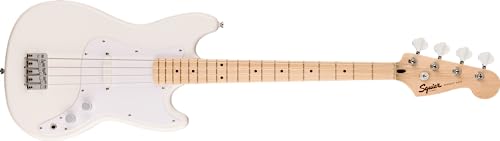
As an Amazon Associate we earn from qualifying purchases at no extra cost to you.
Key takeaways
- Scale length is the biggest lever: a 23-inch scale shortens the nut-to-fourth-fret span by about half an inch compared with 25.5 inches.
- Look for a nut of about 1.65 inches or narrower, and a slim or shallow neck profile.
- Short-scale guitars run at lower tension, so use the string gauge the maker recommends to avoid a floppy feel.
- Small-body acoustics, parlors and travel-size models are not toys; several have solid tops.
- Picks come from maker specs and published reviews. We did not personally play them.
Best Guitars for Small Hands: Reach Compared
| Pick | Type | Scale length | Nut to 4th fret (calculated) | Why it helps |
|---|---|---|---|---|
| Ibanez GRGM21 miKro | Electric | About 22.2 in | About 4.6 in | Shortest reach on the list |
| Martin LX1E Little Martin | Acoustic-electric | 23 in | About 4.7 in | Compact body, short scale |
| Taylor GS Mini | Acoustic | 23.5 in | About 4.9 in | Full voice, easy chords |
| Squier Sonic Mustang | Electric | 24 in | About 5.0 in | Slim, light, standard feel |
| Yamaha FS800 | Acoustic | 25 in | About 5.2 in | Small body, familiar neck |
| Gretsch Jim Dandy Parlor | Acoustic | Short-scale parlor (check listing) | Lower than 25.5 in | Small body, mellow tone |
| Reference: standard electric | Electric | 25.5 in | About 5.3 in | Baseline |
The calculated column uses the standard fret formula, where the distance from the nut to the fourth fret is about 20.6 percent of the scale length. It is a geometry result rather than a physical measurement of any one guitar, but it shows the pattern clearly: each inch of scale you remove shortens that stretch by about a fifth of an inch.
How We Chose These Guitars for Small Hands
We did not personally play these guitars. The picks are based on maker specifications and published reviews, and every pick had to meet at least two of three criteria: a scale length below 25.5 inches, a body smaller than a dreadnought, or a nut width of about 1.69 inches or less. We favoured instruments with solid tops or proper pickups over toy-grade copies, kept each brand to a small number of entries and avoided bundles that hide a weak guitar behind accessories.
1. Taylor GS Mini: Best Small-Body Acoustic With a Big Voice
- 23.5-inch scale · Grand Symphony Mini body
- Solid Sitka spruce top · layered sapele or mahogany back and sides depending on version
- 1 11/16-inch nut · standard acoustic string spacing
- Acoustic and “e” versions with onboard electronics available
Best for: small-handed players who want a real acoustic guitar tone rather than a compromise instrument.
Skip if: you need a very narrow nut. The 1 11/16-inch width is standard rather than slim.
Pros
- Short scale reduces fret reach and bar-chord effort
- Solid top gives volume and tone beyond its size
- Travels well and fits easily on a lap
- Published reviews often describe it as a favourite for smaller players
Cons
- Top-end cost for a small guitar
- Bass response is smaller than a full dreadnought
The GS Mini is a good fit when you want a primary guitar rather than a spare. The 23.5-inch scale is about two inches shorter than a typical electric, and at the first four frets that amounts to nearly half an inch of saved stretch.
Why it earns the top spot: the GS Mini is the only pick in the group that pairs a solid spruce top with a short scale and a body that still projects convincingly. Many compact acoustics sound thin because they are built to a price. This one is built to sound like a scaled-down full-size guitar, and that is why published reviews so often mention it as the benchmark for small-bodied players. It also gives you a clear upgrade path, since electronics-equipped versions and different back-and-side woods are available within the same shape.
2. Martin LX1E Little Martin: Best Compact Acoustic-Electric
- 23-inch scale · modified 0-14 fret body design
- Solid Sitka spruce top · mahogany-pattern high-pressure laminate back and sides
- Fishman electronics on the E model
- Gig bag included in the listing
Best for: players who want the shortest acoustic scale in the group and plan to plug in occasionally.
Skip if: you want a fully solid-wood instrument. The back and sides are laminate.
Pros
- The shortest acoustic scale here at 23 inches
- Small body is comfortable for seated and travel playing
- Reliable construction from a well-known maker
- Electronics allow amplified use
Cons
- Smaller body means less low end
- Laminate back and sides rather than solid wood
The Little Martin earns its place by being the shortest-scale steel-string acoustic that still comes from a traditional guitar maker. The modified 0-14 design shifts the neck joint to the 14th fret, which gives a clear arrangement for upper-fret access and keeps the overall instrument compact. If your hands struggle with stretches in first position, the 23-inch scale is the most noticeable relief you can get without moving to a ukulele-sized instrument. The built-in electronics on the E model mean you can take it to an open mic without buying a separate pickup.
3. Yamaha FS800: Best Standard-Neck Small-Body Value
- Concert (small-body) shape · about 25-inch scale
- Solid Sitka spruce top · nato/okume back and sides
- 43 mm (about 1.69-inch) nut
- Natural satin finish
Best for: players whose hands are small but who prefer a normal-feeling neck and a smaller body to ease strumming reach.
Skip if: you need a short scale. At about 25 inches, it only saves a little reach over a full-sized guitar.
Pros
- Small body shortens the reach across the guitar’s waist
- Solid spruce top at an affordable price tier
- Familiar neck dimensions make it easy to move between guitars
Cons
- Scale length offers modest reach savings
- No electronics in the base model
The FS800 is the practical choice for players whose hands are small but who don’t want to relearn neck dimensions. At about 25 inches the scale is only slightly shorter than a typical full-size acoustic, so the main benefit is the smaller body, which brings the strumming arm closer and reduces shoulder strain. The solid Sitka spruce top is unusual at this price tier and is the reason it keeps appearing in beginner-to-intermediate recommendations. Choose it when comfort of the body matters more than a dramatic reduction in fret reach.
4. Gretsch Jim Dandy Parlor: Best Budget Parlor for Comfort
- Parlor body · laminate tonewoods · X-bracing
- Listed by retailers as a short-scale instrument
- Frontier Stain, Rex Burst and Deep Cherry Burst finishes
- Budget tier
Best for: beginners with small hands who want a compact acoustic at a low price tier.
Skip if: you need loud projection or solid-wood tone.
Pros
- Small body is easy to hold
- Short-scale design lowers string tension
- Retro styling
Cons
- Laminate construction limits volume
- Check the exact scale length on the specific listing
The Jim Dandy Parlor is the pick for players who want a low-cost, low-commitment guitar that is simply easy to hold. Parlor bodies are shallower and narrower than dreadnoughts, so the guitar sits closer to the chest and the strumming arm travels less. The laminate construction means volume and sustain are modest, but for home practice, travel and songwriting that is often enough. The advice from most reviewers is to treat it as a comfortable starter that you can keep as a couch guitar later.
5. Squier Sonic Mustang: Best Short-Scale Electric
- 24-inch scale · poplar body · maple C-shape neck
- 22 frets · 9.5-inch radius · 1.65-inch nut
- Two ceramic single-coils (HH version also available)
- Hardtail bridge
Best for: electric players who want a standard-feeling guitar with a shorter reach.
Skip if: you want vibrato or premium pickups.
Pros
- 24-inch scale reduces stretch while keeping a conventional neck
- Hardtail bridge is stable
- Low entry cost
Cons
- Ceramic pickups sound bright
- Budget finish
The Sonic Mustang combines the two features that matter most for electric players with small hands: a 24-inch scale and a conventional 1.65-inch nut. That means the neck does not feel like a toy, but the reach is still reduced. Because it is a hardtail, tuning stability is better than on many short-scale guitars with floating vibratos. It is also the easiest guitar in this guide to upgrade, since pickups and tuners are common aftermarket swaps.
6. Ibanez GRGM21 miKro: Best for the Shortest Reach
- About 22.2-inch scale · 24 frets · poplar body
- Maple neck · dual humbuckers per the listing
- Compact RG-style body
Best for: very small hands, younger players and anyone who wants rock-ready humbuckers on a compact guitar.
Skip if: you want a standard-scale feel for later transitions to a full-size guitar.
Pros
- The shortest reach here
- 24 frets and humbuckers suit rock and metal
- Light and easy to carry
Cons
- Low string tension may need heavier strings
- Switching to a full-scale guitar later takes adjustment
The miKro is the specialist. Its roughly 22.2-inch scale is the shortest on this list, and its RG-style body and humbuckers are designed for rock and metal players who don’t want to give up 24 frets. It suits young players and adults with very small hands, and it doubles as a travel guitar. The caution is the lower tension: heavier strings and a careful setup help it feel firm and stay in tune.
Also Consider
- Squier Classic Vibe ’70s Jaguar: a 24-inch scale electric with 22 frets and a more vintage-style layout.
- Yamaha CSF1M parlor: a parlor-size acoustic with a solid top and a hard gig bag per the listing.
- Squier Mini Stratocaster: a compact electric aimed at younger players and travel.
- Traveler Guitar Ultra-Light Acoustic: a small-framed travel guitar with a removable lap rest.
Which Guitar Fits Which Situation?
| Your situation | Best match | Why |
|---|---|---|
| Adult player, long-term acoustic, willing to spend | Taylor GS Mini | Solid top, 23.5 in scale, lasts for years |
| Wants the shortest acoustic reach and amplification | Martin LX1E | 23 in scale with onboard electronics |
| Normal-feeling neck, smaller body, tight budget | Yamaha FS800 | Solid top and 43 mm nut at a lower tier |
| Beginner who wants low cost and light weight | Gretsch Jim Dandy Parlor | Small parlor body and short-scale design |
| Electric rhythm and indie playing | Squier Sonic Mustang | 24 in scale, standard nut, hardtail |
| Rock or metal, very small hands | Ibanez GRGM21 miKro | About 22.2 in scale with 24 frets |
What Actually Makes a Guitar Easier for Small Hands
Scale length
Scale length is the working distance of the string between the nut and the saddle. A shorter scale compresses all fret spacing proportionally. That is why chord shapes feel closer together and wide barre chords require less hand opening. The trade-off is lower string tension, which can feel slack with light strings, so use the gauge the maker recommends.
Nut width and string spacing
A narrower nut brings the strings closer together and shortens the reach across the fretboard. A nut around 1.65 inches is common on electrics, while many acoustics use 1.69 inches. If your fingers are short and slim, a narrow nut is as helpful as a short scale. Wide classical-guitar necks, which often sit near 2 inches, are usually the hardest option for small hands.
Neck profile and depth
A shallow C or D profile lets your thumb sit behind the neck without cramping. Descriptions such as “slim,” “thin” or “SlimTaper” in maker specs point to this. Avoid chunky profiles described as “baseball bat” or “50s rounded” if reach is your main concern.
Body size and arm reach
For acoustics, body depth and width decide how far your strumming arm must reach around the guitar. Parlor, concert and travel bodies shorten that reach. For electrics, lightweight, contoured bodies are more comfortable on a strap.
Action and setup
Low action reduces the finger pressure needed to fret a note. A basic setup by a technician often matters as much as the guitar itself, and it costs little compared with the instrument.
String gauge for short-scale guitars
Shorter scales lower the string tension at pitch, so strings can feel floppy. Many players move up half a gauge on short-scale electrics or use medium-tension sets on acoustics to restore the feel. Follow the maker’s recommended gauge for the instrument and adjust from there.
A Worked Example: The Same Chord Shape on Three Scales
Consider a full barre chord at the first fret with a fourth-finger reach to the fourth fret. On a 25.5-inch electric, that shape spans about 5.3 inches from the nut to the fourth fret. On a 24-inch Sonic Mustang it shrinks to about 5.0 inches, a saving of roughly 0.3 inches. On a 23-inch Martin LX1E it falls to about 4.7 inches, saving roughly 0.5 inches. On the 22.2-inch miKro it is about 4.6 inches, saving about 0.7 inches.
Those fractions of an inch sound small, but they apply to every fret of every chord. Players with a hand span at the lower end of the range often report that the difference between a clean barre chord and a buzzing one lies in exactly that margin. It is also why the same player can feel comfortable on one guitar and strained on another with the same name on the headstock.
Common Mistakes When Buying for Small Hands
- Buying on body size alone. A small body helps your strumming arm, but it does not change fret spacing. Check the scale length separately.
- Ignoring nut width. Two guitars with the same scale can feel very different if one has a wider nut.
- Choosing a toy-grade instrument. Very cheap 3/4-size guitars with thick action are harder to play than a properly set-up short-scale instrument from an established maker.
- Using the wrong strings. Light strings on a short-scale guitar can feel loose. Use the recommended gauge.
- Skipping the setup. A high action cancels out most of the benefit of a short scale. Ask for a low-but-clean setup.
Keeping a Short-Scale Guitar in Good Shape
Short-scale and small-body guitars are not delicate, but a few habits protect them. Solid-top acoustics such as the Taylor GS Mini, Martin LX1E and Yamaha FS800 respond to humidity swings. Maker care guidance from Taylor, Martin and Yamaha generally recommends keeping them at around 40 to 50 percent relative humidity, which means using a case humidifier in dry winters and avoiding sun-heated cars. Laminate guitars like the Gretsch Jim Dandy are more forgiving.
For electrics, the main upkeep is strings and setup. Short-scale necks can be more sensitive to string gauge changes, so if you change gauge, expect to adjust the truss rod and intonation. A once-a-year technician visit is usually enough.
Left-handed players should check availability before buying. Some of these models are made in left-handed versions, and others are not, so confirm on the specific listing.
A Simple Reach Test Before You Commit
- Measure your hand span. Spread your fingers on a flat surface and measure from thumb tip to little finger tip. Most players with a span under about 7 inches will benefit from a short scale.
- Check the scale length on the spec sheet. Anything under 25 inches counts as short-scale in this guide.
- Try an F barre chord and a basic C chord. If either demands a painful stretch on your current guitar, prioritise scale and nut width.
- Compare nut widths. Choose 1.65 inches or less if reach across strings is the issue.
- Check the return policy. If you buy online, confirm you can return the guitar if it doesn’t fit.
Frequently Asked Questions
What is the best acoustic guitar for small hands?
The Taylor GS Mini is the best all-rounder because it combines a 23.5-inch scale with a solid top and strong projection. The Martin LX1E is a good alternative with an even shorter scale, while the Yamaha FS800 is the value choice.
What are the best guitars for small hands that are electric?
The Squier Sonic Mustang offers a 24-inch scale and a conventional neck. The Ibanez GRGM21 miKro offers an even shorter scale and 24 frets for rock players.
Are short-scale guitars good for adults?
Yes. Many professionals play short-scale instruments for tone as well as comfort. Short scale is not a children’s feature; it is a different design with a looser feel and a slightly warmer attack.
Do short-scale guitars sound worse?
They sound different rather than worse. Lower tension gives a rounder tone and softer attack. A good setup and the right strings narrow the difference.
What are the best guitars for short fingers?
Choose a guitar with a short scale, a narrow nut and a slim neck. The Ibanez GRGM21 miKro and Martin LX1E both fit that description, and the Squier Sonic Mustang is a more conventional option.
What are the best small body acoustic guitars?
The Taylor GS Mini, Martin LX1E, Yamaha FS800 and Gretsch Jim Dandy Parlor are all small-body options. They differ in price tier and in whether the top is solid wood.
Will a short-scale guitar hold its tuning?
Yes, if it is set up properly. Lower tension makes strings more sensitive to picking force and temperature, so fresh strings, a clean nut slot and a correct setup matter more than they do on a longer scale. Hardtail electrics such as the Squier Sonic Mustang are the most stable option.
Are guitars for small hands only for beginners?
No. Plenty of experienced players choose short-scale or small-body guitars for recording, songwriting and travel. The Taylor GS Mini and Martin LX1E in particular are used well beyond the beginner stage because their tone and construction are those of full-grade instruments.
Can I use a capo to make a guitar easier?
A capo raises pitch and moves the nut closer to the body, effectively shortening the scale. That can ease reach for chords but doesn’t change nut width or neck depth.
Which One Should You Buy?
- Best overall acoustic: Taylor GS Mini.
- Shortest acoustic scale: Martin LX1E.
- Best value acoustic: Yamaha FS800.
- Best budget acoustic: Gretsch Jim Dandy Parlor.
- Best short-scale electric: Squier Sonic Mustang.
- Shortest electric reach: Ibanez GRGM21 miKro.
Choose scale length first, nut width second and body size third. Once those three fit your hands, the rest is a matter of taste and budget.
Sources
- Taylor Guitars product specifications
- Martin Guitar product specifications
- Yamaha product specifications
- Fender and Squier product specifications
- Ibanez and Gretsch product pages
Last updated: October 2026





Write Your Review
No reviews yet. Be the first to share your experience!