

Key takeaways
- A lap steel is played with a tone bar, not fretted with fingers; you will need a steel bar, finger picks and a way to sit comfortably with the instrument across your lap.
- Most beginners start in open G or open D tuning; C6 is the classic country and Hawaiian tuning for later.
- Solid-body lap steels are cheap to enter, but build quality varies widely, so brand-backed entries like the Gretsch G5700 and Rogue EA-3 reduce risk.
- Pedal steel is a separate, far more complex and costly instrument; start on lap steel and decide later.
The best lap steel guitars for beginners and slide fans are the Gretsch G5700 Electromatic for a proper mahogany instrument with brand backing, the Rogue EA-3 for a low-risk first lap steel with stand and bag, and the SX Lap 2 Ash for an ash-bodied alternative that feels more like a conventional electric. A lap steel is a flat-bodied electric guitar with no frets that you play across your lap, sliding a polished steel bar along the strings. It is one of the cheapest ways to get a completely different sound from your guitar hobby, from Hawaiian swing to country weep to blues slide. This guide ranks the best lap steel guitars by build, tuning flexibility and who each suits, and explains where pedal steel fits if you want to go further.
Our top picks



As an Amazon Associate we earn from qualifying purchases at no extra cost to you.
Key takeaways
- A lap steel is played with a tone bar, not fretted with fingers; you will need a steel bar, finger picks and a way to sit comfortably with the instrument across your lap.
- Most beginners start in open G or open D tuning; C6 is the classic country and Hawaiian tuning for later.
- Solid-body lap steels are cheap to enter, but build quality varies widely, so brand-backed entries like the Gretsch G5700 and Rogue EA-3 reduce risk.
- Pedal steel is a separate, far more complex and costly instrument; start on lap steel and decide later.
What a lap steel is and how it differs from a regular guitar
A lap steel has a solid body, a pickup, usually six strings and a fingerboard that is flat and often fretless or marked only with painted dots. The player sits and rests the instrument on the lap or on a stand, holds a polished steel tone bar in the fretting hand and picks with fingers or finger picks. Because the strings are raised high above the neck and the bar slides rather than presses, the instrument is tuned to a chord, called an open tuning, so that laying the bar flat across the strings produces a major chord.
According to maker descriptions from Gretsch, Rogue and Epiphone, lap steels are built for this purpose: a straight, stable neck, a high nut, and a slotted or flat headstock design that keeps tuners out of the way. The result is a sound that glides between notes, which is why the instrument shows up in Hawaiian music, western swing, country, gospel and blues.
Quick comparison of the best lap steel guitars
| Pick | Body | Notable features | Best for | Price tier |
|---|---|---|---|---|
| Gretsch G5700 Electromatic | Solid mahogany | Branded Electromatic series | Serious beginner or hobbyist | Mid |
| Epiphone Electar Century “1939” | Solid body, vintage design | Reissue of an early lap steel | Vintage look, collector appeal | Mid |
| Asher Electro Hawaiian Junior | Solid body | Specialist maker design | Players who want a boutique lap steel | Premium |
| SX Lap 2 Ash | Ash body | Includes stand and bag in the listing | Value and familiar feel | Entry |
| Rogue EA-3 | Solid body | Stand and gig bag included | First lap steel | Entry |
| Recording King RR-36S Maxwell | Square-neck resonator | Acoustic, no amp needed | Acoustic slide, Dobro-style sound | Upper-mid |
| Amuic Lap Steel Guitar | Solid body, slotted headstock | Gig bag and slide bar in the listing | Trying lap steel at lowest cost | Entry |
1. Gretsch G5700 Electromatic: Best for a branded, mahogany lap steel
- Solid mahogany lap steel in the Electromatic series
- Vintage White and Tobacco finishes appear in the listings
- White plastic fretboard in one listed variant
- Mid price tier, above the entry options
- Gretsch also sells a matching lap steel gig bag separately
Gretsch is one of the few big guitar names to sell a dedicated lap steel, and that matters for beginners because the quality control and parts supply are reliable. Mahogany gives a warm, slightly rounded tone with enough sustain for slow slides. It looks the part, too: if you want a lap steel that doesn’t feel like a toy, this is the model to consider.
What to check: find out what is included, because some listings sell the instrument alone and you will need a stand or a way to hold it. Best for: hobbyists who want a lasting instrument. Skip if: you only want to try the idea for a few weeks.
One advantage of a mahogany body is that it settles into tune quickly and holds it, which matters on an instrument where a slightly flat or sharp note is obvious because there are no frets to guide you. If you intend to play with other musicians, set up the instrument beside a tuner every time and check the 12th-fret position with the bar, because intonation on lap steels depends on the bar landing directly over the fret marker rather than behind it.
Pros:
- Brand backing and parts availability
- Warm mahogany tone
- Attractive vintage finishes
Cons:
- Costs more than the entry options
- Accessories are separate
2. Epiphone Electar Century “1939” Lap Steel: Best for a vintage-style reissue
- Lap steel reissue inspired by a late-1930s design, per the product name
- Solid-body electric lap steel
- Mid price tier
- Part of Epiphone’s vintage-inspired line
The Electar name harks back to some of the earliest electric guitars, and Epiphone has brought it back in a lap steel format. It will appeal to players who like instruments with a story and a classic look. Tone-wise, expect a warm and simple pickup voice rather than a modern, hot sound, which suits swing and Hawaiian playing.
What to check: read the listing for included accessories and for the pickup type. Best for: vintage-minded players. Skip if: you want a modern, high-output tone.
Vintage-style instruments reward a patient approach. Use fresh strings, check the nut and bridge height, and set the pickup height so the output is even across all strings. A small amount of tremolo or spring reverb in the amp can bring out the old-time character that the design is meant to evoke.
Pros:
- Vintage design and name
- Established guitar brand
- Good conversation piece
Cons:
- May not include stand or bag
- Fewer reviews and tutorials built around it
3. Asher Electro Hawaiian Junior: Best for a boutique specialist build
- Electro Hawaiian Junior lap steel in Antique White in the listing
- Made by a company known for lap steels
- Premium price tier, the highest on this list for an electric
- Designed for players who take the instrument seriously
Asher is a specialist builder, and its lap steels are aimed at players who want a considered design instead of a generic one. The Junior version is the compact, more approachable model in the range. If you already know that lap steel will be a long-term part of your playing, this is the tier where you stop worrying about build quality and start focusing on tone.
What to check: because it’s a smaller maker, check lead times and return policy before ordering. Best for: committed players. Skip if: you are still deciding whether you like the instrument.
Specialist lap steels often have more careful nut and bridge design, which improves tuning stability and the smoothness of the bar slide. If you have already tried a cheaper model and found the limitations frustrating, the jump to a purpose-built instrument can be worthwhile. Treat it as a long-term purchase and keep the original packaging if it has resale value.
Pros:
- Specialist build
- Long-term instrument
- Compact design
Cons:
- Premium price
- Limited availability and fewer local dealers
4. SX Lap 2 Ash: Best value alternative with a familiar feel
- Ash-bodied electric lap steel in Natural
- Stand and bag included, according to the listing
- Entry price tier
- Part of the SX Lap series, which also includes a Lap 3
Ash is a classic electric guitar body wood, known for bright, snappy tone with plenty of sustain. SX packages this lap steel with a stand and bag, which makes it ready to play out of the box. For a low outlay, it gives you real lap steel body proportions and an instrument you can leave on a stand without worrying.
What to check: inspect the tuners, since entry instruments sometimes need a little tuning stability work. Best for: value-minded beginners. Skip if: you want a mahogany-warm tone.
Because the listing includes a stand, you can leave the instrument ready to play, which in practice means you will pick it up more often. The ash body is bright, so a touch of tone roll-off or a warmer amp setting can balance the sound for slow country slides. Replace the strings early with a set that matches your chosen tuning.
Pros:
- Stand and bag included
- Bright, snappy tone
- Low cost
Cons:
- Entry-level hardware
- Brand has less heritage
5. Rogue EA-3: Best first lap steel with a stand and bag
- Lap steel with stand and gig bag, per the listing
- Metallic Blue and Metallic Red finishes appear in the listings
- Entry price tier
- Made by a brand known for starter instruments
The Rogue is the textbook starter lap steel. It comes with the extras that a new player needs and is available widely, so replacement parts and online tutorials are easy to find. Do not expect boutique tone, but expect a playable instrument that lets you find out whether lap steel is for you.
What to check: expect to replace the strings and possibly the bar for better feel. Best for: absolute beginners. Skip if: you want a premium-sounding instrument.
For beginners, a complete package removes the biggest friction point: working out what else to buy. With the stand and bag included, the first spend is just a decent bar, finger picks and strings. Many players later keep an entry model as a travel or practice instrument even after upgrading, since the loss from knocks and scratches is small.
Pros:
- Complete package
- Widely available
- Low risk
Cons:
- Basic pickup sound
- Cosmetic finish is simple
6. Recording King RR-36S Maxwell: Best acoustic option for a Dobro-style sound
- Square-neck resonator, played flat on the lap, according to the model description
- Vintage Sunburst in the listing
- No amp required, since the resonator cone projects the sound
- Upper-mid price tier
Not every slide player wants an electric. A square-neck resonator is played in the same lap position with a steel bar, and it produces the unmistakable Dobro-style sound of bluegrass and blues. The Maxwell Series is Recording King’s accessible resonator line. If you want something that sounds good unplugged and fits country and roots music, this is the pick.
What to check: confirm that it is a square-neck version, because round-neck resonators are meant to be played upright with a slide on the finger. Best for: acoustic slide and bluegrass. Skip if: you want an electric tone with effects.
Resonators are loud enough to be heard over banjos and fiddles without an amp, which is why they became a bluegrass staple. They can also be played with a pickup added later. Keep in mind that the metal cone and heavier build make the instrument harder to carry than an electric lap steel, and a proper case is advisable.
Pros:
- Loud and acoustic
- Distinct resonator sound
- Works without an amp
Cons:
- Heavier and bulkier than electric lap steels
- Higher price than entry electrics
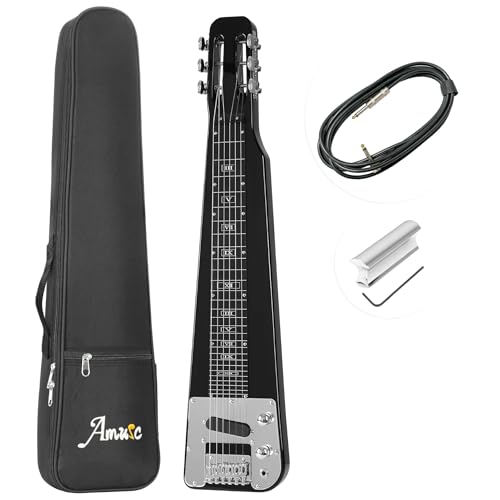
7. Amuic Lap Steel Guitar: Best for trying lap steel at the lowest cost
- Six-string electric lap steel with slotted headstock
- Gig bag and slide bar included, per the listing
- Sunburst and Black finishes
- Entry price tier
If you only want to see what a lap steel feels like, a low-cost package like this does the job. The slotted headstock follows the traditional lap steel design, and the included bar and bag mean you can start without extra shopping. Keep expectations modest and plan to upgrade strings, and perhaps the bar, early on.
What to check: unknown-brand instruments vary, so choose a seller with a clear return policy. Best for: experimenters. Skip if: you want reliable long-term parts support.
Choose a seller with a clear return policy, and check the instrument on arrival for flat frets or markings, tuner function, jack security and pickup output. If anything is badly off, return it quickly instead of trying to fix it yourself. For a first experiment, that safety net is more important than the instrument’s specification.
Pros:
- Very low entry cost
- Includes bag and bar
- Traditional slotted headstock
Cons:
- Quality control can vary
- Limited brand support
Your first week on a lap steel: a simple practice plan
- Day 1: tune and set up. Tune to open G, sit with the instrument supported across your lap or on a stand, and hold the bar lightly with the first and third fingers.
- Day 2: find the chord positions. Place the bar directly over the 12th fret to get the open chord an octave higher, then over the 5th and 7th frets for the other major chords in the key.
- Day 3: practise clean slides. Slide between two chord positions slowly, aiming to land directly above the fret marker without sliding past it.
- Day 4: add vibrato. Move the bar gently back and forth after landing on a note.
- Day 5: damp the strings. Use the picking hand’s palm or the fingers behind the bar to mute unwanted strings.
- Day 6 and 7: play a simple melody. Try a familiar tune using single strings and slides.
Which lap steel fits which player: a quick decision matrix
| Your situation | Instrument type | Features to prioritise | Strong match from this list |
|---|---|---|---|
| Curious beginner, small budget | Electric lap steel | Stand and bag included | Rogue EA-3, SX Lap 2 Ash |
| Hobbyist who wants a keeper | Branded solid body | Build quality and parts supply | Gretsch G5700 Electromatic |
| Vintage enthusiast | Reissue design | Look and tone | Epiphone Electar Century |
| Bluegrass or acoustic slide | Square-neck resonator | No amp needed | Recording King RR-36S |
| Committed specialist | Boutique build | Tuning stability, craftsmanship | Asher Electro Hawaiian Junior |
Ownership realities: what wears first on a lap steel
The bar and the strings wear first. Steel bars develop scratches that add noise, and they can be polished with fine abrasive pads. Wound strings suffer from the sliding action, so expect to change them more often than on a fretted guitar. Tuners on lower-cost instruments may slip, and a small drop of lubricant on the tuner gear and a check of the string winding helps. Jacks loosen with movement, so keep the cable strain-relieved with a loop. Store the instrument in its bag or case, away from heat sources, and use a cloth to wipe oils from the strings and fingerboard after playing.
Also consider
- SX LAP 3: another model in the SX lap steel range, listed in black with a carry bag.
- Batking Lap Steel Guitar: a very low-cost six-string lap steel with a slotted headstock; treat it as a trial purchase.
- Ernie Ball Steel Bar (Medium or Heavy): a proper tone bar if the bundled one feels flimsy.
- Gretsch G2165 Lap Steel Gig Bag: a protective bag designed for Gretsch lap steels.
How we chose these lap steel guitars
This is a research-based list. We did not personally play these instruments. We compared maker and listing descriptions, concentrating on body type, what is included in the package, brand support and the likely user. We limited the list to two models per brand, covered electric and acoustic options and avoided tonal claims that we could not attribute to makers. Treat the spec lines as a starting point and confirm the current details on the maker or seller page before you buy.
Lap steel buying guide: tunings, bar, picks and setup
Choose a tuning first
Open tunings make chords easy because a flat bar across all strings sounds a chord. The table below shows the most common starting tunings, from low to high.
| Tuning | Notes (low to high) | Typical style | Beginner friendly |
|---|---|---|---|
| Open G | D G D G B D | Blues, slide, rock | Yes |
| Open D | D A D F# A D | Blues, slide, folk | Yes |
| Open E | E B E G# B E | Blues, rock | Yes (higher tension) |
| C6 | C E G A C E | Western swing, Hawaiian | Moderate |
| A6 | E A C# E F# C# | Hawaiian, country | Moderate |
Scale length and string spacing
Lap steel scale lengths vary by maker, with shorter scales making the bar slide easier on the fingers and longer scales giving a tighter tone. Confirm the number on the maker page if you want to match a particular sound or an existing string set.
Tone bar
The bar is as important as the instrument. A solid steel bar is heavy and delivers sustain, while lighter bars are easier to handle. Rounded ends help reach single strings. Many players try a medium-weight steel bar and then experiment with different weights.
Finger picks and thumb pick
Traditional lap steel playing uses a thumb pick and two finger picks. They give a clear attack and protect fingers against string wear.
Strings
Match string gauge to your tuning. Heavier gauges give a fuller tone and better sustain in lower tunings, while lighter gauges are better for higher tunings like open E or C6.
Amplifier and effects
A clean amp with a little reverb is the usual setup. Add a touch of overdrive for blues, or a tremolo for vintage character. Keep the volume manageable because pickups on lap steels can hum.
Humidity and care
Solid-body lap steels are more stable than acoustics, but wood still responds to the environment. Keep instruments at a stable room humidity and wipe strings after play, as maker guidance for guitars from Martin and Taylor suggests 40 to 50 percent relative humidity for wooden instruments.
Best steel guitars: lap steel versus resonator versus pedal steel
Search results for the best steel guitars mix three different instruments. A lap steel is the simplest, with a solid body and a bar; it’s the best entry point. A resonator with a square neck is the acoustic equivalent. A pedal steel is a large, standing instrument with foot pedals and knee levers that change the pitch of strings while you play, and it needs a lot of practice and a larger budget.
Best pedal steel guitars: should a beginner consider one?
Pedal steel guitars are the instruments heard in classic country records, and their expressive, vocal-like sound is unmatched. They are, however, complex and expensive, and learning them involves coordinating both hands, both feet and the knees. The sensible path is to learn bar control, tuning and basic phrasing on a lap steel first, then move to a pedal steel if you want the full country sound. If you do, strings such as Buddy Emmons style sets in E9th tuning are the standard reference point.
Frequently Asked Questions
Is a lap steel easy to learn?
The basics are easy: a bar across the strings plays a chord. Clean intonation and smooth bar movement take practice, but you can get a satisfying sound within days.
What is the best tuning for a beginner?
Open G or open D are the most common starting tunings because they are widely taught and used in blues and slide.
Do I need an amplifier?
For electric lap steels, yes. A small practice amp works. Acoustic resonators do not need one.
Can I play a regular guitar with a slide instead?
Yes, and many players do. A lap steel is built for the style, with a stable layout and lack of fret interference, so it’s easier to play in tune.
What is the difference between a lap steel and a pedal steel?
A lap steel is a simple instrument played flat on the lap with a bar. A pedal steel has pedals and levers that change string pitches and is far more complex.
What should I buy with the instrument?
A steel bar, finger picks, a thumb pick, a stand or lap support, spare strings and a small clean amp.
Which one should you buy?
- Brand-backed, long-term instrument: Gretsch G5700 Electromatic.
- Vintage look and story: Epiphone Electar Century “1939”.
- Boutique specialist build: Asher Electro Hawaiian Junior.
- Value alternative with a familiar body: SX Lap 2 Ash.
- Safest first purchase: Rogue EA-3.
- Acoustic Dobro-style sound: Recording King RR-36S Maxwell.
- Lowest-cost experiment: Amuic Lap Steel Guitar.
Sources
- Gretsch Electromatic lap steel information
- Epiphone Electar information
- Asher Electro Hawaiian information
- SX and Rogue lap steel product descriptions
- Recording King Maxwell Series information
Last updated: October 2026




Write Your Review
No reviews yet. Be the first to share your experience!